
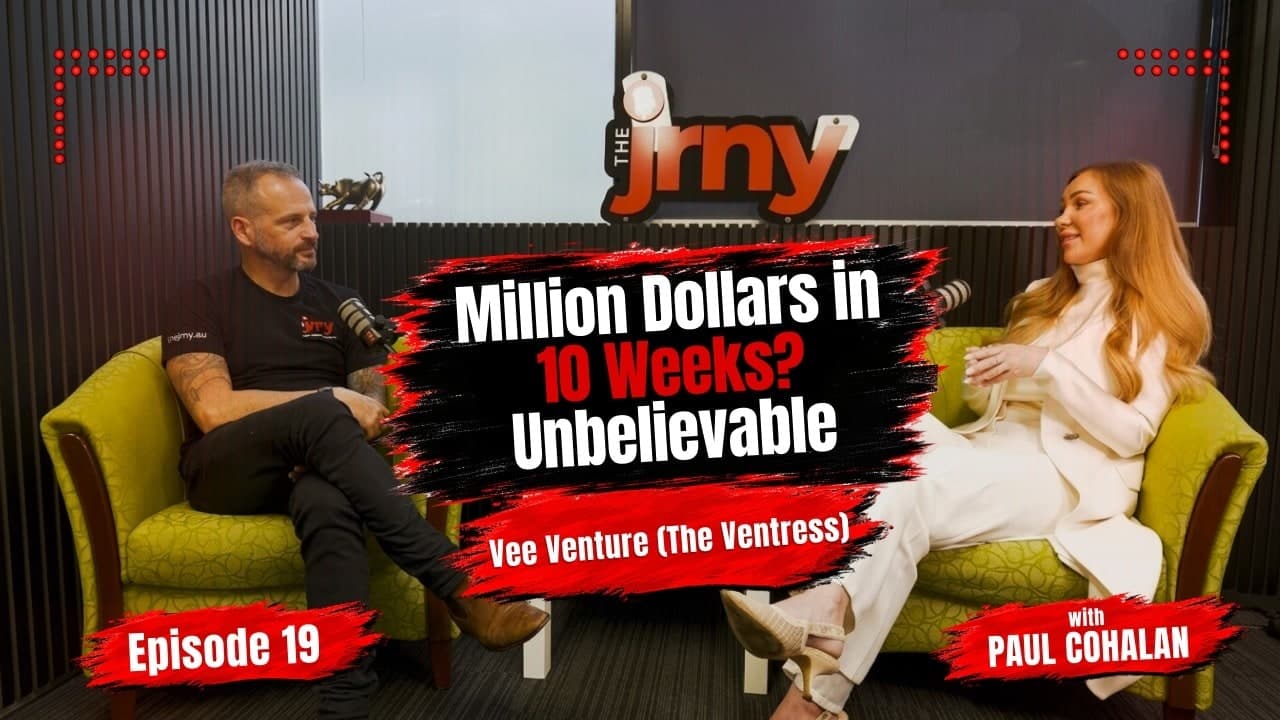
Meet Vee Venture
Founder of The Ventress
Vee Venture is a businesswoman and the founder of The Ventress, a coaching business for women in the adult entertainment industry. She is one of six children, born to a mother who was 16, and moved out of home at 13, living first with her grandfather and then with her high school boyfriend's family. Her background is nutrition and health science. She competed in fitness competitions and managed the websites for Supplement Mart before a divorce, just before COVID, sent her back to university to study psychology. A friend talked her into dancing in a club to pay her way through, and within a few years of working six nights a week she had bought her first home and later sold it for a $700,000 profit. She started mentoring other dancers, coached a few hundred women in 2025 and now runs a smaller inner circle. She hosts the podcast Undress Success and co owns a hair extension company with the friend who got her into the industry. She has an eight year old daughter.
Episode summary
In episode 19 of The JRNY podcast, Paul Cohalan sits down with Vee Venture, founder of The Ventress and one of the few people coaching women in the adult entertainment industry on money and business. Six years ago she was newly divorced, back at university studying psychology and starting from nothing. A girlfriend spent six months trying to talk her into dancing in a club and the answer was a flat no, until the club owner, cutting numbers during COVID, said it was now or never. She took it. Three or four years of six nights a week later she had bought her own home, sold it for a $700,000 profit and set herself up, and she had noticed that most of the women who had been in the industry longer than her had not.
That gap became the business. She hired a mentor to learn how to mentor, then started taking on dancers in rounds of 10 to 15 who together were making a million dollars in ten weeks. Last year she coached a few hundred women. This year she has cut back to an inner circle, and she is honest about why: she took every client's result personally, could not keep it professional and poured more into them than the course ever promised. She is equally blunt about the industry. Do not get into it to get rich quick. Treat it like a business, know your numbers, save a 20 per cent deposit before you buy anything, and remember that the money runs out the way it does for athletes if you do not put it somewhere.
The rest of the conversation is where the discipline came from. Vee is one of six kids, her mother had her at 16 and was in a domestic violence relationship, and she left home at 13. She credits the family of a high school boyfriend with showing her what a normal dinner table looked like, and her mother, five years clean, with doing her best with what she knew. She talks about the $30,000 a regular client scammed out of her in her first months, and why she calls it the cheapest lesson she ever paid for. She also talks about the daughter who is the reason for all of it, the one game of chess they play every day after school, and the ten year plan to build after school programs for kids from the kind of streets she grew up on.
Key takeaways
Now or never. The club had cut numbers during COVID and the owner said start now or not at all. Vee says that moment is the one she goes back to whenever she is tempted by the safe path: we only live once, and no one will care what you did in a hundred years, as long as it aligns with who you are.
Treat the club like a business. Nobody in the industry was teaching it as a structured business, so she learned from people outside it and applied their thinking to the club. Show up, know your numbers, build repeat clientele and think like an entrepreneur rather than identifying only as a dancer. That is what she teaches, not how to dance.
Fifteen women, a million dollars, ten weeks. Her coaching rounds of 10 to 15 dancers were doubling, tripling and quadrupling their income, and some were making $100,000 to $110,000 in a ten week round. She is careful to add the cost: no social life and very little sleep, and the point is your own definition of success, not the numbers on Instagram.
The $30,000 lesson. A regular client spent months building trust, talked about his daughter the same age as hers, and told her never to lend him money. Then he swapped her $30,000 in cash for bitcoin on a fake exchange and vanished. She told nobody at the time out of embarrassment, and now calls it the cheapest way she could have learned to keep her cards close.
Save 20 per cent before you buy. She bought her first home during COVID for security, not investment, after moving through eight primary schools and five high schools, and sold it two years later for a $700,000 profit. Her rule for the women she coaches is a full 20 per cent deposit and no over leveraging, because the industry's income can disappear and a dancer can save a deposit in 12 months anyway.
Resources mentioned
Transcript
Read the transcript
This transcript was generated automatically and lightly edited for readability. It may contain minor errors.
Vee Venture: I was in my first couple of years in the industry, and there was actually young girl, early twenties, she committed suicide. And I never thought I would have built everything I have now or never from it. Now it's now or never. And it's like anytime I have that moment and that hesitation where it's like, you know, I can pick the safe path. But I always think, like, we only live once. Yeah, we're all going to die, literally, and no one's going to care what you do 100 years from now. There was always. In every club, there's always a small percentage of women that it would connect, hit home. We'd work with and, you know, they're buying investment properties in 12 months. They're doing all these things for themselves. They're thinking as using this industry is like the stepping stone for something far greater.
Paul Cohalan: All right, here we are with dventure. Someone I've probably known for a few years, but not too closely. She's got a beautiful daughter and she's had a extensive career now. Businesswoman. So gone from. What'd you start. Start doing?
Vee Venture: My background is actually nutrition, so nutrition and health science. And I was in sport fitness.
Paul Cohalan: I probably learned more just having a copy with her for about half an hour than I've ever learned. Then you've learned to dancing, entertaining. And then really the biggest bit that's interests me is the coaching and taking other people under your wing, which really is what you've intrigued me with. And obviously the whole business side and owns her own places now and all that kind of stuff. And really the discipline and the focus is probably. And second to none. And that's what I can't wait to hear about. So where do we start?
Vee Venture: Thanks for having me.
Paul Cohalan: No worries.
Vee Venture: I guess the part that everyone's always, like, curious about is the stripping and then how that really transitioned to being more of an entrepreneur. So it was like rewinding. Like during COVID was like just before that I got divorced.
Paul Cohalan: Or just before COVID was.
Vee Venture: Yeah, just before COVID I got divorced. And then, you know, we all went through that unpredictable time. And I was kind of at this crossroads where I was like, you know, I need to do something else in my life that seems a little bit more essential, I guess you could say,.
Paul Cohalan: And support your daughter. That's kind of what I remember.
Vee Venture: Yeah. So I was at uni. Actually, funny enough, I went back to uni and I was studying psychology. And just a way to get myself through uni. A girlfriend had convinced me to get into stripping. And when she first said it, I was like, hell, no. I would never see myself doing that. I never.
Paul Cohalan: So it was a flat out no.
Vee Venture: It was a no. It was like, I didn't even take a second think about it. I was like, no, never. And I think this went on for like six months of like, I'd go get my hair done with her and she would sort of talk about it and I'd be like, curious. I'd be like, you know, how much are the girls making? And she's like, you know, so I'm making $10,000 a week. And back then, I still, to this day, we always talk about it. I said, if I make an extra one or two thousand a week, that would change my life. Because I was pretty much starting from.
Paul Cohalan: Cause that's where you're at.
Vee Venture: Yeah.
Paul Cohalan: Yep.
Vee Venture: And eventually, yeah, she said, you may as well just come in and have a look. Went into the club. And even then I still hesitated. It was like a very professional environment. Not what I thought it was going to be. But even in that moment, I was like, no, I gotta get my body in shape. I gotta do like. I'm really hard on myself with everything that I've always done.
Paul Cohalan: And still to this day.
Vee Venture: Yeah, still to this day. And pretty much then it was. They'd fired a bunch of people because of COVID and because you had to cut numbers and things were limited. So she was like, it's now or never. Like the owner said, you either start now or. And that now or never is something that I've, like, tried to like, take with me. And that in that moment, you know, I could have made one decision and my life went this way. And that was the moment that, like, everything just shifted.
Paul Cohalan: Yep.
Vee Venture: And my life changed.
Paul Cohalan: So. So. So just go back. Like, I wanted to start this three years ago and probably self judgment. I didn't. But the. The three words that go with it are risk, roadblocks, and resilience. So you'll see me butt into it here and go back and forth, but that. That moment. And I always try and sit myself in. In that moment with you, and it's like, you could have went either way. You've taken the risk, you got roadblocks. It's probably shifted you to do that. Like, it all kind of adds up. And like you said, you will never know the other path because you went down this one. And it's pivotal point in your. In your world.
Vee Venture: Yeah, it really was. And I never thought I would have.
Paul Cohalan: Built everything I have now or never.
Vee Venture: From it now. It's now or never. And it's like anytime I have that moment and that hesitation where it's like, you know, I can pick the safe path, but I always think, like, we only live once. We're all going to die, literally, and no one's going to care what you do a hundred years from now, as long as it aligns, I think, with who you are. Yeah. Yeah. That was a moment for me that.
Paul Cohalan: I got into stripping and the whole stripping thing. Right. Like, I think what I appreciate with you and why I really wanted to get you on is just the whole what you've used it for. It's. You love doing it, you love teaching and coaching others, and, like, you've just turned it into this business, set yourself up, property, you know, all that kind of stuff. And that's, you know, whether you keep doing it or you don't do it doesn't matter. It's been your foundation to get where you are. That now and ever moment.
Vee Venture: Yeah.
Paul Cohalan: So how long did you just do the stripping for before you started, like, branching, going, I can help others, or is that kind of what happened?
Vee Venture: Or. Yeah, I honestly think I was, like, three, four years in, where I was just, like, six nights a week, worked relentlessly, set myself up. And I'm not gonna say it happened by accident. Like, I never planned to ever coach women in the industry. And I think I'd gotten myself to a position where I'd made a lot of money in such a short period of time, and I'd set myself up and I'd learned everything there was to learn, I felt. And I was at this moment where it was just, like, I looked around, and there was so many women that were in the industry, had been in it longer than me, and I just felt they hadn't set themselves up. And then I became obsessed with, like, trying to really work out the difference and probably a way to, like, entertain myself, like, within the industry, because if I'm not being challenged, I noticed, like, with my personality, I definitely, like, I get bored. I need. I need a challenge.
Paul Cohalan: You've told me that about three, four times already today. I get bored.
Vee Venture: I get bored. I'm very, like, I need that next thing. And a few women had actually, again, it was probably not feeling ready. A few women had come to me and asked for, like, help and guidance, and because I wasn't ready where I then wanted to because I always moved that goalpost, I felt, no, I wasn't, like, good enough to coach them. Even though I knew I'd achieved all this, which was like a crazy thing. And then I got a mentor who helped me. Just because you're good at what you do, it was like, doesn't mean you're gonna be great at teaching people.
Paul Cohalan: Definitely not different.
Vee Venture: So one thing now that I've always like, and I really live by whenever I'm trying to do anything new, is like, I like to just learn from someone who's done it before and learn from someone else's mistakes. And, like, really fast.
Paul Cohalan: Don't reinvent the wheel.
Vee Venture: Yep. So I got a mentor to help me become a mentor, and I started taking on girls. And it just was crazy, the results they were getting, they were like doubling, tripling four times in the income.
Paul Cohalan: Is that right?
Vee Venture: In very short periods of time, we run rounds. I'd have like 10 to 15 girls. We're making a million dollars in 10 weeks. Like, it was just like the most insane thing. And like, I had girls fly in. I started.
Paul Cohalan: Million dollars in 10 weeks.
Vee Venture: Yep. So. And that's. So some girls would be making, you know, like 100, 110,000 in that time. And then others, depending how many nights they work, they might be part time and they're, like, making a little bit less. It really, you get what you put into it, but it also comes at a cost. Like, when you're at that level and you're making that kind of money, it's like, there's no social life. You're not sleeping very much. Like, it's not for everyone. And I think one of the things that I've always tried to, like, keep with the women is like, whatever is your definition of success and what you're trying to achieve, not compared to others. Because even if it is working just two, three nights a week and buying yourself a house and working your way through, you knew that's fine.
Paul Cohalan: Go back to what you said earlier. Like, if I could just get extra one or two grand a week, that'll help me.
Vee Venture: Yeah.
Paul Cohalan: But that's where I changed my life.
Vee Venture: And I tell that story a lot to the girls because it's like, it's not what you see today. It's not the crazy numbers that I have put out there and what I've sort of shared with the girls.
Paul Cohalan: Yeah. And. And the big something else that I really resonate with, and I think it takes. Takes a bit of an ass kicking, humbling and. And learnings later on in life is really, there's only one person you're competing against, and it's yourself. Like if you try and compete with everyone else, there's ego comes into it. Usually doesn't always work because you're too worried about what other people think. And the mom, you just take that step back and go, what do I need? And then obviously compete against yourself where you more of a purpose, more reward then because you know you're moving forward, moving the needle in the right direction. And obviously you've done that and you're helping others do that now. So how many girls you.
Vee Venture: Helping now, give or take? This year we've cut back. Last year I had a few hundred women that were coaching.
Paul Cohalan: Yeah.
Vee Venture: And it took everything for me. I don't regret it. Like it was like I had to put everything into it and that was fine. But this year at a bit of a transition where it was like, you know, the girls that are actually really serious and committed not just say they want to be successful.
Paul Cohalan: You call it inner circle something.
Vee Venture: Yeah, yeah, we have the inner circle. So we've got like fortnightly lives. We do four two day in person events. And that's just like the accountability, the check ins. And I'm loving that a lot more because I actually feel like the other side of it came with so many challenges. Like it was the most rewarding thing I ever done. But at the same time I think people need to also know like I could give someone the tools but if they're not prepared to show up and do the work, you won't get the results. And I would take that very personally when I first started mentoring because it's like my business is not successful if you are not successful. And there are a lot of people, not just in that industry, like in every industry that say they want to be successful but they're not prepared to.
Paul Cohalan: I think we've all been there also do the work. But you got to be ready to show up and do the work also.
Vee Venture: Yeah. So yeah, it was definitely like a transition for me where I like was in it and I was going to do it full time. So yeah, I did it all full time for last year. It took a backburn like step where you're like trying to think about like what's next and what you're also trying to build. And at some point something's got to give. So I'll always share my story. I'm always going to like be an advocate for the industry where it's like, you know what you're able to achieve. But I unfortunately do Think like next year is maybe the year that I am going to take a step back from the mentoring only because it's like I just want to do what I love and what I enjoy. And while I loved that part of my life, it comes with so many challenges and it really does consume you, taking on other people to really their.
Paul Cohalan: Energy and from here to there.
Vee Venture: And it's like I could never say you had like sold a course to someone and you're meeting with them weekly for 10 weeks in phase one when they're struggling. I kept seeing myself like, you know, go above and beyond and take extra calls and pour more into them and help them with their life. And it's like I couldn't just keep it professional. I couldn't just keep it like, oh, you know, this is what you've signed up for. This is all that you get. And I kept giving and giving.
Paul Cohalan: Like, is that a deep down kindness of Vee?
Vee Venture: I think it's just like, I've been.
Paul Cohalan: There, wanna see him?
Vee Venture: Yeah, I wanna see them do.
Paul Cohalan: Well, you're there, you've been through it.
Vee Venture: And I know what it's like when you're going through that. But it almost became helping them with so much beyond the scope of what I think that they're actually there to achieve in that time. And yeah, I found that hard, like when women do well. Like, and I just was so emotionally attached and I did have a business mentor who said to me that if I was to keep running the business, I'd need to hire someone in between as kind of like the lackey, the.
Paul Cohalan: Have you got anyone else that helps you?
Vee Venture: I didn't, I was always. Because I felt like girls signed up because of my story and they signed up because I was helping them. And I know I could grow and scale. And yep, like, money was never the problem. Like, it made so much money. The girls made so much money from signing up with us. But it was just like, I didn't want to scale it. Like, I didn't want to bring people in that didn't understand it. They couldn't put themselves in that situation because I did hire a few people and did bring them in. And maybe it was just my skills and not being able to like get the right people, but I was just like, I didn't want to turn this into just like this money making thing. The goal was always for it to be successful.
Paul Cohalan: Then it becomes transactional.
Vee Venture: I wanted to be able to operate from that place of like where I didn't even care about the money. So I still always have a place where I'm, like, going to mentor and speak and potentially do events. But as far as just, like, taking these women on to do, like, these intensive courses and these coaches, and it takes a lot, and I think you need to be in the right space. And I was then, but now I just have too much going on that it's, like, really hard to get.
Paul Cohalan: Do you think I'm putting my business hat on here? Hate to say, see, you give it away since it's been a big part, but do you think, like, you could hand it over to someone else that's. And. And maybe just be like, the. I don't know, not consult back into it.
Vee Venture: Still.
Paul Cohalan: Still have it, but I don't know, be the. It'll. It'll teach you to probably delegate and train more. Training. Training's hard. Like, coaching is one thing and all that, but bringing people in, like, in any business, I'm talking and bringing people in because our problem is no one ever does it like you do it. Right. And you know the rule. If they do it 80% or better, let them do it because they'll get better. And it's consecutive. Right. Compounding, you know, could you step back and oversee it more and do even less, but then put people in and they'll get there kind of thing so you don't have to, like, put it.
Vee Venture: Away like a few students that it's like. Because I think what an incredible story that it's like, you know, I walked the path, and my path was very different to then me coaching someone to walk the path. So then to see them achieve their level of success. I just think that would hit home for so many women, because for me going through the industry, I figured a lot of it out where the next set of girls is like, you know, they've really been coached through. Like, this is where I was now this is where I am. And I think that would just resonate with a lot more women as well. So, yeah, I have my eye on a few. I would love to transition and train them up and introduce them to community and pass it off, rather than. Because I do believe in the work. I think the industry does need all the help that it can get, but it's a very funny industry. And we talked about this at coffee, but we're talking about tall poppy syndrome.
Paul Cohalan: Yeah.
Vee Venture: You would think that a lot of the women in the industry would actually group together and support one another, and I found my experience to definitely be the opposite.
Paul Cohalan: Is that right?
Vee Venture: Yeah, very. Much never from women, like, doing quite well, but especially when I travel around. Like, I would go into clubs. I try going unnoticed. It's like a lot harder now because people know who I am. But I would go in, I would work the week in their club. So at the end when I would host like a free mask class act. This is what's possible for you and your club.
Paul Cohalan: Yeah, I remember you like traveling, like, I think New Zealand. And then I was talking to you.
Vee Venture: And you're like traveling around. I was away from my daughter. I was like sacrificing a lot to like. And I'm in a very comfortable position where it's like, I don't need to do that. I don't need to get on the floor. I don't need to sacrifice, grind out the hours. But it's like, if I didn't, I felt they really couldn't like, believe that it was possible for them in their environment. So it was a part of like doing your head down. And some women would just instantly not like you and not even know you because you've come in, because you're doing well, because you're there. And there was always. In every club, there's always a small percentage of women that it would connect, hit home. We'd work with and you know, they're buying investment properties in 12 months. They're doing all these things for themselves. They're thinking as using this industry as like the stepping stone for something far greater. And it's like, I love that as long as you've impacted a few, it was always worth it. But I would say, oh, that's definitely like the majority. When you would go into those environments, it was very uncomfortable. It's very hostile. It was like.
Paul Cohalan: But supportive at all from the outside in you. I would like most businesses have that also industries, but I would think probably be in that industry and probably like the stereotype of that industry. They've probably got walls up, but it take a long time for them to shift A lot of them because, like. And then you get someone like you coming in or they've been in it for 10 years. They have, like you said before, they haven't set themselves up.
Vee Venture: Yeah, it's a hard.
Paul Cohalan: So it's a 180 straight away. When they're judging, it's not really about you coming in. It's.
Vee Venture: Yeah, it could be anyone. It's never personal.
Paul Cohalan: No, they just probably upset that. That you're succeeding and doing well, you know, and that happens in a lot of industries. But I could Imagine that industry. Yeah.
Vee Venture: I learned early on because I'm quite direct. I say exactly what I think. So I never guessed I'd went in and maybe I could have softened my message when I initially, like, very beginning, but I went in and I was just like, you know, at the end of this, like, what do you have to show for your time? And I think that really triggered women that had been in it for like five years, 10 years. And I was like, but I'm saying this so you make a change. Like, if you've got two, three years left, you can achieve a lot in two, three years. Being committed and disciplined. It's like. Or if you were to look at, you know, your past, however long you've been in the industry, it's like, what do you have? And I think that really, like, hit a lot of women where it's like, you know, I could learn from it, but other women will get defensive.
Paul Cohalan: Yeah.
Vee Venture: And not like you do.
Paul Cohalan: You know why it's good you direct? Because it doesn't matter what business industry, you've got all these little people, you go in this window, listen, engage, you know, it happens everywhere. Then you got this window and then you got these ones that are like, who's that? Blah, blah. But when they're like that, if they get a direct enough punch in the face, let's say figure of speech, they will not admit it to you or anyone else, but they will go home and process it. Most humans do.
Vee Venture: Yeah.
Paul Cohalan: When they're. When they're that bitter or it's a 180, because they're probably deep down in here dirty that they haven't, you know, done whatever, they will go home and process it. So you probably made more of an impact than you've ever known.
Vee Venture: I actually, I see that 100% people as well. Like, even if they've never worked with me, I know by our messaging and what we said and women taking it seriously and just like you see the trends, like, through social media and what they're posting and they'll change. Yeah, yeah. And a mentor once said that to me, where it's like, you'll have more of an impact that again than you'll ever know. And you don't need that validation.
Paul Cohalan: Face value is not always. No, you don't.
Vee Venture: Because it's like knowing that you like the difference and made the change and the shift for the industry as well.
Paul Cohalan: Yeah, yeah. So how. How many years you've been in it now?
Vee Venture: Six.
Paul Cohalan: Six years. Let's talk about before then. So Divorced and then went into it. So you told me a bit about your ex before. Don't have talk about it obviously. But you said you were together since 17.
Vee Venture: Yeah, 17, nearly 18.
Paul Cohalan: Yeah, yeah. And back then it was a fitness.
Vee Venture: World for six and a half years.
Paul Cohalan: Yep.
Vee Venture: Yeah, I was young, were both very into our fitness. So yeah, I worked like a full time job and then funny enough I actually worked from Muscle Work Supplement Mart and managed the websites for them.
Paul Cohalan: Oh, did you?
Vee Venture: Yeah. So I knew Adam and Chris really well and it was really cool to see like even their story today, what they've been able to build.
Paul Cohalan: We were lady a lot. Which, what is it? Muscle works, isn't it?
Vee Venture: They're more Supplement mart.
Paul Cohalan: Oh, that's supplement. Oh, that's Adam in that.
Vee Venture: Yeah, yeah. So Supplement mart used to be owned by a gentleman called Eunice and then Adam and Chris started Muscle Works and then they came in and brought Supplement Mart from them.
Paul Cohalan: Because they're kids.
Vee Venture: And then they've built it into what it is now.
Paul Cohalan: Today they're doing really well.
Vee Venture: So yeah, that was really cool. So I worked for them and I was competing so I was doing like the fitness comps. And that takes a lot from you. Like I'm training three hours a day, six days a week.
Paul Cohalan: Didn't you say you're splitting it then going back and training?
Vee Venture: Yeah, twice a week I'd get up at 3:30 in the morning, train, go to work, finish, go back to the gym, go home, eat my meals, go to bed.
Paul Cohalan: All right, so let's touch on something else. And this is a bit that I actually like. Like so you got together 17. So between 17, you know, six years ago together, you were saying before you got along really well because of the.
Vee Venture: Whole really good routine.
Paul Cohalan: Yeah, routine. And you just gelled, you and your ex before 17. Like where this discipline come from, where this focus, you know, where did it all come from? It's very hard to find and yeah, and being your own worst self critic, that's a big thing that drives you because I've had that before as well. Probably more relaxed. Like where does that come from?
Vee Venture: For me I don't think it comes.
Paul Cohalan: From where'd you grow up?
Vee Venture: It's different for everyone. So yeah, I grew up, I'm one of six kids. My mom had me when she was 16.
Paul Cohalan: Okay, weird. Already starting to hit it.
Vee Venture: Yeah, I went through probably a lot like I guess everyone always has a story but for me it was like she was a addict and in a domestic violence relationship. And I had a very unusual upbringing. So I moved out of home when I was 13. And I learned at a very young age, if you want anything in life, the only person that's going to get you there is yourself.
Paul Cohalan: We have a very similar story. Yeah.
Vee Venture: Yeah.
Paul Cohalan: Cool.
Vee Venture: And it was like, for me, I see it as a positive. Like, even I now say to my mom, she's been clean for the last five years, and I'm really proud of her.
Paul Cohalan: Awesome. That's so good.
Vee Venture: And I've said to her, she did her best. I mean, she was 16, she had six kids. You know, she was also caught up in her own thing. Like, I feel like she always genuinely tried her best to what she knew. And I said, do you know how strong I am because of the way that we grew up? And if I didn't have that, like, that's turned out to be, like, the resilience has been my.
Paul Cohalan: You took the words out of my mouth.
Vee Venture: The biggest blessing.
Paul Cohalan: I talk about these heaps.
Vee Venture: Yeah. And I learned very early on to, you know, take accountability, that I didn't have a victim mentality.
Paul Cohalan: Yeah.
Vee Venture: I worked really hard.
Paul Cohalan: And just on that, just, just on that.
Vee Venture: Right.
Paul Cohalan: This gets talked about heaps now, especially when you start, well, I'm in my 40s. You're. You're still at start of 30s. Is like, you have siblings. You could have taken the other. The other mentality, you could have stuck your head in the sand being a victim, being all that, but you took that one. Right. And you can have the same siblings go through the same stuff. Right. And you got. You got six siblings or one of six.
Vee Venture: I'm one of six. I got little brothers.
Paul Cohalan: And this is the thing. And I, I get asked about this heaps because similar. Moved that home when I was 15. Violence, drugs, alcohol, all the stuff. Right. And. And I get asked the same thing, like, and they're always like, even back home, a lot of people look up to me and they're like, you've done all right, Paul. And I'm like, well, it's all here. Right. You could either go down that path. And even now, even with things that go on in your 40s or 30s, you'd either stick your head in the sand and whinge about it, or you can dig your heels in and you go, it happened. And I'm actually putting this on the wall. It happened for me, not to me. Right. And I think there's so much in that. And would I change it now? No way. Exactly what you just said before. Risk roadblocks and resilience. And the reason you're sitting there and so resilient is because of everything that's happened on your journey, right? Yeah, big time. I really love that you appreciate your. The other piece. And I spoke about this with Wes Capper the other day and two other people. Our parents only knew what they knew. Right. It's part of evolution also like generations are different. They were back in survival mode A lot go back to our grandparents now you just said about your mum, she was 16 and had fucking six kids like me. Like.
Vee Venture: Yeah, what else? What else?
Paul Cohalan: It actually nearly justifies it. No jokes but you know what I mean, like. And. And back then never had the tools, the resources that we've got now. We're very lucky in this generation now keep kids are going to be even luckier. So the appreciation of what you just said. Unreal. And you. And you're proud of your mom the last five years and that's unreal. I've still got, you know, one of my parents up and down with that road as well and. And my mom I haven't spoken to for three years and it's the victim mentality that I can't handle. Love it a bit. She looked after us when were kids and going through all the stuff. But for you to have that appreciation and. And just highlight instantly that go. It's probably where all the resilient come from. And I had to be accountable and if you want something, you've got to go get it. There's no one else's connection.
Vee Venture: There's no one's gonna get it to.
Paul Cohalan: Yeah, yeah. Sorry to interrupt, but it's just. Nearly comes up. Wears a zinnia, owns a boxing gym, blah, blah. We end up talking about fucking parents and not talking about mums. Nearly every episode stems from our childhood. Everything. Once again, I always say this. 95% Of our brain is subconscious, which we don't get a choice over between 0 and 8, 0 and 10 and 5% is conscious. And the subconscious is what is our triggers and our drive and our identity and you know, all that kind of stuff all comes from our childhood. And we didn't get a choice over it, but now we do. So once again you're gonna pick it up and go. Do we move the needle forward or do we stick our head in the sand? That's the way I look at it. And I think, you know, we're a bit alike like that. And in your industry you must. This conversation Must come up a fair bit.
Vee Venture: It does. It's like no matter what's, it's. There's very few women that I've met in the industry where they're like, when I was little I dreamed of becoming a stripper. And the ones that actually really went into it were more performers. Like. Yeah, like the girls that I know that love this and find it the most soul fulfilling career was because they were a bit more of a performer. They got to express themselves and it's something very different.
Paul Cohalan: Are they left field Question. A lot of them introverts and this. It's like singers, you know, a lot of introverts, but when they sing, that's what, you know, gives them the front half. Yeah, yeah, Half. Yeah. Okay.
Vee Venture: Yeah. Like there's some really introverted women and obviously struggle like, and especially their social battery to do what they do. But then this is definitely the other side. No, I wouldn't say that. There's like a common denominator when it comes to that. But a lot of what has led women to the industry usually is like, they wouldn't have really planned this for themselves or I do know a lot of women in it that like, this is not really the dream for them.
Paul Cohalan: Stepping stone, only stepping stone. And that's not a bad thing either, right?
Vee Venture: No, I think either way, I mean, who cares?
Paul Cohalan: Yeah. There's no right or wrong.
Vee Venture: Yeah.
Paul Cohalan: Fucking rulebook.
Vee Venture: Yeah. If you're happy. But if you're not and you're in it is an incredible opportunity where they can set themselves up. Because one thing I've been really careful, especially with social media, is I've never wanted my story to encourage women to get into it. I think it's like I, I came from a place where it's like I didn't really have a good baseline. I didn't have someone that could like teach me. I didn't come from money. So it was like stepping into it. I was like smart enough to actually like go through it and set myself up. But I've seen more women be hurt by the industry or get, you know, if you're someone who's going to struggle with addiction, confidence and.
Paul Cohalan: Yeah.
Vee Venture: And all of these things, it can be a really slippery slope as well. I don't want women who are in like a desperate situation to feel like, oh, this industry is going to like turn my life around because it could go the other way and I don't want to be responsible for that. But at the Same time. It's like, if you can really understand what the job is and you're fine with that, then go for it, who cares? But it's when people are looking for that get rich quick. Like, you know, when it comes to crypto, when it comes to day trading, it's like, don't become a stripper because you're trying to get rich quick. It's like, do it because you really understand what the job is.
Paul Cohalan: That's really good to hear because if I. If I thought about it that on a quick note, I probably would have thought maybe the other way because. But you're right. Like, it's like any. Anything. Get into it when you understand it and you can give it the best shot. You can give it.
Vee Venture: I was in my first couple of years in the industry and there was actually a young girl, early twins, she committed suicide. And it was like, it must have hit. Yeah, it was hard. It was like. I remember just being in a booking with her, like two nights before and no one really even knew she was young and there was a lot of things there and, you know, like, for her, I guess, parents, privacy. I don't want to talk about that too much, but it's like there are so many. I think when women get into it young, if you don't have the right guidance, right role models, it's like they really can be taken advantage of. Not necessarily, like, you can have the best club, the best management, but it's just like, yeah, it can be a slippery slope for some with their background. So it's like, I think if they're getting it to. From a young age, like, I'm GLAD I was 20, 25, 26 when I got into the industry. So I'm older, I've become a mum. Like, I'm. I had so much more responsibility. It's like when I see the young girls get into it, 18, or a lot of the girls that I now know that have done it for 10, 15 years, they're like, I wish, like, this mentoring existed when I first got into it, because the industry really wasn't like that and some of them learned the hard way and then some didn't learn.
Paul Cohalan: How many, how many people are actually doing this whole mentoring thing? There mustn't be many.
Vee Venture: There's not many.
Paul Cohalan: It's not a common thing.
Vee Venture: Yeah, there was definitely like one or two that I'd seen before I started it.
Paul Cohalan: But did that trigger you? Did that go, oh? Or was it more someone going, hey, you're doing really well, because Obviously your discipline and focus is like I'm going on to focus do. No matter what I do, I'm going to do it. Well, is it the people asking or is it a bit of both? Like you're seeing someone else mentoring or.
Vee Venture: The mentoring was quite tricky because I felt when I was in the space there was like no one that could have mentored me. Like I felt like very early on I was like someone in my opinion needs to be a lot further ahead than you to lay the road. So it's like I think the industry deserves all that help and support it can get. And there is someone for everyone that's gonna feel like a calling to their style.
Paul Cohalan: Is that like 23 year old life coaches who've got a certific.
Vee Venture: I'm not very like, I guess like I'm very like structured and disciplined. I'm not very like, I guess some people would call it like woo. Where it's like yeah, I guess manifestation to a degree. But I'm like, you gotta do the work. Like I'm.
Paul Cohalan: You gotta do the work.
Vee Venture: Yeah. So I think some people were allowed to have different views and opinions. But I felt in the space there was no one actually treating it like a structured business and that's what it should be like. You should be showing up, you should be treating it like a business, you should know your numbers, you're earning money, repeat clientele. So I actually learned from a lot of people outside the industry that were just in business and I applied it all to stripping and that's what helped me become successful rather than coming from it, from like I'm a stripper and I only identify myself as that like thinking more like an entrepreneur. So I guess like the difference was to teach women business and really get them in that mindset rather than like hold their hand through the strip apart. Which I think there are definitely women that are more suited to that. And it was never me, I was never a dancer.
Paul Cohalan: Even, even chatting with you. Like I think what's for me, what's more attractive of you is being the businesswoman when you know, you started posting and then even just chatting with you like coaching these women and I'm traveling and I'm doing this and grabbing all that business stuff and putting it in there. I'm like, that's unreal. Like, you know what I mean? Like getting hold of it and making something of it. Especially when it's not a common industry to have that coach or mentor in there.
Vee Venture: Yeah.
Paul Cohalan: So you've actually done something that is nearly.
Vee Venture: There's not really anyone doing it that way. Yeah. I do know women that's like. Like now, like, in other areas of the industry of sex work are starting to, like, really think of it and treat it that way and doing that, and I think it's great to see.
Paul Cohalan: Yeah, yeah, definitely.
Vee Venture: Because I think the industry, it's. It's just crazy to me that with no qualifications, women can step in and actually they can make so much money, but it's like, without that business acumen behind it.
Paul Cohalan: Yeah. You still gotta have the discipline in that, though, don't you? Like you said before, you can't just go in for it to be a savior. You've still gotta go in. Otherwise you go in and earn money and you blow it anyway or you don't set yourself up right. Yeah, yeah.
Vee Venture: They have a nice life, they buy a lot of nice things, but then they don't really have. It doesn't last forever. The way I'd compare. It's like. It's much like an athlete, you know, you would go in, you would have a career span of however long, and you can really capitalize on that. But a lot of athletes as well, like, long.
Paul Cohalan: Oh, and they don't know what to do when they get out.
Vee Venture: Yep.
Paul Cohalan: That's one of the biggest challenges of sport.
Vee Venture: Yeah, it's very similar.
Paul Cohalan: Yeah. Okay. When did you go on your own?
Vee Venture: Yeah, so I moved out at 13.
Paul Cohalan: Yep. And, yeah, you said that before.
Vee Venture: You actually lived with, like, a high school boyfriend.
Paul Cohalan: Oh.
Vee Venture: Did you at the time move straight in with him? I was with my pop for a little bit, and he was like a dad to me, but.
Paul Cohalan: Oh, cool.
Vee Venture: It was like a really nice moment in my life because it was like, the first time ever I felt I saw a normal family or what. I guess. What's.
Paul Cohalan: Yeah, it wasn't, like, where the family.
Vee Venture: Would, like, sit down and have dinner together.
Paul Cohalan: Yeah. At the table.
Vee Venture: The dad had, like. The dad was a detective, actually. The mom, she worked her job and.
Paul Cohalan: You meet your boyfriends. Yeah.
Vee Venture: And it was just like, really nice to see. I think it came at that, like, moment in my life where it's like, I could have had a boyfriend that was like a real, like, I don't know, bad boy. Different. And I could have went a different way. I don't know. But it was, like, really nice for me to see and just be like, I. I like this. I want this.
Paul Cohalan: You appreciated that? A head.
Vee Venture: Yeah, I really appreciate it. Just like, the simplicity of just like a. Like they didn't have this crazy life that I'd experienced. And it's. It's a. It's a funny thing though because I really think like even with the way that I was brought up, my mom's partner who mum had me and then she met someone else and she was with him for 10 years and that was the domestic violence relationships. It's like I look at it and I just feel sorry for him as well because it was like his upbringing was really harsh and I'm like, no wonder you ended up the way that you did. Like you had no hope. And I just think of a lot of people now even. It's like you're like a kid and.
Paul Cohalan: You have feel sorry for them.
Vee Venture: Yeah. Even though he did all these horrible things and he ended up dying in a car accident. But it was like I think to be able to look at life through that lens and really feel compassion to people that have done you wrong as well was like.
Paul Cohalan: And being able to go, I feel sorry for you. Like we actually spoke about this before and it's like I'm the same and like.
Vee Venture: And I spoke about it happened to you for you to be this way, you know, and it's usually.
Paul Cohalan: Well, the reason I moved out of home when I was. When I was 15, that same person now is my best mate, like, and help me through my divorce, like. And it's like. And the reason is they only know what they know. I'm pretty big on being. I want to be that shift in the generations to change any childhood trauma or the patterns that come down. We always talk about a lot of. Especially from my biological father that I've never lived with. We still talk in that one and off but he's got his roller coaster which is similar to what we've been talking about. And I just hope I can be that big shift for the kiddos. Right. It all comes back to them. And it's funny passing on the legacy. Right.
Vee Venture: I've got my 10 year goal. It's so funny. Have you see all of the this and it's like very similar.
Paul Cohalan: This is why I do this.
Vee Venture: Yeah, it's. Do you know Camila and Matthew McConaughey?
Paul Cohalan: No.
Vee Venture: The actor.
Paul Cohalan: Oh, yeah, yeah.
Vee Venture: Oh, so they have what they do and I don't know if you've heard of about it, but it's like they have like the after school program, the charity and all that for the kids.
Paul Cohalan: No, I just listen. That's it.
Vee Venture: Yeah. They help kids through like sport, moving Their body, educating them on nutrition and mentorship. So it's like, where do you learn that? Yeah. And they do it as like after school programs for kids. And it's like, yeah, their charity and everything that they do. And it's like, I'm doing something very similar in Australia. I'm like, I don't know why we don't have that. And it's like, you know, for the areas that I kind of grew up that were not always the nicest. It's like you can't change the home environment, but it's like you can change maybe the. How they're handling it. And I think to get kids into sport and I'm really passionate about nutrition and what we eat and how we feel our body.
Paul Cohalan: And it's like that was your foundation. Right.
Vee Venture: Guidance can just change. And they have all those characteristics which can build someone to be really successful. They're resilient. They've went through a lot of. But it can. Yeah. So that's eventually 10 years. When I'm where I want to be, that's when I see myself.
Paul Cohalan: And that's making a social impact. Right. It's like even doing this, it's like people always, how do you monetize? I'm like, I haven't even thought about it. I'm like, I'm doing this because hopefully a social impact or one chat or one conversation, like real authentic conversation, which is what people actually relate to more than anything. Authenticity and like hearing stuff like that from yourself that has gone and done well and come from there and then you go and do something. I've got a similar thing. I'm like, I reckon in four or five years I'll probably wrap up a lot of stuff and I want to do something. But now what I've learned is I don't know what it is yet, but I think this is the beginning of it.
Vee Venture: Yeah.
Paul Cohalan: And I always said counseling or something, but it's not that I wouldn't do.
Vee Venture: That, but I thought I wanted to become a psychologist.
Paul Cohalan: Yeah.
Vee Venture: So you can have an idea, but you kind of got to run with it.
Paul Cohalan: Like business though. Like if the market doesn't say that or that's not what you feel, you just keep moving forward and pivot until you know, it's the way. The way it works. Yeah. Unreal. Your high school boyfriend lived with him how long?
Vee Venture: A couple years.
Paul Cohalan: A couple of years?
Vee Venture: Yeah.
Paul Cohalan: And had the dinner at the table and.
Vee Venture: Yeah. And yeah. So that was like a very light for me. I Think just at that point in my life, just, like, seeing that, I think his parents did so much for me that they wouldn't even.
Paul Cohalan: They wouldn't recognize. And that's cool.
Vee Venture: Even saying this, I'm like, I need to go and see them. I need to go.
Paul Cohalan: And this is why we're sitting here,.
Vee Venture: To go and thank them. Because it's just, like, would have been so small for them taking me in.
Paul Cohalan: And for you, it's like.
Vee Venture: That really changed, like, thinking, like, oh, I can have, like, a normal life and my life doesn't have to be all this chaos. And.
Paul Cohalan: And it could have been a big reason you got with your partner because you said, how much is in routine? And you obviously had a daughter.
Vee Venture: Yeah.
Paul Cohalan: And you were telling me about your ex before, like, very, like nine to five. But gym.
Vee Venture: Yeah. It was a very structured routine.
Paul Cohalan: You learned it.
Vee Venture: Yep. Yeah. And that was like, safe. And I was like, I just want the safe.
Paul Cohalan: Yeah. I just want it.
Vee Venture: In saying that, though, I think when it comes to business, and I, like, maybe from my upbringing, it's like, I enjoy chaos.
Paul Cohalan: Yeah.
Vee Venture: As in, like, the chaos of business. Like, building a business is hard, doing.
Paul Cohalan: All of this, but you get off on it.
Vee Venture: Not easy, but it's like the challenge, I think. Otherwise, I'm bored.
Paul Cohalan: Well, I can't do that. Challenge accepted.
Vee Venture: Learning the healthy challenges and what's actually good for you to make a difference rather than just creating something.
Paul Cohalan: Well, if you ups at the beginning usually teach you that, like, because when you. When you love the chaos and you're entrepreneur and all that kind of stuff, and you go hard and you still do now, but you.
Vee Venture: You.
Paul Cohalan: You probably pick and choose better now than you did when you first start, don't you? So I'll leave that chaos alone today,.
Vee Venture: But I'll take this one. This is safer.
Paul Cohalan: Yeah. You get older, you get more mature, you learn from your mistakes. You lose time and money usually at the beginning. So then. So 17 you got with your husband.
Vee Venture: Yeah. So it was not long after that relationship ending. It kind of ended in a really nice way. We didn't even have a bad breakup. It was like, were friends kind of fizzled out. Like, it was. It was probably the nicest breakup that you ever could have had.
Paul Cohalan: And then no chaos.
Vee Venture: No. I remember were then out on a Wednesday, and I'm, like, helping him, like, pick up his next girl. Like, and were just friends. Like, it was just.
Paul Cohalan: Wow.
Vee Venture: Like, were just, like, friends by the end of it. And Then I met my ex husband and like at that time, like, and then. Yeah, went on that journey with him.
Paul Cohalan: And how old were you when you.
Vee Venture: I'm like, I'm nearly 18.
Paul Cohalan: When you had Bobs?
Vee Venture: When I had her. Well, were together for four years, so 22 and then. Yeah, so I think I had her. I'm like 23 at the time, like give or take a year. I was married at 21.
Paul Cohalan: Oh, yeah.
Vee Venture: I got married at 21. So I was married quite young and then not that long after, then I fell pregnant and then.
Paul Cohalan: Yeah, and then. Yeah, a couple of years. So 22, 23. Cool. And she's obviously your world right now.
Vee Venture: Oh, best thing ever happened.
Paul Cohalan: Forever. Yeah.
Vee Venture: I always hear people talk about their kids and I know they're biased, but I'm like, no. I am so lucky. God blessed me with her. She is the most well behaved, kind, caring, just like loving child.
Paul Cohalan: Yeah.
Vee Venture: Even like I was at. She's not like me at all.
Paul Cohalan: I'll just get that out of the way. She's not like me.
Vee Venture: She's not like me. She's not like a dad. She's just so like, you know, growing up, like I was always like into my sports and I was always like, had to come first and yeah, I definitely like have found a love for helping people and that came through my experience and stuff. But it's like we're at her cross country and me and her were training and running together before and I loved that I could go for runs with her. And then during her carnival, she's running and some of the kids were slowing down, so she is running next to them, being like, oh. And I'm like, come back for them. Like, go get first and then go. And she's just like running alongside the kids and she's like, you can do it. Come on, start running. Breathe through your nose. How? Through your mouth.
Paul Cohalan: Like go. No way.
Vee Venture: And she ends up coming. I think she still came like 13th or something. But it's like I love that about her. Like it's like a kid to win. She is so giving and puts other people before her and is the most caring little soul that actually just makes me feel.
Paul Cohalan: And you know, you've created this.
Vee Venture: So proud.
Paul Cohalan: So cool.
Vee Venture: It's a blessing. It's. Yeah, I'm very lucky.
Paul Cohalan: Proud mama moment for sure.
Vee Venture: My best accomplishment.
Paul Cohalan: And. And you know what? And I'll give, I say I give this to my ex wife because she's very kind and introverted but very Kind and calm and all that stuff. But I think they learn a lot of the opposite as well. Like, you know, you learn not what to be like sometimes or what you like growing up. But my two are like that as well. Like boy and my son and my daughter. And daughter's birthday today. And she's like, she's so calm. So much like a mum. Calm, like kind. All that kind of stuff as well.
Vee Venture: Makes you feel like you've done your job. I like, really feel like if there's anything like that's what was my motivator during stripping was like, to give her a life that I never had.
Paul Cohalan: Yeah.
Vee Venture: When I started dancing, that was like, all I cared about.
Paul Cohalan: That was the first thing I probably learned when you ever told me, like, about the story or I watched it or whatever. Is that piece there, that survival bit, that book gives your daughter that life.
Vee Venture: That I always dreamed of.
Paul Cohalan: Yeah.
Vee Venture: I wish was mine. And then to be able to give that to her because I didn't have it. It's like, I wouldn't even change my journey because I appreciate and value that so much.
Paul Cohalan: I. I think I sent your.
Vee Venture: And then.
Paul Cohalan: Yeah, sorry, yeah. I think I sent you a screenshot, as I do when were talking about coming on to my assistant. And that's like, who's that? And I'm like, oh, that's Vee. I said. And that's the first thing I told her. I'm like, about your daughter. It's the first thing I remember every time. And it's like. Cause that's. Once again, that's your drivers and everything that get you there. And then. And it's your driver for the next six years. And like, look where you are. And. And maybe if you didn't have her there, you may not have taken that path and done that. Do you know what I mean? Like, it's one of the biggest pieces of the whole lot. So she tell me a bit about. Besides being kind and giving, what's her. What's her thing? What's her hobby? What's her.
Vee Venture: She values time, people, which is really beautiful. It's like, if anything, I've been the one that's tried to, like, spoil her. And you know, when it's her birthday, when it's Christmas, what do you want? Like, and she's like, all she cares about is spending time with the people that she loves.
Paul Cohalan: That's amazing.
Vee Venture: And it's like, really nice to see. Like, I've even went into shops and I'm like, pick something or what do you want. And she's just like. She'd be like, oh, I just like want to go to lunch with you. I think. And maybe because especially in those early days, like my time was spread pretty thin.
Paul Cohalan: Yeah.
Vee Venture: And that's, you know, that guilt. Sacrifice and guilt of like, you know, showing up and being a parent, but also feeling like you want to be there for them in that push pull. So I think, yeah, with her it's like all she like we're. We try to live our life now where it's like much more experience based, which it's not about money, but money has definitely given me the freedom to create the memories, experience the life that we want. So it's like, you know, every quarter, usually when we have school holidays, we're always traveling, we're always going to places, we're making memories, we're doing the wholesome things.
Paul Cohalan: But it's like, what's her favorite place to go, if you can.
Vee Venture: She would go one or two's ways. She says the Maldives. So it's like she has that side and you know, she lives this beautiful life. But then it's like went camping in Coral Bay. I said camping. We've got Navi, but we parked it on a Coral Bay.
Paul Cohalan: I've done that.
Vee Venture: And we did like, you know, the quad bikes and we're having fish and chips on the beach and just the very simple things.
Paul Cohalan: She appreciated aids.
Vee Venture: Yeah. They're our two, like favorite holiday destinations. But I mean, just before, I've just come back from a month long trip, but went, I took it down to Margaret river and we got like a cabin in the woods and were just cooking breakfast because we don't get to slow down like that. Home's pretty like regimented routine. But we do focus on like quality time. Like after school we always play a game of chess. One game do.
Paul Cohalan: Yeah, yeah.
Vee Venture: It's like our thing. And so it's like it's quality but not quantity because we have obviously a really busy life, but in those moments to always like spend that time and connect.
Paul Cohalan: Yeah.
Vee Venture: She values and appreciates that and I. And I love that as well.
Paul Cohalan: So that's amazing. And you probably kicked my ass a bit there. I've got. I've bought three chessboards for my boy and I think we've played like fucking five games of chess all up, if that. And it's something that I probably should do more consistent. That's cool that you do that. It was one game.
Vee Venture: Yeah. Her school actually started doing chess club and she would do it before school, so she started learning. And then through that, I think a friend brought me a chess board and I don't know, it just kind of. It stuck from there. I played it once, we would play and I never let her win. And it's like some people be like, oh, it's your kids, you should let them win. The day that she genuinely won, though, was like the happiest moment of her life. Took her three months to beat me every. And it's also teaching them, I think, that resilience and that discipline to keep going. Like. Yeah, she played me for three months before.
Paul Cohalan: Did you play much before?
Vee Venture: Not really. So I'm not that hard to beat.
Paul Cohalan: Does she kick your ass now?
Vee Venture: Well, I've only really played her, so yeah, it's like, you know, I probably got to start like trying to upskill and learn if I want to better. But she's good now. Yeah, she's really good.
Paul Cohalan: I actually bought my boy electronic one and I used to have one when I was a kid. That's why I did. It was actually my pops, I got a. It passed down to me and then obviously very old school electronic. But the ones now, you connect them to an app, you can play anyone around the world on the chessboard because it's electronic, you just move the pieces. It's amazing. Yeah. But it's very good game for patience and strategy. Right.
Vee Venture: Thinking, you know, five moves ahead and having that mindset towards business and.
Paul Cohalan: Yeah, it is.
Vee Venture: Yeah.
Paul Cohalan: That's unreal. So speaking of time, what about socializing? Like, obviously you're busy, right. You're traveling. Probably one of the most busiest people I know.
Vee Venture: So for the first four years, I would say when I was building, my social life was non existent.
Paul Cohalan: Yep.
Vee Venture: In order for me to like show up and just like in my downtime, be a mom and then show up to do what I did. It took everything from me. And I say that especially to women that I coach because it's like to be at the level, to be at that, like the top of the top in this industry, earning that kind of money. I made a lot of sacrifices. Like none of it was easy.
Paul Cohalan: Just. Just reflecting, like, sorry to butt in.
Vee Venture: No, you can butt in.
Paul Cohalan: How many, how many times did you, like, I can't do this anymore. Or like thought about it until you dug it.
Vee Venture: Yeah, every week. Every week I'd have a little, like, I would get to finishing my Sunday shift because I'd work six nights a week, I'd have one night off to catch up and then it was back on. And I did that for years.
Paul Cohalan: Did you?
Vee Venture: Years? Six nights a week for years. And I didn't have the energy to then be social with my friends because it was like, you know when you're working the strip, like I'm booked and with someone for like eight hours, they booked me for eight hours to talk to them. So it's like I give a lot to my clients. Like I'm like there, I give. I think what made me very different when it came to stripping was like I never looked at people as like trying to rip them off and take everything from them. I was like, if you give value to others, it will come back. So to go in and like give, give and make people feel heard and seen and actually connect and be genuinely interested in whatever it was that they were doing. Like the nudity, it's like. Like what that entertains someone for like 10, 15 minutes? Realistically.
Paul Cohalan: Yeah, yeah.
Vee Venture: It's the smallest part, the connection. But it's like when you actually like a genuine person, you can connect with people and give value to people and also not push people beyond their means. Like you can sort of tell if someone's like an apprentice come in, spent what he could spend to leave it at that. Where other dancers had the approach of like trying to get someone really intoxicated to take them for everything that they've got. And I'm like, they're never going to come back and see you. It's a one off transaction, the type of experience. So I always thought really long term with that and I always gave so much in the moment with my clients that I was like, I had no energy outside of working six nights a week, then being a mum, there was nothing left to give. So yeah, I didn't maintain a lot of friendships with the closest people they knew that they knew. Like the mission that I was like actually on, they still there and now it's only. I was just in Florence with a girlfriend and were like having these moments and it's really nice. I'm living more now and having you.
Paul Cohalan: Told me that earlier, I'm like, I can tell by the smile on your.
Vee Venture: Face I'm having a really good time. And don't get me wrong, there's still work in between and where like I'm my version of like living is just a night here and there.
Paul Cohalan: Yeah, like you're saying you were just. Earlier what you said to me is you appreciated sitting somewhere nice, having a glass of wine, watching, you know, like scenery or being in the right environment. Yeah. And you just appreciate that moment more than ever. Ever.
Vee Venture: And especially because for years I just didn't do it. And I'm not saying you have to be that extreme, but to get to the level that I was at, to be at the top of the top, like, it took that, like, you know, it took that commitment and that sacrifice and I was all in.
Paul Cohalan: So the difference is though, if you're not all in, obviously that's why probably a lot of ladies do it for 10 years and they still haven't set themselves up. You know what I mean? Like, you've gone in, you've gone hard, probably nearly broke so many times weekly. But look at the outcome now. And now you're starting to have a smile and a couple hours off and.
Vee Venture: Yeah, I think it's like in the beginning it's incredibly unbalanced and you can't have everything you want in life at once.
Paul Cohalan: Yeah.
Vee Venture: But now being able to like, take my foot off the gas just a little bit and enjoy those things. Yeah, you appreciate it so much more.
Paul Cohalan: Yeah. And even like what you were saying earlier about, like, hey, I think next year might be the year that I'll probably step back, like when you can start saying that stuff, like, I've done it as well. Right. Like, I'm not in the trenches every day with the business. It's like, if you're a one man band, you will, but if you. And I know, I know it's you, but you know, you've got this whole inner circle and whole community and all that. And to be able to say that you're gonna step back is actually a really cool feel. Because when you're on the other end, you're like, you know, you're breaking every week and you can't actually see that bit yet. And it's hard and it's patience as well. Right. Like, a lot of people don't last. They'll break before you even get there. Now you're like smiling. You've just been traveling in Europe and you're like enjoying a couple of moments for yourself, which is amazing. Right. And then it makes everything that you went through, besides your daughter obviously being number one, worthwhile and grateful of the whole lot.
Vee Venture: I wouldn't have it any other way. I wouldn't have wished for it to be more balanced early on. And then you wouldn't be there. I wouldn't be. Right.
Paul Cohalan: You wouldn't be there. Like, let's be honest, if it was easy, everyone do It. And everyone would be there. Like it's just. And you wouldn't have a coaching because it'd be easy and everyone would be doing it. Like. Yeah, it's like the upbringing thing. Like I think I told you earlier about like life coach telling me to have some self compassion. The moment I don't know if it was you I was telling or might have been Ben earlier. And it's like the moment I realized I have a bit of self compassion about everything, about like upbringing and all that stuff, it kind of changed my focus a lot. And now I'm like, would I change it? I probably would not change any day from where I am today, like my whole life, 43 years as. Because I wouldn't be here sitting where.
Vee Venture: I am where you are.
Paul Cohalan: Do you know what I mean? Like, you just got to appreciate now and you can make whatever decision moving forward, move the needle forward and do the right thing. And then what it does, it helps anything I've been trying to do moving forward, it probably helps me get there better because you know, we struggle with certain things. Whatever it is, everyone's got their own stuff. But now I'm like, I just appreciate where I've come from more than ever and wouldn't change it. It helps me make a better decision moving forward. Like change shifts. I don't know if that makes a bit of sense or not, but it's crazy how your mindset changes. And I said to you how old you are and you blew my mind. And I'm like, I wish I had that time and kind of thought like you do. I wish you are. If I thought like you at 31. Yeah, but. And I'll say this on camera, I say this all the time. Us men take ages to mature. I think we've got to hit 40 before we mature. I joke about it all the time, but it's true. Women are so much more mature earlier.
Vee Venture: And I grew up fast.
Paul Cohalan: Yeah. So it's like you had a choice.
Vee Venture: Yeah, I was like from a very young age. It's like, you know, helping raise my brothers and be there and have a lot of responsibility very early on. And yeah, I was. Have like got married pretty young, relatively young.
Paul Cohalan: So can we touch on that a little bit? Your siblings, like, do you talk to them all? Obviously there's a few, so there's probably all different. The odds are.
Vee Venture: It's a. It's a strange thing that I think, like for me, family has become a lot more who you choose to have in your life. And I have very Strong boundaries when it comes to. Regardless of if you're blood or not, like, who I want to sort of surround myself with. There's always a little bit more grace when it comes to.
Paul Cohalan: I've said that since this high. Yeah.
Vee Venture: Like, my mum, she's doing so well, so it's like I love having her back in my life. And a few of my brothers, like, one of my littlest brother, he just started his own business and, you know, like, so to be able to, like, ring guide him and coach him and stuff like that is really good. And then I think I would say, like, some of my other brothers are a little bit lost. Yeah. So I don't have a lot to do with them. Like, I know it's like, really good for my mum. So quite recently I took them all to Adventure World and we all went out and had like a day. And just some of the things that they're talking about, I'm just like, oh, like, I'm glad that's not my life. It's like you know, you have that victim mindset and you go one way or you go the other way.
Paul Cohalan: Yeah.
Vee Venture: And I think it is actually a lot harder for men to probably go through the upbringing I went through and not have a really strong father figure role model. I think they struggle a lot more to be able to, like, pick themselves back up and get themselves on the right path. Saying that, like, all my brothers still in their 20s, so they're young.
Paul Cohalan: They got time.
Vee Venture: So they have a lot of time,.
Paul Cohalan: But maybe not in your standard. You're an odd one.
Vee Venture: I'm the black sheep.
Paul Cohalan: Yep.
Vee Venture: I'm like, definitely separate.
Paul Cohalan: If they're on your time, they probably haven't got time. But in the normal world, 20s, they're.
Vee Venture: Still figuring themselves out.
Paul Cohalan: They could fail. Pivot.
Vee Venture: Yeah. So, like, you know, in and out of rehab, sometimes going down the same path that were almost like brought up. And a lot of things that I don't agree with. So it's like, unless those things change, I wouldn't really have this really close relationship and especially that influence with my daughter.
Paul Cohalan: But, but if one rang you, obviously, and I think I know the answer to this. Once again, like, you've been through the journey and seen all different things. Right. If one of your brothers rang you because he was ready to change his patterns or the cycle, oh, I'd be.
Vee Venture: The first person there to help them. Yeah.
Paul Cohalan: And no doubt you let them know that too. I'm guessing you're not just cold and Go. Because you doing this. I'm guessing they know that big sis is probably there when the time's right or the respect is themselves.
Vee Venture: I left when I was so young.
Paul Cohalan: Oh, dj.
Vee Venture: That I actually feel they probably. No. And I'm happy to say this on camera. Cause I don't want to make myself sound like I'm someone I'm not. I feel like I left at such a young age when they were so young that they probably wouldn't feel that way if I'm being honest.
Paul Cohalan: And then because you don't talk too much now at all.
Vee Venture: Not a lot of them. And because of their, like, I guess the type of relationships they've ended up in. And not to judge. I can't judge them because I haven't walked in their exact shoes. It would have been very different for me. But me and my brother below me, he has a child that he doesn't have any involvement in the life. And he was very young and they went through a lot with that. And anytime we got together, I was like, I just don't understand. How could you not fight for your child? Like, we didn't have a dad. I know how that affected you. How could you repeat it? But some people are just different, right? And he now is about to have another child and it like. And it's just. It's very like, he doesn't work. Like, you've got to take accountability. You've got to go get a job. You've got to like, I can't stand people that are not. You can complain about life, but you need to implement. You need to act you like no one's going to save you. And again, it's just having that real victim mentality. If he was serious and he changed, I'd be the first person in that corner. But I think for some people, it's just. I don't blame him. I think it's just really hard for them to be strong enough to actually not be that victim anymore.
Paul Cohalan: Well, they don't. It's like what we say about our parents. They only know what they know. Well, you don't know what you don't know either. Like, and some people. Some people don't know how. And they struggle. And you know what? I never really got this probably till I separated. Like, a few things. The way your mindset goes, it's like, I never understood a few things, but when I was lonely at home, separated, and I've worked and I've got all the stuff, had a wicked life, all that kind of stuff. Wicked Ex wife. But like, you sit there and you're like, you kind of understand some other people and the way they think. And some people just don't know how. They don't know how to speak up or they don't know how to go and back yourself or no one's gonna save you. And it's a bit disappointing and either takes a big shift or, you know, big moment or, you know what I mean? Or maybe the young kid growing up and then kicking their ass or it could take that long. And I think everyone's. And I always said the same about my dad, my real dad growing up. Why, why? I actually understand it more now than I ever have. And I think everyone. You don't do it until you're ready, until along your life or chapter that it kicks.
Vee Venture: You can't make people ready.
Paul Cohalan: You can't. It's like smoking anything. It's like, I can tell you what's logic and this and just go do this. It'll fix it. I mean, you might say it's easy, but it's like they don't know how. Their mindset, which is. Is our most powerful thing, positive and negative, they just don't know how. They can't come to grips with it. And it's. And it's upsetting sometimes, big time. Especially when it's close family. But I've always been like you. I've been pretty black sheep, cold, like, moved away, moved out of home, moved away from home. And I always like, I don't care if you're homeless on the side of the street or you're my father, I'll treat you the same as you treat me. And I've always been like that. But I did probably let my walls down a little bit because why I did is go back to what were just saying, is trying to understand my dad's life and why he was where he is and fucking. I used to sit at litter box for six hours waiting for him and I wouldn't see him for two weeks. You know when you're a kid and you're like, why? And my mum would tell me and you wouldn't listen to her, no, dad will come. You know, all that stuff when you get older and you start to understand your parents and their journey and peel the layers back, kind of like what we're doing now I probably not appreciate, but just to understand life a lot more and how different it is for everyone and. And I've got three sisters as well. And I don't talk to two of them.
Vee Venture: Can I ask why you don't talk to two of them?
Paul Cohalan: Yep.
Vee Venture: Without getting too deep, like. Yeah. So like. Cause it's that fine line between I think like understanding where someone has come from. But again I don't treat anyone different if they have blood or someone close. Cause when you're in my circle, I'm very giving and I'm very generous.
Paul Cohalan: Yep.
Vee Venture: But there's only so much energy to give. I asked you why because it's like I think it's good to be able to understand why they are the way they are.
Paul Cohalan: Yep.
Vee Venture: But there comes a point where I'm like, you still have choices and you're an adult now. And you also need to be able to stand on your two feet and shift and make change. So.
Paul Cohalan: So I'll. I'll touch on it a little bit. So I've talked to my three sisters. I've treated them all the same forever. One I live with and I'm still very close with and like we're really close. But I was always even with them. And they're always all. Technically they're all half or stepsisters, whatever you want to call it. But the two I'm not mainly is they. When I first left the wife or I was over home, they kind of threw me under the bus with a couple of things which I don't care about now because I've held a mirror up for everything. But anyway. But really the deep down bit. And I feel sorry for them actually. And maybe one day it'll work out. And the reason is because it's just a 180 on their own reflection they're not happy with. And I've always been there for em. But they always throw in my face that you're never there because I moved away and all that kind of stuff. And they never lived with me. One messaged me for help and it was with my dad. And I said I got no fucking capacity right now. Cause I just left my wife. And they didn't know. And they didn't know that coincidentally it was at the same timing. And so they went on a little bit of their own little tangent and campaign ring my wife and fucking throw. Throw stories out. Yeah. Make things harder. And then they both kind of. And they're two sisters, like full sisters. And I love them to bits and I just feel sorry for them because they're younger and one day they will understand all that stuff and really what went on. It was a lordy person that first kicked me like because I'VE always been there for them even though I've never lived with them and I just feel sorry for him. One of them. I was there when they were babies. I was there. I seen what they went through. I seen. They don't understand this. Right.
Vee Venture: How much when you're the eldest I think in a dynamic where there's younger.
Paul Cohalan: They never get it.
Vee Venture: Yeah, yeah.
Paul Cohalan: Because you're, you're.
Vee Venture: Yeah, yeah. I was the oldest.
Paul Cohalan: Yeah. So very similar. Right. Like. And do I hate them or anything? No. Do I. Will I race out tomorrow and talk to them? No. They can go themselves and learn their own trail. Definitely. And what they did was pretty fuck from a loyalty point. Right. And I'm not saying a lot. Half of it was made up, half was right. And I didn't give a about and it actually done me a favor in the long run but just the way they went about it and really what I do know because I'm fucking more mature and been through this it's really a reflection on where they're at and that's the biggest piece and that's probably double edged sword there why I don't give a about talking to them at the moment because I've got to go through that. But the other side why I feel sorry for them because I know where they're at. Do you know what I mean? So it's a bit of both. So we'll see and if the universe says we're fucking meant to talk. I actually went home the other week for my brother in law. He was. I shouldn't say that but he was in hospital in a hospital that one of my sisters work at and I haven't seen her for years and I went, I flew over on Monday night last minute and went over there to support him for a few days and. And she was there and I gave her a hug like I wasn't going to go off or. And I. We just both looked at each other and go it's been a minute. I didn't. I think I said hi bye to her and that's it. But I wasn't there for her. I wasn't there to do the me thing and I'm not ready. They can go themselves for now and when things are meant they will do. I want an apology. Don't think I need it but it'd be. I think that's where it'll shift when they let their walls down and probably hold a mirror up themselves because we're all gonna do that at some point,.
Vee Venture: I think I always think family's always complicated.
Paul Cohalan: It fucking really is.
Vee Venture: I just, I don't believe because people are blood that we should treat them.
Paul Cohalan: Any different than we should 100% be.
Vee Venture: And I do think the company that around us environment influence the direction and the path that we take. And you know, to have those people wishing well for you and that you wish well for them. And it's just this reciprocal relationship. I just, I think I don't have close relationships with people where it's a constant take, take. At some point it's got to be give and take.
Paul Cohalan: Have you always been like that or have you learned that over the journey?
Vee Venture: No, I would say I learned that.
Paul Cohalan: Yeah. I think everyone does. You don't just pop out and understand.
Vee Venture: I wasn't just like that. No, I learned the hard way.
Paul Cohalan: I reckon you would have been a giving person. Person for sure because of what you've been through. Like, I think pretty similar.
Vee Venture: I'm very giving, but it takes me a lot to have that like, person in myself.
Paul Cohalan: Especially now. Especially.
Vee Venture: Yeah. I'm very private. I'm very closed off. I'm very.
Paul Cohalan: I love that about you. Actually.
Vee Venture: It's taken me a long time. I even had to go through this journey of like loving people again because I felt like the more that I learned about people, I had this outlook on the world where I was just like, I just can't understand why people so selfish. Why are people like that, like. And it was just, I guess, something you have to go through. But there are so many beautiful people out there as well.
Paul Cohalan: There is.
Vee Venture: And now I think especially on your journey to success, everyone always talks about it where it's like this really lonely chapter and then you finally find your people. But you'll appreciate them more because you had to go through all of that.
Paul Cohalan: Do you know? Do you know? And it was a smile on your face. And the first thing you said to me today, do you know why you're finding people? Because you finally find yourself and you're happy. Whether you're at. That's actually the bit. And everyone says it, but you don't get it right? You're like, no, I'm around people all the time. I'm fucking, you know, successful at business and all this shit. And then you kind of get fucking humbled. But then when you find, when you're happy, that's when you find your people.
Vee Venture: Well, I think in that moment on that journey, I wasn't who I wanted to be. So if I Had have in that moment, tried to be around some of those people, it just. It wouldn't have worked.
Paul Cohalan: Yeah.
Vee Venture: And I had to go on that journey and I had to grind and I had to make the sacrifice and I had to do all the inner work and really go through it.
Paul Cohalan: But you got it. You can't get there without it.
Vee Venture: And then. Yeah, to be where you're at. So it's interesting, but it's you. You learn a lot and you get, I think, very disheartened along the way. I definitely did with definitely some relationships, the triggers to be. But again, to be able to, like, forgive them, to move past, to understand, it was like a lesson that I maybe needed to learn.
Paul Cohalan: Let's be honest. And me and you chatted before and I can see it anyway, your emotional intelligence and mine are pretty. Pretty good, you know, compared to most people. I think not. I wouldn't say most. I don't know if it's fucking sound egotistic just from learnings now. Now that there is the difference. Because when you can sit there and all of a sudden feel sorry for someone when they fuck you or do something, or whether it's family or friends or ex, but you can feel sorry for someone when they're in a position. I think that's a huge EQ thing. Not many people can do that. People usually throw stones straight away. I've had it recently and it's like, do I want to talk to you? No. Will I talk to you? No. Do I want to punch you in the mouth? Yes. But do I feel sorry for you? Yes. Cause if you go do that, because the position. I feel sorry. The position you must be in to go and do that. Do you know what I mean? And I just spoke about it with a mate for about an hour and a half earlier. And I didn't realize. I haven't seen him for a couple of years. He was a CEO of a bigger company and he just got divorced and run through the ringer and media and heaps of shit, like end of last year. And I'm like, we just had the same chat and he went through the same thing. And it's like. And now he's like, you feel sorry for some people. He's like, I'm in a really good spot. I got my ass kicked and humbled and fell to the bottom.
Vee Venture: And I just did a speech actually at Lamborghini only a week ago. And my whole story was like kind of talking about what I did, what industry I got into, but it's like, we can't judge. You really can't judge other people ever. You don't. You've never walked in their shoes. You don't know what decisions, what sacrifices, or what they've had to go through to be where they are today. So it's like, who are we to judge? And I think as humans, it's. It's like only natural that you'll make assumptions and judge people. But even if I've ever caught myself doing that, now it's like, why do.
Paul Cohalan: You get it straight away?
Vee Venture: And it just clicks to me and.
Paul Cohalan: It's like, I do too.
Vee Venture: Life is not my business. And. Yeah, but it's funny because it just highlights in you sometimes what's within yourself that you need to work on if you do feel anything towards someone.
Paul Cohalan: But, well, every trigger, anger reaction is actually about ourselves, not the other person. Go back to like road rage or someone urgent or. And I've done this for years now. I used to be really bad road rage, but now it's like even go back five years, wouldn't be the last two years because I've got a license and I can't drive. But go back five years and like, you know, someone's angry or they're in a rush. Like, I'd go, they must need it today. Like, you don't know how their morning was. Do you know what I mean? Like, you have that perspective even if you're in a rush or whatever. But really, what's fucking. Couple extra 10 seconds and go back 10 years before that you're like, idiot on the road. But now it's like, they must need that. You. And you don't know what they've been through this morning. They, you know, it could be absolutely anything. And it's the same with life or judgment. Judgment. It's like you just can't, like, you know, going back to our parents. You understand when you start to understand. Like my conversations with one of my parents now and what I've Learned the last 18 months, what they went through when they were 15, 16, 17, blows my mind. I actually. I couldn't even talk about it, to be honest. And like.
Vee Venture: Right.
Paul Cohalan: It just puts a hold in perspective of me worrying about my upbringing and you know, all that kind of stuff. Yeah. Sorry, I'm just. I'm going down the rabbit hole. It's. It's crazy, right?
Vee Venture: It's.
Paul Cohalan: You can't just let it be, though. You go back to what you said before. People are still. No one's coming here to save you've still got to, you've still got to do hard work, give everything you got. You can't just let people walk all over you or family.
Vee Venture: Yeah, you gotta have boundaries.
Paul Cohalan: You gotta have boundaries. Right.
Vee Venture: Respect.
Paul Cohalan: So out of your siblings, just go back to that, your youngest one you talk to obviously, because you just started a business.
Vee Venture: What is he starting a business? He's doing like the interior and rims on cars. So he's kind of got this mechanic background. But yeah, now he's. I mean this has all come about since I've been away, so I've only literally just gotten back so I haven't really heard everything about him.
Paul Cohalan: How long are you away? Five weeks from.
Vee Venture: Oh, yeah, I was like nearly a month.
Paul Cohalan: Yeah.
Vee Venture: Yeah. So it's quite a long time.
Paul Cohalan: Good on him. Young fella.
Vee Venture: I know. So I'm quite excited for him and he'll be like really smart. You know, you can just, I feel like you just tell with people. I can tell this when women come to even coach with me, just based on their answers, whatever their goals are, what their challenges are. Like, I run through this qualification thing now when I even talk to girls because it's just like you can tell by someone's goals, by someone's struggles, if they are taking accountability, if they genuinely want to learn and they're going to be coachable or if they blame the book, you know, and it's a. Some people just, you just have to have that open mindedness to learn, to want to grow, to want to better. Like never in any position do we know it all. I still don't think I know. What do I know? A lot, maybe in a particular area. But to always be hungry and to learn and to grow. And he has that, he just has that like to ring me to be like, I'm starting my business, I want to learn. Like he just has it. And not everyone always asks for help.
Paul Cohalan: No, they don't.
Vee Venture: But it's like you've got to be coachable though, if it's there. Or you've got to be able to take a step back and think about it from like another person's perspective at times as well.
Paul Cohalan: So yeah, if you're too naive or blinkered and you don't want to, you'll struggle big time if you're not coachable or you don't listen. I think the other thing I learned is being a manager over the years, like because I was in mining and all that kind of stuff. Or running workshops is also listening to even the younger ones that haven't got the experience. Like, everyone's got a different view. And you must learn a lot with all the girls you're around, even though you're doing what you're doing and you're the. The coach, the mentor. How much do you learn about people and from them?
Vee Venture: Like, from them? I learned a lot being in the strip club. I learned a lot. Yeah, a lot as well, Funny enough, because you just have all these different people from all walks of life coming through, and everyone's there for a different reason. But I was always really curious, so to connect with people and to get their story and to hear and just the experiences that I would have in comparison to women that I'm coaching. I never forget. I had this one client, he's been coming in, and he was, like, seeing me for years, and I was in a booking. So in the meantime, he went and booked another girl. And she came up and I heard her just say, like, how annoying he was. It was like, really hard work. And then as soon as I got upstairs, 10 minutes later, he breaks down his crying. And he was going through something that was like, so hard to go through. And I just couldn't even imagine being in his situation. And just like, I could, like, really sympathize, but she obviously didn't open up to her. She didn't know that. And it's no excuse. She shouldn't then trust, treat people the way that. But it's like, if she only knew really what that man was actually going through in that exact moment. And I've always, like, that's a example for me where it's like, whenever I've been in the strip club or whenever I've been in life and in business, to be like, you know, when I'm confronted with, like, a personality that's like, I don't agree with or to really be able to put myself in their shoes or maybe not know. But it's no excuse. You know, you've still got to be boundaries and your respect. But yeah, I learned so much from just, like, dealing with the different difficult personalities in the strip club.
Paul Cohalan: But you read in the room and your empathy is like, second to none also, right? Or it's right up there. And that's the piece that's the great example.
Vee Venture: It's taken a long time to, like, I definitely lost my cool. And a couple of times I have had them test me. But again, I've always really stood up.
Paul Cohalan: What's the craziest Night. Tell us. Tell us something funny or crazy. There's no names, obviously.
Vee Venture: There's so many wild nights. Like, I've been on, like, I've telling you before, I've been on bookings that go for, like, 60 hours. That is spent, like, 150,000. No worries. I've been one booking where a guy, him and his friend booked like, seven dances. We all got tipped $20,000, sat there in our clothes, eating Uber eats for breakfast, and then all left. Like, it, like. And it's like, no, but did that really happen? Did other things go on? I'm like, genuinely, no.
Paul Cohalan: No.
Vee Venture: The guy didn't even see a booth. Like, it was just like, is that right? And, yeah, we all got 20,000 for that. And he's done so many crazy stories, but I, like, I don't have one. I have so many. So many bookings, so many crazy stories, so many funny nights.
Paul Cohalan: What was one of your biggest learnings? Oh, besides the one you just said before, what was something like, where you went in one night and. Yeah. Or something like that.
Vee Venture: Yeah. My biggest lesson. And it's not like a happy story. I learned very early on when I came into the strip club, I was new. I was new to stripping.
Paul Cohalan: Yeah.
Vee Venture: I can talk about it now because it's years later, but at the time, I didn't tell.
Paul Cohalan: There's no way.
Vee Venture: It was like, just pretend that didn't happen and move on with my life. I was very early on in my stripping career, I'd saved 30,000, which was just like. To me, to have saved that money all by myself is a lot. This was during the hype of, like, bitcoin, when everyone's buying bitcoin. And I was having this client come in and he would book me, and through booking me, he would always, like, you know, transfer on his app from his wallet to something else to transfer and then end up paying. And he just did this. And this went on for months. And he was so, like, what I felt was to be authentic to me about, like, you know, what he'd been through, the type of businesses he had. Like, he wasn't like, the perfect person by any means.
Paul Cohalan: Yeah.
Vee Venture: And I think over that time, he'd really built. Built, like, trust with me.
Paul Cohalan: A rapport. Yeah.
Vee Venture: And built a lot of rapport with me. He'd said to me one day about wanting. He needed cash. And I was like. And he's like, I'll give you some bitcoin for the cash. And I was like, you know, he's. I'll give it to you before I send you the bitcoin on all this kind of stuff. So he transfers me the bitcoin, I give him the cash, and I found out that, like, it was like, a fake website that. That went down. Like, he completely scammed me. But it was like, I just never thought I'd be someone that could get scammed. And it was like, wow. Now I look at it and I'm like, oh, like, you know, I was so stupid to trust. But I'm like, no, but this was, like, for months. Like, I was way too open in the beginning. Like, you know, I talked about my daughter quite openly. I was like, I. I was always just a really genuine.
Paul Cohalan: You had the trust piece there.
Vee Venture: Yeah. So we, like, talked, and he had a daughter the same age. We connected. I just never for a million years did I think, like, that he would do that. And he'd go to the casino quite a bit. So we'd go and he'd like, gamble and he'd say things to me like, if I ever asked you for money, like, don't give it to me. And he never once asked me for money when he gambled. And just. It was just.
Paul Cohalan: He was good.
Vee Venture: He was good. And this went on for like. Like, it was a couple of months and he never asked me for a single thing. So then when he was like, said about the bitcoin, but it was like, you know, I'll give you the bitcoin first. You can check. It's in your wallet. And all those things, everything checked out. And very quickly. I learned so early on, like, in that type of environment, trust number one. In the strip club, for me, it was like, trust lost. No one going into it.
Paul Cohalan: So that happened for a reason. Yeah, to kick your ass. Early days.
Vee Venture: Yep. And I was like, what a blessing. Like, yeah, okay, it sucked. I lost 30 grand. I didn't even tell the club at the time. I didn't tell a friend, a family member, because I was like. I was like, I just couldn't believe. And I was embarrassed. I was really embarrassed that had happened to me. But then I say, what an expensive lesson. But at the same time, I think I've saved myself from many situations where, like, not about the money, because it.
Paul Cohalan: Was that extreme, where it was like.
Vee Venture: Like just to not trust, to go into a certain environment with a man, to not put myself in that situation where something bad could happen. Not money related. And I think that's if I have to pay 30 grand. To have learned that lesson early on, to Just be a little bit more like, keep my cards close to my chest and not. Not have to give every part of myself and I could still be a genuine person.
Paul Cohalan: Yeah.
Vee Venture: I mean, that was a lesson that early on. I'm glad that I learned it just from money, because money comes and goes. I really don't care about it.
Paul Cohalan: They still print it. That's what I always say.
Vee Venture: So. Yeah, that was like. Like when you first asked me that, I'm like, that's probably the moment where I think share that. Yeah, that was a really great lesson for me to learn. I, like, had to learn it through, you know, but to.
Paul Cohalan: And I'm guessing, you know what, compounding off the back of that, I don't know if you talk about it with the girls or not, but that's a really good example. Like, when you're talking, you're building rapport with someone for three months. And like, I know how quick I can connect with someone. Or you would as well. Right? Like, but three months, like, that's. That's a. That's a decent amount of time. Yeah. And so that's a really good case scenario, obviously, when you're coaching that as well like that there, because how many. How many girls do get scammed or so many things. It must happen a bit. It must.
Vee Venture: Happened a lot. And yeah, I'm grateful. I learned that lesson very early on in my career. Yeah.
Paul Cohalan: Wow.
Vee Venture: Yeah.
Paul Cohalan: So what happened to him?
Vee Venture: I never saw him ever again.
Paul Cohalan: Disappeared.
Vee Venture: And I had like, years later, when I'd, like, told a friend the story, they were like, you know, they wanting to defend me and find out, and I was like, you know, what if. But again, like, we talked about this at coffee. I was like, if you're the kind of person that needs to do that to someone, like, you knew I was a single mom. I just started dancing. That was all my say.
Paul Cohalan: And break some woman's walls down person.
Vee Venture: To do that to someone. I feel sorry for you. Like, I do believe in karma. And it's like, it's not up to me to get any kind of revenge.
Paul Cohalan: It's like, again, and then where's your energy go?
Vee Venture: Yeah, it's not worth it. It's just not where you want to put your attention and say, I appreciate my friends being very like, you know, wanting to look after you in that way, but it's just like, I don't need that.
Paul Cohalan: Yeah, good on you. And then once again, go back to emotional maturity and all that kind of stuff. Like, that's where you're at. Right, yeah. So don't know if we can talk about this property. Yeah, talk to me about it. Talk to me about how this whole industry, obviously we know the drivers and how much it's changed your life. Talk about the whole property piece and even the girls. You said earlier on, in 12 months of investing and so such a really cool story.
Vee Venture: Yeah. So I'm really big on, like being able to diversify for what, like what excites me in life is business. Because I just think like, you know, you're looking at a property and it's like, you know, you're trying to get your 6, 7%. If you've got a good deal in this market, it's just like, it doesn't really excite me. But then when I think of business, I'm like, oh, you know, I can like thousand x this and just like grow it. And again, you've got to put a lot more work in it to get the return. But I, I've always been like really big with the girls to diversify their portfolio.
Paul Cohalan: Some things can drop, you could lose your job.
Vee Venture: So it's like from early on it was like, for me, I did have that goal of having my own place. It actually wasn't from an investment perspective. And I say this to the women.
Paul Cohalan: All the time, safety and security.
Vee Venture: Yep. For me, I moved eight primary schools, five high schools. I wanted a place that was mine and that mattered more to me than money. It just turned out that I brought it the perfect time during COVID I sold that one two years later and made a 700,000 profit off it. Like that was time boom. I couldn't predict that. Right. But I do think when you're living in your alignment and you are like working towards things and you're taking action steps and opportunity presents, you'll get wins. You've got to take them now and ever. Yeah. So I do say to the girls, like, investing now, it's like they're probably not going to get that real good uphill that I did get. But, you know, some of them, they're doing it for stability. Others it's like, you know, to have a few properties just under your belt by the time you exit this industry. It doesn't take a woman very long in this industry to save up a deposit.
Paul Cohalan: Yeah.
Vee Venture: It takes someone 30 years almost working just to a normal 9 to 5 to what a woman can achieve in a year. Like, it's just, it's quite crazy. So I think along the way, if you can just get yourself a Home, if that's what you want or if you are someone that, you know, you're happy with where you're at, get a few investments. But along that way it's like, you know, I've always sort of. I'm not a big risk taker. I know it sounds like I am, but it's not. I like to play it like safe, as in like even if it's business, it's like I'll have done so much research or work into it that it's like not really a risk now.
Paul Cohalan: Yeah.
Vee Venture: To a limit. Eliminate the risk, I guess.
Paul Cohalan: De risk it.
Vee Venture: Yeah. But yeah. So I think for the girls, like I've always encouraged them to, you know, get their own properties, you know, make sure their superannuation was set. Think about the stepping stones, building a business and having all of these different things. So it's like you're not reliant on just one thing. You've kind of got like your safety net. You've got your backbone. And that also then allows you to go and take more risk in life. It's like cool if this doesn't work out. Like this is my worst case scenario through. It's really not that bad. And I think you're able to operate and move like that when you have built a foundation for yourself. So I think a really stable foundation is nice and then you can start taking more risk with other things. Yeah, yeah. I'm really big on like trying to get the girls to. It's different for everyone because I always say to them, like, what are your goals and not what success looks like on Instagram, what it actually is. Like, what is it that you want with your life? What do you value? What is it that you really want to do? So it takes a lot of the time, the women really looking inward. But yeah, like property is one avenue. But I don't have a huge core focus around like trying to build out this multi million dollar portfolio again. I've definitely gotten a few properties along the way.
Paul Cohalan: Yep.
Vee Venture: But unless her passion was real estate, it's like, okay, go get yourself a few properties and then see what's next.
Paul Cohalan: Foundation or leverage or equity.
Vee Venture: But I'm much more bigger. Like I guess the vision for me was always like, you have one life, like you can now dream. And I didn't dream from an early age. Like I no way would have thought that everything I've built now would have ever happened. So I think if you can be the person that can help someone dream and just show them how it's actually really attainable for them and that they can achieve that gives them a lot of hope. And then after they sort of get their first property, their second property even yesterday I called one of my girls and they just secured their first investment property.
Paul Cohalan: How good?
Vee Venture: And it's like the best feeling. It does. But straight away, I'm also into them. Like, all right, so the next one.
Paul Cohalan: Yeah.
Vee Venture: You're always going to be thinking about what's next. But I am, I'm very happy for them. And I always try, like, get them a little gift or make a big deal out of it because I'm like, it's a big deal to go and to do that and to work so hard. And the crazy thing is, like, girls can just. It takes them 12 months. It's really not that long as well.
Paul Cohalan: Yeah.
Vee Venture: To actually, like, just be committed to this goal and you can achieve this.
Paul Cohalan: Yeah. And it sets them up, right?
Vee Venture: It does.
Paul Cohalan: Well, even if, like you get one place and you know, you're not maxed. So if you've got a bit of equity or something in it, then, like, if something happens or you change your mind or whatever, at least you've got that there, don't you? And most of the time, property goes up. Fucking who knows what the world's doing at the moment right now.
Vee Venture: I think if you're not trying to, like, sell it and get rid of it within a couple years, like from now to 30 years, the property prices will be high.
Paul Cohalan: Yeah.
Vee Venture: History says don't over leverage yourself and invest. And again, I don't. Like, I know they brought out that 5%. Like.
Paul Cohalan: Yeah.
Vee Venture: And I said to the girls, I was like, all of you, I don't want to say any of you getting a property until you've saved 20%. It's the point. It's like that delayed gratification. It's the discipline. It's like, don't over leverage yourself. Anything could happen in the economy, especially with stripping. They rely on that income. So it's like you need a safety net, you need a baseline. Like, I don't over leverage myself just,.
Paul Cohalan: Just on that with. Just curious, like the whole economy piece and going up, down. Like, how much do you see it shift in the clubs or private or stripping? Like, you know, you have your people that always got money. Right.
Vee Venture: This happens all the time. I see a lot of women online complain about the economy and say that it was like better years ago. But when I stepped into the. There's like, when I stepped into the industry.
Paul Cohalan: Yeah.
Vee Venture: Women were always saying, before COVID Pre. Covid days, it was so easy. I'm like, we make higher figures now than was ever made, depending where you.
Paul Cohalan: Sit in the market.
Vee Venture: And it's like, I've traveled around. I've went to so many different clubs in so many different countries as well, where it's like, women tell me it's the economy. It's like, I've also seen income trackers from girls across all over the world. Now, you can't change what you can't control. If you're genuinely in the club and no one comes in that night, that's fine. But even if one person walks in the door, it takes one to change your entire night, week or year.
Paul Cohalan: Does it really?
Vee Venture: Because sometimes that person becomes a regular. And I've had definitely regulars along my way that have spent so much money. And I really wouldn't be where I am today if it wasn't for their help and their support, like, during that journey.
Paul Cohalan: That one person.
Vee Venture: That's one person. But if you're not there and you also don't have the skill to actually, like, talk, connect, and give value to someone, that opportunity is just always gonna pass you by. So for a lot of the women, I think that when they talk about the economy and they complain, I'm like, yeah, okay. Cost of living is high. I definitely am more compassionate to people because I know when they come in, they don't have as much to spend for a lot of people. But it's like, you don't need a lot of people. And there are always people that have money going into those places.
Paul Cohalan: Yeah. No matter where the economy.
Vee Venture: Yeah. Like, it's maybe sometimes I would say it's like there's some quieter nights. There's a couple thousand here or there in the week, but it's, like, still making thousands a week. You're still making way more.
Paul Cohalan: More than the average person. Yeah.
Vee Venture: You can still, like, easily live your life.
Paul Cohalan: I just spend a bit less that week.
Vee Venture: Even if it's bad. Even if for whatever happened in the world and I lost, like, half my income, that is still more than enough to have achieved a lot. I think it depends how you look at it.
Paul Cohalan: Yeah. Mindset.
Vee Venture: But again, they're not taking accountability if they're blaming the economy and the way the world is. Is. It's like, you know, but, you know, are you at the top in your thing? Are you investing yourself? Are you.
Paul Cohalan: Did you set yourself up?
Vee Venture: Yeah. And when the money was flowing and coming in, what did you do with it. Yeah, because that's a big thing for a lot of women in this industry. It's like making money is one thing, but now making your money work for you, that's a whole different skill set.
Paul Cohalan: It's like, it's like the golden haircut. It's like going up north mining it all very similar. It's like, what'd you do with it? Why are you still up north? 15 Years and then you complain about it. It's like you're going up there for five years with a goal to, you know, get paid 250 grand, whatever it is. Right. How many, how many of them stories like when I was in mining and that's like, you've been up here for 10 years and then still haven't got much, haven't bought, you know, property or invested that. I think any industry. And I think it's something we need to be taught like our kids who learns money.
Vee Venture: You shouldn't have the right role models to guide them.
Paul Cohalan: My parents had no idea exactly what I've done.
Vee Venture: Like the business tip, for anyone doing it's not my space.
Paul Cohalan: Yeah.
Vee Venture: If there is someone in mining that has walked that path and set himself up, I can't tell you the amount of men that come into the strip club and spend all their money through fifo.
Paul Cohalan: Yeah.
Vee Venture: And it's like, I'm not saying you can't do that. Live your life, you're young, have fun.
Paul Cohalan: Yeah. But he's probably broke for a week along the way.
Vee Venture: Along the way, get yourself some property, set yourself up. You're not going to want to do it forever. The same scenario. And exactly what I've done with dancers, I feel like the money, I don't know of any male out there that is mentoring FIFO work. And again, I think he has to have walked the path he's had to have. Like, there are some smart ones out there. Had guys come to the strip club and spend a little bit and then be like, oh, no, why would I do and not continue? I'm like, yeah, I get it.
Paul Cohalan: You can tell.
Vee Venture: Like, I get it. You've got to make that sacrifice. And yeah. So exactly what I did for the dancers, I think in all different industries, we need it. But for FIFO workers, maybe even male role models, someone needs to be that sort of person.
Paul Cohalan: It might take a woman like you to teach the FIFO workers. That's your next inner circle, outer circle.
Vee Venture: It's funny, I actually, I kept it off social media, but I took on two of My clients that were in the strip club that were, like, coming and spending all their money, and I coached them and, like, I banned them from the strip club during their time. Not say they couldn't do it, but to be like, you know, you're coming in, you're spending all your money, and it's like, you know, to put a portion of this aside to get yourself out of debt to. Because it is crazy the amount of people that will go into a strip club and spend what they spend, and they're really not in the position where they should. Should. And it's like, I never wanted to see that, like, within people and sometimes you don't know until much later. So, yeah, I have had two male clients that have my. That I saw in the strip club, met them there. So it wasn't a joke to go down a different path. And I was like, you know, you enjoy the strippers, you want to go in, you want to have fun. Yeah, life's about having fun.
Paul Cohalan: Yeah, of course.
Vee Venture: But balance it.
Paul Cohalan: Yep. Get ahead. So comparison. So you, when we spoke before, you just got back from over 60 overseas, up to you say where you were or whatnot. What's the differences in the strip clubs working, the culture, getting around, like. Yeah, tell us a bit about it.
Vee Venture: Oh, they're all different. They're so different. Where it's like, Australia's really great because it's quite regulated and everything's very strict here. I think it's up to the woman going and working a club to do your due diligence, to make sure, like, whatever your comfort level is, that's the type of place that you're going and working in that aligns with that. So I've never put myself in situations where. Where, like, I wasn't comfortable with what that club offered. So, like, I've never offered full service.
Paul Cohalan: Yeah.
Vee Venture: Again, if women are in that space and they're working in clubs where that is the extras that they offer, I don't judge. But I also wouldn't go put myself in that situation to work in an environment where that's the expectation of me.
Paul Cohalan: Yes.
Vee Venture: In saying that, I've also mentored quite a few escorts. Again, I've never done that job at hand, but I could help them with the business side of things, with connecting with their customers.
Paul Cohalan: Yeah. So you do overlap with that.
Vee Venture: So I have a few escorts and even a girl who she has an agency where she runs girls. She's young, she's in her 20s.
Paul Cohalan: Wow.
Vee Venture: Her whole story, again, it's not my place to fully share it, but it's like from everything she went through, she didn't want women to have the introduction to the industry that she had. So to actually be able to help women in it, whether you agree with.
Paul Cohalan: It or from her journey. Yeah.
Vee Venture: Because of what happened to her was the only reason that I even agreed to work with her in the beginning. Cause in the beginning I was like, well, I don't wanna touch that area. I've never been an escort, so I can't help you with that. And even to this day, I still would never coach them on that job at hand. But through business and life and all those other things, you're actually able to, like, make a difference.
Paul Cohalan: Yep. Provide that value.
Vee Venture: Yeah. So it's like, there's such a variety. But I think for me, going environments overseas, my favorite. My favorite club. Overseas.
Paul Cohalan: Yeah. Can you say or not?
Vee Venture: I probably can't. The only reason I can't say my favorites is because, like, you know, in business, like, I have loyalty to places because I'm like, oh, they. They had the shift and they changed my. My life.
Paul Cohalan: Yeah, well, they'd all be.
Vee Venture: And I prefer the management in the club. I have places where it's like, some of them I could definitely make like the most money in certain places. And I really don't even want to give them the shout out because I think the way they structure or treat their girls, I don't agree with, like, morally when it comes to business. So I can work in environments where it's like, cool, this could be the most money. But also, if I put that out there, I know a lot of girls are going to go work in that.
Paul Cohalan: Yeah.
Vee Venture: Because they're just going to hear the money. And it's like, not everybody. Everything in life. I know it's hard to tell a dancer this very early on, but it's like, not everything is about money. And it's of course, easy to say that when you have money and you're not in your survival mode anymore. But it's like, I think you can be a lot happier, earn it in a place where you're actually going to be looked after and taken care of and the money will come. And I mean, it's a few thousand here or there, which it does add up. But yeah. So I have my favorites. I get asked it all the time. And when girls are in my inner circle, I obviously share, but I just don't really put it out there.
Paul Cohalan: So any close calls or just what's something that's Been really different over there, like compared to here. Obviously you said it's regulated here and it's not over there.
Vee Venture: So I've always like, I've done my respect before going in. So it's like I've always talked to women in different clubs. Even if I'm just going in, hosting master classes and not working. Yeah. I've always done it like a really good background check on what type of establishment and because often these clubs are not always owned by the most professional of people as well. So I think again, it's like actually being accountable. Accountable and doing your own research and not walking in blind.
Paul Cohalan: Yeah.
Vee Venture: To think about like when you're walking into situations that you've done everything that you could do to make sure that you're not putting yourself in a compromising, I guess, situation.
Paul Cohalan: Yeah. What's. I'm trying to get something out here that's international, that is different to here. What's something great that's different to hear what's something they do different or is it all pretty much the same? And when you go over there, are you going over there for. To coach or are you going over there to strip or.
Vee Venture: Or a bit of both different things. Like a lot of my focus has been around like sharing my story and mentoring for women and like. Cause I like a lot of that's how my business really grew.
Paul Cohalan: So is that going there and speaking in front of. Or you actually got girls on like in your. In your community?
Vee Venture: So I both. I have girls that have like worked with me quite closely. So then I've made an effort to go to their club, meet them in person, give them tips, you know, for their.
Paul Cohalan: Yeah.
Vee Venture: Cause like there's kind of like what's works for everywhere, but then in every little place there's like these little fine things.
Paul Cohalan: Yeah.
Vee Venture: Details that could make the little bit of a different 1% different. So often, yeah. I've went to places where the girls have seen me through online. They've reached out to me and I've worked with them and then I've went into those environments. Prior to that I would just travel around, I'd go through strip clubs, just doing masterclasses, free masterclass, sharing my story. Then if they wanted to work with me, they would reach out. So I didn't work in all of them, but I would share my story.
Paul Cohalan: So did that get you a lot of. A lot more following doing that? Obviously it does in most industries when you go around and obviously speak and work whatnot.
Vee Venture: You know what Gave me the most following and I like stopped doing it. It was like you can get the clicks and the views. When I shared all the money, there was a point where I was like showing like you know, the girls making a million dollars in the thing when how much I was so transparent about how much money I was able to make sharing my Rasheed. It's like I don't forget anything that I've done up until this point because again you wouldn't be where you are today if I hadn't. Yeah. But I was worried it sprang spreads the wrong message. So social media is really funny, like it's attention. So it's like if I just jump online every single day and did a money count, my following grows. Like people are so interested to like clickbait that. But it's like I don't, there's like this thing where it's like you can grow and you can be viral and you can be controversial and I mean to be a stripper and switch a business is a very controversial topic. And I noticed like even with like hooks or things that I would say it's like I could grow and put all that out there. But then I worried like the impact that it would have because if like, if I'm just sharing the money for a while it was like I felt like, you know, women are seeing that women are getting into it, they're not really listening to the story. So I think my content definitely changed after that. And then I even went through this year, I took a couple month break off of social media and actually was like really present in the moment to really take a reset and be like, you know, but what is the impact that I want to have? What is the message that when I see to actually think have a decent following on social media but to also, I don't care about that and it's like I would rather that like.
Paul Cohalan: My message, your social impact internally in.
Vee Venture: Your own communities is a lot clearer than yeah, I, I share how much money I've made. They always got the most clicks, they always got the most views. That definitely helped me grow. So I couldn't say that I regretted being transparent with people but at the same time I'm like it's good to show women what's possible, but does it really do that much? I don't, I don't think it does.
Paul Cohalan: Like I think they think it does, but it doesn't.
Vee Venture: Yeah, I just, I don't think it does more good than harm to a lot of women. In it because a lot of women start comparing themselves if they're not at that level. I think a lot of women get into it without understanding all the.
Paul Cohalan: What you're talking about earlier.
Vee Venture: I don't have the freedom of speech on social media to actually talk about like the nitty gritty because it's like, it definitely gets flacked through social media.
Paul Cohalan: I was gonna ask you that.
Vee Venture: It is so annoying the amount of times posts of mine have been taken down. Like, if I was to be like, no filter, like, really talk about things in the industry, it would never be able to make it.
Paul Cohalan: Is that right? But yeah, so.
Vee Venture: So the Vee Venture is like my personal brand. All my photo shoots, me traveling out, me kind of like when I was a dancer and then the of was linked to that. So that was really like, I had like brand deal opportunities and things that would go through that anytime I ever wanted to go to a club. It's also that you cannot reach out because there's some level of like, you know, you can see, I've traveled the world, I've done all these photo shoots. People take one look at my account and they're like, yep, okay, like, you can work it. You can do this. And I get a lot of leads.
Paul Cohalan: You got a standard, you got a. Yeah.
Vee Venture: The Ventress was a lot more of the business, the behind the scenes. It was the girls for a while. Then it was like, I've really switched it lately to just like a bit more of a personal brand now that I'm not taking on new girls as well. And it's.
Paul Cohalan: That's The Ventress one.
Vee Venture: Yeah, that's the other one's Victoria. More of like the behind the scenes. Like the.
Paul Cohalan: That's cool.
Vee Venture: The life, the discipline. When I was traveling, like, again, I had a bit of a break off of that one for a while, but I felt like that showed more like the real life. Like, I would jump on and have not slept for two days and I'll be jumping on the stories and I'll be talking and I'll be sharing and I'll be like, I've laying in bed off of this booking. Okay, I've got. I'm getting on a flight to Sydney. I'm going to have one hour sleep on the plane. Then I got to go do this, and I would just jump on and I went through this photo. I shared everything for years and it's only now I've taken the step back to just be like, I've really enjoyed living. I've really enjoyed not putting my whole life on social media. While I know it had, like, the impact, it was really good for everyone. I feel like I've created enough of that impact to now be like, I'm allowed to also take a step back and enjoy my life as well. You and I still have my inner circle, so it's like I'm very, like, close and connected with them and sharing a lot more with them. But I don't know, I just feel this, like, part of my life where it's like I shared everything about my life for so many years.
Paul Cohalan: Yep.
Vee Venture: It's really nice to not share every detail to everyone.
Paul Cohalan: Yeah. You're appreciating that more.
Vee Venture: I'm appreciating that.
Paul Cohalan: But it got you there. It helped. It's once again, no regret.
Vee Venture: I have no regrets. I would do it all the exact same way. I think the impact that it's had. But I also think I'm so ready to for a next chapter of my life that's going to be. It's in my best interest in that next chapter to be very private and not put everything out there. So it's like, because I'm so. Say what I think and transparent, it's really hard for me to show up on something if I can't say everything. It's actually really difficult for me. So I, Yeah, I'm kind of enjoying being more private and not putting all that out there and. But in like five, 10 years, then I'll be like, okay, so I did this.
Paul Cohalan: Yeah.
Vee Venture: About 10 years later. And this is everything that I did. And it all sense. Makes. Makes sense then, but maybe to now, because I've put everything out for so long, people won't understand it.
Paul Cohalan: That's cool, right? Because you will see girls there that all I want to do is post on socials and half the reason they do it and get photo shoots is just to probably be on socials and try and, you know, and a lot of them look great in that. But for you to turn around and go, yeah, I did that. Been there, done that. There will be a point that you'll probably want to shut down for a bit and. And reevaluate and value what you've done. Now, they won't see that today in the moment, but when that time hits, they'll go, I remember Vee telling me that. You know what I mean? And that's the impact. And it might not be today, but could be in a year or two. Like, you know, you shared everything. It's actually what intrigued me, I used to watch your ones. I. I'd rather watch you chat laying in bed. Just got home, just got whatever it was.
Vee Venture: Exhausted.
Paul Cohalan: Yeah. The whole business piece. Right. The whole travel. I can do all that. That there then watch. You know, you've got great photos, all that stuff. But that bit there is like that real authentic bit. I think that's what gets people. Right. And. And that must have got you heaps of extra following as well. Right? All girls on for the journey.
Vee Venture: Yeah. There was a lot of women that I. And I'm always grateful. They've always like followed along, really supported the journey and I can't tell you the amount of messages I would get where it's like, you know, I needed to hear that today or that made the difference or, you know, just a lot of things that I've said. Like, it's like has clicked for them and it's like even if I didn't coach them, it could also be in many areas. I had a lot of men message me as well to be like, you know, some guys had like come out of retirement to be like, you know, you've motivated to me, like what am I doing in my life? I've still got more and just it. You can have just such a positive impact in so many different areas. It wasn't just tied to the industry and I found that with my social media there was so many people on their following that like nothing to do with stripping. Would never become a stripper. Yeah.
Paul Cohalan: It's like that is the reward and you need that. Like we all do. It doesn't matter what you do, but you probably need that to keep going to go through your. You're working flat out, fuck all sleep just. Do you know what I mean? You get them a couple of messages like, this is why I do it. Or part of the reason why you do it and keeps you going also. Right.
Vee Venture: Yeah.
Paul Cohalan: Because it's hard.
Vee Venture: I'm guessing it's like you're just trying to like juggle so many things.
Paul Cohalan: How much does it hit you sometimes when you don't get to see a little one? That must be a challenge. Obviously there's moments when that happens. You don't get to see your little one as much from traveling and yeah,.
Vee Venture: That was the hardest part. Part. And I think. Because I really want to share. No, no, that's okay. I don't mind sharing. Yeah, the hardest part was being away from her. And at what point I also had to get really accountable saying like, because I was Always doing it for her and that life. But there's still a moment where you also have to go, you know. But our life is set up now like she's set for the rest of her life.
Paul Cohalan: Yep.
Vee Venture: And I still want to teach her a lot along the way and not make her necessarily just feel that way because I wanted to follow her dreams and her passion. But, like, she wouldn't have to financially worry. And I'm really proud to be able to be in that situation. But there becomes a moment where it's like, you're still working relentlessly. You're still working really hard. And I think I've this year definitely, like, taken that step back to be like, you know, it's a huge reason why we're not taking on another few hundred women this year.
Paul Cohalan: Yeah.
Vee Venture: It's like, because it is taking away my time with her and I'm now in that fortunate position where I can give back and have more quality time with her and I share it with her. 5. So I try time, everything that I do to be like when he's going to be with her because it's like I already had to give up that time.
Paul Cohalan: Yeah.
Vee Venture: And he deserves it just as much as I do.
Paul Cohalan: Yeah. And you get along with it. You just get along really well.
Vee Venture: Yeah. We're so amicable now. You never would have thought divorce was one of the hardest things I ever went through. But it's like we both just love her and if it wasn't for each other, we wouldn't have her.
Paul Cohalan: And that's so cool.
Vee Venture: Yeah. We have this really, like, nice connection now where it's like, we have this. This is what we created. So. So it is hard. I try because I already have to halve my time that I try time a lot around when she's there and give or take if it's just a few days here or there.
Paul Cohalan: Yeah.
Vee Venture: You've also got to, like, live for you.
Paul Cohalan: He must be pretty understanding and flexible too. Hey. Yeah.
Vee Venture: Yeah. He is now. Not going to make it sound crazy. Like, can you. I always think about putting myself in his situation where it was like, you know, we got divorced and a year later, like, his ex wife becomes. Becomes a stripper. And like, that would have been a tough pill to really swallow.
Paul Cohalan: And doesn't just become it and then just cruise along.
Vee Venture: No, I'm like the top of the top in the industry. And like, yeah, it was. It would have been hard for him, actually.
Paul Cohalan: You know, I don't envy him either. I. I agree.
Vee Venture: Yeah. Yep. But I Mean, went through our years of, you know, not getting along and then to find this happy medium.
Paul Cohalan: And I said to you earlier when were chatting, I said, I've been divorced two years a bit over and we don't really see speak and it's probably a little bit one way, but that's okay. And you're like, I don't know about. Took me three, four years and now.
Vee Venture: We're in a really good position and you eventually just realize you.
Paul Cohalan: I wish we spoke.
Vee Venture: Like, put your stuff aside.
Paul Cohalan: Yep.
Vee Venture: And you do what's best for the kids.
Paul Cohalan: Yep. I think resentment and like trying to still prove a point. Like, I don't give a anymore. Like, there's no point to prove.
Vee Venture: That's when it's personal.
Paul Cohalan: Right.
Vee Venture: And that's when it's like, you need to fully be able to let go of all that literally for the kids. You need to be able to put themselves before you. Irrelevant.
Paul Cohalan: Like I said to you, I'm fucking lucky. I've got a beautiful ex wife. Beautiful. She's a beautiful mother. Like, take me out of it. Me and her bullshit and whatever it is. She's a great person. I'm a great person. Like, and we've got two beautiful kids.
Vee Venture: And say she's a good mum. That's all that matters.
Paul Cohalan: Unbelievable.
Vee Venture: Mum. That's all that matters. Yes.
Paul Cohalan: Yeah.
Vee Venture: And yeah. So. But I, I do think of that now that my daughter's 8, I'm like, she's growing up so fast.
Paul Cohalan: Can I ask, does she. Does she ask about it? Does she know anything? Does she not? Does she.
Vee Venture: She, she doesn't know yet. And I'm so glad there's that on social media for kids now. But like, I, I know by high school I'll be out. I won't be in it the same way.
Paul Cohalan: I'm sure it'll be a history thing you'll be talking about.
Vee Venture: It will be something I will always be honest about and tell her I could only imagine at the right age. Like, I really get to sit down and be the one to explain it to. I hope that's the case and that's how she finds out. But she doesn't know.
Paul Cohalan: That's a perfect world.
Vee Venture: She's actually really cute. Like, she goes to her school thing and she took one of my suit jackets in and the kids, they're like, what do you want to be when you grow up? And she goes, I want to be a CEO like my mum. Because it's like the business stuff that she sees it's obviously not the club.
Paul Cohalan: Yeah.
Vee Venture: She knows I work nights, but she knows I coach the girls. She knows, like, from when I had, like, my Airbnb, from when I had, like, all the business stuff that I've done beyond the industry is it's purely business. It's not necessarily, like, even to do with stripping. So it's like she's always just seeing that version in front of her. So. So I think she just sees it as, like, you have, like, multiple business. I have a hair extension company as well. And so me and Dell are, like, behind the scenes, packing this and doing this. And then, you know, I'm on the phone about this. So I think she just sees it as like, you have all these different businesses and you work all the time.
Paul Cohalan: You and Gal are really close. Hey, you've got that long term.
Vee Venture: Yeah, I noticed since I was 15.
Paul Cohalan: Oh, have you?
Vee Venture: Yeah.
Paul Cohalan: Wow.
Vee Venture: It's funny. We actually did film a podcast episode, me and her, about the whole story. Like, there's a whole story behind. She was the one that got me into stripping. I got her.
Paul Cohalan: And you're like, no.
Vee Venture: Yep. And then I got her into it after. And then, you know, full circle moment, we end up having this hair extension business, which we met when I was 15. We met a hair salon. I'm not a hairdresser. She's the hairdresser. Like, again, it's just like, everything that has happened, for us to, like, go through those 16 years of knowing each other, to, like, go through these different phases, like, I think you choose your favorite family, and to me, it's like, she is like my family.
Paul Cohalan: Yeah. Wow. Yeah. That's so cool. Yeah. And. And Obviously, through that 16 years is. It's a. It's a roller coaster. Right. But to still be there and speak about each other, I'm guessing she says the same. And have businesses together or work together is amazing.
Vee Venture: Yeah, we have a whole, like, we spoke about this recently, actually, when we're In Florence, like, 10 years from now, we're gonna, like, come back here and we're gonna achieve this, this and this. And we have all these different from personal to business, to, like, all these goals. And it's really nice to be able to have a select few in your life that, like, just down to their core, wish you well, and you wish them well. And it's like, you want to go on that journey with them and happy.
Paul Cohalan: Happy for them.
Vee Venture: Yeah.
Paul Cohalan: Yeah.
Vee Venture: Irrelevant of what's happening in their life.
Paul Cohalan: Yeah. It doesn't matter.
Vee Venture: So rare.
Paul Cohalan: And be there for each other also, you know what I mean? Like, because when you're there through the wins, no doubt you're there through the losses as well, right?
Vee Venture: Yeah. And we're very like low maintenance friends, like through my grinding and my years.
Paul Cohalan: I reckon you'd be hard work friends.
Vee Venture: Yeah, we're very like low maintenance, as in like we could not talk for however along. I mean we talk a lot more now because of the business and everything, but we could go through these phases where we didn't talk. And it's like when you see each other, no time has passed.
Paul Cohalan: That's a real friendship, isn't it? Yeah, yeah. I actually talk with lads about that a bit. It's like you might not speak for a few months because I was ex navy as well. That's why I come to WA and I've got a lot of navy mates. And you might not speak, but then, you know, you catch up or have dinner or something like that. And it's like there's this core group and it's like. And even when you get older, it makes you feel good. It's like we've still got that good relationship because you live with each other on a ship for fucking three months. So you know what I mean? Very hard to find though, I think in relationships.
Vee Venture: Incredibly hard to find. A core focus of mine though, this year was like really taking a look at like financially. I feel like I achieved so much success over the last few years to then be like, once you have money, I felt like it's like, what next? What are the things that money can't buy? And then for me it was relationships and it was like the relationships with myself, relationship with my daughter and the people around me. And like going through this year, I've definitely made a lot more of an effort to like just have things in the calendar where it's like I am slowing down, I am connecting. I'm spending a few days with people that I love. Like.
Paul Cohalan: And how do you go with dating? Do you date? It must be the hardest thing.
Vee Venture: Yeah. With what I have done for work.
Paul Cohalan: And that's what I'm talking about.
Vee Venture: And the level of extreme. It's like dating was so non existent because it was just like you just can't like not when you're like. Like I'm working six nights a week back then and. And it's like it's a very intense schedule. It's like I don't even have enough time for myself, let alone enough time to like Pour into someone. So I think you've obviously got to go through this phase. Like, of course I've had little things along the way, but I don't think, like, you know, we spoke about earlier how you hadn't found your people because you weren't who you needed to become. And I think to have that relationship, you also needed to become that person being worthy of having the person that you want. Where again, it's gonna be give and take.
Paul Cohalan: Yeah.
Vee Venture: Not just a take relationship, but. But I think I've got a lot of friends that have met people early on their journeys, maybe before they got started and they were there for the journey, and that's incredibly hard. But I always say to the girls that I mentor, you can ask me about business, stripping, all of these things, but I say, like, do not. I can't give you relationship advice because I would need to have been successfully married for 20 years to be able to be that person. So it's like when it comes to relationship, I'm like, don't listen to me.
Paul Cohalan: But you are given the raw truth about your industry. And that's why I say it'd be hard, like be your partner or date. It's like. And obviously I know one of your close friends and ex and like, and there's a few. Few I know like that. And I'm like, it must not be easy.
Vee Venture: It would take the most secure person as well, very secure, like to actually be okay with everything as well.
Paul Cohalan: Yeah.
Vee Venture: Yeah.
Paul Cohalan: And I think it'd be more someone like you that turns it into business and all that you can tell you know, the boundary, like you put your own boundary. Boundaries in your work, your business and all that than just someone that goes and does it done in 10 years. Haven't set themselves up. Like, there'd be so many different dynamics from a relationship point.
Vee Venture: That's a whole different episode.
Paul Cohalan: Are you like their relationship coach? A lot of them? Yeah. Anyway, I'll leave that topic out.
Vee Venture: Yeah.
Paul Cohalan: I feel sorry for the guy that. Anyways, that would be fucking hard there next last thing. Unless you got something else. But next 10 years. What the fuck's they doing?
Vee Venture: So there's a. Like, I've always shared something.
Paul Cohalan: You've achieved so much.
Vee Venture: Yeah, I've always shared some. And I think I feel so young in my journey.
Paul Cohalan: You are.
Vee Venture: And I. I really feel like over the next 10 years, I have so many things that I'm not going to share for this year.
Paul Cohalan: I'm so excited for you.
Vee Venture: But it's only because I love sharing. And I've always been, like, an oversharer before things happen. But it's like I'm going through this phase in my life where it's. It's like, it's actually not in my best interest to be open about so many things that haven't happened yet. From just like, a business point of view. We touched on a little bit, like, you know, like, 10 years from now, what I really want to be able to do with, like, the kids and the schools and having that.
Paul Cohalan: That's cool.
Vee Venture: I think along the way, it's, like, still building upon what I'm building. I'm learning a lot about mergers and acquisitions. That's probably the part that I could say.
Paul Cohalan: And is that through the program you're in with. What's his name?
Vee Venture: Sean.
Paul Cohalan: What's his name? I went to his.
Vee Venture: Oh, we spoke about jt.
Paul Cohalan: Yeah.
Vee Venture: I've learned so much through them and their network and even from branding. Actually, like, a lot of what I learned through, like, branding around chips. Oh, yeah. He's brilliant.
Paul Cohalan: Yeah.
Vee Venture: Yeah. And I think it's important to have, like, so many different people in your life that can mentor you in a way to really, like, lay the steps down in front of you.
Paul Cohalan: So you went to the JT Foxx thing in Sydney, didn't you, last year before.
Vee Venture: Before we spoke about.
Paul Cohalan: Yeah, because I was gonna go to that a year. I paid the 10k, went to his thing and all that. I didn't end up going to that next thing or joining his group. Yeah, but I seen. You did.
Vee Venture: Yes.
Paul Cohalan: Yeah. You get a lot out of that, the Sydney trip and all that. Yeah, it was good.
Vee Venture: Yeah. I've done. I've done quite a bit with them, actually, and learned a lot. Met a lot of, like, great connections and people as well. Really, like a big shift for me to really think like an entrepreneur as well. Yeah. I've loved it, but I always say it's not forever. I. Right. You've got to be committed, You've got to be disciplined. You've got to show up and do the work.
Paul Cohalan: Yeah.
Vee Venture: So not everyone's at that level to actually like you. Someone can give you the roadmap, but you need to execute.
Paul Cohalan: I'll tell you why it's good, really. Where I see a big synergy with you is you're international as well. And, like, he's very international based. Even when he speaks. When I met with him, like, and.
Vee Venture: He's helped me a lot with that as well. From that.
Paul Cohalan: That's what I mean.
Vee Venture: And for me to also challenge myself and think bigger and. Yeah, to expand, like those hard conversations as well. So I did get a lot of that.
Paul Cohalan: Oh, that's good. Fantastic. Yeah, it's good to hear that because I don't know. I don't know a lot of Australian people that have followed. Obviously, he's very good at saying who he's connected to and all that kind of stuff and the whole spiel. So it's good to see that someone done it. That Sydney one would have been wicked. Yeah, I nearly went. Yeah, yeah. I actually, when I first spoke to him, I'm like, fuck, I'd love to speak at it like that. Like, throw myself under the bus. Because that's kind of where he was heading 12 months prior. We're not planning it. And yeah, they roll into the whole M and A thing. What's the lady's name that he brings her in around with her. She sold for 75 mil.
Vee Venture: Katie K. Yeah, Katie.
Paul Cohalan: Katie. She's unreal. She is a beast.
Vee Venture: Yeah.
Paul Cohalan: She sold 75 mil a construction company. Yeah.
Vee Venture: She's incredible. And I like, I love her story where she was like, just so underestimated and just. Oh, like, she works hard.
Paul Cohalan: Yeah.
Vee Venture: And that's it. Like, again, nothing for nothing. Put in the work, you've got to put in the hours to actually make something of yourself. And I think, again, people looking for that quick fix, it's never gonna work out for them. But yeah, she is incredible. Yeah.
Paul Cohalan: So are you still on their journey or not? Yeah, yeah.
Vee Venture: I'm very close with a lot of them now and it's definitely been a really positive experience for me.
Paul Cohalan: Yeah. What about east coast of Australia mentioned in Sydney? Like, how much do you do east coast compared to here? We talked about overseas, Europe and all that kind of stuff. Like, what about east coast? Like Melbourne, Sydney, Brazil? How different is it to over the this way?
Vee Venture: I spent a lot of last year putting a lot of my time over east coast. Every couple of weeks I was traveling back there. I. I haven't worked in Queensland personally, but I've had a lot of students from there.
Paul Cohalan: Yeah. Yeah.
Vee Venture: So that was the only city I haven't worked in. But just because of like the commission structures, Higher Commission rules and stuff.
Paul Cohalan: Oh, is that right?
Vee Venture: Because I've worked so much in Australia, I had enough of an impact. I never really needed to go into that city. But I also love, like challenging people's when they think that they can't make the money. In there. And it's just like, I've trained girls who. Again, one of my inner circle girls, she's from Queensland. And it's. It's not always where you work, it's how you work. Like, there's definitely going to be more opportunity presented to some women with foot traffic, but it takes that one person. So I think it's like they're different from, like, who they run and commission structures to what most of the women actually believe in this industry. Like, some clubs, you'll pay a house fee and then everything that you make,.
Paul Cohalan: Like, you know, as a woman.
Vee Venture: Yeah, yeah. To work there, you'll pay a house fee. Everything that you make that night. Night, you keep.
Paul Cohalan: Oh, okay.
Vee Venture: Yeah.
Paul Cohalan: So is it like flat, though? Like, if you win, you. Yeah, you could lose.
Vee Venture: You could also live negative, right?
Paul Cohalan: Yeah.
Vee Venture: It's not guaranteed any hourly thing. It's also really good when you make a lot of money.
Paul Cohalan: You back yourself.
Vee Venture: You make a lot if you don't give commission. In saying that, I generally preferred working in clubs with a commission structure where it was like, for every dance it's split and they're all different. I've been in 50.
Paul Cohalan: I was meant to ask you.
Vee Venture: 70, 30S. I've been in every different scenario that you can imagine.
Paul Cohalan: Yeah.
Vee Venture: And it's like, I quite like those because. Because in business, everyone's doing well. Like, if the club's doing well, I'm doing well. While I end up paying, like, a lot more in commission, I don't mind. I like other people doing well in some areas, but they also, in those clubs tend to back you a lot more care about you being booked. Because, I mean, when they're. When you're winning, they're winning. So it's like this mutually beneficial agreement to actually come together and help each other. Because now we're all winning. Where? In those house feed clubs. While I've been able to definitely turn over a lot more money, I'm like, they. I've had experiences where it's like the match management. It's almost like you're in trouble for being booked so much. Like they're up because you're good. Because you're good. You've got to replace your table sets because you're always in books and it's like an inconvenience.
Paul Cohalan: And it's like, what kind of fee would you pay? Can I ask roughly?
Vee Venture: I've worked in every kind. Like, I've literally done so many clubs where I've had ones that are like 20 a night. And you keep everything. I've had one where it's like 150 a night. I've had ones where I'm in a club paying 50% commission. So I was like, the difference could be like, from $20 to. I'm paying sometimes thousands a night. Different. And it's like, I've genuinely preferred the clubs where I'm paying thousands in house fees, which goes so against, like, a lot of women in the industry get really upset by that the club's making this much off you. And I'm like, if it wasn't for them, you wouldn't even have.
Paul Cohalan: You wouldn't have it.
Vee Venture: You have a place to work. You also go in and sign up what you are signing up for. Like, you agree to their terms. Don't complain about it later. Like, I. I have always preferred a commission club, even though I pay a lot more. But I don't know, good businesses, wherever I wins, and we all do.
Paul Cohalan: Well, it's like paying tax, right? No one likes paying tax, but I'm like, if I got a big tax bill, yeah, he's a make of money.
Vee Venture: I'm making money. And the more tax that I pay, the more that I make.
Paul Cohalan: Obviously, no one likes it. Be more strategic, but. Yeah, yeah, that's right. Yeah. Okay.
Vee Venture: So it varies. I've just, I've worked and been in so many places now that it's just like, there's every level. Like, I've worked at it and I've went through it. And it's like one thing that's always consistent is I've made money in all of them. I've never. And I've went. And I've been very transparent. I went into clubs where, like, I went in and, oh, my God, I made 200 that night. And I'm like, that could still happen to me. No one came in. You know, it was a quiet night. And then the next night I show up, I double down twice as hard, and you make thousands.
Paul Cohalan: Like, well, same place.
Vee Venture: Very. Yep. In the exact same place. So you've. It's. It does require you always be switched on and you get out what you put into it. Like, it's not like a. You know, you go to work and you're guaranteed anything per hour. You literally get out what you put into the gym every single day. And sometimes it's just not your night. And that's also okay. But the worst thing is you show back up again and it's like any.
Paul Cohalan: Job or business, like, not every Day is your day. Your hard days are usually your learnings and your fucking grit and building that resilience.
Vee Venture: Yep. And you need that. While it doesn't feel great at the time, that million rejections that I have had to go through to get told no and it's like no doesn't even phase me anymore. This is where the game starts. They tell me no. Now we're on.
Paul Cohalan: Yep.
Vee Venture: My ability to turn those into challenge acceptance, like it's like cool. This is what fires me up. If it's all yes and it's easy. It's, it's like. Was it fun in that?
Paul Cohalan: Yeah. As left field conversation. I was talking about dating with a guy with a mate the other day. And it's the same. I'm like, you're confident. I'm like, you get told no. You gotta ask, you gotta be kind. You can't be disrespectful. It's like you're told no and it's like winning work. It's the same thing. Go and you know, go back to the beginning. Knock on doors, as they say, get told no nine times and hopefully that tenth one is a yes.
Vee Venture: I can't tell you the amount of people that I look up to where they were told no so many times.
Paul Cohalan: Yep. And then you know, anyone that's dumber, let's be honest.
Vee Venture: You need that. You need it to be told no. You need to be knocked down, you need to be humbled and you have to keep going.
Paul Cohalan: I think the biggest thing you learn out of it is just less and less you stop giving a about what people think. And at the beginning, if you're worried about knocking on that door and even just asking you care too much about what people think always. And the more nos you get, the stronger and more resilient you get. Without a doubt success story out of one of the girls. Obviously no names. What's one of the biggest, like probably didn't think it was going to work. Excelled or something like that from your coaching piece.
Vee Venture: So hard. Because I like it depends how you measure success. Right. I have so many something significant situations where it's like because I come from the health background as well.
Paul Cohalan: Yeah.
Vee Venture: I've had girls that I'm coaching and I have like, you know, the non negotiables. You got to be drinking water, you got to be moving your body. Like I put all of this stuff in there. Nothing to do with the strip club. And it's like I will get messages from girls that are just like they don't drink water and it's like the craziest thing. And then they feel so amazing.
Paul Cohalan: Dehydrated.
Vee Venture: They're so, they're like I can't believe it. I've got so much energy. I feel amazing. And I'm so proud that like it could be the smallest thing that she just consistently drinks water now and the impact has had on her life. Obviously I've had so many women I've coached that are like, you know, the big milestones, always the ten thousand dollar weeks when and that girl like has been building, building and finally starts to hit the $10,000 weeks. That's a big milestone. Every dancer seems to like kind of strive for that. Especially when they thought it was never possible for them. Their first investment properties. That's always like a big one. But I don't know, I just think it's like the confidence to know that you know, no matter through the ups and downs of the industry, to really back themselves and have a dream and to know that even though the journey is so hard and they get knocked out, it's like that The Ventress was always something that they could always refer back to during the hard times as a way to cope. Like I think that's the biggest thing that I love to see is like.
Paul Cohalan: The shift, the change. Yeah.
Vee Venture: And that they dream for themselves.
Paul Cohalan: Is it most of their mindset shit. Like the biggest thing.
Vee Venture: It's definitely the mindset.
Paul Cohalan: I was going to say, yeah, success, whatever. But like when you see it, must feel your cup. When you see their mindset change. And that's probably where I was going with it. It's like they do the job, they live, they go fucking shopping, buy bags, whatever and they don't really set themselves up and then all of a sudden their mindset changes and they're, you know, even if they're not in their ten grand weeks, but the whole mindset changes.
Vee Venture: One of my favorite stories is one of our girls. She works two, three nights a week.
Paul Cohalan: Yep.
Vee Venture: Never walked, worked more than that. She used to compare herself a lot to women in the industry that were doing that and working more and everything. But she's a mum. She prioritizes being a mum.
Paul Cohalan: Good on it.
Vee Venture: She prioritizes showing up in her life in other areas and hasn't like given into having to be that 10k a week earner. And she brought her property this year. It was after actually. Yeah, I sent a little basket in and like got it all done but. And she posts these Little things where, like when she finishes a shift on her close friends, where it's like just her at the fireplace, like in her home or the little things. And I'm like, when I see that is wholesome to me. That is like irrelevant. Like no 10k amount ever could connect to.
Paul Cohalan: You're at home in front of the fire, having a glass of wine or whatever.
Vee Venture: Something that's hers, that's her own, and for her and her son. And it's just like that those kind of things make her brilliant, emotional, and really happy with her. Because I'm like, I know how that felt when I finally got the place for me and my daughter.
Paul Cohalan: And she's got the right mindset. She's not trying to fucking. Doesn't have to be. Obviously a personalized. Probably not on the insta. Have to earn the 10k a week. You know, all that.
Vee Venture: And she definitely. She compared to all those girls. And it wasn't just easy. And I knew she, like, she would go through. I had so many talks with her about like, not comparing to those skills and she felt like she didn't belong. And I was like, I. I did a podcast episode on mine, actually, about her journey and her story to really, like, show those women that even if you're just doing this one, two days a week, what you can achieve for yourself. Yeah, to really show. Because everyone obviously saw the big numbers when were throwing all those around. So it was really nice to scale that back and just be like, it's possible for you. Yeah.
Paul Cohalan: And how cool is that? Really? Like, take whether people like the industry or not and take the 10k fucking week out of it. But you can go work two to three days a week and as much as a normal job and you've got the flexibility and to have the Utah one night, there you go.
Vee Venture: It's crazy.
Paul Cohalan: Like, yeah, like that's a fucking win. I don't know about the 10k week. It's like, I don't have to work seven days or five days or I.
Vee Venture: Had a girl reach out to me recently because I get asked this a lot. And I put up a post on social media where she's like, she's building her business, she's growing, and she wanted to start scripping. And I was like, you know, is it something that you actually want to do or is it like. And. And I was like, I. The. By the end of the conversation, it was. Was like, just put more time into your business. It's working. It's Growing that I don't necessarily want women to necessarily, like, shift. Shift and go into it, because it is. It's. It's really hard. And I said to her, once you start making all that money and you start making it that easy, golden handcuffs are golden handcuffs. And it's like, she has a business. It's doing really well. And I was like, I just didn't want to see her get, like, sucked in when, like, her goals and her dreams and everything that she's achieving are happening for her. Like, it's just taking.
Paul Cohalan: It's so fucking good of you.
Vee Venture: A little bit longer, younger. And it's like. I mean, of course I could have, like, tried to get into the industry, coach or into that, but it's like, again, at the end of the day, it's like, I don't think we should be on this planet to convince people to do things that. Because it's in our best interest. And, like, I wouldn't even be the right mentor for women if I couldn't say, like, look, I actually think, like, everything you're doing that you've told me, business, you're on the right path. Keep at it. I know money is, like, a little bit tight, but I'm like, as long as you can afford to live and you're taken care of.
Paul Cohalan: Yeah. And you'll appreciate it more, then this.
Vee Venture: Will pay off, you know, so cool. It's different for everyone.
Paul Cohalan: But what else can you tell us about.
Vee Venture: Yeah.
Paul Cohalan: That we don't know. One thing.
Vee Venture: One thing. We will have to write that.
Paul Cohalan: Because I actually then got to. Because I got to think about me.
Vee Venture: I don't know. I'm better at, like, a question.
Paul Cohalan: All right, so two things I always ask at the end then. Unless you think of something. What'd you get out of today?
Vee Venture: I think it's been nice to actually have this conversation, even, like, obviously before the podcast. It does remind me how important it is sharing the journey. Like, I get really bogged down in the work of it now and especially sharing and social media. And it does kind of remind me. You like, why you do it.
Paul Cohalan: Yeah.
Vee Venture: Also going back to that couple when I lived with my high school boyfriend,.
Paul Cohalan: I was like, well, you're doing my job here. I love that.
Vee Venture: To actually go and thank them. Set aside that time to actually just be like, you know, I don't think that they would really realize, like, the impact they had on my life and to go and let them know and that would be a nice experience. My brothers, to. Again, you asked me, like, do they know that I am there? Even though I don't agree with a lot of what they say, I was like, no. I don't think they probably would feel that. Some of them, like my youngest one. Yes. But the other ones, no. To even extend that olive branch and put it out there. Because if you are ready to make the change that I am there, well, you learn so much. I'm very.
Paul Cohalan: You filled my cup.
Vee Venture: Yeah.
Paul Cohalan: Because that's why I love doing this.
Vee Venture: That's.
Paul Cohalan: That's cool. Two nuggets.
Vee Venture: Yeah.
Paul Cohalan: Yeah. And nothing to do with this. This happens most of the time. Nothing to do with business, usually, and nothing to do with the occupation you do like. It's like it usually goes back to the family piece, the nuggets. Yeah. That's cool. And if I was to get anyone on here who would come to mind, I always try and compound this from someone else's network. One or two people.
Vee Venture: There's so many people that come to mind that would be so good for this.
Paul Cohalan: And it doesn't have to be your industry.
Vee Venture: No. Yeah. That's not even the first thing I have. Like, obviously the girls, they're all on their journey, but I think a lot of people that I've met in life and in business, and there's one, she comes to mind. I'm going to give you her details. I'm not going to actually ruin it.
Paul Cohalan: No, no.
Vee Venture: But there's someone that I would love to connect with it. The work she's doing, she's making such a difference in her industry. It's healthcare. Ndis. It's a whole different thing.
Paul Cohalan: And that's a pretty.
Vee Venture: It's just like her story is. It's. Yeah. I'm not even going to say that's awesome because it's like, I'm going to connect you with her because I think.
Paul Cohalan: I'll get Nat to reach out or myself and we'll talk and. Yeah, yeah, cool. Oh, that's it.
Vee Venture: All right, thanks. Thanks for having me.