
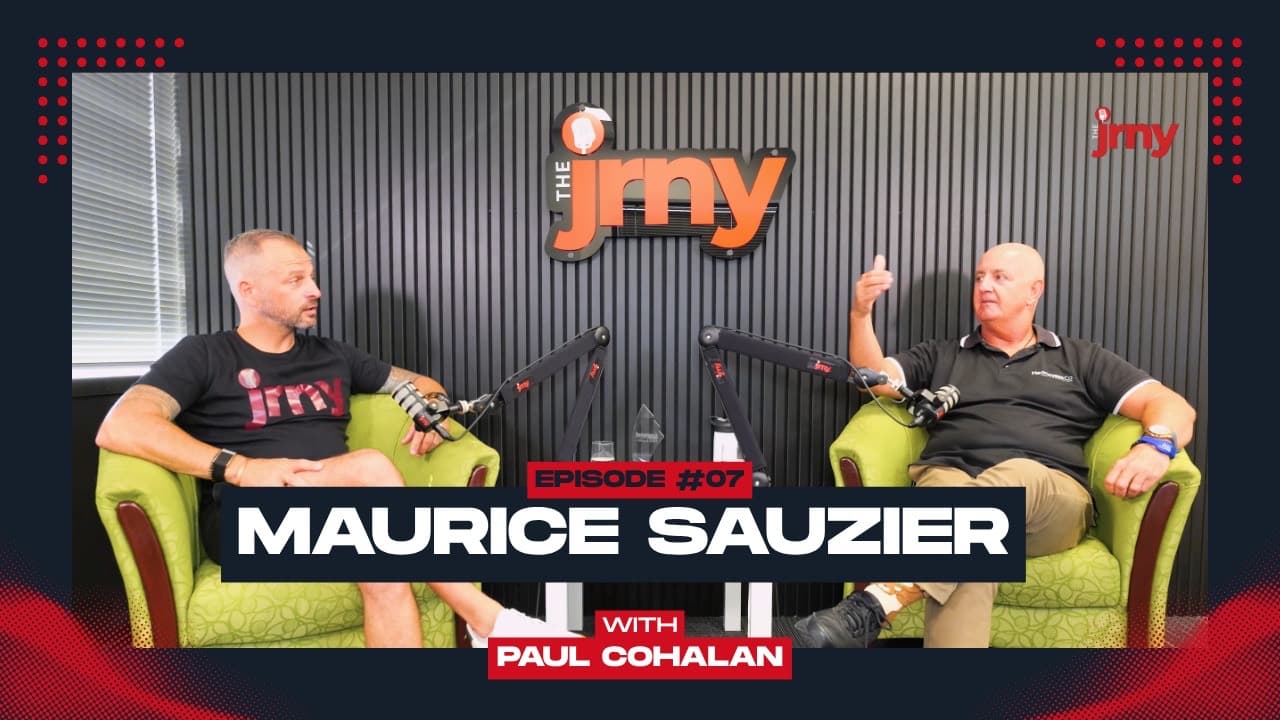
Meet Maurice Sauzier
Psychologist, exercise physiologist and strategic lead at Happiness Co Foundation
Maurice Sauzier, known as Mo, is a Mauritian Australian community builder, psychologist and exercise physiologist, and strategic lead at Happiness Co Foundation. He grew up on a chicken farm in Canning River, went on to become WA Aerobics Champion, and worked through multiple redundancies and a business partnership he calls his Harvard MBA. He now runs the Momentum Revolution men's workshops and leads work including Moving Mountains and the Road to Happiness Tour.
Episode summary
In episode 7 of The JRNY podcast, Paul Cohalan sits down with Maurice Sauzier, known as Mo, for one of the most honest conversations on the show. Mo is a Mauritian Australian community builder, psychologist and exercise physiologist, and strategic lead at Happiness Co Foundation.
He shares the full arc: growing up first generation on a chicken farm in Canning River, running away from school because he could not speak English, becoming WA Aerobics Champion, and working through multiple redundancies and a five year business partnership he describes as his Harvard MBA. He is open about micro traumas and burnout, about landing his dream role at 50 and still hitting rock bottom, and about the road back from suicide ideation and depression.
From there the conversation turns to what he built out of it: the ABC model of attitude, behaviour and consequence, why busy is often avoidance in disguise, the Momentum Revolution men's workshops, and the work of Happiness Co Foundation.
Key takeaways
Rock bottom does not discriminate. Mo hit his lowest point at 50, shortly after landing his dream role. Success and struggle can arrive together.
Busy is often avoidance in disguise. Filling the calendar can be a way of not sitting with what actually needs attention.
The ABC model. Attitude, behaviour, consequence. A simple frame for taking responsibility for what comes next.
Hold space and energy. Supporting someone properly means offering real presence, not just words.
Resources mentioned
Transcript
Read the transcript
This transcript was generated automatically and lightly edited for readability. It may contain minor errors, and speaker labels are not yet added.
You've still got to be you. What what works for you doesn't work for me or vice versa. But I take a lot in on that whole energy piece. And e even coming down to when we eat, the energy of the day, the meetings we have in my calendar.
Now I'm talking I'm working out my energy because you want to get the best out of productivity and efficiency. Right. So I won't go into anymore. I love that you brought that up because you've always said that to me a lot.
Um I've changed or evolved a lot with it because I'm more intentional about it and and just from a generic sense, you're right. you've this holding space and energy for people because everyone's different. This is Mo. We've known each other for eight, nine years.
Um followed each other along some different journeys. Mo's um Mo's seen and been in probably probably more the last two three years he's been very supportive of me uh going through my personal stuff, but also through the business. And then on the flip side, and we'll dig into that, but on the flip side, um you know, Mo Mo Mo Mo Mo Mo Mo Mo Mo Mo Mo Mo Mo Mo Mo Mo Mo Mo Mo Mo Mo's had a fantastic journey. He's the go-to guy when uh support um help, listening, probably listening is probably the big piece.
And um he's always giving giving giving out there in the community. Um and really big on the mental health and the self-care piece, but we I won't go into it anymore. So that's uh that's how my intros go. If it was Mo, it'd be down to a tea, right?
But um how are you Mo? actually doing really well after that splendid uh wholehearted intro. So Mo Mo Mo Mo Mo Mo Mo Mo Mo Mo Mo Mo Mo Mo Mo Mo Mo Mo Mo Mo Mo's also um big piece of uh Happiness Co, which I'll let him go into because there's so much to it now. I wouldn't even get it right um but they do a fantastic job and um anyway, I'll pass over to you because um Okay, give us a little All right.
Well, I'm Mo. Hello. Uh Mo's short by the way for for Maurice. There you go.
Um and there's a whole story behind that. So first born uh first born to maritian family migrants in in Australia. Yep. Um so uh 63 years back my my folks migrated to Perth and in homage to Il Maurice which is in French obviously the island of Mauritius.
Um I'm learning already and my and my grandfather whose name was was Maurice and there's a really nice little story around that. Yeah, that's that's where it's come from. And um you know, while uh while at school um you know, being Franco Maitian Aussie, so I'll call myself a Mozy. Um it was pretty pretty unknown to you know, unique to have a a name like Maurice, you know, not like Paul, which is really solid.
And you know, my my first name is Paul, my second name is David. Probably the most um two most boring names in the name book. Are they Are they going to have a comeback like everything else? Probably not.
PD or PD, you know, just just short PD, you know, um like Mo. So Maurice shortened to to to Mori to Mozy to to Mori to to Mo and that's where it's landed. So it's it's spelled with a C. So it's is it Mori or Morris?
It's Maurice. Maurice. So with a rolled R. Yeah.
Yeah. A very a very frank rolled R. Well, you know, that's why I I you know, I dropped it down. I drove it down to a mo.
You know, it's a bit easier. But it's funny because um I'm introduced now as Mo. Yeah. And of course us Aussies, you know, the way we do things, we don't shorten if we don't need to.
We extend. So it's now Momo. Are you kidding me? I get called Momo.
Yeah. So the number of people call me Momo. But can we put that on the name of the thing? Momo, please.
A Momo. But with that, um, yes. So folks migrated here. Got got a real passion around uh uh around, you know, the culture of France and obviously Maitius as well.
Um and uh been there multiple times which is an amazing country. Um and then uh yeah so that's sort of the you know where where Maurice and Dormo you know comes from which is uh Thank you. That's that's me 63 years ago. Here I am.
Nice. Nice. Ready to take on the world. So sorry.
So where were you born? Were you born over there? Born Australian. So first born Yep.
to Marian parents. Um this is all the stuff I don't know about you. I'm a southerner. I I uh I I grew up born and bred grew up in uh south of south of Perth.
Oh yeah. Um and then met my wife who's a northerner and the second half of my life has been moved north of the river which is because there's this whole sort of conversation divide between you know north and south. I'm going to tell you something really funny. Last night I was walking last night I was going for dinner and I was walking um with this friend down to into the city and it's a female and she's trying to tell me how good she is at maps.
And long story short where it ended up is she goes, "Yeah, but like it's easy cuz if it's either north of the river or south of the river." I'm like that's Yep. So you're really good GPS and this is the whole Perth thing, right? This north of south of the river. Yeah.
Cuz you're not you're not from Perth, are you? No, originally I come over in 04. South of the river. Yeah.
Yeah. Yeah, there you go. It is. It is a big thing.
I I used to have to look up what's N and S. It's just such as this biggest thing. You're on Facebook or you're on something and it's like north of like okay and then of course east and west. But talking talking of um you know of I suppose situational location.
It's uh it's amazing how people do anchor themselves in different locations and then refer to themselves in and around that location. And uh yeah, I'm I'm observant of that when when people talk about north or south or west. You know, it's pretty broad when people say north or south. That's what I was saying last time like Yeah.
Yeah. You can't get there just by being north saying north of the river. Yeah. There's this big divide, huge divide.
It it's like um and I'm not that much into footy, but you know, which which code do you follow? Which which team follow Yeah. And uh that's a whole funny funny actually. I I grew up my town is a bit like that.
Aubrey Wonga. So Aubry is on the new south side. Wonga's on the Vic and the Murray River goes through it. Correct.
Like all jokes aside, it's actually very similar. It's like this Aubry Wonga. Yeah. You know, I was born in Aubry Aubry base, but I grew up in Wonga.
Um it's nearly the same thing actually. I've never thought about that. It's very similar. Yeah.
Well, talking about growing up, I mean, grew up on a farm. The farm was 32 32 hectares. It's it's the farm was on Spencer Road, Canington. Yep.
So again, 60 years ago, it was, you know, rural um amazing and uh and that was that was life. That was living as a kid, you know, um living in country literally and and on the Canning River. So before the Canning River was damned, etc., etc. We we built um very Mark Twain, we built RAS out of 44 gallon drums and strapped them up and you know, got the ores out.
And then uh as we as we grew on the farm um it really you know the whole connection to you know to to the land was there and is there and that's part of the you know my value set. Um amazing place and growing up with uh with my cousins so they were the two families that lived on the farm and I recall one year what' you do what just quickly what did you do on the farm like what was it farming anything or just land? Well, no, it was uh it was not not No, it wasn't land. It was actually um chickens.
Oh. So, dad and his brother um built the you know the the the storage sheds for these chickens and the whole automation piece as well as the time was amazing engineering in its time. So, they were pioneers of unfortunately of caged chicken. Yep.
You know, egg laying. Uh so it was an egg laying farm and uh they sold eggs out of a little shed on the on the property which is just amazing. So as a kid I grew up in and around that environment and uh you know saw the saw that dad and his brother actually build these these sheds which is amazing. And just sidebar, um, a lot of maritians now have been when they they come to come to Perth.
Y, uh, they actually, uh, go into chicken farming and have reference dad and his his brother as, you know, the pioneers of that space. That's like it's funny how actually people from different country end up doing the same things. Irish construction form workers, concers. What else comes to mind?
And Greeks, of course. And Greeks. Um, yeah, that's crazy. Hey, yeah, but so, so far where it was and I I recall one year it was uh it was an amazing year uh in that where the farm was located and that was two Spencer Road and we were on three Spencer Road.
So, the little house that we were in was up the the drive, but the Canning River before it was damned just flooded. That whole area was lowland. So, the the estate farmhouse was center and then it was literally like, you know, around it was a moat of water. is front and center of the West Australian um copy.
Uh dad uh his his brother, myself and my cousin, they were rowing us up to up Spencer Road on the farm uh because it was so much so much rain and uh you know, we were flooded in. Wow. So, you know, history as it is, uh you know, government came in and said we we need the land and they gave us, you know, the the dollar for it, which wasn't the very best. And can I can I I just want to touch on something there.
Obviously, this podcast is about roadblocks, risks and resilience, right? And I didn't probably put that in the intro, but people getting used to that. So, let's reframe it then. Yeah.
So, we go back to like I I just this is what I absolutely love like hearing like these days we the the conversation what we're talking about now be talking about like the cage chickens and all that, but you go back then to the survival era. I always call it survival. these days convenience but you go back then it wasn't thought of like that because everyone's trying to survive and the population wasn't there and you know like in regard to Australia etc daily now we winge about some of the hardest things and I had a I had a max day yesterday hence going ice bathing but then you go back to what you just said and you got a row and you got a road because it's flooded and you've just you know you built these sheds for the chickens and you know that's what puts food on the table right survival back then it's different you haven't got the breathing space for a up or you know for to go backwards or or mother nature to go and turn you upside down. Now they're the roadblocks.
Now they're the risks. Absolutely. The things that you can control, contain, influence, etc. Uh and for for the folks um for dad in particular, it was incredibly challenging.
You know, I I I look at him and what he and his brother had to go through. Yeah. You know, first sort of migrant family um from from Maitius. They they were pioneers.
Yeah. There's a whole story to that which you know is is the reason why I am who I am today. You know forget the sins of the father you know the these dad was amazing still is as was my grandfather as is my uncle. Just just to without going into the other story and I may we may come back to this.
I'm trying to get everyone to come back three six months later. Right. Yeah. Um because the stories are unbelievable.
Right. So, but just why are you like you are where today? Like just give me one or two nuggets like out of what that story. What are the things that come to mind instantly out of that story without going into the story?
Yeah. Well, first of all, y the camaraderie of of family and the love associated with that. So, as I said, there were two families y plus plus. So, at one stage there was like 15 people living in a whatever it was a two or threebedroom farmstead.
Yeah. Yeah. And and an extended, you know, an extended shed here. And then the smaller house where we, you know, we like cage humans with the cage chickens.
Yeah. But no, just Well, correct. Um and making do just just, you know, talking about resilience. Um making do with with what what they had.
And by the way, you know, their first language is is French. Y True. I spoke French for seven years. Good job.
It's my primary language. So I spoke French. And again, talk about resilience, you know, that that barrier of of language at a tender age. You know, I ran away from primary school because, you know, this is it's as if yesterday this occurred.
I ran away from primary school because I couldn't communicate. How important is that? So, so the lessons learned from that period of time of of finding your voice and being able to communicate and making sense of everything that you you know I I I think that piece there and I'm going to quickly touch on two two separate stories just quickly. That piece there I reckon is one of the biggest uh roadblocks and reasons a lot of people from your era are where they are today.
Now one of them is my father ex-father-in-law. He come over Croatian I think 76. Wicked story. Never take it away from him.
He he he taught me a lot of resilience from roadblocks. Now he couldn't speak English. Had to redo his trade and his license and he end up very successful. And now another uh another creation actually someone I've known for a long time.
Large transport company now in Perth. I remember hearing his story as a fitter. Sat in a classroom couldn't understand everyone and left and never went back and went and drove trucks. That's the short version right.
And he he's very successful now as well. Now I take that piece like that language barrier we don't realize once again go back to communication and relationships. How do you build relationships? Communications correct and go back to that family piece like sticking together and the survival.
It's amazing how close it brings you. Right. 100%. and and the adventures that we had with with nothing, you know, uh I still recall mom saying, you know, she had a lipstick and it was like, you know, she she'd get sort of fingernail to get a bit of the right at the base of the lipstick so she put on her lips because she was she was and still is incredibly beautiful and powerful, you know, woman.
um and how she presents herself and again the 60s French you know very styled you know very stylish you know I think uh you know Bridget Bardaux and u and the rest it was it was an incredible period to be to to now reflect and and observe what so what years were this 62 to to 80 so so basically 20 years we 18 years 18 years yeah y to 80 so formative years I wasn't even born yet I I and this is it thanks Paul for aging the the reference point. Try not to highlight that. But no, no, I I'm I embrace it, you know, and I'll share many a story with you around the decades, you know, and uh and who you are and how you show up now. Yeah.
Um but yeah, back to your blockage, you know, to um to resilience. Absolutely. I've learned that through through my dad and my dad unfortunately um did have a significant mental health issue and uh having qualified in psychology you know being in my my late 20s and still you know finding out where I'm where I fit into the world he was going through this serious serious situation of depression and having studied psychology I I reflect back on it again it's like what was he going through at that stage and and I wasn't aware connected to or actually empathetic to it. So just on that right like and which is really cool.
So you were saying mid20s did you say around that time? Late 20s. So it was studied psychology. Your dad's going through this stuff, right?
But like just think about like go back uh time machine to that spot knowing psychology to now knowing psychology. And I'm not even talking doing a psychology degree. I'm talking just just the world now how transparent the mental health we understand just by even you know me and you talking or what I've learned off you over time or you know social media or whatever, right? like the difference then and go back to what you just said you you weren't even aware you didn't even click like how much of the whole depression bit the mental health of your father and totally and I and Paul on the flip side of that how resilient the women were so how resilient my mother was but they had no choice and and I mean that really nicely I mean like all of them like the survival is like you didn't have the time or the or the space to go oh but you know they they were so strong like I you know once again I go back to my ex-wife's parents and their grandparents uh their parents which is my wife's grandparents just watching them you know and like language barriers or even to this day they're so tough even my grandmother's um back one just passed end of last year but both of them and I've gone down the rabbit hole with this family thing both of them are probably a big reason why I am where I am and like that generation the survival and the toughness in it and it's like you don't have a choice but to worry about like we're lucky we have the time now to stop and go home.
Hey Mo, can we chat about something cuz I don't feel well. I don't I don't And that's great. That's wicked. We need to do more of it.
They didn't have it or have the technology go. You can you can speak as you know as a a product that happiness group is going to be launching in the next couple of weeks. It's a companion piece that you know. But yeah, back back to that um the whole notion of of being aware that your father who is the person that you look up to absolutely love, hate or otherwise all the all the experiences that you go through as a teenager while you're fitting into your skin.
When did it click for you? like so late 20s done your degree um you know studied psychology what like when you hit say 30 so what what would that have been early 80 oh man oh man between between between the 25 to 30 so y not only a finished degree but then I went back and studied exercise physiology with with the idea of uh again at the time there was there was no um no courses advanced courses in sport psychology and I always loved the the notion of performance, you know, and and how to how to, you know, to be the best um that you could potentially be striving forward to to that, but then using psychology to to really support those individuals. So, just just I just want to make a quick note. So, survival, generation, parents, family.
Yep. Then psychology, then exercise, uh physiology. Is that right? So, so just two sex.
So, there's three pieces here. The reason I do this podcast, one of the biggest reasons at that moment when you were doing that and you're working life out now you go get it today and you reflect back on it which we'll go through. You don't realize how much they help you now. People think they waste 5 years doing something because they never use it but how it all connects later which is probably where we'll roll into.
Keep going. Sorry. I just want to make that point because you know the whole notion of connect. Okay.
And I connect you know and the moment had now is that you're connecting. Yep. Well I'm also known as the connector. Yep.
Okay. Um so back to that. Yeah. And it is it is a journey.
It is absolutely a journey. And I uh um so real realizing that I wasn't going to be a psychologist because at age 21 when I graduated I was like what the I mean let's be realistic. What have I got to offer an individual? So then you know my my second love if you wish um it was you know was physical activity.
It still is. So it was like okay how do I blend the two together? And that's how I landed landed myself into the fitness well-being space all those years ago. 25 years ago.
Wow. Not 25 years ago when I when I was 20 to 27. Um so I finished my studies and at the same time uh and you wouldn't know this but at the same time uh my then partner u you know physical well-being partner um Peter uh she was invited to Japan and she was invited to Japan to then um demonstrate uh what was then called aerobic dance. Yeah.
Okay. Back then. So back then. So this was seven uh 87.
So Peter and I were the West Australian champions um of aerobics and and with that Yeah. Yeah. I can give you some moves. Absolutely.
I've I've got video footage of my moves. So So that again was an opportunity. Seize the opportunity. Y So we we were crowned champions.
She was the the state women's champion. So between the two of us, we were invited. She was invited. I came along.
Yep. I saw the opportunity. I went, "Yeah, okay. I've got nothing else to do." Uh because that year in particular was a massive year.
87 was a big year. And then we went to Japan and we opened uh a cardio um hospital for in Osaka. Um and that opening was us demonstrating. We also uh you know did classes for the local university for Fuoku University.
Um and uh and spent time with the students there. It was it was an amazing two weeks. Japan 87 people it's a hot spot now. people going there, you know, but 87, talk about culture and talk about, you know, 27 years of age going, "What the hell is all this about?" Here's an opportunity.
I reference sliding door opportunities. 29 years ago. Wow. Okay.
Um, I reference sliding door moments. So those sliding door moments, the door opens, you stand. Okay. You look, the door closes.
All right. The door opens again. Do you step forward? Do you stand?
Or do you step back? Make a quick decision. Okay. And in that situation, I stood and I didn't step forward.
And the step forward was the potential to study secondary um exercise physiology at the university. And I was I wasn't comfortable. I wasn't comfortable with the language. Back to language.
Y um and also the notion that um Japan culture etc. huge culture shock. I traveled a little bit but I hadn't traveled to you know to Asia and in particular Japan. Japan's an amazing country, culture, etc.
So that moment didn't happen, but within 20 within a year of that, so much happened in the space that I So let's just fitness industry. Let's just touch on that for a sec, right? Y because I'm really big on these days. I'm really big on like the universe will make things happen and things happen for a reason, right?
Sure. So you just said you didn't step through the door and the instant I'm like where's this going? Do you have regret? What not?
Do you know that my biggest thing the way I look at this? You're never going to know what the other path would have done. Correct? Whatever your path you're on, and this is a bit this is a big piece, right?
I I actually think about this a lot. Make a decision and move on. And this is what a lot of people struggle to do. And even if let's say it's the wrong decision or you hit a roadblock, pivot.
I'd rather fail, fail, fail, pivot, you know, or sorry, fail pivot, you know, fail pivot. And then you you're going to get somewhere. But every little step you make, whether you step through the door, you don't step through the door, the other option, plan A, plan B, you learn a bit and you'll never know what the other one is. So it doesn't matter.
Don't get caught up on it. And you just said to me after, that's why I didn't butt in yet. Is but in the next 12 months, so you get your glass half full. So much happened.
It's epic. Like it's so Well, that's who who I am and I always have been. Yeah. I uh and I'll throw in the term victim in a minute um in reference to mental health and its impact.
Uh but yeah within that 12 months so graduated exercise fizz which is awesome Japan awesome competition Japan awesome next 12 months um I'm the president of the fitness institute WA oh wow at age 27 okay and that again was opportunity was opportunistic and um back then back then not like roles like that these days you'd probably see a 20-year-old in it I would think back then no matter what associations not many 20- year olds get into that stuff. No, no, totally, totally, totally. And it came from being a volunteer and that's also, you know, with the foundation that I am a director of, um, it's really important to be part of community and that was a that was a great way of being part of community, but it also complemented what I was doing. So, at that stage, you know, I was running my own business, consulting business.
I was consulting to corporates. I was teaching others to uh we set up the first um private training program so myself and my mate at the time John um uh and and that was that was monumental you know um so all these fitness leader of the year etc. So that was the year that was like a major year. And the fitness industry was young.
So we're talking 87. So let's say 90. Here we are in 26. That's that's 36 years ago.
Y. All right. 36 years ago. I was talking about corporate health.
Okay. And the balance between work, life, physical well-being, mental well-being. So and also sorry Paul and also then that whole social community piece. Yep.
All right. So that's what was your biggest roadblock at late 20s like doing all that? What was it's all exciting all that stuff. What was your biggest roadblock?
The biggest roadblock was and talking about half a glass half full was the notion that I wanted to do it all. Mindset? No, not at all. I I wanted to do it all and I was trying to do it all.
Yep. And at one stage that age you don't have patience. I had I had triple triple booked myself. Yeah.
And one of the things was I was I was a judge for this competition competition after the years of competing. I then became a judge and at the same time I just add that. No, but but this but that that's that's just the episode. That's that's the industry episode.
It was and it was huge. I didn't I didn't tell you about Miss Summergirl. That's a whole another another conversation. So at the same time I was a a sponsored athlete for three years.
Were you through Reebok? Yeah. Doing what? Aerobic competition.
Aerobic dance. Yeah. teaching being being a brand ambassador, a social influencer without the media piece. So what what impact did that have?
Did you back then in your 20s did you have the ego then? Did you like you're doing all this stuff? I've got a feeling maybe at some point a couple of it dropped off as it does. Did that impact you?
Like what was your roadblock around doing all that besides trying to do it all? And I'm probably one of those people that have leared that over the time also and you probably pointed out to me over the years and and it's probably from your own learnings. Slow down, Paul. And you know, so tell me like back then like what's probably one of the biggest things that sit with you now like out of that.
You mentioned ego. Um you know I we all go through that. I think I I reflect more so that it was drive than ego. Yeah.
Okay. I look at a I look at a positive softer um explanation to to what that is. Okay. You need to you need drive.
You% you can't keep going year in year out decade decade. I always put a just on the ego word, right? I always put a negative spin on the word ego, right? It's just and I think I think you kind of did as well then because you're like I'll put the positive.
Do you know someone said to me a year or two ago and I always thought intentionally trying to work this ego piece out but someone said there's good ego and bad ego, right? Or negative ego. And and it's kind of what you just said then. There's drive, there's confidence, there's a line, right?
And I think there's a fine line between it all as well, right? Because can I answer that? Yeah, of course you love love love to hear you. Because it's it's all about who you bring with you on the journey.
If you're ego driven, you bring yourself on the journey and no one else. That's a really good way of putting it. All right. If if if you see yourself, your motivation, your energy, you will bring the people with you.
Yeah. With you. Because you can achieve so much more. I reference that now in some of the work that I do, the me, we us.
So me what can I do about anything and everything? What can we do as as you always say this right and then how does it then influence the us so ego to me and there are many leaders in our in our community now who are ego driven it's about them it's about what they need to go look at the companies that fall over corporate mining small and all the businesses like whether they're corporate or business owners what one of the biggest reasons even in my own last 10 years like if anything's buckled me it's it'll be ego and I'm I'm really big on being an upside down all chart and going with everyone but I think we all have these spaces and it might be a lot of it's a defense and a protection piece at certain times as well because you end up in your own little world um and me and you chatted about this you've built it you've built your IP etc etc there's a lot of risk to that return on investment piece but e back to the ego it is absolutely about the journey that you're on if if that individual is driving that journey motivated etc achieves you know whatever that level of of success is however you want to measure that wherever that is If that person has brought others along the journey, okay, then boom, it's to to me it's someone I want to have. Something someone told me a while ago and when you talk money, which is it happens along when you when you're trying to grow, there's no point being the richest guy at the end of the table and the most expensive bottle of wine by yourself. There's no point.
And I've really sat with me uh and it was actually an ex-friend of mine that told me that. And I really do believe that because like I always say there's no finish line. This is why I called it the journey. I've always said it's about the journey, right?
Totally. And and a lot of people talk about that in the last few years, but I've always said it and and enjoy the process. And it's and and it kind of aligns with the same thing. There's no finish line.
There's no number like when you talk money like million dollars in the bank, $10 million. Well, there's no number because it comes back to filling your cup. And like I'm I'm pretty big like you like upside down or chart. Have the people come with you, the community, like help others.
But there's also a line in that also. If you give too much, you got to be selfish to be selfless. And if you give too much also, it can change that people around you also like on their side, their ego. That happens a lot.
I've learned a lot about that last few years. 100%. And I've seen you in your journey in the last few years. Um, uh, another close close mate of mine, brother of mine, um, who's an incredible young entrepreneur, you know, 37 years of age, he's Irish, runs a business Yep.
Um I I continuously reference to him, be humble. Yep. Have have your drive, etc. All that.
There you go. But be humble. I keep reminding him of that. Yep.
You know, being humble, having humility um to me is is is an amazing leadership skill. Yeah. Which which people within our community look at and admire. Yeah.
More so than the flash car, the house, etc. So the ego piece where it sits okay and there's a whole you know fraudian another you know relationship with ego and where it sits generally for an individual but you know be the person that others want to be with you. This is from someone in the business that I work closely with. Um I just want to read it out and this is a little bit of a feather in my cap but this is this is what fills my cup.
So, it's given me credit, but it's like when you go back to leadership, right? This is what gets me out of bed in the morning. You know, we we all get humble. Actually, you know who humbles me the most?
My physio. She kicks my ass and humbles me. I I tell her that all the time cuz you don't get this all the time. You got to as a as a leader or an owner or whatever, right?
mom, dad, like father, husband, you just got to keep when they talk about the men because you know it's a bit different the the woman and the man but in certain ways it's like you just got to keep going and you don't get credit and you don't but it's the little one% now and then that you get that really like keeps you going if that makes sense. Y um we're on the right path mate. I know I don't say it enough but even today mate you got it. Being a great leader is not dictated by the success it forms, how you act when things aren't going to plan.
Thanks, mate. Uh that is what builds true culture, not just words on the wall. Two days ago, the last two days I've been maxed, right? Which I love.
I I love it, right? I love being back here in the fire in the belly. But there was a bit a couple of challenges going on personally with someone. But my whole day stopped because it was crossing the line.
And actually, I nearly wasn't going to be here today because of it. I was nearly going to cancel the podcast because I was going to go see them because what's going on and there was a couple of challenges in the business and then a couple of personal and and like what prioritizes right now money clients all that stuff like clients are most important in business but all that kind of shifted in a 10-minute window and it was like stop and it's kind of off the back of that message I can't go into it but uh that why do we do this it's not the numbers at the And it's like it's like it's the journey, right? So I have someone that is, you know, we're in the same community. We follow each other.
We're going to be on the journey together. Or I could have been worry about that after hours worry about like, do you know what? You get what I'm saying? I don't want to say too much, but it's uh I love people coming on the journey, coming along with me because that they have been for a few years now.
And um and it was I love that I can support that person when the time moment happens and my whole world stopped for that 10 minutes. It was like I I said to my eh can everything I need to process what find a solution to a couple of things and that's the message I got that night and that's huge. That's a huge piece. It's it's powerful and this is if I go back to the mi we us know you don't know what that conversation can lead to.
Yep. So and and no one like I I love that it would come up and it come up in the spare of the moment. No one would have known that though we do this and no one knows and you it fills my cup makes me go to sleep at night. Right.
So then the question I pose back to you is then why do you do it? Okay. So philosophically why are you doing that? Is is it to your point of filling a cup?
Is it filling part of the cup that for some reason is, you know, is is detached, dis associated with If I was going to answer that, I'd probably have to go into a bit more detail because once again, it goes back to family, but just reflect on it. And I think for for the people who look on the podcast, you know, just stop the moment. All right? And what is it?
Why am I doing that? Why why am I doing this random act of kindness? So, the happiness coound foundation, we talk about random acts of kindness. Why am I doing that at that moment?
All right. So, flip it. When people ask, and I've got the the tagline on the back, making happiness attainable. Um, so Mo, I was having a coffee with a mate 18 months back.
I have a lot of Just I'm going to say the word responsibility quickly. We'll come back to it just so I don't forget what I was going to say. Keep going. Yeah, keep going.
Um, so with with that having a conversation with the mate, t-shirt, polo on the on the back. Um and this this woman stopped interrupted our conversation and said how do you make happiness attainable? Super powerful question given the brand and who we are the foundation etc. And without you know without thinking through it uh I said it starts with a smile.
Yeah. And that's part of the logo right? It's a smile. It's so true because the power of the smile what what it can do.
Okay. It's it's reflective in itself and and like a mirror reflects then with that the conversation. So if you smile okay then you're opening the door to a conversation and because we're so disconnected having that conversation then starts the connection. Yeah.
All right. Which then has that ripple effect. But also you've got to understand that in that situation lovely lady interrupted a conversation I was having. Okay.
And I'm not necessarily into that Yeah. being interrupted when I'm having a you know a decent conversation I find it very disruptive and um also from a regulatory perspective you know you lose you lose the idea of the thought pattern et can I can I can I can I can I dig dig on that a bit and I'm really big on when something triggers you what was the reason the other person it either triggered you or the other person now I'm going to think about if that woman so for her to be able to walk up and interrupt you and ask about that sentence that she's already read three times. Let's be honest, right? Like there's a reason.
You don't just skim it and then ask. She sat there and thought about it. I believe she has something in here. There's a reason she asked.
100%. Yeah. Yeah. There is that whole empathy piece to her like you'll never know probably unless you chatted to her later.
And I know you said she buted in. The wicked bit about that shirt and you got that on the back is that would have took some courage to do that. She obviously has something internally like this is going back the the 180 the other way like for her to come and ask you how do you do that she's asking for something or trying to find a solution for something now that's that is a really cool thing about what you guys do and even just having it on your shirt. Yeah.
Look absolutely and you know you interrupted that conversation but I also engaged with the conversation. That's awesome. All right. But what I was going to say within that respectful of the individual I was sitting with.
Yeah. Yeah. Of course. Okay.
Um who looked at me and went oh Mo's Mo's doing his thing. Y you know he knows me well enough and respectful but I'm also needing to be respectful of the individual I'm yeah of course conversing with so there were two interplays there two two person interplays I had the conversation but no also at that point look thank you very much you know have a good day and it was like okay talking about parameters just close that conversation down because I'm here to have this conversation y you can't have two y all right talking of priorities you can't have two priorities I like how you compartmentalize you do. You do it you do it with nearly everything. You probably do it.
But but with the whole thing the whole thing of priorities. Okay. I may have I may have spoken to you about this um end of last year. I said I don't do busy.
I like the term busy. I think it I think it's it fills in space and and pumps people's tires up and and whenever someone says I'm super busy, I'm busy busy. I'm going okay fine. That you you own that.
So when you I don't do busy. So when you're busy I do a lot of What are you doing? I do a lot of stuff. What's the other word for busy?
Why are we busy? And I've I've done it myself for years, right? Probably it's why I'm divorced. But what is it?
Avoidance. It's avoidance from the that you don't want to deal with. No. That is the bottom line of busy.
We're all We can be productive. We've got to do. We've got and and really we're all busy and if I don't answer the phone and we don't do something, you're not up on that priority list. And I I've been really digging on on this whole busy thing a bit, right?
It's like I've done it for years. And yeah, you are busy, but it's like a lot of people say it automatically by default, but do they actually intentionally think about when they say it, why they say it? Now, when we're busy and on on a lot of it's avoidance, right? And I've done it myself.
And um when you start to understand that and then you talk about being productive and getting done, it changes that changes the whole dynamics of that question. It's a really key bit that whole busy piece for me. Absolutely. And again you brought it up for you know for people listening in uh really you know put the handbrake on think about that how are you filling your day y okay because with priorities and I had this conversation in human on Friday when I was in day yeah y um class there was you I could I could sense that she wasn't she wasn't coping she was emotionally disregulated okay so she was sitting there and she was I said what's up and she said I've got this priority and this party and I said, "Right, you can only have one priority." Yeah.
Okay. You're going to have a list of things that you have to do. All right. And I said, "Right, let's shift this conversate." I said, "First of all, I asked because I'm there very specifically to do work on psychosocial well-being uh with their leadership team." Um, and it was like, I'm not about to give advice.
I don't go into advice mode. I asked, would you like me to, you know, reframe or give you a reference to to work from? And she went, "Yeah." And the reason I asked that of course is that sorry mate she she at that stage was not able to self-regulate. Y all right so it was like okay I'm seeing this this is what's happening um and she said yeah look fine.
I said right look at this objectively forget the subjectivity because the subjectivity I'm seeing at the moment your behavior okay is around this emotional you know this emotional piece. So I said look let's let's be objective about this. Let's put a risk framework around it. Yep.
All right. So, likelihood and consequence. Everyone knows about risks. Likelihood, consequence.
Compartmentalize those priorities. Okay. Where does it sit? If it is lifethreatening for that individual and it's part of your role in this organization is to make sure that person doesn't die.
Urgent, important. Yeah. Massive. Y.
All right. Because that then what that then does is once again compartmentalize the emotional. Yeah. Subjective piece to now being pure objective.
you've gone through the processes and as a consequence of that it was like yeah okay and you could just see you go I said before you do anything just take five minutes take five minutes get out of the seat and just walk go somewhere and just think through what I've shared with you what you're thinking through around that and then what the actions okay what are you going to do differently now which is also a piece of you know advice what are you going to do differently now and not continue repeating So she went, "Okay." So she went out and she said, "Right, okay. I've got three priorities." I said, "Right, put it back into the risk." Yeah. Matrix. Which of those three is absolutely, you've got to do that now because the more you're thinking about it, the more priorities you've got, the more busy you are, the less you do.
Correct. I only seen it this morning. Uh, less you do on a on a reel and it's like bouncing on five things and they go up every time you bounce on them or bounce on one thing and it'll go up. Right.
Okay. It was only this morning I seen it. So Paul taking that. Okay.
And if we weave it back into, you know, um, a business that I was involved in, um, and I was a I was a partner in this business with a married couple. So, can I can I stop you for a sec? I just want to touch on before we go too far the responsibility piece. Before you said about why we do the acts of kindness and why does it fill our cup and why do we do it and why do we help?
Now, I'm going to change that a bit. Right? There's that which I think I do less of now because it's good to do ad hocy but when you give too much things change uh the dynamics change but what I did what I did the other day why I got that message I think we got a responsibility if someone's part of my team or you're a close friend or you're in our in my community or yours be the same as if you know I thought you're a bit off I reckon I have a responsibility and not everyone can do this I reckon I do because I've got the personality. I can speak up and I can ask the question and I have the relationship with you or the other person on the other end of the phone.
I don't think it's an act act of kindness where I said my world stopped for 10 minutes and I had to problem solve. I got a responsibility there too because when when when you get older and this person's in their late 30s, I'm low 40s, you you have less people around you. So what happens? The people that are around you become more important.
You're also you get rid of the fluff, but when something happens that you don't have many people to go to. Now, I know this by this person, right? And even the like we all know a lot of people and got a lot of friends, but how many do you actually lean on? I learned this last two years getting divorced, right?
You actually don't have many, right? And people don't know what you're going through. It's the same with this person. I know that he wouldn't go to probably some 5, 10, 20 year mates, but me and him work very closely together, and I am that person.
So I think there's a bit of a responsibility there. Not saying it's on me and if I don't do it. Do you get what I mean? Oh, absolutely.
So responsibility predicated on relationship. Correct. Okay. So if the relationship is or however you want to define that.
Okay. The one in five people in your orbit or the one there's actually a model the theory is called being an employer even the model of 150. There's 150. What's that?
It's a model of 150 of 150 people within your life at any one stage. Y. Okay. So if you've got hypothetically 150 people in your life that you know and from a if you look at a cons concentric rings from from center the core the core five people in your life you know to what you've just said there the next five the next five all the way to the peripheral that you might see once a year still in your life.
Yeah. Okay. Their level of in influence on you and you on them is predicated on a relationship. Y the ones that you really spend time with and get you and have your authentic conversations, you're going to spend more time with them.
Yeah, of course. For from multiple reasons, but and usually environment and your life and that that waxes and and waines, but if someone then comes into that orbit of 150, there's someone in that orbit of 150 that has to potentially step out. Yeah, you can only maximize and I'm and this this model, by the way, um there are, you know, individuals who have debunked it as well. Um but just just the notion of you've got so many people that you can Yeah.
to your point of decades of age. All right. Yeah. There are people in my 20s and my 30s and my 40s and my 50s and my sixth decade 60s in my 20s and my 30s that I still see and I've still got very wrong strong relationships with but that again is predicated on the relationship piece.
Yeah, it is. Do I see them every day, every week? No. There are individuals that I see more frequently now.
Yeah. Okay. It's circumstance and situation as well. And go go go back just to people that you just click with relationship wise, but and I I think I said it in the last podcast last week.
There'll be people that you don't speak to for 6 months, but you can pick the phone up or they text you. I got a couple mates now maybe Navy 20 years ago. We still talk when they fly in. I can meet up last minute, but we don't have to talk for 6 months, but no one's got no one care.
We do we do life but there's still there's still that that relationship is there like I could ring and lean on today. Do you It's weird how everyone you got different relationships with everyone. Not at all. And and that absolutely um but I'm going to challenge that and and that challenge is um you know if if you don't invest time, effort, energy in that individual, but yet in six months time you pick up the phone, you know, and you might be needing to lean in on someone.
Um that to me is that you're not really building nurturing that relationship. Geographically though causes that a bit too. Yeah. You know but you know okay so we go back to some of the the men's work.
I'm just thinking about my examples. Yeah. No no exact and this is it you know it's not for me it's not black and white. Yeah.
Okay. Definitely not. This is this is reflective. It's reflective of the grace of six almost plus decades.
um you know investing time, effort, energy. So you know you might message someone five times a day. Great. Why don't you pick up the phone and and give them a buzz as an example.
Yeah. And it doesn't matter geographically where that individual is. And again this that's a personal thing too. Yeah.
Look it is it's right communicate and what the relationship is. But to that point when you age you definitely for men in particular that reference circle goes to that go and and and in particular because when people then are looking at retirement men are looking at retirement in particular because back to ego going etc and work and the success and all and sunundry that's referenced you know by by the work that you do. I just on that whole going like this right like I'm 42. Yep.
You you learn that. I learned that and I'm a bit of a socialite. go back a few years. I learned how much it does that last two years getting divorced.
Significant time whether you're going broke, things are going wrong or you're getting divorced. I think of the three things people say you'll work out who your friends are, who's close to you and who who really can give without wanting something back. Learned that three very close people part of ways with and I just call it growth. I'm not there's no stones being thrown here.
Now the other piece what I really learned and this is a couple of months ago, three months ago I got every once a month we maybe started doing it fortunately but there's there's about six seven six seven thing um lads that I go for dinner with and everyone on that table we're not high school sweethearts we haven't known each other 20 years maybe one one or two each we have but on that table the trust and the loyalty and everything that's sitting at that table is probably there's probably no one else on that from that that's not on that that it's just funny how it changes in life, right? Like, yep, I still got a couple of mates back home that, you know, go back to the 20, 30, you're very close with, but the way my world is now, what I do daily, my environment, the business, the gym, the kids, you know, cuz it goes with your life, wherever it's heading, right, is who you spend time with, who you text every day, all that. But I just learned walking away from that table and walk, you know, just separating friendships with certain people, but then sitting at that table, how how at at the moment could change in a couple years. And that's the part of the journey in the life um and and the choices we make.
But uh sitting at that table there and it's just funny none of them are like 20 30 year mates just I learn a lot from just sitting and thinking about that intentionally. And um once again there's no black and white. There's no right and wrong with this I don't think. Yeah.
It's reflective learning. Yeah. You know you you and this is what authentic leadership is about. The core of it is um you know taking time during the day generally at the end of the day for most leaders is is to stop and reflect on okay what was it today how did I show up how did I you know what were the conversations I had um that busy piece you know what did I actually achieve y so so you're reflecting on that to then hopefully hopefully learn y I want to put also another framework around this and I call it the ABC model is attitude B is behavior C is consequence Okay.
So, I'll just repeat that. ABC. Attitude, behavior, consequence. Yep.
All right. So, let me work work you through that. Attitudes. We can't see.
We can't I can't see what's in your head at the present moment. Yes. Your values, your emotions, you know, what you're thinking about. And again, back to men men's health in particular.
Um, you know, we do a lot of that. And we're disconnected from from mind to heart, okay? Mind body. So, so with that, I can't see that.
But what I can see is how you show up. So as a leader, how you show up. If you show up and I I referenced it again, is this the behavior bit? Stormy stormy waters.
If you come in stormy waters, yeah, okay, as a persona and you just crash and burn and there's waves and lightning and you know just bring this energy be it you feel is positive but for others it could be absolutely you know demanding and devastating for them but in particular if your whole posture how you come up and how you show up y is is dark. How does that make that individual feel? Yeah. To then what is the consequence lot of so the consequence then is the impact.
So you can either have your positive, your negative or your neutral impact. Read the room and self-awareness is a big piece of that 100. But go back to then me observing you in the space. All right.
So I was looking at you and uh and you said Mo can you just you know check this out. Um I want to clarify some stuff that's happening in the team. Okay. Um first and foremost you sit and observe.
You observe how people position themselves, how they show up. Yeah. So from that if their behavior is then impacting on you then what is the consequence aka I'm really not in a good headsp space I'm angry I'm showing that through the behavior and then the consequences are boom how do you then manage that from a leadership so how do you manage that piece so attitudes behavior consequence so how do you show up every day what's your attitude you know what is the one thing that you do every day what is the one thing that you want to say, "Yeah, this is what I'm going to do. What is the one thing I want to change?" Because we know we all need change.
People talk about it. Okay. God, I could have done. I should have started this.
What is that one thing you're going to change? Yeah. And what is that one thing you're going to continue doing, but do it better? So what I think about when you when you say this, right, and it's um not going into examples and stuff, but it's one of the biggest learnings I think of leadership over the years is I could have 10 things go wrong this morning and I'm talking business owner here or a manager, but the way you walk in walk into the office, if it's an I game, a me game, and all my problems, other people won't have the safe space or they won't feel comfortable and they'll have walls up.
Correct. Now, this can be and I believe this is probably why I'm doing this podcast. I'm pretty good at getting people's walls down. Even last week, Trent in here where he opened up was unbelievable.
And it's like, but it's the same when you come in the office. It's the same as me not being in the office the last couple of years. I had churn, right? Because my motivation, energy, and the safe space where people were energized and also they could come and talk to me, right?
I wasn't there to do that. And I learned a lot about that in business. And I learned why my business changed, the structure, the culture. Yeah.
Uh um because not every I probably take it for granted that when I when I am in the office and I do that that I'm I I think I'm pretty good at that. But I'm also always trying to learn it and self-reflect on it, right? Because we all it up like you might and then some days you come in you don't realize intent not intentionally but you might be like in a bad mood or you might but when as a leader if you do that the other people that are looking up to you or you're working with I should say they will put walls up and they they'll stop right now everyone hence the journey the book the chapters of everyone we all have going on so as a leader there's no nineto-5 anymore it's really upside down or chart you're coming in to support your people and be there for them. I think a big piece of leadership is really allowing that space.
It's like being at home with your kids. It's they probably taught me more about this than anything. It's like giving that space, not putting your stuff on them, which it does. It happens all the time in business, right?
And it's probably more the physical and outside space that that happens a lot in allowing that space where an employee or a teammate or someone can come and talk to you. I even with clients I I put my take my insurance hat off, put the business hat on or even a personal hat a lot with clients and they'll ring late at night or be sitting here. We'll end up talking not policies, we'll talk this here and like because why it matters and for me in business and having a team is if something's going on on the other end of Mitch, it's going to affect the business. It's going to affect the person sitting next to them.
it's going to affect you because they won't communicate and they're being a different person. So go back to how do I get them to speak? And it's not about going, "Hey Mo, you need to tell me what's going on." Because they're not going to because no one does. But if I allow when I come in in the morning, it's positive.
It's about them. How's your day? How's your morning? And you ask the simple questions and you've probably you can probably go a lot deeper on this, right?
I'm just talking from my experience. That there is one of the most key strengths you can do as a leader or learn on constantly evolve on I think because and it comes back to the culture piece starting from the top. Absolutely. So predicating all that again is relationships.
Yeah. And uh what is the relationship that you have with yourself? So me before you can have a relationship with someone else. Yeah.
Um and hence the you know the reference storm waters. So if you as a person come you know as a storm you're just going to dump dump water on everyone. It's going to be uncomfortable. Some people thrive in water.
Okay. Yep. You know for some it's a cleansing you know cleansing process. Great.
But that cleansing process is, you know, is wrapped up in their own space though. But it's also wrapped up with, you know, from a notion of care. It's it's not a notion of I'm here because I've got my and I'm going to now shift that negative energy into you. So the whole space becomes a negative energy.
Um but you know in referencing your business you know your business and the journeys that you had um you know I've had I've had multiple episodes in you know my life um some some of which you're not across but yeah I was in a a business relationship for five years I reference that as um doing my uh my MBA my Harvard MBA in business and that partnership I was um I was a director of and I had one share there were three partners we we each had one share unfortunately in my late 20s. I was absolutely wet around the ears. Yep. The Harvard Business School of course um reference um they they were a married couple.
Um and the conversations they had talk um I wasn't privy to obviously. Uh but I wasn't able to achieve what I potentially could have achieved because I had the one vote reference. They had the two vote. So anything major they generally vote two to one.
So I had a 25% share um in the business. Five years, blood, sweat, and tears, major projects nationally. Um I was FO national. Um one week, sorry, one one gig was a sevenwe gig where I was away from home.
There were chunks of of that five years of memory I can't recall. Yeah. because I was doing so much toward busy. I was doing so much responsibility as a director responsibility as the director of education training delivery client but then also the team the the young team that by nature of the program uh you know they came on that journey with me and I had to look after them.
So not only was my energy delivering 14hour days okay one-on-one stuff in particular. So just on that window how old were you then? Sorry. I was uh late 20s, 30s.
30s. Okay. So, we're starting to go into 30s now. Yeah.
Good. Good. Good. Yeah.
And I want to reference the business piece because that to me was a fantastic opportunity. Um, incredible. But I experienced a lot of micro traumas and I want to throw that into the conversation. So, they were your roadblocks.
They definitely roadblocks. Massive roadblocks. Um, and with that at the back end of that five years, the realization from my partners that a their marriage wasn't going and they subsequently separated. But that stormy waters really impacted me from being on the farm, seeing my parents, you know, the whole piece of I'm viewing these behaviors and I'm going, "Oh, it's confronting.
It actually impacted on my on me, my well-being." Okay, that was one episode. There have been multiple episodes that in particular because at the back end of five years, the opportunity for me to take this business, okay, step it up. And for whatever reason, that didn't happen. But I pivoted.
I pivoted and this is one of the the 30 two years of age. One of the major pivots in my life having delivered five years almost rearing a child and then all of a sudden that child was no longer my child was gone. I pivoted uh and the conversation I had with the then director of uh HSC, this company that we're delivering the program to, um I had a conversation with them. I said, "Look, I know we're we're looking at extending the program to an extra year." Great.
But just for your FYI, I won't be part of that. This is what's happening. I'm stepping away from the partnership. I will no longer be that person assisting your organization.
Said, "No, we don't have a relationship with your business. We have a relationship with you." Yep. Again, really powerful. Can I just I just want to touch on something there.
Um, sorry to interrupt. So five years build it for whatever reasons there was roadblocks right massive and after five years you're like you know personal feelings things happening stormy waters all that stuff you've you bred you know this grew this baby right three of you three of you was it yep um that's always hard um and then to to make that decision this is the these are the bits because these are the bits that I resonate with the nights the nights, the weeks coming up to making that decision and you don't just make it overnight. You know it's coming and you think my the decision may be to split and I've done it myself actually. How did you feel?
How did your gut feel? Like there's pride, there's ego, there's all the time you think you're going to waste it even though you're not because we'll go into probably where you pivoted. Y but before you go into the the outcome which is probably a great thing. How did you feel coming up to making that decision that I'm going to part ways if it wasn't forced?
Okay. But even even so, well the flip side it was forced. Yeah. Okay.
It was like um the the business was was draining what the revenue that was being generated at the time was being drained out by secondary and tertiary add-on businesses. Okay. Which weren't caught. Another thing expanded referencing u uh you know utilizing the money as as cash flow for their businesses.
Um one of which all of which were amazing in themselves but they were amazing in themselves and they required their own profit loss. They required their own system. All of that. So the central business which I was predominantly responsible for um was funding.
So it got to the point that the owner the two owners um my partners said that's it. We we can no longer continue this. We're going to start shutting down the business over the next six months. I thought okay but then what where do I sit in this?
Because I've given my my time, effort, energy, etc. born this figurehead the whole piece because I was the one that was delivering most of the programs. So how I was feeling at the time was again shock was there definitely um okay survival mode what do I do I've given birth to now what it's all the risk ego success here we are this is great fantastic well we'll we'll give you here it is okay right so in my head I've already moved I'm no longer at lounge y no correct no longer train station number three I'm in train station number seven um and part of that in particular was um relationship pieces with with the client science similar to yourself, you know, it's it's it's the me why. Um, so, uh, in my head, I'd started moving forward and as part of that conversation with this client, uh, which was a major client, I had the conversation.
I said, look, this is what's happening. You know, I will no longer be I'm I'm stepping down from the director of um, and so this this whole stepping into discomfort, some would say absolutely not because I knew what I needed to do again, motivation, drive. Yeah, I knew what needed to happen. I knew this could morph into a hybridized program.
Build it. And by the way, company X, you don't need an external. I can be your internal consultant. Y.
So the pivot was being an external to then being what was the risks to making this shift to the whole business itself minor in so far that we were closing the business down. All right. the realization, no, I'm I'm not going to continue six months down the track delivering falsely to um and also then be part of it. I didn't want to be part of it.
I I had got to a point through all these micro traumas. Okay, exhaustion was coming in. Burnout was was on the horizon. I I'm I'm going to have this moment where I pivot.
Three month hiatus. I stepped down, closed out my part. Three month hiatus. My lawyer at the time is an old school friend of mine said, "Mate, you've just got to reinvent yourself." I said, "Yeah, that's what I'm going to do.
Spend the three months creating what you want to create," which I did. Let me let me touch on that. That's awesome. Love it.
So, you got the roadblocks. You've been through the through that chapter, that journey. Then obviously there's a window. There's the risks obviously, which you probably didn't have a choice, but you had to take, but there's all risk there.
And what do you do next? You're talking to a significant client. You take the three months and you had to reinvent yourself. Now when you when you go the roadblocks of risks and the journey you were on there and then um and then you re reset where you would have become there and the learnings you would have got out of them previous pet peeves and the resilience you would have got then it's like once you kicked off and you forward momentum through the front windscreen not the rearview mirror your resilience then and you would have been it would have been like a breath of fresh air.
Yeah. But with with so we now reference it as as emotional resilience. Okay. what what you learn to not to repeat and the micro traumas they would have been a big they would have been a big piece of this resilience piece because what what happens after all when whatever type of trauma and I'm telling you how to suck eggs here is when you reflect you go they've got me where I am today or that moment like and you go I got through it so then if you have ever have to deal with them again you're a bit tougher and stronger and more resilient you are to a certain level y okay Um, so in that situation, Yep.
Yep. contract sign and seal delivered very much. Thank you very much. I'm now contracted employee.
Yep. Okay. So, a very different commercial relationship. At the time, my my two partners then came after me, of course.
Oh, did they? Y Yeah. Um, we were going to have mediation, you know, and I still recall the time um I was working uh my wife represented me at this mediation session. The two of them said, "Where's my working?" It's like, "No, there's no mediation.
He's out of the organization. Yep. Doesn't matter what you do with it. Okay.
Um div it up as you do which they absorbed. They channeled um money's any there's a whole another chapter but all all that's negative. So back to the positive he's he's fine. He's he's okay.
Yeah. You don't have to worry about him. You know they they play this passive aggressive piece. Um here I am two years on.
Okay. This organization by the way you know financial global financial crisis and all sorts of stuff is happening those bust um and peak cycles uh over the last you know 30 30 years got this organization to zero LTFI you know reduction in um in insurance premiums you know workers compensation went from you know 500,000 down to another huge huge huge huge KPIs but you know what Paul that wasn't my driver my driver self worth. Y I'm going to show up. I'm going to do this.
But also the who me is um I'm going to support individuals in this organization to be their best. Yep. Go back to filling your cup. You've gone and left that five years, right?
You didn't go to the mediation. It's like no, Mo's got to work, but he's going to work and still doing what he loves doing and hybridized. So this is Mo program two. Y there are mo programs two, three, four, and five.
And then now there's Momo program. Momo to my extent. Absolutely. All m All moments in time.
Moments in time. There's a there's a whole story around those moments in times. But so how how old were you then? So that was in my early You're working for the HSC company.
They went broke early 30s. Early 30s. Yeah. Let's fast forward a bit.
Yeah. So back so so to then. Okay. Thinking, oh, I can add an additional an additional year.
But no, that organization then had started to right size and of course as a you know as a two-year contract all thank you very much doesn't matter what you did how you performed this is this is the the sting how you perform how you impacted you're a number y on that spreadsheet yeah of course all right and that's cool that's business that's cool but from that again from that I'd had two years of experience developing this program which by the way then for the next four years I actually went out market and had some major clients. Yeah. How good. And delivered, you know, and and collaborated, etc., etc.
to the four-year point. Now we're in our late mid30s, late 30s. Um, where exhaustion starts to kick in, you know, as a consultant. Um, and uh, an opportunity arose where what I'd created uh, was literally bought into a major organization um, where I delivered, but I also then became more commercially.
Oh, nice. So I've had this this technical road but this commercial road and they parallel each other. Y um but again so your commercial side ended up parallel and end up catching up the knowledge experience and then the focus and then became who I who I was. So from there to to sort of 40s yep you know the 40 decade.
So that that decade leading up to 50 which is the moment which I'll talk about. um lots of different experiences um opportunities another organization multi-disiplinary engineering company global footprint you know doing some amazing amazing work here in person major projects in the resource sector uh again global financial rightsiz the organization um at the time supposedly I was being performance managed by a manager who wasn't coping okay only for the within two two weeks of that conversation or his role and other roles were made redundant. So executives I was I was subexecutive just just touch on just just for a bit of clarity the program give me in a few words what the program was that evolved obviously it was the the program the program was called back safe well the business called back safe Australia y um and it was fundamentally u prevention of muscularkeal injuries in the workplace y okay so so that was it what I added to it was a behavioral lens and a well-being lens okay so it then grew from pure muscular scalidal to fitness, wellbeing, which is again the training, physical, behavioral, all of which so behavior, behavior based, wellness, y human factors, um, ergonomics, the whole it was shaping, but in the time where a lot of this was still experimental. Y, you know, so the reason I asked you that question is so it was the physical side, which I I didn't know that when you were first talking, that's why I asked.
Then you got the behavioral and then you got the wellness side, right? So, but like over the say when you're 30 then 40 then 50 like that space even to now how much it's just like and how much more needed it's needed whether it's an white collar office physical mining resource does not matter but over that time you would have seen it just get cuz we're getting more educated around it and like I talk about workers comp all the time early intervention before there's even a claim it's like correct like undervention getting you know understand build trust and educate with clients on prevention and what it comes back to the culture piece and how you walk in in the morning like to if someone's going to have bit of an attitude or take a shortcut or end up injuring himself like and then look after himself wellness at home you know like it's all so relevant but I think it's shifted so much in my last 20 years like being Navy to where I am but going back to where you were 30 40 50 and working on these programs how much that would have evolved and how much more people need it now more than ever is absolutely crazy. There were huge moments in time, you know, where where I know number of occasions, but one in particular. Yep.
By part of the program was a one-on-one consultation and it was a lifestyish well-being consultation which then also had a look at what people were doing at work. So, human factors ergo. It was really, it was really quite, you know, quite advanced in its time. It's what we now refer to as psychosocial well-being.
Y okay. safety and or wellbeing. That's where that's where psychological safety well-being has borne itself from from ergonomics from issues with industrial um repetitive strain you know RSI that's that's its precursor to what the legislation this legislation you know strip it back to you know duty of care putting the care back into that duty of care. So at the time I don't think that's talked about enough either.
Oh, look and and we could spend a whole whole bunch of time. Maybe another time we actually do this you know around your business as well and how how the two you know to two link in but that one one situation where I had you know the proformer this is what I got to do so metrics I've got to count blah blah blah and demonstrate justify this one individual two sex mindset and wellbeing can you write that down for me I have some crazy idea mo actually keep going sorry no nothing today but at that moment in time all right this is why I reference now moments in time that moment in time reflect back on being there, being able to have the conversation with him. And by the way, didn't go through the proform. I said, "Hey, just parked.
How about we go around and just walk the site? Let's just walk the site. Let's take that 40 minutes for me to get to know you and to understand what's happening." Yep. I save that man's life.
Yeah. Wow. Wow. Okay.
So, on that one occasion, Yeah. Let alone all the other occasions. Give me these ones. Yeah.
Let let alone all the other other situations because again, you don't know the ripple effect. So that was and I'm going to sort of fast track from that amazing to all all within this what's happening are also experiences of micro trauma the micro trauma which then led to the macro trauma and I need to speak to this this is the shared moment with you um and it was predicated once again on my values corporate values and the clash between the two. Wow. All right.
So building building this is all the episodes the learning the resilience pieces around that. So at age 50 okay top of the I've gone back to do some more study in around the space. So um organizational psychology 25 years in the fitness well-being industry. Okay.
Um and I got headunted for this role as a director of the then largest employee assistance program service provider. Yeah. who had nationally who had brought out the largest competitor here local to then combine the two into this massive entity beast. That was pretty well my job.
So, wow, what an opportunity. You know, I'm going to be able to really make an impact here. Yeah. Make a difference.
At the at the end of the day, everything my life has been around impact, social impact individual. You talk about this a lot actually and you taught me a lot about the social impact. Um, can I just touch on something what you just said and and I love buttoning because it just it resonates with me a couple of points. I I rang you for a favor in a meeting about six seven uh 12 months ago, over 12 months ago and it was to do with a charity I was helping someone with and talking about the charity and what to do and you know I've never really been behind or organized one um turned out a really good outcome but the biggest piece that sits with me just going back is like Paul you can do it once you probably don't make that much money and even if you do what's the social impact like whether it's the money piece the message on the night you and you're like, it's like, are you going to keep doing it?
What happens over the next couple years? And you just shifted my whole mindset. And I I actually I've got a logo with a charity symbol. I'd love to one day do it whenever the time's right.
And and I think that moment was big for me when you were like, we can all do charities. Go and have an event, a conference, do an auction, do it, you know, raise money. But there's this whole other piece you taught me about the social impact of you know hence you know you with happiness co and you you've been I think I what you was a footy for life when I sponsored you there. Now when I go back to that yet.
Yeah. When I go back to this stuff though like you you know you've know this you're my go-to for this stuff. Since that conversation I really realized all this stuff you do and the social impact which is a big part of what you do in life is I never looked at it like that. Now I really now when I talk or hear or if I'm going to be involved in it like that stop and go what is a social impact and that it's epic honestly.
So sorry go back to your story cuz I want to hear it but it's super powerful and huge and and we do we do need to does it move the needle or not like what's the impact? Yeah that is the reason why now. Yep. Okay without a doubt.
Sorry keep going with you. So did did that you know um yep I'm had an interview with the the CEO um admired her for for who who she presented herself to be um within the next eight months uh I was really struggling just struggling with culture with values with mixed messaging largest EAP largest EAP so employee assistance program people who will support an employee when they're struggling. That was me. Huge struggling to the point where um I lost an incredible amount of weight and I was sitting in a a meeting with a client.
I looked down, my fly was undone, my belt was my button was, you know, undone because I'd lost so much weight. Y Okay. And trying to trying to keep it all together. And this is this is a whole story in itself but I will I will condense it because at that moment I realized that I really wasn't coping and all these micro traumas over the years all these value clashing etc was me continuously fighting I can deal with it because I don't I can deal with it I'm going to pivot it I'm blah blah blah I'm going to you know matrix bit the whole piece y but the reality is you get to a level you'reing that ceiling yeah that ceiling at age 50.
Tick tick tick. Did it all great. You know, this is what I'd been working towards. Yeah.
You could not find a better role. Talk about impact community etc. at that time that I thought at age 50. The humbling moment, the the realization of because what we think when we get there like that, I think it happens to all of us.
That there is so significant probably was probably one of your biggest pivots, I'm guessing, right? And learnings. I I couldn't imagine how you felt at the time, especially knowing like your mindset and losing weight. Age 50.
Yeah. At age 50. All right. You You've hit it.
Okay. You've really Okay, here I am. I've made it. Whether that was selfm motivation for for cup ego definitely ego part of that.
Yep. But then eight months into it, I'm on sick leave. Wow. Not formal.
I'd seen I went saw my doctor and said, "This is what's happening." Two days beforehand I'm in fetal position at home. Yep. Okay. Crying just not coping.
Wow. So huge amount of you know this is this is my whole being shift. Yep. My my why.
You know the doctor said this is what's happening. I said yeah okay that makes sense. You I'll need to put you on medication. Okay.
Under a mental health plan 50 clean of health. Live well-being. Right. that whole I was about to say and you're you're living that it's a huge we're talking monumental I mean this is this is big what I what I want to share today is that yeah even even through that I'll hold the term here I'm not the victim I didn't go into victim mode far from it I was a victim all the way through that three three decades worth of lots of stuff happening around that the work and the micro traumas this was the macro trauma there was an episodial anx anxiety attack which led into depression which then led into suicide ideation led into setting up a plan having the plan ready to execute tipping point.
All right. So that's that's that part and I'm really condensing but part of that and this is really really important for for everyone to just just to realize there is a processor system and that process system GP mental health plan okay talk therapy okay even psychologist living living in that space EAP I mean this is a cluster happening seriously upon reflection to then three three session conversation with a therapist which by the way um by the way I mean sorry the role well I was uh I was made redundant the role wasn't made redundant I was made redundant but I was in such a state I was not coping to be able to go hang on a minute this isn't right this is what I I just I had shut down totally totally shut down um to the point of I'm 50 now I've just reached this is who I am I'm spending 65 30 hours a day, sorry, a week, caring for people, caring for others, not caring for myself. I talked I mentioned just before about being selfish to be selfless. I think there's a really really big key part and or or you can put it caring about for everyone else except for yourself.
And I think I think nearly everyone that loves helping others and giving goes through this point because you end up not looking after yourself. But like we're talking here like you've you've done psychology in your 20s back in a generation that probably wasn't thought of or or you know wasn't too common. You done the exercise physiologists. So and then you combine them two.
You've you've been at the top of the game with your aerobics. You've traveled to Japan. You open up centers. You're constantly giving the other way being that support person over through your journey.
you had so many wins and then your ideal scenario would be and and and key job and I think we all have this until we don't is that whole EAP be a director be part of that merge two companies like you're at the top of your game you're 50 you're smart you're you know I think we know that in your 20s and 30s and 40s we all change and mature at you're 50 you're at your pinnacle you weren't just a trade you're someone else you're in that space living the wellness and the self-care and all it and And no doubt it's changed now, but back then when it wasn't talked about as much and done as much as it is now, then you go into that role for that role and then you end up with a mental breakdown. I'll just say that or you know struggles and walls and roadblocks, trauma, major trauma after putting the minor traumas and learning resilience. But this this point here and I think going back to what you said earlier, you you've learned the resilience. So then you still you ignore yourself even more.
Now that is the catch 22 that you said earlier that it's great because we learn we can get through it. The problem is you ignore yourself more. Now that's nugget because the more and I think I've done it as well. You're like it.
I can get through it cuz I've always got through it. But then you ignore yourself more. You've gone into your key role that you you know if anyone asked you this is where I am at and that's the one that broke you and that and the support for an EA company. sorry that the support for an EA company employment assistant program company major doesn't have the EAP piece that it needs to have I believe from what you said now I'll let you continue for its two IC so I was three three of the two IC's y reporting directly to the CEO you're just blowing my mind blow my mind but anyway but and because this is part of the space that you occupy in regards to workers compensation etc etc this was 13 years ago all right so monumental 50 the brain chemistry at the time was absolutely shocked and hence why the whole ideation towards suicide as part of that the realization is I've got to talk to a therapist holy what's that all about y here I'm in the space helping people having to now and you've gone oh so this whole well-being you know the the northern u you know the northern your what is it referenced um you know how your whole moral comp compass is pointing north was totally got it actually shifted off it its axis.
So how I live my life is shifted to the point of what transpired couple of days doctor said yep couple of days is you know I' I've shut down I've I know what the the issues are I'm disassociating from it taking phone calls from the CEO who was a large part of this to then get a message on Sunday when I finally one of the other directors is coming over and is going to have a conversation on Monday. Now you don't have to be a brain surgeon to to realize that. So this this my colleague I've only got to know over eight months um who's a psychologist by the way comes in and delivers the note and that note is that your your role as of now is mad you are made redundant and here's the letter and here's the compensation and by the way golden handcuffs. So it's like but but in particular resilience going to do going to do there's a whole story around that which which needs unpacking another time but I went from being who I who I was to literally nothing how much which included 60 to 65 hours a week trying to manage this major project and people so two in two businesses my my two what that do for your purpose or self worth my my two I'll come back that so my two two IC's okay one was the clinical lead so looked after all the clinic clinicians I wasn't across this until I came on on board uh was being performance reviewed so I inherited that number one number two the the operations lead who obviously went for this role but didn't quite make it to my face um said this is the most this amazing company best within two months she resigned and stepped out just perspective.
How many employees in this company like nationally or globally? Uh I can't speak to national global but here in WA it would have been 25. Yeah. Okay.
Just for perspective. Yeah. Yeah. Yeah.
Cool. So substantial. Yeah. And that's just huge.
Huge and national. Yeah. Yeah. Global now part of a global.
Yeah. Um but you know risk risk mitigation. She had a job to do. how she did it, the CEO to me, how that was communicated, how that that left me feeling.
Yeah, that that's the part that is like, wow, could have gone into victim mode. I shared this with someone the other week when I was on site. I story tell this episode, but condensed and this supervisor came up to me and said, wow, what a powerful story. Um, you know, I can't believe you didn't go into into victim mode.
And I stopped there and then and I thought, you know what? Never. Yeah. All these episodes never a victim mode.
Never. Never. I was survivor if anything. Yeah.
Survivor. Okay. Next 13 years. What does that look like within a 10 year period?
So fast track to to now. So 40 50 to 60. Um three three redundancies let alone having to restart. Yep.
on somewhat lower level because cognitively I was still trying to recover. Can can I can I just something comes to me right when I seen a life coach 18 months ago something she taught me and and and I want to ask you this. So I'm really big on not being the victim as well right and there's another chat relationship with my mom and all that kind of stuff and and it and it's about the victim mentality and and I try and understand it a lot more for a few various reasons through family and myself and I always say I don't have it either. I use everything as a driver.
Glass half full as much as you can. Not every day, but you know, it's how you get yourself back out of say today was a bad moment. It's like dig your heels and get back out of it right now. Something that really got me to slow down and reflect.
You don't have to be a victim, but you but you do have to appreciate and give yourself self-compassion. Oh, totally. Self-compassion. And she said it to me one day.
It gave me a tear. Was it he does the it was at the end of a session and it was the last two minutes and she said it to me in a way and it just resonated with me and I left. This is about 18 months ago uh year ago and I left and I'm like wow no one's ever taught me that self-compassion bit because we always talk about the victim and the drivers and the because I go back to your childhood the micro traumas and all that. Now you you got hitting that at 50.
It's like like from then and I kind of know where this story is going to go. I think um because I know you but it's not about not being a victim but it's about learning to appreciate yourself and where you've been 100% to to to have them as fresh drivers. I believe now probably more than ever a little bit woohoo maybe. um is that you went through that and hit that point when you're 50 for a reason because it's why you're going to do good.
Now, I know that's a whole lot, but that self-compassion piece. Absolutely. And if you don't give yourself self-compassion, you be hard on yourself because that's what we do as business owners and drivers or corporate, you know, when successful and I don't mean money there. And I just mean like always trying to win and evolve is you be hard on yourself and you self judge a lot and you and then you and then you know you'll ignore a lot of it and it comes back from survival pieces and drivers will drive you but you do need to stop and go look what I've been through look what I've done and it's not about being a victim.
There's a line there I believe. Tell me what you think on that. Yeah sorry so self-compassion. Yeah.
Okay. Self-care, self love. Yeah. Okay.
The the three common term there is self. Right. when when when you're not me we me I okay you're not you're not doing that then this can't happen then the communication all right so being kind to yourself all right compassion being kind um is fundamental and if you're not kind to yourself and you're constantly battling that then uh then okay what can we do about it how how do we how do we shift that so yeah 13 years down the track all right there's multiple other episodes may I got to say one more thing two sex by my mind away today to be kind to yourself right the bit I've learned we self-sabotage which is not being kind correct now the point I want to make here right is that 95% of our brain is subconscious and 5% is the conscious piece now our subconscious which is 95% roughly whatever the percentage is is created by not our own choices growing up and through our journey it's other other environments and people you've got to kind of start to understand that so then you can get rid of the self-sabotage which you know I I've been learning a lot about and it's like to go back to be the kind piece right and then understand you know like your micro traumas and your traumas that you go through you peel the layers back hence working out why we are where we are today and the resilience we got from the risk and the roadblocks right so anyway sorry keep going and that's why this you know when you asked me to you know to come on board um you know part of me was saying okay what is it yeah what's the conversation going to be but that says it all it is about the journey and knowing that you know, these episodes in your life um however you want to measure them uh leads to where you are now. Yeah.
And and the piece is I'm here 13 years after y the potential of taking my life. Yeah. Okay. And that was really that was really scary.
Super super scary. Wow. But the the brain Thanks for sharing that. Absolute pleasure.
The brain chemistry at the time was absolutely shocked. And this is what happens when you're trying to cope and you think you're coping and you keep finding more and you keep pulling that energy that motivation that who you are you know that that piece and bit of it's ego driven but that is who you are at the core of who you are and when that is stopped and it's stopped handbrake like you've hit a wall. Okay. Yep.
And that wall was was put up in front of you by a third party and you had no way of going up around through. You had to stop. Now I had to stop. Yep.
I absolutely had to stop. But then I had to reframe. And this is this is the piece that's really important for y this conversation is don't let that define who you are. If anything, reframe around it and then use all that who you are to then slowly rebuild.
So I had to slowly rebuild to the point of where I am now. Y and it's still a journey. That's for sure. Yeah.
Every day it's a journey. Yeah. And there's a there's a big piece to that. So reframe it and and know that from that point.
Don't let that define who you are now. So don't let let that define you as a as a victim. Okay. But as a survivor.
And that was again a couple weeks back that conversation with that supervisor on site. you know, she said, "Wow, this is so powerful." 32 year old getting her head around leadership and what it means to be a supervisor. And she said, "I can't believe it." You know, I went, "I've never thought of that in that reference." Yeah. I talk about, you know, part of the the uh momentum revolution workshops that I co-f facilitate with this amazing man called Dr.
Brett Del. Are you talking about the ones down south? Yeah. I actually had that in my head to bring it up with you.
Their weekend weekend uh experiential growth. Yep. Do you just want to touch on that quickly? Yeah, I will do.
We won't sit on it too long because there's plenty. But just tell us a little bit about that. So for the last five years um prefring that. So five years back I was working um in my role with um Mates in Construction.
Yep. Okay. And I think that's sort of where we if not a little bit before I think it was around there. So Mates in Construction amazing organization focused on prevention of suicide in in place in particular in the day construction but Uh they've grown that amazing formula.
You know what they deliver. One of the most powerful um education workshops that I've ever done. A two-day suicide prevention program. Absolutely unbelievable guys doing a great job.
Where where was I going with that Paul? Um so five years back this is situation with with Momentum Revolution. So I was there I was seeing my chiropractor. Um and my chiropractor unbeknownst to himself was part of that that cohort.
So he was um a mentor um on crew as they call and uh talking about the stuff I was doing mates and constraint said no I'm sure you'd love this this workshop you know I'm going yeah okay fine um and long story short had the phone call with with Brett um and I said Brett thank you if if you're okay with me coming on this two-day two and a half day you know workshop as an observer fantastic because I do this this is the stuff I do this is how I've lived my my life to this point. So again, sling door opportunity um door open, boom, went straight into it. Y um attended, participated but observed. Participated but observed and one of the critical pieces itself um you go through this uh this journey.
And uh I said guys, I don't need to do that. I've done that. I know who I am, where I am at. A lot of the men in that in that two and a half day don't.
They're struggling. Yep. Funny enough, not so funny. Age norm 35 to 55, 60.
Yep. Okay. In the face and and and absolutely there's I sat there and because I'd been delivering and so I sat there and I went, "Oh, this is great. Okay, you could do that better." This So anyhow, long story once again um at the back end back end of it um uh we had the conversation with Brett and he was then organizing the next.
He said, "No, I'd love for you to be a mentor." I said, "Yeah, absolutely. Absolutely." So I volunteer my two and a half days. Yep. Twice three times a year.
Yeah. I was going to ask you that. Two, three times a year. Yeah.
Awesome. What's it called? It would be or should be by monthly. Seriously.
Yep. The number of men. Okay. Yep.
Who should and would benefit from? Should go and would benefit from. It is transform of anything I've done. What's it called?
It's called momentum revolution. So was it momentum before? Is it just coincidental? No.
I know. Isn't that Or did you change your name? No. No.
No. No. Well, you know, so it was momentum before my birth. I know universe does a funny thing, doesn't it?
It's like that and and don't reference I say momentum revolution, not momentum revolution. Momo, I cannot I cannot take you know any any credit bar the fact that I've you know I co-deliver. Yep. I'm you know one of I was actually just I was actually going to go on it last year but I couldn't because I had my kids and it was about the wasn't it on Father's Day or something like that.
What was the date? Yeah, one of was one of the significance dates and um that's right. And I had my kids. I was like, Mo, I'm going like he asked me the year before and I couldn't.
But anyway, I I'd love to go on it one day. Um we can all learn I think 100%. And and the awesome thing about this is, you know, everything I do this community relationship with the guys. So there are generally eight or 10 guys.
Yep. Um and I, you know, who participate and there are generally eight to 10 mentors. So one-on-one within the two and a half days which is really important because again connections we connect differently with different people. Okay.
Y but that is transformational momentum revolution 100% transformational. It is y the the I can no longer you know I can't talk more so than what I I've just done in the the work that that Brett does through this and the team does through this is unbelievable. Um talk about building a healthy community. Yeah.
So many men who have gone through it now five years. Um some of whom I call my best my best friends. Yeah. My best mates.
How good. They're actually brothers. Yep. Okay.
We throw around the band and band around the the term brothers. These men are brothers who experienced fact coming in here. I was listening to Hey brother Amichi. Yep.
To to pump the wheels a bit. All right. Nice. It anchors us down because without our brothers and we lose so many men to suicide.
We got to stop it. Yeah. We really do. Um, so that's that's part of the wise.
So we don't at Happiness go and the foundation where where I'm at now. So through that I was at mates um and I looked over the fence one day um and so five years back now four years back looked over the fence and this group we're doing this amazing stuff called the happy stuff. Okay. I was what the hella imagine calling your company happiness company hapco short just like cool and they were doing some amazing stuff and around social media and stuff and I went wow because we're occupying and mates and construction suicide that's the conversation and it's a tough conversation but boy we need it so I'm now going to go back to where my roots are which is the prevention pre event I'm at at uh Mesa Construction doing some amazing stuff out here.
The the group running a social impact running our our programs as community based programs etc. you know, which included the um uh the the laps around Baba Gallow race racetrack. Again, amazing community. Done that before.
It's pretty cool. It was it was cool. But riding from a prevention suicide, you know, just and and just the networking community, how that that happened, that's a whole another story, but it happened which was great. So, looked over the fence, managed to say to Jules, who's the the founder of Happiness Code, um hey, you know what?
We need to have a chat. Love what you guys are doing. Don't know if we can collab. Yep.
But just just to know just to know because no competition in mental health and wellbeing. No. Correct. But there is.
But when you can combine but there is. Is that right? Oh why absolutely. That's a whole another story.
But I want to I want to clearly state now there should be no competition because I love that point from from a product service delivery positioning brand whatever the focus isn't on I it's on the we us to be because if you're focused again egoing people in the world there should be no competition on it and we're still losing people to suicide still got this major bankup situation mental health a whole that's a whole again another conversation so let's let's park that and see what we can do um And so had a chat with Julian, you know, and it was amazing. I said at the back end of that, Jules, when because he was talking about setting up a charity, I said, "Well, when you set up your charity, I'm going to be on your board." Yeah. Okay. Fast track, I was on the board.
I was on the board for three years. Um, and then 18 months back, I stepped down from the board into a strategic operational role. Foundation. So I could I could do so much advising on a month or six weekly basis.
Boy oh boy, what can I do if I roll day in day out operationally roll the sleeves up? A lot of lot of colleagues, friends, etc. said, "Wow, that's a huge shift from being through your journey to where you were, okay, to being a board, you know, on the board and people go, well, this is sort of your pinnacle of who you are." You want to talk about social impact like that? Seriously, boards a whole another story.
Impact where where where can you make the big impact? Where do you move the needle? Hugely. So, hugely hugely so.
So, uh we just few minutes ago obviously hit home just thinking about it. You shared something pretty significant with us now. How just like in a few words the micro traumas to your big major event at 50. Real big personal share there which I appreciate heaps.
How is that that that has obviously put you where you are today. It's a big piece of where you are today. Give me the the connection there on the positive side, which I know you will because you always do the glass half full. Like I I say that you probably went through that because you learned so much and you and you build a different resilience, but you also like the social impact and the give now.
Like you're like I'm on a board for three years, but it where can I move the needle? Jump into a strategic role. like your journey, your book, your chapters, like where you are now doing that for the last 18 months. Yeah.
It's it's incredibly powerful. Yeah. But as a literally a startup foundation, okay, we're a small foundation, big name brand out in the marketplace, so we feel, so we think, but fantastic, too. By the way, still, you know, thank you.
But still, you know, we're still a grassroots unlike the, you know, black dogs or lifelines. We're we're doing the Can I comment on this? I don't know a lot about it. I've probably learned more from you and Julian and just like I I follow a lot of even just a couple of days ago Julian was in in Bumbrey.
I love love what he does. Um he's going to hopefully come and speak at the breakfast we'll have for our 10 year. I'll talk about that in a sec. Actually, I want to mention that for that.
So So just on that 10 years in April for connect uh my insurance broker business. So instead of having to piss up and drinks and all that kind of stuff, we're going to I'm like, I got enough connections and relationships and and I try and give back as much as I can. Plus, I've met people like this along the way that what why don't I get these guys in to get other business people, clients, friends, family, whoever, and the people that have been on the journey for 10 years with me in the room, breakfast, lunch, whatever. So, we're doing a breakfast 22nd of April.
I'm pretty sure it's all coming together. Um Julian's going to come and chat. I've got Dave Cla coming from over east to talk about leadership and culture. Um Mo and Julie are gonna really get onto the self-care point and and it's pretty cool.
So um super cool. It's super cool because this is where it's at. Yep. Now the reason I thought about it and it was on the phone with Mo the other week is I'm like Mo, you know, we went to the galler and I'm like part of the partnership and sponsorship was getting Mo and Julian's time back and I'm like, "Hey man, I want to do this different.
I want to record Julian and yourself or whatever we do about self-care because when I on board brokers and employees and and you connect partners, I want to be able to give them that education. It's actually what I was thinking and then I'm like, how about I just shift my 10ear celebration and we do it and I'll record it. So, I'm going to get a lot out of it right now. That's enough about that.
But to go back to the happiness co uh 10 years, isn't it now? Yeah. And I think is it 10 years? Yeah.
No. No. So, so they're happiness co are in their ninth year this ninth year. So the first and it sort of coincides.
All right. So the story behind it coincides with the loss of Julian's father died on his 21st birthday. Yes. Okay.
Celebration but huh I wasn't going to go into that. That that's okay. And and that's really powerful again. You know he he he was lost for 5 years then he found himself and then boy look at it now.
Yeah. So when you talk about next level and absolutely shifting the the you know the dial I just want to do the comparison bit sorry because you said you mentioned Lifeline Black Dog they do a fantastic um job you know the black dog I was part of last year at the other charity um just got to actually had a meeting with them got to know them but they're a big piece um they're one of the biggest mental health um ones that goes back to the the study and the science and that behind it research. the research, but all these big ones end up becoming it's like business like the EAP. They get that that big and they just end up another name.
Now, I hope I think the difference with happiness co and Julie and Mo and the team is that they're constantly evolving and fresh in front of you. I see him as one of the leaders. I always talk about you guys um one of the leaders like look at the clients and support you give to the big tier ones you've sponsor you know the whole opt thing the RAAC the clients like and and just the impact you have and like Julian's story which I wasn't going to go into but um is is epic as well and the team and the name of it like you already know from the name of it the mindset on it is going to be different the culture is going to be different I'm not saying better or worse I just think no comparison or competitiveness mental health obviously, but the it's epic. Happiness Co.
is epic. And and had a meeting with you and Julian actually. Mitch was there as well. Uh what 3 months, 6 months ago, whatever it was, and um we chatted for a couple hours.
We talked AI, tech, the happy app coming out, which I think we'll talk about a bit more. There's so much. And there's all these divisions and businesses now. And um you guys are doing a fantastic job.
I just wanted to Yeah. No, really appreciate that. Absolutely. And um yeah, be being on the inside is vastly different to being on the inside.
Yeah, I bet. Like like with any business. And so so happiness code is the forprofit but cause social cause um entity. So before the foundation was set up the non for profofit um a percentage of funds was then granted back or gifted back should I say to community and that's where the free community activations pieces now clever piece of commercial business but social impact heart okay and I really want to make that very very clear social impact thing has to be all right because pe companies are really struggling with the notion of what does um our corporate social responsibility look like what what does that mean for most organization it's about governance and with that it sits generally in the environmental space you take it now into the corporate space as in employee well-being community well-being what the hell does that look like y and by the way thank you very much corporate donations it's not about the donation to me donation hunting for donations okay it's soul destroying and that's part of my journey in the last yeah 12 months which I'll share with This whole notion of for us for the foundation to do what it can do by the way take a step back.
So happiness go the foundation was born four years back three years back we're in our fourth year for the foundation to do what it can do or needs to do it has to have funds. Okay. So that comes from a whole bunch of different you know uh financial revenue streams of which major one is the events that we run and it's by the way year in year out it's been the gala I can talk about that you know it's amazing piece but that's a gala and then women's international women's week which is coming up in a couple of weeks time but it's also around the the community aspect the community piece around those events. So we have a week of community based act activations.
So the funds that are raised from the from the gala and other and through our uh you know through our fundraising donations etc. All those different revenue streams goes back into giving back to the community. We have three part-time employees. I'm part-time.
Mhm. Plus plus say plus I volunteered my time y on the board as a volunteer and now this role unlike the other majors. Okay. Who who aspirationally do what they do and you know thank you very much for for the service they provide.
Um money that comes in we go out. So one of those as a as an example which I want to you know speak to and reinforce what you said Paul in regards to pivoting reinventing being fresh. It has to be. Yeah.
It absolutely has to be. So the biggest fundraiser that we are now operating and uh is monumental and there's no reference to ming that is 20 people are going to be climbing to base camp. Yep. Everest.
I've seen this. Yeah. Okay. That is in partnership with another charity.
Fantastic. Okay. So that charity it's super powerful. Who's that?
Can you say or not? Yeah. Yeah. Absolutely.
No. Absolutely amazing. Amazing organization set up as a result of the loss of a of a son and a brother to suicide. Oh wow.
Okay. It's called Moving Mountains. Y Okay. And um the crew there just amazing.
But what they do is they fund raise for impact. They they don't and all that fundraising and all that is voluntary. Okay. Because of but then they went well who do we partner with to give this money to?
They identified us and the work that we do and now so it's the one plus one equaling the three compound. Y so 20 people are going to be climbing now I see Julian sharing that a fair bit aspirationally 150ks. Okay, we're we're working on um and this is by the way is not not a pitch. Okay, this is really around just fundamental 20 people community.
They are building that relationship as we speak and the brands that are coming on board understand what is that social impact going to be? that social impact going to be that 150 we're going to then do X with not going to do X just oh this is a great idea let's just do it we're going to do that in consultation with the other charity what what is it that we want to do a large chunk of that is going to go back into the southwest to fuel the tour that we do in the southwest with um 15 to 18 year olds okay super powerful incredible influencing young minds okay not to look at life, you know, uh, sorry, to look at life objectively in in in a positive way. But that's one event fundraiser. We were charity partner ourselves and Blue Tree Project who again do amazing amazing work.
We were the the the co-charity partners to Merc, which is a mining and industry um, sorry, mining and engineering, no mining and emergency response y competition. So it's a competition where you know x number of organizations and their emergency response teams come together at Langley Park. It happens November. It's been happening now 15 years.
Right. So the last merc we were we were uh co-artners with blue tree. So this cohort fundraised 150,000. We're recipient of 75,000.
So as a result of that we're going out and we're delivering the road to happiness tour. So not only we moving mountains all right we're also road to happiness tour that we're now going to four regional regional locations and this is we're not talking about international women's day or g they're events these are actual movements this is where the community piece kicks in this is where organization can actually say right I understand how corporate social responsibility translates into doing in in community in country for community what I want to do back with Merc is that, you know, super grateful, okay, that that they've just identified us and love what we're doing. I made contact with Sue Steel, who's one of the founders of Merc um just the other day. And in that conversation, I'm sure Sue won't mind me uh you know, referencing it.
Can we get her on? Absolutely. We'll talk after this because she's super super amazing. Absolutely.
M by the way, is voluntary. This whole voluntary it's just next level. Got two or two major organizations that have come together 15 years back to create this independent okay space for emergency response crews from tier one you know companies you know the mining companies etc and utilities to come together and compete against each other to maintain their skill level to help people in crisis. Okay.
emergency response, right? Beaten community, beaten their community on site, etc. So, this is an opportunity for them to actually compete in a friendly environment down at Langley Park where, by the way, community can come in and have a look and that's a whole another piece to save lives. Wow.
Okay. So, of course, aligned with us. Fantastic. 75K is coming our way.
Thank you very much. What are we going to do with that? We're not going to do with that unless we've had the conversation with Merc. Yeah.
So, I spoke to Sue the other day and I said, "Hey, Sue, you they've had a change of guard with their lead person who's taking some time out, Jean." You know, call out to Jean. Amazing, amazing people, lovely people. Um, to go, right, what are we going to do with this? We we're already planning, but we want you guys to be part of that conversation.
And Sue said, "No, this is the first time a charity who we've fundraised for, respect to Blue Tree, and others who've actually post that gone, hey, come back the other way." Yeah. What are we going to do? We know what we want to do, but let's do that together. And in particular, because those 15 or whatever organizations that fundraised, where's the lens on them, giving back to them and their community?
So, how do we amp my word for for now, you can use it, is amplify. Yeah. How do we amplify? I like that word.
It's it's huge. It it how do we amplify? And we are amplifying in consultation collaboration with them. Um and she said mate that is just amazing.
By the way, I rang her at a time where she was not coping and just that pivoting from hey purposeful conversation towards it. No purpose purposeful conversation around hey how are you doing? Yeah. I gave I gave I was I was entrusted in that moment of time and energy to be able to go hey half an hour conversation.
Wow. She acknowledged it and appreciated etc. And you know what impact it bonded even more so. Wow.
Because it's not just a charity doing the that we're doing. All right. Very much it's about it's not transactional. It's about that long longterm piece.
Correct. And this is where where charities in particular just you know need the commercial strategic and not saying and you make a point there and I know you're saying that very fragile and carefully then and it's not that charities or just anyone in general has bad intent. It's just businesses do it. They evolve and they get to a point.
Go back to your story the EAP. Does anyone wake up in the morning intently don't want to do the right thing by people and not support people? No. But things evolve.
But it's about taking that moment for a second then reflecting and and I think that's what happiness co and yourself Julian and the team do really well. They stop and go how do we do it different? We don't follow the way it's always been done because we want a different outcome has to right and and just going back to what you said there and keeping the things at front of mind relationship the empathy the the listening um collaboration the collaboration selfare the people care the community care it's what fundamentally is to be community. So if you're a corporate out there and you're thinking corporate social responsibility um you know what this is what I do just stop and re reevaluate that hell is that what does that actually mean?
You're saying it because it's on a policy or a program or is it like what does it mean to you? Because in the corporate we you know we've all been there. You read this stuff it looks good feels good because that's what they do very well. Oh, they got plenty of money, the branding, you know, the big corporates, they're good and there's thousands of people, but like go back and grab the bit of paper that, you know, talking about that stuff and go, what does it really mean?
And like what's the impact it makes? Because go challenge it if doesn't because these these other bigger companies need you to challenge. I used to do it all the time in my role. Nothing to do with mental health or anything or support, but they need to be challenged because that's how they evolve the big companies.
That's because, you know, they're big beasts. That's how individuals evolve. That's how teams evolves. But it starts there.
It's like an up. And that's our communities. Y I we us. Yeah.
That's go back to that that model of of care, you know, selfare, self-compassion, you know, us compassion. If I'm if I'm not compassionate about myself and looking after myself, how the am I going to care for anyone else? I I haven't got that energy space for another person. Back to Momentum Revolution after that weekend.
the next day episode went to a business news u breakfast sitting next to two incredible women doing some incredible stuff anyhow long story short we're going to hopefully do some some collabs together but I was so centered I was so grounded I I had love that experience pure love between guys who had found themselves and been able to go now I'm I am who I am self-compassion to the next day going well let me process this but while I'm processing this let's be present for these two conversations I'm having which was so powerful in a room of 500 corporates who was all about not all about a large chunk was look at me look at me I'm wearing my suit my tie yeah disconnected totally disconnected y why was I sitting uh next to these two individuals what's the potential between did it resonate yeah both did and they both come and said hey love that conversation wow love where you're going with that how good and what can we do y and that's Excuse me. Heaps of energy talking about I love it. Moment of time and space. So I comes back to the basics listening at present spot you were sitting the listening you know because you were obviously you started talking to these these ladies and then obviously they um everyone's got everyone's got a story in their journey and they and they're different stages but how many are glazed over and go yeah yeah or how many sit there like when you when you actually take a moment and sit there and get to understand it the the the exciting and the wonderful things that can come out of that is second to none.
Yeah. I'm I'm very fortunate my my short name will make me name is Mo because I can use moment of time and I do you know with some with my social voice some that's probably the name of it dude. Hey um so on that note y here we are. Okay love the conversation.
I know we've we've definitely chatted probably a lot longer than and I know you're going to struggle with this. Can you give me 60 seconds on footy of footy for life because it was a part of our journey. massive massive massive part of the journey. Okay.
So, at the heart of that and credit to the individual who I was with mates at the time, the the individual who who found his way to to me to say, "Mo, this is what I want to want to do." Okay. What I want to achieve. And I said, "Yep, fine." The young man still is struggling. Absolutely struggling.
He's got um uh severe ADHD, you know, aspiration he wants to achieve. But anyhow um so came to me had the conversation I try to make make sense of it dealing with an having conversation with an individual with with extreme ADHD is challenging but hopefully moment of time calming it down clarifying etc to go okay let's see what this go where this goes goes to the point of this aspiration is what he wants to achieve I said sure through the the charity will be the recipients of funds fantastic thank you very much but Mo I need you to help me on this and it's like okay that's a whole another dimension all right it's not just the recipient piece it's now being heavily involved in to actually make it work to succeed when we talk about success in KPI okay the figure that I look at is that we had three and a half thousand people at this event at lead footy club uh footy over so that's that's probably the point I want to touch on and don't go down the rabbit hole too much I think maybe bring this up another time I'll chat to you after this podcast but Yeah. What was the impact there that three and a half thousand three and a half exceptional by the way? Okay.
On a shoe absolutely fray shoed. Thank you very much for I think it was two and a half threek y inind insurance to enable us to do that. Okay. Without you we wouldn't have done it.
Y okay without all these incredible there was heaps of yeah input. It was fantastic. But from a risk mitigation etc. By the way, the week beforehand we were we were come out of mask.
We're just about to we were restricted by the number of people that could could congregate because of uh the virus. This this is again history in the making you know I mean there's so many chapters in this journey but that one in particular and at the heart of this this young man wanting to achieve what he what he what we achieved we were able to bring Ben Cousins y okay out of where he was and I don't say that lightly but with the journey that that we were on the conversations I had with Ben who's an amazing man to him trusting me with some of his story. Y okay to then enable that relationship piece to now commercial here it is the impact we want to create to release that to market was phenomenal because not only did we get Ben on board but we also got Wooer as the coach. So this is after what 15 years captain coach.
Yep. So cool. Okay. Came together.
Yep. So when you talk about impact boy that was and I'm getting goosebumps thinking about it. By the way it was a 42°ree day. Yeah, we had to wear literally the mask situation was happening so we had restrictions going into it going holy what are we doing?
I remember talking to you the week week coming up to it like just there was a heap of variables for you but massive but come back to you in relationship just for a sec right like and this is why you're my go-to when it comes to this stuff besides being friends like I learned a lot about you actually at that point because we probably didn't know each other as much was a little bit of growth along the way and um I remember talking to you and I think it got a bit stressful and there's a few variables there was you supporting and helping your friend uh the young guy um I know there's been challenges there and after but That's another chat. But you're you're once again didn't stick your head in the sand. Didn't go negative. Didn't go victim.
I'm probably doing more than I should or you know this is not going to happen. It was like we're going to make this happen. We had the mask thing. You had the capacity.
The whole Ben Cousins piecing it together. That's relationship. Go back to what we talked about. Community and relationship.
like two words that you said the moment we walked in here were probably two of the key pieces of that whole thing coming together. Right. I remember talking to you on the phone. So, it's a credit to you.
It's a like go back to you. It's a credit. Right. Thank you.
I Well, we'll definitely definitely on this that episode definitely take cuz I remember talking to you 12 months after you went through that no one knows large large chunk of Yep. that for sure. But again, I can only do so much of course back to me. I we Yep.
So, you know, the young man who brought it to my, you know, to our table literally, yeah, struggle struggled and is still struggling and um unbeknownst to a lot of people at the time, and I'll close out with this, um he was near enough to suicide ideation. Okay. And he was beingounded by by a government entity at the time and I had to I had to sort of buffer that. Yep.
And at one point, it was actually a local newspaper as well. um had to buff that and say, "Look, please take the heat off this. This this that is not the story. This is the story.
Be aware that he is struggling." Okay. And I'm now supporting him in and around that level of of risk. Unbelievable. All right.
So again, talk talk about talk about the things the things that happen that people don't know and will probably never find out. Like this is this is the key stuff, right? It was amazing, mate, and I appreciate it from from the bottom of my heart. It was an amazing opportunity.
Um, even in those days, um, shoestring budget. Seriously, thank you for the corporates that that came on board, including Beno. Yep. Um, my mate Steve, who's an amazing man.
And I actually wouldn't mind getting him on. He's on my list because I know you got a relationship. I You may need a you know, a teleprompter or whatever over interpreter because of his his Irish accent, you know, especially when he gets excited. Um, but he's amazing.
He's grown so much. But with that again the relationship piece all those sponsorships came through the relationships that I had with this individual companies getting Ben on board okay was super super critical to the whole success of without him on board it wouldn't have happened y without you on board it wouldn't happen without you know Steve without me without whoever it's the community coming together communities together creating this y and what an experience it was oh I still remember hot day as I said, bloody hot. Being on the ground with a microphone, cheering people up, turning my head around and seeing a couple of young, you know, really young kids, okay? It was so hot we had a deister um spray and they were just there having fun, you know, it was so organic, old school community, you know, y respect opera stadium, etc.
Next level, major levels up, but that was ground. It's the community space, isn't it? grassroots. It's the It's that environment it needed.
It was perfect. And coming out of co in particular, you know, this was one of the one of the for us and it could have went either way four days prior. Like it was like yeah the the you know said thank you very much but no you can only have 100 people you know you can have 50 people that's it everything that we work to. So, opportunity, timing, you know, people, community.
I mean, you could you could write a chapter on that because of what it was and the people around us that actually made it happen. Y and shout out to all those everyone that literally volunteered, you know, um, incredible, unreal, huge learning from it as well. So, I'm glad we touched on that. Bring that up.
No, no, I had it in my head the whole time. Like, I know the other day you rang me. You're like, Paul, what's a podcast about? I there's a couple of reasons you I don't need to do it for you.
But I don't I don't make a structure. I don't do anything because I think I'm finding my groove and getting really good on this because I know key points about you and I've learned a lot and I didn't. So if it was structured, you'd probably overthink it too much. Maybe not you, but other people that get on.
So I love that I just throw things in. It'll work if it works. If it doesn't, I think there's another 10 stories, man. You could talk about without a doubt.
I want to talk to you about after this. Maybe we do a little short sub side thing, but it really touches on a lot of topics that we talked about today. I would love to dig on a couple of more just set little topics. Don't know whether that'll work for you, but we'll talk about it because if any of them points can impact or help or someone relates to it, this is why I do this because if someone relates to one little nugget, I'm stoked because it lets their walls down.
They be vulnerable like, you know, like Trent last week, you know, he's been locked up. he'd done this and he and he was a rat bag for years and he disappointed his dad and like he he's never spoke about it until last week. I can break his walls down now. I love that I've got that ability to do that.
Um you know, you're pretty vulnerable anyway, but we really dug deep today. I don't know how much to share your story, but I really appreciate that. That was uh hit home for me. Um, no, I appreciate appreciate more to the point that you shared that you shared it like that there, this here, you sharing that that's huge and my brain is going 100 mph.
What we can do after this just like sharing more I can see that happening right there. You know me better than most people. And so, and the last thing just to close out what I what I'm I want to close out with is Yep. you know, and I'm saying this to quite a few people.
Um, I'm holding space and energy for you. Yep. I love You said that to me yesterday in the message. Holding space is one thing.
Yep. Holding energy is another. I love it. All right.
Um because there is a lot of energy that comes from you. 100%. Love it. And and I love that energy, but also it can it may not be sustainable.
It may actually create a lot of other stuff associated with it. Not you specifically, but just in in general. Yeah. But then also the construct of negative and positive.
Do you know why I love that you brought that up? I love that you brought that up. So I'll go back actually I met him at a workshop. My breath work guy Matt Bruce and he taught me a lot about this.
He used to be part of happiness co doing workshops or I can't remember the involvement. Y now you always talk to me about this energy piece right now. I've done a heap of work around it and it's all about the wavelength being more consistent than the up and down. And I know firsthand and I this will be this will be one of our sub chats because I uh I am that guy or was that guy.
I think now I pick my moments a lot. You've still got to be you. What what works for you doesn't work for me or vice versa. But I take a lot in on that whole energy piece and e even coming down to when we eat, the energy of the day, the meetings we have in my calendar.
Now I'm talking I'm working out my energy because you want to get the best out of productivity and efficiency, right? So I won't go into anymore. I love that you brought that up because you've always said that to me a lot. Um I've changed or evolved a lot with it because I'm more intentional about it and and just from a generic sense, you're right.
You've this holding space and energy for people because everyone's different. Like how I sit with you, I'd probably sit with someone different because everyone takes it in. I've learned that from relationships even um or even your kids. You like the energy you put out and and how you are in the room is what you get back.
And probably my daughter's teaching me more about that than absolutely anything right now. So So we And I'm seeing we're seeing you because you're sharing that y family time. How important that is. Yeah.
Okay. Unbelievable. And when people talk about being busy. Yep.
All right. And they're not busy with their family. Yep. And guiding their guiding their children in particular.
I've got one mate in particular who went through Momentum Revolution. He's got two young sons um who are struggling struggling with the change. They're selling their family house. The separation is happening.
Two young boys, one in particular, who's so emotionally connected. Um, but can't make sense. And and for this this mate to be there to be present for his his his boys who are throwing stuff at him left, right, and center, he because of the workshop that he went through, he's actually able to cope with that. That is super powerful.
Yep. So yeah, you know, um, we talk about the sins of the fathers. I mentioned my father, my grandfather, my uncle, and three incredibly strong role models. Um, dad still gives, you know, local local charities, sausages, how good where I've come from.
But I didn't know that. Y only just the other the other month just stopped and thought about that. I said, "Yeah." So sins of the fathers generations, okay, positive, negative. In this case, it's absolutely positive.
It influenced me to the point of who I am. I could talk about this for another hour, but I won't. But but let's flip that to the other side. At what point do you stop that?
Do you stop that? That is a whole another chat, mate. If I answer that, we will be here for another two hours and there won't be enough recording in the camera. Hey, I want to touch on something that's really and I've been thinking about this like roadblocks, risk, and resilience, right?
It's not really a motto, but that's what this is based around. So, I'm going to say they're the three pillars or the three what you know the the pieces, right? But what I've something that's popped up in my head heaps the last couple of weeks and it just resonated me with me with you. What if it happens for us, not to us?
Now that's really big with me. That resonates with me heaps and it helps me get through stuff right now. Yes, some people the worst happens, but it's before then. It's like what if we had the mindset that it's happening for us, not to us.
Now I want that up there under this because the journey, the podcast, the book, the chapters. Yeah. Yeah, like if we always and I do this heaps if we grab something even my heart even last June laying on this floor 3 in the morning by myself restructuring the business all the next morning how do I get up because we all go through the hard days how do I get up and dig my heels in is by going that just taught me something I'm going to smash on dig my heels in let's use it now it comes back to that saying what if it happens for us not to us now my bush fire last year was hard without going into it it'll probably be in another chat. But the green shoots out of it now in the springboard 2026.
Have I still got some big sign even today significant things I got to make decisions that I don't want to and I avoid. Yep. But every time I get hold of it, I'm like, what if it happens for us not to us? Yeah.
Now, if that's a shift of the glass half full, half empty victim, you can tie it all in. Yeah, absolutely. What's your thoughts on that? Yeah, 100%.
You you you 100%. Like I I went back and I said to you earlier, not that you want this to happen to anyone. You're 50 uh years of age pivot moment. What if it happened for you, not to you because look what you're doing now today and like how many impacts?
So you know I don't have to say anymore. And this is it. I mean you you know on your floor etc. me I was feet all on the floor.
Absolutely. You know going right I've got to just just one more. I wouldn't change it for the world though right now as of today. But boy oh boy it was it was horrific.
It was absolutely horrific. Um so absolutely um there are there are moments in time where you'll find that energy moments of time where you'll find that energy. Thanks Paul. And and some of them may be your defining moments, you know.
Oh, I want you to give me two names I can get on here. And whether I know them, don't know them, you intro, me don't intro. I'll uh I'll give you two names for sure. No, no.
Come on. Shout them out now. Yeah. Go on, dude.
Come see your head. I'd love to get Julian at some point obviously, but he's going to do something for me in a couple of months. Uh I think based on session we had today around that um I think uh shout out to Stu to Sue Steel. Yep.
That'll be epic. Red Earth. Um amazing amazing woman. Um I think yeah would be would be great.
Especially the people that maybe aren't out there. They make this big impact behind the scenes. They do all this stuff. I love to pull that out.
and Red Earth Health. I mean, just what what can we not mate? So, Sue more than happy to to intro and again the what she's done with work as well is just amazing. And I think from a a remote regional piece um I mean I mentioned Brett uh I mentioned uh Steve Steve um probably probably Steve.
Yeah, I reckon you've told me a lot about him over the years and but there's there's a bit of bit of little bit of um comp there because I was keen to get him on there's no competition in this mate. What we might do is is have a three-way convo. How cool would that be? That would be that would be insane.
No pun there, but that would be because yeah, the energy around the three of us would be amazing. But this will tie into what I want to talk to you about after after this actually. Um just quickly before you go. So, um, that might actually kind of work and kick it off.
And it's a bit of a collab. My brain just went 100 mph. We're we're just about on board a uh a youth speaker. Oh, cool.
And uh I'll I need to check in with him. Yep. I think again 23 23 year old. Where you at?
Where you at? I mean, you've had a 63 year old 23 year old just at the start of this journey. Huge. And just to just to be present in that level of, you know, energy is just amazing.
There's no We're going to wrap it up there. There's no better way to end this than a big hug. Mo, a mo hug. A mohug.
Thanks, mate. That was so good. Big impact, mate.