
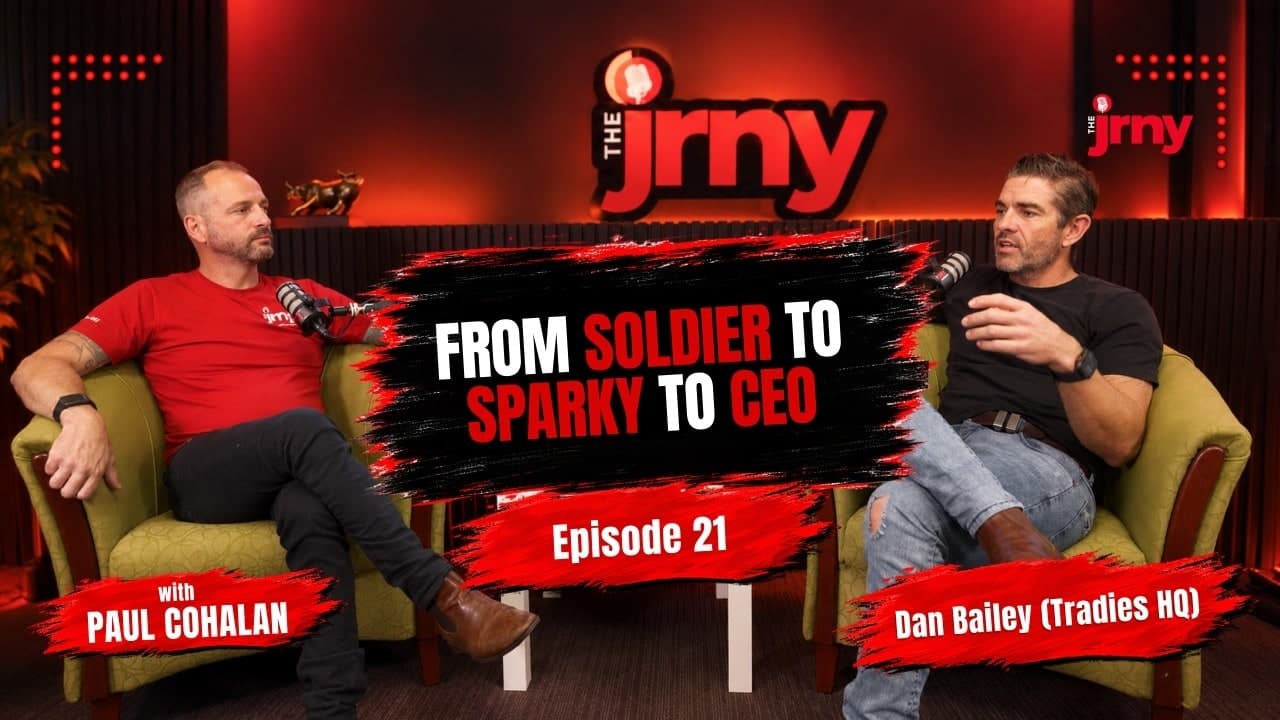
Meet Dan Bailey
Founder and director, Tradie HQ
Dan Bailey is an electrician and the founder and director of Tradie HQ, a co-working and incubator space for trade businesses in Osborne Park, Perth. He joined the Australian Army straight out of school and spent 11 years in logistics before leaving in 2008 to start a mature age electrical apprenticeship. As a qualified rope access technician he became the only abseiling electrician in Perth, and the first contract for his own company was installing the BHP sign on Brookfield Place, a sign he has now installed three times. Tradie HQ opened during COVID after Dan found there was nowhere for a one man trade business to rent an office, a workshop bay and secure storage on flexible terms. He also works on remote standalone power systems in regional Western Australia and is vice chair of the Electrotechnology Training Institute, the parent of ECA WA and the College of Electrical Training. Dan is a father of twin boys and has coached them in T-ball and baseball since they were old enough to hold a bat.
Episode summary
In episode 21 of The JRNY podcast, Paul Cohalan sits down with Dan Bailey, the electrician behind Perth co-working space Tradie HQ. Dan joined the Australian Army at 17, straight out of school, because he wanted out of the classroom and wanted to see the country. Eleven years and eight interstate moves later he left for the same reasons he had joined: he was tired of being moved around and there was no room to build anything of his own. He and Paul, who served in the Navy, compare notes on what military discipline does for you and what it does to you, from the mates who never adjusted to civilian life to the habit of getting a hard, boring job done today because it has to be done.
Dan did not do his trade in the Army. He started a mature age electrical apprenticeship in 2009 through his dad's contracting business, did an industrial rope access course out of curiosity, and found himself the only abseiling sparky in Perth. When he started his own company the first job was hanging the BHP Billiton sign on the Brookfield Place tower, a structure never designed to carry a sign at all. He has installed all three versions of it since. The idea for Tradie HQ came from an informal arrangement between three one man electrical businesses who kept each other's shirts in the van so no job had to be turned down, a crowdfunded motorbike workshop he stumbled on in Melbourne, and the realisation that a tradie working from home has a garage full of stock, a trailer, and staff who know where their family lives. Tradie HQ opened in Osborne Park during COVID with private offices, a shared workshop, storage and parking for a ute with a ladder on the roof, and short notice terms so a business can try, grow and leave.
The back half of the conversation is about the man rather than the business. Dan was screened for ADHD as an adult, complete with his mum reading out a shoebox of old school reports, and Paul argues the impulsivity that comes with it is the reason Dan has built anything at all. Dan talks about coaching his twin boys' baseball teams and what that taught him about leading adults, about a school suspension and an assault on one of his sons at a yacht club, and about therapy, separation and the Jordan Peterson line he now tries to live by: treat yourself like someone you are responsible for helping.
Key takeaways
The reason you join is the reason you leave. Dan joined the Army to avoid more schooling and to see the country. Eleven years and eight interstate moves later he left because he wanted to settle somewhere on his own terms. He and Paul agree the discipline is the gift, and that not enough is done for people on the way out.
Read the rulebook better than the person enforcing it. Pulled up on parade for an uncreased collar, Dan quoted the Army's own dress standing orders back at his commanding officer, who conceded the point and told him to iron the creases in anyway. Dan says the habit of reading dense doctrine closely is exactly what later made him good at a heavily regulated trade.
Set the expectation, then be predictable. Both men land on the same word: expectation. Whether it is a handover, a scope of works or the morning routine with the kids, most failures trace back to a leader assuming the other person already knew. Be fair and approachable, but do not move the goalposts from one person to the next.
Speed over perfection, with a plan B already in your head. Dan credits military contingency planning for his fast decisions. He would rather start on a basic plan that might change than freeze trying to perfect one, because the worst case is rarely fatal. Paul says the same: the quick call usually has a night of thinking behind it that nobody sees.
Nobody drops the ball on purpose. Coaching kids' baseball, and later pitching for the senior side, Dan learned that shouting at a teammate who has just dropped a catch helps nobody. The same rule runs his crews now: assume the apprentice did not set out to wreck the job, work out what went wrong, and own your share if the scope was never made clear.
Treat yourself like someone you love. After years of therapy and a separation he takes responsibility for, Dan's closing rule is a Jordan Peterson line: ask what advice you would give a good friend in your position, and notice it is never to beat yourself up. Paul's version is to stop and give yourself some credit for the hard things you got through.
Resources mentioned
Transcript
Read the transcript
This transcript was generated automatically and lightly edited for readability. It may contain minor errors.
Dan Bailey: Even if it doesn't, right, like no one's going to die. What's the worst case scenario? Yeah, like you said, electrician by trade. Started my mature age apprenticeship in 2009 after being in the army for 11 years.
Paul Cohalan: Now, when I was married, I used to think were the majority, you know, regimented, organized and all that. What I learned people around you is we're the minority. The brand is. Your resilience today is built from the risk and the roadblocks that you took along the way.
Dan Bailey: You know, what I've found a lot of times when guys get out, especially after being in for a longer period of time than me, where they become semi institutionalized, is that they sort of throw their hands up in the air and go,.
Paul Cohalan: All right, so. And I'm pretty informal about this, man. There's no questions, nothing, as I don't know if I told you that the other day. So I've got Dan Bailey on from Tradie HQ. I always say I know everyone for five years. I don't know how long we've known each other. It's probably a bit longer, actually.
Dan Bailey: Yeah, I know. I mean, I think. I think we've definitely known each other since I started Tradie HQ.
Paul Cohalan: When was that?
Dan Bailey: That was at the beginning, December 2020.
Paul Cohalan: Okay, so six years. Yeah. Okay, cool.
Dan Bailey: Yeah, so. But I was trying to think about that last night. I can't remember how we actually met first. Who was through? Was it in the insurance game? Was it like. I think it might have been Doug? Eh, Doug Dragaskis, maybe?
Paul Cohalan: No, that was after. It was after I already knew you. And I go, oh, I know your insurance broker well because me and him still talk to this day, but we help each other out. And so Dan's. Dan's sparky by trade. Loves helping out people. Started Tradie HQ and incubator for Tradies. We're going to find out where it's at. I haven't spoke to Dan properly, probably for a year. I think you come over and give me a little bit of advice at the apartment about some sparky thing. It'd be good to catch up. We know each other. Probably more surface level than anything and a little bit of business, but hopefully we dig a bit deeper. He's got two boys and he's in a really good spot. Where do we start? All right, let's start with where we met. Tradie HQ, 2020. What inspired it? Let's start there. Yeah.
Dan Bailey: Right, so, yeah, like you said, electrician by trade. Started my Mature age, apprenticeship in 2009 after being in the army for 11 years.
Paul Cohalan: Yeah, that's right. Yeah. It's defense.
Dan Bailey: Yeah. So, yeah, joined the army straight out of school and so did that for 11 years. And then ironically, when I wanted to get out of the army, it was for the same reason that I wanted to join. So I wanted to join because. Well, A, I didn't really want to do any more schooling and B, sort of, you know, travel around, see the world and the country and all that sort of stuff. But then by the time I'd done 11 years and moved into state eight times, I was like, sort of a little bit sick and tired of moving around. Now I wouldn't mind sort of. Yeah. Settling down somewhere and traveling on your own terms. Yeah, yeah, exactly. And I mean, that was the other thing as well. You know, inside of the Defence Force or I guess any sort government organization, there's very limited scope for any sort of. I, I wasn't even thinking about entrepreneurial things then. It was more about sort of, you know, you'll only ever be whatever the army or the military want you to be.
Paul Cohalan: Yeah, you know, talk that about it. I'm. I'm navy. Ex Navy. So we talk about that heaps, especially being out, you reflect on it and you really understand the box you're in and what they make you.
Dan Bailey: Yeah, that's right. And I mean, you just, you get a little bit tired of sort of seeing people, you know, ascend to leadership roles and otherwise a lot of the time through pure attrition. Right. Like one person drops off and then it's slightly look around and like, oh, you'll do.
Paul Cohalan: Yeah.
Dan Bailey: And that person is unworthy of being in that position. That said, you know, like, part of being in the military Defense Force, the best part I've found is that, you know, you are exposed to a whole raft of leaders of different caliber and structure and yeah, it gives you the opportunity to sort of, I guess, emul the ones that you like. And then, you know, the ones that you didn't like look at that and go, I don't ever want to be that sort of person, you know, so.
Paul Cohalan: It was part of the reason I got out as well. And I remember going in, my stepdad wanted me to get in heaps, like that was their thing, the safe bet, you know, go and defend to learn discipline, even if you only stay short period. But it's the same thing you, I think, want to get in because of the structure and the discipline and all that stuff. And it's the same reason you want to get out and the qualifications, and I'll ask you in a sec is that's probably the most disappointing thing. But I also understand it, like, they're not in there. It's not just about trades. It's about, you know, defending the country and all that kind of stuff. So did you do the Sparky in there and do an upgrade when you got out or were you something totally different?
Dan Bailey: No, I didn't. So I was in logistics while I was in the army.
Paul Cohalan: Oh, yeah. Okay.
Dan Bailey: And I did at the end there, I did consider doing my apprenticeship or, you know, doing my trade in the Defence Force because I think it was around maybe, I don't know, maybe early 2000s, where the ADF actually became an RTO itself. So.
Paul Cohalan: Is that right?
Dan Bailey: Yeah.
Paul Cohalan: Okay. Yeah.
Dan Bailey: So any training that was taken on within the Defence Force actually did marry up with the sort of national framework.
Paul Cohalan: Yep.
Dan Bailey: And the units of competency.
Paul Cohalan: But, you know, still not perfect, though.
Dan Bailey: No, no. Typically standard army, it's like. Or Defence Force would be like, well, yeah, here is 65%. You know, you're still gonna have to do some form of bridging once you get out in order to be qualified. So. But no. So when I considered that there was, you know, the return of service obl, if the Defence Force put you through some form of training, depending on what it is. Yeah, they want you to sort of, you know, they want to get their monies back out of you sort of thing. And so for an electrician at the time, I think it was about four years, so. And then there's a reduction in rank from sergeant to probably craftsman, which is like the equivalent of a private in RAEME, as it's called, the Corps, which I wasn't too concerned about, that would have been fine. But I really didn't want to, you know, have to do another 18 months of training, then another four years return of service obligation. So my dad at the time was part owner of an electrical contracting business here. So I, yeah, got out and started my mature age apprenticeship. So. But it's funny what you say about discipline and that's something that I, you know, people say a lot. They're like, oh, you're ex military, you must be disciplined and that. And it's like, well, certain areas, yeah, I like to think that I am. But the other side of that is that loose unit. What's that? Loose unit? Yeah, yeah. Well, that's right. And I mean the other extreme, isn't it? Everyone was always sort of surprised, is it when I said I was going to join the army as a kid because I had long hair and you know, I typically was relatively anti authority. So as much change there? Not really. Not really. I just become a little bit more, I guess, selective in the authorities that I choose to.
Paul Cohalan: How old are you now?
Dan Bailey: 45. Be 46 this year.
Paul Cohalan: Okay, so you're a couple of years older than me.
Dan Bailey: Yeah, yeah. So. But yeah, on the discipline piece, it's. Whilst you're in the Defence Force, it's an enforced discipline.
Paul Cohalan: Right.
Dan Bailey: You know, there's fairly strict rules. There are fairly. Can be fairly severe consequences for breaking those rules. So, you know what I've found a lot of times when guys get out, especially after being in for a longer period of time than me, where they become semi institutionalised, is that they sort of throw their hands up in the air and go, not gonna shave for three years. I'm a sleepy beard. Yeah. And that's where they struggle to sort of assimilate back into society, I guess. And I think that's where a lot of the problems come around. Reintegration and you know, finding their sort of, I guess, purpose in life again now that they're outside of this little.
Paul Cohalan: Yeah.
Dan Bailey: Comfort bubble.
Paul Cohalan: So just on that, like I remember in the Navy, like how many the old Chiefs and POS that joined from 17, 18. Like I was 22, 21, 22. They get out, they don't know what to do. They go back in. Yeah. Or they go to the cops. Yeah, yeah, either one. And I think the same happened in the army heaps.
Dan Bailey: Yeah. And I mean, that was another reason why I wanted to get out of that point too, because I had seen mates do that, you know, like they had, you know, get to a rank of, say, warren officer, where everyone calls you sir and all that sort of stuff and you've got this sort of standing. And then they go out in this. In this civilian world and they really struggle with not having that sort of authority. Authority, yeah, granted authority. Right. Because they go out of this system. Yes, it's a meritocracy to a degree, but like I said, some people do attain that position.
Paul Cohalan: Yep.
Dan Bailey: Purely through attrition.
Paul Cohalan: So on that, Right. Like I, I think me and you're a bit similar. Like rules are there to be broken sometimes and you've got to be more selective when you're older. I can be that extreme. But I also like the regimen And I love the training. Get up at 4 on the 3:30 in the morning. You know, like from all the way from recruit school. The, the bit that used to blow my mind and actually why I wanted to get out is I didn't travel enough. Just that was timing, you know, going in a refit in the ship and that. But like when chiefs and like woes and all that they would not just have the authority but that's all they knew. So they leverage on it, they treat you like a dick on it. I don't know how else to say. I think this is where you're going with it, right. They get put there, been there forever, just follow the process. They actually don't know the real world. Do you know what I mean? Like they actually would not be able to walk out in the real world. And it happened heaps. And I actually feel sorry for him now looking back on it being older, but it's like I wish I had a different mindset in there. In the end I got out four and a half years instead of six because I'm like, I can't stay in here because my brain just goes too much. And I'm like, when people play on authority, it's like you must go home and get told what to do.
Dan Bailey: Yeah, yeah, that's right. And it's, yeah, it's. So that does actually lead into another. I guess, strangely enough, it was a, a good skill. I suppose so. You know, defense forces, you know, are highly doctrinal. Right. So there's a manual or there's a book or there's some form of guidance for basically every single task that you're ever going to do, whether it's an SOP or just not people skills. No, no, that's right. But, so what I found is that because my conduct record was fairly substantial, let's say by the time I got out and so I want at least one story. Yeah, I've got a pretty good one. And so, but what that meant was, so I, I, I did a lot of reading on all these sort of, on all this doctrine and you know, the army standing Order for dress and all these other bits and pieces.
Paul Cohalan: Yeah, and, but is that so you can manipulate it?
Dan Bailey: Yes, it was purely to exploit loopholes. Right.
Paul Cohalan: Yeah.
Dan Bailey: And it used to superiors to tears because, you know, to be like a classic example. Okay. So the army standing order for dress states that the camouflage uniform that we used to wear was not to be, there were to be no creases ironed into that uniform. That. That was what it stated, you know, as opposed to, like, your. Your ceremonial dress, you know, you got creased arms and bloody.
Paul Cohalan: No train tracks.
Dan Bailey: No train tracks. So one day and I. I picked this up. So one day I've turned up to morning parade and my collar was not ironed and I got pulled up for it and I said, oh, well, sir, army standing orders for dress state that there are to be no creases ironed into the uniform. And he just stood there looking at me. I was like, this is going to kill me.
Paul Cohalan: Yeah, yeah, you wait till later.
Dan Bailey: Yeah. He's like, we'll speak about this afterwards. It's like.
Paul Cohalan: It's like Mum going, you wait till dad gets home.
Dan Bailey: Yeah. And he pulled me into his office and he's like, what was. What was the point of doing that? I was like, no, I didn't mean there's any disrespect, sir. It's just. It's just the rules. Like, they're the rules that it says there's no creases. And he's like. He goes, unfortunately, I think you're actually right. He said, however, I know I'm right.
Paul Cohalan: Because I read it 10 times.
Dan Bailey: And he's like, however, tomorrow morning you will have ironed your collar, won't you? I'm like, yes, sir, I will. And so you know that. That sort of skill.
Paul Cohalan: So, hang on a sec. So four days prior, what'd you get your ass kicked for? Like, what triggered you to go and do that?
Dan Bailey: Oh, no. So I just sort of. It was for something else. It was something. It was some other thing that I'd been pulled up for. And so I'm reading through it all and I'm like, I was. I was in the wrong in that. In that particular. But then as I'm reading through it, and I think it was like the next morning when I started ironing my uniform because I still had to iron crease wrinkles out of it, I was like, thinking, why am I ironing this crease in my collar when I'm. I'm ordered explicitly not to, like, that ability, I guess, to sort of read these, you know, boring doctrine and be able to sort of interpret it and sort of maybe even think a little bit sort of outside of the box about it. So it helped me sort of further on in my new career as an electrician, because, again, you know, it's highly legislated, there's standards you need to abide by and that sort of thing. But there's also this scenario where you Know, because it changes. They change almost every year, if not more than once a year. You know, you always get like the old electrician saying, we can't do that. You know, you should be. And it's like, well no mate, that was in Australian standards. 85. Yeah, things have changed. And so then it's. Yeah, that was one thing that I found I was pretty good at is reading these standards and because they are sometimes hard to read, there's particular language and that sort of stuff.
Paul Cohalan: Well, that's what causes issues, right, like in trades and stuff like that. Like you took the words out of my mouth. Like I was going to say, like obviously the journey's risk. roadblocks and resilience and like how something back then didn't matter so much. It was more of a smart ass, probably antic. And then these days it's your strength. Right. And it's the same. We look at our kids and stuff like that and like insurance policies, electrical regulation, legislation, you know, or you know, whatever it is. And I believe you're on the. Are you on the board of one of the. Or were.
Dan Bailey: Yeah, yeah. So I still am the vice chair of what's now called ETI. So it used to be ECA WA and we used to have a partnership with an organization called NECA, which a lot of people would probably recognize more now. ETI, the Electrotechnology Training Institute.
Paul Cohalan: Yep.
Dan Bailey: So we are a $50 million charity, not for profit charity.
Paul Cohalan: Yep. Fantastic.
Dan Bailey: And so underneath the umbrella of ETI we've got ECA WA, which is like our member services arm, CET, which is the College of Electrical Training. So we train, you know, two and a half thousand electrical apprentices each year.
Paul Cohalan: It's amazing.
Dan Bailey: And then we've got ECA Legal and then we've also got equipsafe, which is a high risk RTO for like, you know, scissor lifts and safe worker heights.
Paul Cohalan: Yeah, because that'd be the most common that you guys use equipment.
Dan Bailey: Yeah. And that's one of. And that's why we bought the. The company. So it was an existing company and we bought it probably three years ago. And the main reason for it was, you know, were seeing. We've also got egt, which is like the gto. So we've got a pool of apprentices that we basically sub out.
Paul Cohalan: I've seen that egt.
Dan Bailey: Yeah, yeah. And so we bought Equip-Safe because were, you know, on the books. We were seeing that were spending so much money training our apprentices in those skills, like, you know, scissor lift, VOCs, EWP training and that sort of stuff. And so we thought, well, if we acquire this business, then we can do all that training in house and just have it as an intercompany invoice. And then we can also offer our services to other organizations and people. And so one of the things that we developed was something called the orange card, which is. It's basically a combined VOC for scissor lift and EWP, which, you know, they are the two main things that as an apprentice, if you've already got those skills, it sort of puts you in a good position. But we've also got funding from the construction training fund, ctf, so there's a lot of fee, free training that can go on there for eligible apprentices in the construction industry.
Paul Cohalan: So. Yeah, awesome. Well, let's come back to that because it'll come off the back of the Tradie thing as well. But just back to the defense. So how long were you in?
Dan Bailey: 11 Years.
Paul Cohalan: Oh, you're in 11 years where you've done a good stint, which is. It's a. I think we need more people like that and longer. Like, it didn't suit me in the end. And, you know, like, you got out for the same reasons you got in, which is. And I think that happens a lot, to be honest. And it's like in business, I always talk about this. Your strength becomes your weakness. And I think it's. It's a bit similar. Like you went in to do the travel and do all that stuff, but then obviously you traveled interstate and moved around so much, then you want to get out and see the rest of the world, but in more of a civilian. Civilian way. What's. So what year did you get into the army?
Dan Bailey: So I joined in on March 23, 1998.
Paul Cohalan: Oh, no, no, you're already in when I was in. Yeah. Before 2000 and then. So it would have been 2009, roughly.
Dan Bailey: Yeah. So the end of 2008 was sort of. I marched out of the last.
Paul Cohalan: You've done the mature age, Sparky. So in. In the army before we move on from that. So what else is the big learnings like? And there's no disrespect to defense here. Right. It's. It's evolution with the Army, Air Force. Well, let the Air Force out. Navy and Air Force. Right. And I actually want to join the Air Force originally, but joined the Navy. So there's no disrespect there at all because there's a big place for it and I think the discipline and all that is really good. But I have a lot of mates now that struggle getting out and they're in really bad spots and I think, I still don't think, I think it's so far from, and I don't know these days if people get out, but I still think it's so far from helping people get out. Now when I was married I used to think were the majority, you know, regimented, organized and all that. What I learned off my ex wife and just people around you is where the minority, you know what I mean? Like being regimented and all that kind of stuff because they, and like emotions or being blunt like you just, you're put in this bucket, right. And that's the way you're trained, right?
Dan Bailey: Yeah, it's, I guess that it's, it is a double edged sword. I guess that's sort of where you're going because.
Paul Cohalan: Yeah, it is.
Dan Bailey: The thing that I sort of, I guess developed in the defense force was you know, you might have something hard to do or there might be a task that needs to be done that you know, is boring, repetitive, hard. But at the end of the day it's got to be done right. And you do it and so you just got to do it and,.
Paul Cohalan: And, and you don't just touching on what you just said. Like when you're in there's not much that beats you up. But then get let out, get with a bunch of lads or whatever, it's extreme, right? It's this yo, like you said before, like being regimented then get, I mean get out of the defense and you go nuts. But even when you're in and you just get let off base.
Dan Bailey: Yeah. It's the whole work hard, play hard thing, right?
Paul Cohalan: Oh, bang on. I used to say it all the time. I don't say it anymore because I don't want it to be in my head because you know we're trying to get this to level out to this when you get older.
Dan Bailey: Yeah, yeah, that's right. And so, but yeah, I mean that's it is that work hard, play hard. And so, you know that is something that, and what it does is it really takes the emotion out of everything. The good thing or the thing that sort of helps deal with that when you're in the defense wars is you're surrounded by a bunch of people in the same position. Right?
Paul Cohalan: Yeah.
Dan Bailey: No one has the opportunity to Go. I think this is a psychosocial hazard. Here's my. I mean, you probably can now in the Defense Force because it's changed a lot, right? Like, there's a lot of going on now to the point where I like, people ask me, would you know, would you encourage your boys to join the Defence Force? And, and now I, I say not because, you know, there's just too much PC that's infiltrated into it. And, and I think if there's any profession on the planet where they should be exempt from some of this narrative and PC sort of stuff, like, I think it should be the Defense Force. Like at the end of the day, if you're getting on a battlefield, right? Like, and you've misnamed someone's pronouns, like.
Paul Cohalan: Who gives a. Yeah, that's right.
Dan Bailey: It's like mate.
Paul Cohalan: I remember we. And it was probably crossing the line a bit. Something happened in recruit school a few days before pass out and I nearly got kicked out just a few days before pass out. And like always aced everything. Probably like you always good at everything. But work, play hard and then like we're around and then like someone whinged about and I shouldn't say winged you let us say that. But I actually don't give a. But like there was a complaint and I'm like, I would not want him to hold it F88 sty beside me and we're going to war. Hang on, hang on. Like you'd probably shoot them first and then go. Because otherwise you'd be in deep. You know what I mean? Like, and I mean that like, figure of speech. And it's like, we got, we're getting trained to go to war. We get up to 3:30 in the morning, we're getting, you know, no sleep, you know, and that was recruit school. Go on the ship, same thing. You know, you do all this training out in the waxer. Same thing, right? And you're like. And then, but then we go to the other extreme and it's like, it's all about I. I love being a kind person and all that kind of stuff. But it's also environment and timing, right?
Dan Bailey: No 100%. And so, you know, but what, you know, invariably what that does, like I say, is it is, it takes the emotion away from things. And so it is one of those things. And I, I mean, I still do it to this day. And it takes a little bit of effort to sort of understand the environment and realize that, you know, in Some instances or in a lot of instances, people, you know, can see, I guess maybe a lack of emotion as being cold or heartless or whatever. But, you know, I still, to this day, even when, you know, in the job that I do now, if we work away and that sort of stuff, you know, like it's hard, you know, working in Pilbara or Kimberley heat or Esperance cold and it's like, if it's raining or it's hot and. Yeah, but it's like you've got a job to do. By all means, of course we'll manage it. You know, I'm not expecting.
Paul Cohalan: Be safe and all that stuff.
Dan Bailey: Dig holes for eight hours a day in 42 degree humidity.
Paul Cohalan: Yeah.
Dan Bailey: You know, we'll take breaks and that sort of stuff. But, you know, there's no point in sitting down and getting upset about it.
Paul Cohalan: Yeah.
Dan Bailey: And. And similarly, like, I understand that everyone's got a different threshold too, so always manage that and make sure that, you know, because the last thing I want is someone to feel as though they can't approach me.
Paul Cohalan: Yeah. Right.
Dan Bailey: Like I want someone to come to me if a problem or they're having a hard time. But on the same token, you know, we're there as a small team. Everyone's got to pitch in and get the job done. Otherwise it's unfair on everyone else too. So, so yeah, I guess that sort of work ethic and the, and just the mindset of like, well, it's gotta be done.
Paul Cohalan: So you'll find I, I reckon I get and I think once again, me and you're similar in certain ways. You can upset people really quickly also. But if you're the person that's pretty forward and doesn't beat around the bush and put things under the rug, you'll find we're more approachable than most because it's like, just come tell me how you feel. Go Paul down. I can't do this, or I don't feel. Or. And you'll be like, you'll have more empathy than probably most people that tread around on eggshells. If. Does that make sense?
Dan Bailey: Yeah, yeah. 100. And that's. I think, I think that's what, you know, the guys who work for me now understand.
Paul Cohalan: Yeah.
Dan Bailey: You know, like, they know that if they're having a hard time, they can come to me because I am.
Paul Cohalan: And you'll back them 300, 100.
Dan Bailey: Yeah. And you know, I say to the, like, the new Guys, the new young guys especially, you know, I'll say to them, you know, when you're working away, because I know they're like, you know, I'm not always there. I might be, you know, observing from Perth or whatever.
Paul Cohalan: Yeah.
Dan Bailey: But I say to them, if it's their first or second or third triple or any trip away, really, where someone gets into a position where they might need to come home, but they don't necessarily want to tell their supervisor, we'll give me a ring. I'll get you back home. And it. And I'll make sure that it's never disclosed that the reason why you wanted to come home. I'll just say you've got some training or something, and I'll arrange a flight and I'll get you back, you know, so.
Paul Cohalan: And even, like, in business, man, like, you know, some days, like, you'd be a hard taskmaster. I'd use them words, right. Like. But it's like, also, if it's family, if it's the opposite, I'll also kick my team's ass and go, you're going home now. You're not coming to work. Like, when you like that. Yeah. Even all the way through. Right. It's fair. Draw the line in the sand, you know, like, there's nothing beats health and then family. And, you know, we both know this. Having kids and separation, all that kind of stuff. And that's what you try and get that point across to people. And it's about being fair and being really supportive. But also when. When you've got to dig your heels in and get the done, it's.
Dan Bailey: Yeah, it's about being predictable.
Paul Cohalan: Right.
Dan Bailey: Like, you want people to know where the boundaries are and sort of what the expectations are and that sort of stuff. Because if that's constantly changing, you know, if you're always changing the goalposts or you're changing the way that you react to certain things, subject to, you know, the person or whatever, like, it makes it hard. Makes it hard for them. Makes it hard for you know, and, like, you say the last thing you want, and I mean, like you said, we're both acutely aware of this now, is you don't want someone being distracted by things that are going on back home or elsewhere.
Paul Cohalan: It's unsafe. And mentally, it's not good for them or. Or us or the people around them. It's not fair. Just that word expectation, I don't think it gets talked about enough. Expectation, Right. It's nearly the problem, the lack of expectation or the Lack of the word nearly in most circumstances from leadership, management or having your kids like think about it, right? If you set the expectation, whether it's in the morning with the kids the night before, whether it's, you walk in the morning, whether it's hand over a project or go to a scope of works on a job up north, if you set the expectation, it changes the whole game. And I don't think we talk about that enough because we go in and we assume sometimes as leaders that people know what they're doing. And just because, you know, it automatically doesn't mean the guy over there knows it automatically. And it's the same with the kids are the worst because they just do what they want because they're still learning, right. Evolving. But you set the expectation. I think that's really important. Word and action.
Dan Bailey: Yeah, for sure. I mean, and tying in with that, another thing that I've come to realize is, and it's completely different from again, being in the Defense Force, you know, the doctrinal means of training people. You know, it's the whole demonstrate, explain, teach. I can't even remember the act. Yeah, but it's there, right? And it's like, this is how we do our training. Because I remember doing my subject courses for different promotions to different ranks. And I remember it was like, I can't remember whether it was a drill or it might have been a weapons lesson or something. I remember saying to one of the other course members who was a, an ex recruit instructor, and I was like, why can't we teach it like this, like a different way? It's like, no, that's not how it's done. I'm like, okay, no worries. Because it just seemed like a bit more logical to do it in a different order. And so, but then as when I got out of the army and started sort of, you know, teaching more and being exposed to different people and different, I guess, learning styles in an environment whereby it's not forced upon you. I came to realize that there's, there are so many different ways that different people will observe something and learn, right. Some people, you know, they'll need it written down on a bit of paper. They'll need step by step instructions and that sort of thing. Other people, you can give what we would have called in the Defense Force, the commander's intent. You know, I'm like, right, I want this house wired as an example. And they're like, sick, yeah, no worries. I know how to do that, and they'll run through it in their logical process, whereas, you know, the next guy will need step by step instructions and a little bit of a handhold. Doesn't mean one person's better than the other. It just means that, yeah, as the leader or as the sort of supervisor, foreman, whatever, you need to appreciate the fact that other different people need different degrees of tuition or guidance in order to achieve the income.
Paul Cohalan: So, you know, that makes me think of. And it's like the world wouldn't go around without different people. Right. Like, and you, I think you learn that over time. When you're young, you're like, why don't you do it this way? And that's probably the way were taught by our parents and whatever else. But I always, I got told something once and it's like, if you're in a building, you look down at a car park, what do you see in a car park? What do you see?
Dan Bailey: Cars.
Paul Cohalan: Yep. What's. What's the key factor? The difference colors, different types makes everything right. And like, it always resonates with me. It's really simple. But it's like, we don't all go to the same make and model, same color. We. There's different people in the world. Right. And it's actually, when you look at it like that, it's like, it's exciting. It's like when, like, I remember running the workshop and you do this too, even if an apprentice or third year in come up and give you an idea and that, it's like, don't dismiss them. Like the old school would dismiss them. Go do it the way I said, you know, go back to the whole command thing. But it's like, everyone's got wicked views and they could be looking at it. Things evolve.
Dan Bailey: Yeah. 100%. Yeah. And that is.
Paul Cohalan: You'd see this more than I would. Yeah.
Dan Bailey: And I, And I say that all the time to the apprentices and then. And to the tradesmen as well, you know, like, and don't get me wrong, there are times where it's like, you need to say, do I appreciate your input? And, you know, but trust me, I know this is the way for this particular task that we need to get.
Paul Cohalan: And it's probably risk, it's probably safety, it's probably, you know, and just experience,.
Dan Bailey: You know, you can't learn experience. But like, you say 100%. There's been plenty of occasions where, you know, that and I. It's almost contradicting What I said, but earlier about, you know, the older tradesmen saying, oh, this is how we've always done it.
Paul Cohalan: There's still experience.
Dan Bailey: Yeah, yeah. And then the other thing is, you know, that objective sort of, I guess, inexperienced perspective on a particular task or something can actually bring about a potential different way of doing it. You know, it's like.
Paul Cohalan: Yeah.
Dan Bailey: And it's just in the delivery as well. It's like, oh, you know, Dan, what if we do it like this? Yeah.
Paul Cohalan: Right.
Dan Bailey: Well, let's have. Let's have a chat about that. You know, like, let's. Let's think about it. And, you know, a lot of the time I. I would much rather have someone come to me with an idea or a way of doing something and then let them run with it. Right. Because it gives them ownership, you know, and then they sort of have that sort of intrinsic motivation of like, I come up with this idea and Dan's decided to roll with it. Now it's sort of on me to make sure that it works. But in the same token, you know, I've. I've always been a big believer in like. And I was thinking about this on the way here because I. I will talk about my impulsivity, but, like, not. Not getting caught up in, like, that being sort of frozen because you can't make a decision.
Paul Cohalan: Yeah.
Dan Bailey: I'd much rather make a decision. And a. And a basic plan with the understanding that might need to change.
Paul Cohalan: Yeah.
Dan Bailey: And then. And then start.
Paul Cohalan: Yep.
Dan Bailey: You know, speech.
Paul Cohalan: Trans. Perfection.
Dan Bailey: Yeah. Yeah. And then, you know, like, Tracy, my partners. I can't remember the exact sort of quote, but it's around the line of, like, don't aim for perfection.
Paul Cohalan: Yep.
Dan Bailey: Because 80 is going to be good enough.
Paul Cohalan: Yep. You know, and then you. The sooner you give it a crap, mate. I talk about this all the time. And I'm. And we're very similar. Like, I make quick decisions, but just on that. Also, people don't realize I probably spent last night thinking about it and being patient, like, you know.
Dan Bailey: Yeah, yeah.
Paul Cohalan: They don't realize this because my head goes so fast and I've got so many thoughts and. And in a good way, when I go and make decisions, it's you. You know, you've already probably put somebody behind it. Right. But if you sat on it and you've got to read it and you've got to be thorough and try and perfect it, you'll never get. And we all do that as well. I think I've learned from doing that, you know, whether it's procrastination, sitting on it, scared, whatnot. But I always say speed, trans. Perfection. That's. And I think that's.
Dan Bailey: Yeah, definitely. And I think one. Another thing that sort of. And you know, I'm almost 100% sure that this came from your military experience too, is that, you know, when you are planning something from a military or you know, an operational perspective, part of that planning process is always contingency planning. Right.
Paul Cohalan: Plan BC in your head.
Dan Bailey: And, and that's. And that is what helps you make. Make fast decisions, right? Because like you say whether it occurred the night before the drive out site or. Or even on the spot, you know, you're like, right, okay, well let's just do this. And in your mind, you know, like, if this doesn't work, then we can do that. Now you might.
Paul Cohalan: You don't tell anyone that.
Dan Bailey: No, no, no. And so then, you know what people.
Paul Cohalan: See is like, oh, I spoke about this yesterday. No. Yeah, with my ea. I'm like, you don't realize. Sorry to buddy. But it's so funny how it comes up. It's like I, like, I'll make decision and I'll be like, hey, Nat, you know that the thing over the last seven days is about two, three things, like business stuff. And I'm like, I already had. If this didn't go ahead. Even my daughter's 13th birthday party, we had like four or five things at a piece together. I'm like, I already knew in my head if that doesn't happen, that will go plan B. Like, you just constantly like it. You don't tell anyone and they're like, what if it doesn't happen? Like just. I'm like, no, I've been thinking about this for three days.
Dan Bailey: Yeah, that's right. And then do you just have the mentality of like, well, look, even if it doesn't, right, like no one's gonna die. What's. What's the worst case scenario?
Paul Cohalan: So much alike. So I book an accommodation and travel, right? Everyone freaks out and books four weeks ahead. I'm like, I'm booking as I'm learning. Like, there's always a place these days. Like tech, all the little things.
Dan Bailey: Yeah.
Paul Cohalan: People get caught up on it. It's like, that's right.
Dan Bailey: And I mean it's. And it's not the end of the world, right? Like, even if you have to sleep at an airport, like, what's so. What end?
Paul Cohalan: Yeah, yeah, I'll laugh about it and joke with the lads a week later. Like.
Dan Bailey: Yeah, it's. It'll make a good story. Yeah.
Paul Cohalan: So. So just on that, something I want to jump back to is. So how old were you in 98 when you joined the army?
Dan Bailey: 17. So you're born in 17 and where were you born? Four months in Perth. Yeah, Subiaco.
Paul Cohalan: Oh, she grew up here.
Dan Bailey: Yeah, right here. Born and bred.
Paul Cohalan: Yeah, we're in Subiaco right here. This is your backyard.
Dan Bailey: That's it.
Paul Cohalan: So tell us a little bit about your upbringing if. If you want.
Dan Bailey: Yeah. Mum, dad, together, sort of standard. Yeah, yeah. Mum and dad. Mum and dad are still. Actually. They just had their 50th wedding anniversary.
Paul Cohalan: Fucking boom.
Dan Bailey: Mum and dad, Kevin Lynn.
Paul Cohalan: Good job. Not that. Not that. Doesn't happen that often. Especially more and more these days. Right. And you know what? Fucking my marriage didn't work out and I'm cool with that also, but I really appreciate and envy like 50. Oh yeah, me 50 years. Yeah. With each other.
Dan Bailey: I know, I know.
Paul Cohalan: And I could only imagine the apple doesn't fall far from the tree. Poor mum.
Dan Bailey: Yeah, yeah, that's right. But yeah, no, you're right, it is. I said. I think I actually wrote that in. In their card, you know, like that they're an inspiration because.
Paul Cohalan: Huge.
Dan Bailey: You know, it's same with like Tracy's parents. They've been together for. Yeah. Probably longer than that, I think. And so, yeah, it is. It is an inspiration. And you know, I guess, you know, on the same token as well, it sort of creates a bit of guilt for. For me, you know, same. Same having. Having separated.
Paul Cohalan: Yep.
Dan Bailey: But again, at the end of the day, no one died. And it's. It is what it is.
Paul Cohalan: Hey, whatever. Our journey is our book and our chapters. It's there our cards that are dealt and when you realize that and let go of it and you know, because the guilt thing's huge and like me and you spoke a couple of times. It's like that shame or that, hey, that father was a good dad, was a good husband. You know, no matter whose fault what when you split, it's like. But in the end it's like, okay, that's my journey. Fucking move on next.
Dan Bailey: Yeah, that's right. And I'm a. A firm believer as well that, you know, and I think it was. I think it's a Jordan Peterson quote. Right. And it's assume ignorance before malevolent.
Paul Cohalan: Wow, I haven't heard that before. No.
Dan Bailey: So it's pretty good. You know, and I. I think about that in terms of, you know, because I've, you know, I do sort of weekly therapy with a shrink and that sort of thing. And, you know, I've gone through periods of my life where I've been a pretty angry person and.
Paul Cohalan: Thanks for sharing.
Dan Bailey: Yeah. You know, like, you might. I don't know, road rage is one thing. Or, you know, someone walking out in front of you when you. When you're driving the car. Yeah. And typically. Or, you know, in the past, I'd be irate and sort of not necessarily like, beep the horn or anything like that, but just in my own mind and be like, what the are you doing? You know, you idiot. And then. But after hearing that quote from Jordan and. And sort of what he was talking about around it's like, well, if you put it into perspective, you know, that person may very well have just lost someone close to them, and so they're not really paying attention. You know, they didn't. They didn't walk out into the middle of the street with the intention of upsetting you. You know, it wasn't malevolence, it was. It was ignorance to a degree, but that ignorance was sort of influenced by whatever they're going through.
Paul Cohalan: And you'll never know.
Dan Bailey: You never know.
Paul Cohalan: Right.
Dan Bailey: And so if you do start beeping the horn and that, like, next thing you know, this poor bastard who's going through a hard times, like, that's just what I need, you know, and when you think.
Paul Cohalan: When you learn to think like that. And I reckon it was probably last Friday with V, a friend of mine, she was on here. Right. Hasn't launched yet. We spoke about this, the road rage piece, and it's like, it was probably just say eight years. I remember getting with my wife and having road rage merging wa coming out. But then I reflect and I'm like, you never know. They could be running late for work. They could have a death in the family. They could edit their kids. And it's like, what's 20 seconds on us anyway? Like.
Dan Bailey: Yeah. And if you apply exactly what I just said, then, like, no one's dying, right? Like, so chill out.
Paul Cohalan: Yeah.
Dan Bailey: For you.
Paul Cohalan: Yeah. It's like, whoa.
Dan Bailey: Another thing that sort of cemented that for me, like. So I've always coached my kids in. In baseball and T ball.
Paul Cohalan: Yeah, yeah.
Dan Bailey: So I played that as a kid growing up. And then fortunately, the place where we're living in Stirling was right next to my baseball club, Balcatta. And so when the boys were old enough for T-ball, they joined there. And I've coached them how old Were.
Paul Cohalan: You when you played. Would you. How old were you when you started playing this back to the childhood stuff?
Dan Bailey: Oh, yeah. So, yeah, I think T ball was like my first summer sport.
Paul Cohalan: That's the thing with the.
Dan Bailey: Yeah. The tee, the ball on the stand.
Paul Cohalan: Baseball and T ball, isn't it?
Dan Bailey: Yeah, yeah. And then, and then, so then played baseball, I think up until I was about 15, 16, just before I joined the army.
Paul Cohalan: Yeah. Oh, did you? Yeah, a few years there. Yeah.
Dan Bailey: Yep.
Paul Cohalan: You're right into it.
Dan Bailey: Yeah. And so. But what I sort of learned in coaching kids, which for anyone out there, like coaching kids sport is a great leadership development tool, I think.
Paul Cohalan: Yep.
Dan Bailey: Because you know, you've got these people there that you can't scream at, you can't shout out, you know, like. And, and you sort of realize none of these kids woke up in the morning and thought, you know what I might do today? I might go out there and drop every fucking ball that's hit to me. Yeah, you might strike out at every at bat. And, and you know, every time I go out to the field, I'm not going to listen to Dan to where I'm playing and I'm going to go somewhere else. Dan not going to take my glove. You know, like, that's not what I woke up and thought, you know, it's just something that happened and then, and that even. Cause then I, when the boys started playing again, I reinvigorated the senior baseball team at the club. So then I started playing myself again.
Paul Cohalan: Oh, good.
Dan Bailey: And coaching that good team.
Paul Cohalan: How good?
Dan Bailey: And then. So, but what we'd have is like, you know, as a pitcher, because I'm a pitcher and it's a pretty high stress position in the baseball field really, you know, like, especially on yourself. Like if you're having a bad day and you're throwing and then like people are dropping the ball in the outfield, it's like, kill me now. Yeah, like, what else?
Paul Cohalan: When's tomorrow coming? Yeah, yeah.
Dan Bailey: And we'd have, you know, some of our other pitches, you know, if someone dropped a ball in the outfield, they'd berate that player from the mound, you know. Oh, and that was another thing that cemented it to me. Like I end up having a chat to this one particular bloke off to the side. I was like, man, like, do you think old mate went out there today with the sole intention of dropping a ball online? And, and obviously he didn't. And I said, do you think that, like, you shouting at him from there, he's going to help him next time? Like, he's already beaten himself up because.
Paul Cohalan: He's dropped a fuck with worse that you start hearing people, ain't you?
Dan Bailey: Yeah. So he's not, it's not like he's out there, like, proud of himself because he accidentally dropped a catch, you know, so you shouting at him from here is not going to help him perform in the next time a ball comes out to him. Right.
Paul Cohalan: And, and what? You're. Let's flip that in a sec. I, I think kids was my biggest learning. I managed since I was 25 years old or something. Right, People, leadership. Even in the Navy, you naturally take over when you're a leader, right? But then you get, I learned heaps from my kids. But then you do what you said. Now grab your stuff. Flip that into business now. Right? How's that? Like, I always jump back and forth here because everything's so related that it's unbelievable. Right? Where we're at, you know, 45, 43 in the workplace now, how much better a person are you understanding that whole piece? Exactly what you said. Hey, man, like, don't beat him up. Like, go back to 20 years, 30 years ago, our parents at work, digging a hole, being a sparky. Be like, yeah, that. Hold on, isn't it done yet? You know, like, harden up like, now. It's like you're having a bad day, dude. Like, it goes back to the kindness bit. Even though you're a firm guy, the expectation. Right. Supporting, but also got to get a job done.
Dan Bailey: Yeah, no, exactly. And that's, and that is 100% what I sort of carried through into my leadership style, I guess, is that, you know, you need to be of the understanding that again, John or Mary didn't come to work with the express intention of, like, job up that you'd given them.
Paul Cohalan: Yeah. And there's no nine to five now. You never know what they got in their head. You know, we're family men.
Dan Bailey: And then like, so then it falls on you as the supervisor, leader, whatever, to understand what went wrong, you know, and take ownership of that too, because, you know, if it comes down to the fact that sort of what, like I touched on before, they didn't understand what the actual scope was, well, then that falls on me as the person who told them what to do, because, you know, I didn't confirm with them that they understood it, you know, and don't get me Wrong. Sometimes people are just right.
Paul Cohalan: Well you do three things the same. You three things the same way again and again. I used to always say that in the workshop, hey, you can make as you can make mistakes, no problem. But do the same thing again. You're.
Dan Bailey: Yeah, yeah, that's right. Learn at least learn from your mistakes sort of thing. And so, yeah, so that's, yeah, definitely something that's carried through. Yeah. So, all right, back to my childhood. This, this whole add bloody interview session's gonna jump all over the place, isn't it?
Paul Cohalan: Yeah, yeah, it does a bit. It's good because what people don't realize going back to this, it's not about a topic or insurance or anything like that. It's like, why are you at where you are today? Right. And it's about picking these pieces up and I, I, I'm listening to you, but I'm all go. Also going that triggered from back then or. You know what I mean?
Dan Bailey: No, I'm down for it.
Paul Cohalan: So it's good. And, and it fills my cup a lot. And nearly every episode ends up like this and then they're like, I never thought about that. I haven't thought about that in 10 years. So yeah, so T ball into baseball. What were you like as a teenager? What was your things to do besides baseball?
Dan Bailey: So yeah. So baseball then. Footy. Footy in the winter. Oh yeah, sort of. Yeah. I was always like as a kid, school.
Paul Cohalan: Talk to me about school.
Dan Bailey: Oh yeah, well, school tone changes.
Paul Cohalan: Oh yeah, yeah.
Dan Bailey: Nah, look, I was. Oh, it's funny, I, I went through the whole ADHD sort of screening process as an adult. There was a point in time where the shrink wanted to have a teams meeting with me and my mum.
Paul Cohalan: Yep.
Dan Bailey: To sort of establish like sort of childhood sort of potential for having adhd. And we're there and I, I hadn't given my mum any sort of brief. In fact I forgot that it was even on. So fortunately she was available to sort of take the call at short notice. And so the psychologist, psychiatrist there and he's asking all these questions and she's answering them and I'm like, oh, this is a no brainer. And then he asked about like my reports and that sort of stuff. Mum's like, oh, hang on a sec, I've got them here somewhere.
Paul Cohalan: Oh, no way. Mum's got them.
Dan Bailey: Yeah. Mum races off into the study, brings out a bloody shoebox full of my report.
Paul Cohalan: Good on you, Mum.
Dan Bailey: She's reading through them. Like, Dan needs to pay more attention in class. Dan needs to stop distracting others. Dan needs to do this and that. And I was like, right? And he's like, okay, yeah, now that's enough. She goes, oh, no, there's another. I'm like, no, mum, that's it. I think, I think that's good.
Paul Cohalan: Shoebox is empty.
Dan Bailey: Yeah. So, yeah, I was that kid. And I mean a lot of the time it was because a lot of the subjects I found reasonably easy and so I'd sort of finish them or I'd understand them and then I'd just get bored and so then I'd be, you know, drawing or, you know, distracting others and that sort of stuff. And. And the funny thing is, you know, now I get all these reports from the kids school and I'm like, Jesus Christ, is this one of my reports?
Paul Cohalan: So I'm gonna, you know my take on this, right? And I love this is ADHD is a superpower. That's it. I don't even like title and I've never gone through a screening or anything and I won't undiagnosed. But let's reflect and give you a pat on the back for a sec. You've gone army, you've got out on your own accord. A lot of people can't. You've got out, you've gone and done an upgrade. Apprenticeship or not an upgrade, you've done a mature age, so you've done the whole thing again. Right. How many people wouldn't do that or have the nous to do that? You now, you went and started Tradie HQ help for other people, had an idea, made it happen, which we can touch on that in a minute actually, because we've gone through your childhood. You got beautiful parents, still together. Now you're a sparky, you're now, I think with another company.
Dan Bailey: Yeah. Yes, I'm contracting to CDI Energy. So we do sort of medium to large scale off grid standalone power systems. So one of our big clients, Horizon Power, so we've, you know, engineered and developed, got utility grade standalone power systems for them for part of their fringe of grid work down in Esperance, basically, you know, installing standalone power systems so, you know, solar battery and a backup generator for these properties. Because down in Esperance there's tens of thousands of hectares, if not hundreds of thousands of hectares of harvest land, you know, you might have at the end of a particular power transmission line, one house.
Paul Cohalan: Yep.
Dan Bailey: But that house has got, you know, 100 kilometers of power line running through all of these harvest fields in order to power it. So. But what happens there is. You remember the big fires in Yarloop a few years ago?
Paul Cohalan: Yeah, yeah.
Dan Bailey: Down south. So I mean, I think people lost their lives. There's massive devastation in terms of property damage and that sort of stuff. And the inquiry into that found that it was caused by a power line that fell over. And so for Horizon Power and any sort of utility network provider, they realize that there's, that's a pretty big risk. Not only a risk, but then there's obviously the maintenance and that sort of liability.
Paul Cohalan: Old infrastructure and stuff.
Dan Bailey: Yeah. So they started the SPS project. So the one we delivered was round five. And you know, we did spent a lot of money and time engineering this utility grade standalone power system that could basically replicate the grid. In terms of. It's a little bit technical, but in terms of fault current, which is a big part of it because what would happen is. And it has happened in esperance. So during harvest time, a lot of the farms will get in people on their holiday visas that need to do country time. Right. So you've got a backpacker sitting in a 1 1/2 million dollar harvester.
Paul Cohalan: Yep.
Dan Bailey: That's all GPS controlled. So you basically just get in, hit the button and it'll, it'll do the work.
Paul Cohalan: Yeah.
Dan Bailey: But what it won't do is pick up a power line or a pole. And so when you've got a pole in the middle of this harvest field, you know, and old mate's too busy Snapchatting or you know, posting a story on Instagram and it hits the pole.
Paul Cohalan: And you're not allowed to tell them not to have their phone these days.
Dan Bailey: I don't know, probably not. And hits a pole, especially if it's in like a canola field, you know, high oil, that's a bad day.
Paul Cohalan: Yeah, that's true. I never really thought so.
Dan Bailey: So, yeah, so that's. So that's that round five that we delivered. Yeah. Basically is helping them have the ability to take down those poles and wires and reduce that risk.
Paul Cohalan: Yeah, yeah. Just, just before you go further on that, I just want to go back to. I just want to go back to the. We'll go back to the business. I want to go back to the superpower thing, the ADHD thing. Right. I wasn't trying to get onto the new business too much yet. What, what's your take on this ADHD thing because like look at what you've done and then you go and you go back into your baseball T ball, you get your boys on there. I, I follow you on socials, you know, me and you chat now and then you're taking your boys on adventures. You playing the army style thing, like tell me. And no disrespect to other people that are different, but if you're introvert or not confident or didn't have the ADHD or I call it superpower, would you have started another business? Would you like look at all this stuff you're doing.
Dan Bailey: Right, yeah, no, that's. And I guess that sort of ties into the, what I was going to talk about around impulsivity. So.
Paul Cohalan: Yep.
Dan Bailey: You know, me and you were doing.
Paul Cohalan: This really well, this back and forth.
Dan Bailey: I think you know, when we spoke about the ability to, you know, make a decision and do it.
Paul Cohalan: Yeah.
Dan Bailey: You know, I think a big part of my ability to do that is, does come from my impulsivity. And look, it hasn't always worked for me. You know, the impulsivity is a double edged sword. It's, It's.
Paul Cohalan: Out of 100, what do you reckon the ratio is?
Dan Bailey: It's, it's, it has to be 50. 50.
Paul Cohalan: Yeah. I was going to give you some more credit. 70. 30. Because I'm going to give you. I'm probably similar but okay, we'll go. It's probably 50. 50. Yeah.
Dan Bailey: And so that's the stuff that most people know about anyway. Maybe.
Paul Cohalan: Yeah.
Dan Bailey: But yeah, so the, you know, the impulsivity. So yeah, you're right. I mean I probably. It's funny because you talking about Tradie HQ, I, I had the idea after finishing my time as an apprentice with my dad's company. Dad retired and he had a business partner and we sort of didn't really see eye to eye. And so once dad retired then I, well, leading up to that I'd already done my electrical contractors course by correspondence. So that means you can start your own company and do your own work. So.
Paul Cohalan: Yeah.
Dan Bailey: As a spark.
Paul Cohalan: Own. License. Own.
Dan Bailey: Yeah. Yeah. So as you know, in order to do an invoice for electrical work, legally you need to either be an electrical contractor or be working for an electrical contractor. So. Okay, you know, even if you do have your ticket, your A grade license, still not legally meant to be doing electrical work unless it's under an electrical contractor. So I did my electrical contracting course by correspondence and then, you know, once dad retired then I basically started My own company. The premise, or I guess the sort of specialty that at that point was rope access, you know, abseiling down buildings to do electrical work and that sort of thing. Because whilst I was in the army, one of the things that I. One of my. Because that's the. That's the best thing about the Defence Force as well is the variety. You know, you don't always. You're not always doing just that one job that you signed up to do, which. Which worked great for me, especially when.
Paul Cohalan: You're out doing stuff. Yeah, yeah.
Dan Bailey: And because that's. That is what I need. Like, I need variety. I could never. Yeah, yeah. Just time. This whole superpower. Yeah. So it needs. I need variety. I can't do mundane. Even as an electrician, you know, you'd be doing an office fit out. And I knew the day was going to come where there's just going to be a week of fitting off PowerPoints or data points and it's just mind numbing. Yeah.
Paul Cohalan: And if you get anxious about it in it, which you probably don't, because ADHD people, I don't think much, but that there would do your head in that coming up.
Dan Bailey: But it's. It's also good too, because that's one thing I found is, you know, again, faced with something like that, I would always try and work out a way to streamline it so that it could get done in the fastest possible way, you know, and.
Paul Cohalan: And it helps us learn to manage better, like doing something you don't want to do. You know, we talk. It gets talked about heaps these days.
Dan Bailey: Yeah.
Paul Cohalan: And you. And you're probably a bit like me. It's like, oh, I'm going to throw myself under the bus with it. I'm going to do it instead. Thinking negative about it, but I'm going to do it better than everyone else has done it.
Dan Bailey: Yeah. Yeah.
Paul Cohalan: And.
Dan Bailey: And find out a way to do it quicker too, you know, like it's. It's like.
Paul Cohalan: So I don't want to be here for seven days.
Dan Bailey: No, that's right. And I don't. And you know, because that whole shame piece, I don't want it to look like either. Yeah. Quality, you know, just. Yeah. You've got to get it. And again, it's gotta be done. So it might as well be done to a standard. Yeah. And if I can do it quicker then. Then that's great.
Paul Cohalan: So tradies.
Dan Bailey: Yes. So. Yeah. So the htr, which is my electrical contracting business, so whilst I was in the army, one thing That I did so after I got promoted to corporal was start doing my adventure training leader courses.
Paul Cohalan: Yep.
Dan Bailey: So adventure training in the defense Force was adopted from the British Defense Force and they basically, they call it battlefield inoculation. So what the Brits found was that they wanted to find a way that they could prepare people for the battlefield. And the way they came up with was by developing a scenario which was of high perceived risk but low actual risk. And they settled on adventure adventurous training. So the main disciplines being sort of roping based activities. So absolute climbing, canyoning, caving and then water based. So white water rafting and kayaking and that sort of stuff. They're probably the main ones really. And then. Oh, and sort of like snow, like trekking.
Paul Cohalan: Oh yeah.
Dan Bailey: Alpine sort of stuff.
Paul Cohalan: Where'd you go do that? Probably my backyard over east.
Dan Bailey: I didn't. Yeah, so I didn't. My main sort of focus was roping. Roping base. Because that was my. Yeah, because I'd been. Oh, that was another thing I did as a kid was rock climbing which was, you know.
Paul Cohalan: So you already had that?
Dan Bailey: Yeah, I'd already liked it and that sort of stuff. And so I did that in the army and so did sort of, you know, climbing, canyoning, abseiling, all rope based activities. And so which was great because for the last, I guess two years of my career, the majority of that time was spent taking groups of soldiers through the Blue Mountains, Grampians, Mantarapolis, Bloody.
Paul Cohalan: It would have been amazing.
Dan Bailey: Yeah, unreal, you know, far North Queensland canyons and that sort of stuff. But then, so, yeah, so when I got out of the army, did my time as the apprentice, started my own business. During that time I'd just out of, I guess personal curiosity, I did the industrial roping course run by an organization called irata, which was a bit of a lot different process to what you do recreationally or what I'd done previously in military roping. But I never really did it with the intention of it becoming valuable. I just did it because I'm like, oh yeah, I'm interested in roping, so I'll do this. And then. So as a second year or third year apprentice, I was a qualified rope access technician and we're actually working on the Perth Arena and were there and were doing the, all those drapes that are in there, the curtain system, doing all the control gear for that. And there was a point where during construction they'd forgotten to terminate A cable out in the middle of nowhere, you know, in that big steel structure in the roof.
Paul Cohalan: Yep.
Dan Bailey: And they were like, oh, we need a rope access electrician. I was like, oh, I've done my rope access course and. Oh, really? They said, all right, well you can. There's no other rope access sparkies in Perth, so. Because a lot of it.
Paul Cohalan: Is that right?
Dan Bailey: Yeah, well, at that point that was true because a lot of the time the rope access was used offshore on oil rigs and that. Cause you can't have ladders on a rig. So a lot of.
Paul Cohalan: You got Vertex, you've got all them that do it.
Dan Bailey: Yeah, Yes. A lot of the work was all done via rope access and it might even be to the point where you're installing cable tray, you know, this far off the ground, but you're hanging off a rope because you can't have a ladder on the platform.
Paul Cohalan: Yeah. Even though, even though it wasn't much height to it.
Dan Bailey: Yeah, yeah. And so then I did that and that sort of made me realize like, oh, hang on, that's a bit of a niche, a massive niche, really.
Paul Cohalan: One person.
Dan Bailey: Yeah, yeah. And so then, yeah, when I started my own company, yeah. The first contract I got was installing the first version of the BHP Billiton sign on Brookfield Place.
Paul Cohalan: Oh, was it?
Dan Bailey: Yeah. So there's been three versions of that and I've installed all three of them.
Paul Cohalan: Have you? Because didn't they have to wait ages, first off?
Dan Bailey: Yeah, because that, what they call the tiara was never actually intended to have a sign on it. But. But when Mr. BHP took over the building, he's like, no, I want a sign.
Paul Cohalan: Yeah. And so it's funny because the first contest.
Dan Bailey: Yeah, yeah. So the first sign that went up there, it was, if you remember, it was a. It was full length BHP Billiton it was actually in neon because that prior to LED becoming so prevalent, neon was the primary sort way of illuminating a building side sign because of its brightness.
Paul Cohalan: Wow.
Dan Bailey: But because of the wind loading and the fact that it was never engineered to have anything more than the sort of perforated panel that was on there, they had to build it so that it was an open face because normally what you do is you know, you'd line it with neon and then you'd put like a vinyl or a Perspex face on it. But because of the wind loading, they couldn't do that. So they had this open face sign with neon tubes and they would attract moths would attract starlings or whatever. Birds they were. And the starlings would attract hawks and the hawks had come in to get the starlings and then smash the tube. But they never talk about education piece today. Yeah, yeah.
Paul Cohalan: But no one knows this and they'd.
Dan Bailey: Never done the ASCON because there was a big dispute over the sign once it was handed over.
Paul Cohalan: What's as cons man?
Dan Bailey: Oh the, as constructed plans.
Paul Cohalan: Yeah, yeah.
Dan Bailey: So normally you know, you'd have the plan and it'd show this particular tube as being X long and X diameter and all that sort of. And so when that happened they'd have to turn the sign off because they didn't want a sign that it wasn't completely illuminated. And then we'd have to go there as a team of three on a weekend, get the little bit of glass out, abseil down with it gently take it to the only or one of two glass blowers in Australia. Old George at right. Light neon in Osborne Park.
Paul Cohalan: Shout out, shout out to Geor if he's still, I was gonna say is he still going? Yeah.
Dan Bailey: And so we'd take it to him, he'd rebuild it and then we'd go back and it was. Cost him a fortune. So then they ended up going to. To led. But yeah, so that's what I started my company on the basis of. I did that for a few years and then my father in law at the time asked me if I'd come and help out at his business which was a hire company. So I went and did that with him.
Paul Cohalan: Air compressors.
Dan Bailey: Say again? Air compressors. Oh it was like a general. It was called. There's still one around. It was, it's, it was called the Hire Guys. Oh yeah, it doesn't exist anymore. At the time there was. He had Osborne Park and Balcatta but they don't exist anymore.
Paul Cohalan: Yep.
Dan Bailey: But I went there with the agreement that I would continue HTR just sort of on the side. What happened during that time frame was the second version of BHP Billiton sign was ready to go and so I, I needed to pre wire these carcasses for the letters and you know they're all sort of two and a half meters big and that sort of stuff and the work itself wasn't technical but you needed the space to be able to lay them out. You know I needed two shipping containers to come in, I needed to get them out, I need to work on them, put them back in and that sort of stuff and it was a pretty lucrative Contract. And so that's what sort of in my mind then planted the seed. And I was lucky because, you know, I was living in Stirling at the time. The, the Balcatta yard was just around the corner. And so I had the luxury that most other one man band sparkies wouldn't have had.
Paul Cohalan: Don't have. Yeah.
Dan Bailey: Of, of having this 247 access to a facility that I could go and work at. You know, I'd young. The boys were young at the time and so, you know, I'd put them to bed and then go out at 8 o' clock at night, get the work done, come back, you know, and so. And could make whatever noise I wanted to. And that's what sort of planted the seed in my head around how lucky I was to have that opportunity.
Paul Cohalan: The incubator thought started.
Dan Bailey: Yeah. So. So then, you know, I sort of. That was in the back of my mind. I remember talking to it. So at the time there were. There were me plus two other mates who were. All three of us were like one man band Sparkies. I would get, you know, we'd all get jobs that we couldn't get to. And the last thing you want to do as a small business is say no to a job.
Paul Cohalan: Yep.
Dan Bailey: And so we came up with this sort of loose agreement between the three of us. You know, none of our sort of Utes have had any signage on them or anything. And so we came up with this plan where, you know, we had a set hourly rate that we'd charge each other.
Paul Cohalan: Yep.
Dan Bailey: And we'd have each other's company shirts in our car. And so if, you know, one of us got a job we couldn't get to, we'd ring or put it in the message to the other two and if they could take it on then they'd throw that person's shirt on and go and do the job. And so the clients none the wiser. Not that they should really give a. Because the job's getting done anyway.
Paul Cohalan: Yeah. And are you doing the right thing? Thing.
Dan Bailey: Yeah. And then we're all happy because, you know, we haven't had to say no and we can maintain that relationship. And so that was the other part of it. Fast forward, I don't know how long, maybe a year or two. I was talking to one of those mates and I'd sort of. We were talking about the idea of potentially getting a shared workshop between the three of us. It's probably a good idea. We didn't in the end because it probably would have just turned into a man cave and like a unlicensed.
Paul Cohalan: Wouldn't be the first venue or the last.
Dan Bailey: So license venue, we're talking about it. And then I, I thought, oh, you know, again, we're not the only three blokes with this sort of issue. And I was talking to one of them about it, he goes, oh. He goes, actually, next time you're in Melbourne, you should go and check out this place. And I can't remember the name of it now, but he's crazy into motorbikes. Like, you know, Harley's like, he builds him. He's an ex aircraft bloody fitter. He goes, go and check this place out in Melbourne. And so the next time I was in Melbourne, I went and checked it out and it was, I guess, crowdfunded workshop for motorbike enthusiasts. And so I remember walking down this alleyway somewhere in Melbourne near the stadium there, just following sort of Google Maps. Then I saw all these motorbikes parked outside. I'm like, this must be the place. And I sort of walked past the place and looked in and there was a garage door and there was, you know, a couple of bike stands, few people milling around and that sort of stuff. And I sort of, I walked past and then I'm like, I might go and have a look.
Paul Cohalan: And then.
Dan Bailey: So I've turned back around and walked past again and looked in and one of the blokes, he goes, oh, you're right, mate. I was like, oh, yeah. I said I was just interested, like, what's this place? And he gave me the full rundown. And what it was, yeah, one guy had come up with the idea and he'd created this facility where, you know, like minded people could come and hang out. Obviously all common by the fact that they were interested in motorbikes.
Paul Cohalan: Membership model?
Dan Bailey: Yeah, membership model. And so inside the facility they had a lot of the stuff that, you know, as a hobbyist you probably wouldn't have. You know, there was like a lathe and a milling machine and you know, like a hammer stands and bike stands, tools and. But on top of that, what they also had were these sort of, I guess, motorbike savants. You know, they had, you know, Johnny, who's the carburetor expert or, you know, so and so, who's all over electrics and stuff. So what you could actually do as a member is you could pay that person for two hours of their time at Whatever the stipulated rate was and they would help you on your bike with whatever problem you had. But the thing that struck me most about it as I walked in was just the camaraderie and I guess the enthusiasm, you know, because you've got all these like minded people in there. Their hobby, they love it.
Paul Cohalan: Community. Right, Community.
Dan Bailey: You know, camaraderie is probably one of the biggest things I miss about the defensive.
Paul Cohalan: Just on that. How many mates do you catch up with still or, or you can, even if you don't speak for a year or two.
Dan Bailey: Oh yeah, it's a bloke thing, you know, for first and foremost but it's more. Yeah. Like you say like those and it comes back to shared hardship as well.
Paul Cohalan: Right.
Dan Bailey: Like as soon as you.
Paul Cohalan: I haven't heard that in a long time.
Dan Bailey: Yeah, shared hardship, like that's got to be one of the strongest ways to bond.
Paul Cohalan: Yeah, sorry, keep going. But that there, I haven't heard that in years. Yeah.
Dan Bailey: But yeah, I've got heaps of mates like that. You know, we might not have seen each other for 20 years. You catch up again and it's like you were back there.
Paul Cohalan: Yeah, yeah. So this shop. Yeah, yeah.
Dan Bailey: Had the tour, thought it was bloody amazing. So then went away, stayed in contact with the bloke who started it and he sort of gave me a few pointers. Not much of it really. Sort of percolated through to what I wanted to do. But then I sort of had the idea and I'm like, right, I had a look on Google like co working spaces for tradies, trade based businesses and that sort of stuff and I couldn't find anything. The closest thing I could find was somewhere in Canada which was like for woodworking but it was still a little bit men's, you know, it wasn't really a sort of business based model. You know, two things come out of that. Either either it's a idea, that's why no one else has done it or you might be onto something.
Paul Cohalan: Yep.
Dan Bailey: You know, going back to my impulsivity.
Paul Cohalan: Trust your gut.
Dan Bailey: I sort of reached out to a few mates and that I knew in the trade industry and to try and drum up a bit of sponsorship and get their feedback on the idea. Resoundingly it was like, no, it's a great idea like. And so then I was like, all right, time to find a place. I went through the process of, you know, look and I thought because in my mind. So the key features for the Facility were going to have to be. Obviously co working has been around for ages. Right. Like we're in a co working facility.
Paul Cohalan: You're just on that but you're getting this co working space and you're putting the co working into a niche.
Dan Bailey: Yeah, that's right.
Paul Cohalan: Basically. Right, Right.
Dan Bailey: Yeah. Which, which again like trades. Yeah, which again can be a drama.
Paul Cohalan: Right.
Dan Bailey: You don't want to over niche yourself because. Yeah, but there's definitely enough tradies around to fulfill that niche. You know my key things were yes, there's coworking that exists and yes any tradie can take an office and be able to work away from home. However, typically as a tradie if you've been working from home, you've probably got a garage full of like parts and that sort of stuff. If you've got a ute. Yeah, yeah, A trailer. And if you've got GU working for your sort of typical day to day is probably going to be they'll come to your house, they'll get garage and then they'll go to work.
Paul Cohalan: That's true. I forgot about that.
Dan Bailey: Yeah. And so I thought, well that one of the key features that this facility will need is the ability for storage. So.
Paul Cohalan: And meet up.
Dan Bailey: Yeah, yeah. So some and somewhere they can go. Because that was brought to my attention early on by one of the builders that had an office there. Shout out to Mike, he said, he goes mate, I run a team of like 35 sub lobbies. He goes, and I don't want all of them knowing where I live.
Paul Cohalan: Very true.
Dan Bailey: Social Security, privacy things.
Paul Cohalan: Security, safety for the family.
Dan Bailey: Yeah. And so yeah, so it needed storage, it needed accessibility because again, you know like the city is a pain in the ass. Like I don't like going in there if I'm being paid to be there. Let alone, you know, trying to find parking with a ladder on the roof in the city and paying for it. Because as a tradie again you don't have the luxury of a, let's say white collar or tech sort of startup where you've just got a laptop and a backpack, you know, you can jump on the train, you gotta drive. And so accessibility and then coupled with the fact that I was living in Stirling at the time, Osborne Park to me is sort of, you know, like the commercial CBD let's call it, you know, there's heaps of stuff there. All of the supplies for all the different trades are there.
Paul Cohalan: So fucking good. Osborne Park.
Dan Bailey: Yeah, it's close to the city, so yeah. So then I embarked on trying to find a property. Went through heaps like, you know, and not having a great deal of exposure to the commercial property market, you know, like a, you know, realize that it's, you know, unlike renting a domestic property where the tenant pays for. Sorry, where the landlord has to cover everything. It's complete opposite in commercial, like the tenant pays for and everything. So, so went through that, found a few properties, went through them, didn't like them, couldn't come to an agreement. Found a property that I thought would be suitable, signed. So this is all around sort of, I guess early 2020, maybe late 2019 when I started, signed the contract as part of the due diligence. Went through City of Stirling and they said that the sewerage system wouldn't be large enough for the proposed business I was putting in there. And then that was right around COVID too. So COVID had just sort of kicked off. And I thought to myself, I thought, well, given the uncertainty that we're facing at the moment, I might use this opportunity to break contract and get out of it. Because by the time they had come up with a plan to remediate the sewerage system, it had gone outside the terms of the contract. So I got my deposit back and sat on that for a while. And then during COVID a property around the corner from where I was looking at came up. And so what had happened there was that the tenant was subleasing to a builder. When COVID kicked off, the builder basically said that he couldn't sustain it and had to leave. And then they couldn't sustain the rent on their own, so they had to break lease. And so I went in there and had a look around and I was dealing with the agent. We just weren't coming to an agreement on what he wanted for the property versus what I wanted to pay because I had a pretty good understanding of what the market rates were in Osborne Park at the time. And so I was trying to get a good rate, he wasn't budging and.
Paul Cohalan: Then start up all that stuff as well. Right. Yeah.
Dan Bailey: And I was actually being pretty cagey about what my idea was, you know, because I was like, oh,.
Paul Cohalan: Get that big X. Yeah.
Dan Bailey: Or I don't want people sort of taking my idea. Oh yeah, that's a good idea. And so I hadn't actually told him what my plans were. I'd sort of basically just said, oh, I want to start my electrical contracting business out of here. We got to a point where we'd sort of decided to agree to disagree and part ways. That was on at the end of the week. Over the weekend I noticed that this property agent had looked at my LinkedIn profile and on there I had mentioned about Tradie HQ. So he rings me on Monday and says, Dan, what business do you actually want to start in there? He goes, because I, and obviously I knew I had looked at my LinkedIn. I said, oh yeah, I said look mate, it's actually, it's. I've called it Tradie HQ. It's a co working facility for Tradies. You know, my intention is to basically, you know, renovate it and then sublease out the offices and the storage space and that sort of stuff. He has, mate, he goes, you didn't know this previously, he said, but the owner of this property is actually my dad, Ted Sullivan. Shout out to Ted as well.
Paul Cohalan: Thanks Ted.
Dan Bailey: And he goes, dad bought this property in the 70s and then grew his plumbing business into one of the biggest in Perth. You know, he did all of the high rise plumbing for all the buildings when they were building.
Paul Cohalan: What a legend.
Dan Bailey: Yeah. And he goes, I explained to him what you want to do and he said that we are to take your offer.
Paul Cohalan: How is that?
Dan Bailey: I was like, oh, I was like that's great.
Paul Cohalan: Why did I just say that before?
Dan Bailey: And so, yeah, so then, you know, I end up meeting Ted and like, you know, he used to like to come out every now and again. I mean he's still around but yeah, when he was a little bit more mobile, he'd come out all the time and sort of so good, you know, wander around and he loved it.
Paul Cohalan: You know, it would have filled his cup, man. Yeah, like looking back, being a plumber startup knows the, you would have went through.
Dan Bailey: Yeah. And then, so yeah, started it and then so did the, did all the, all most of the work myself again coming up with a plan. So my initial sort of idea for Tradie HQ and what would be the USP or you know, the thing that would attract people was the co working side because I thought, oh, you know, majority of guys are just going to be pretty content with paying a co working membership and having the ability to bring their laptop in at the end of the day, punch out their job sheets, invoices, whatever, shut the laptop and go home time. So upstairs I There were a whole bunch offices that I basically open, planned it all, turned in the CO working space. Once we got off the ground and started getting into it, the demand was for officers. So you had to rebuild all the offices that I'd knocked in. Yeah, but was good, but it was good because that gave me the insight. Because what I realized was that, you know, a lot of the people who were interested in Tradie HQ literally wanted that walk out the door, forget about work scenario, you know, so they can leave all their stuff in their office.
Paul Cohalan: They might have something that impacts them personally.
Dan Bailey: Right, yeah. And so then, you know, they knew that when they walked out of Tradie HQ, work was finished. When they walked in home, they could be the present father, mother, whatever that they wanted to be without.
Paul Cohalan: Tools and everything everywhere and people rocking up and.
Dan Bailey: Yep, yeah. So. So. So, yeah, so that was it. So I built more offices.
Paul Cohalan: Awesome.
Dan Bailey: Had the grand.
Paul Cohalan: Who's your first, who was your first 10 and so was it the SafeStyle boys?
Dan Bailey: No, no it wasn't. So my first tenant. So when I was in the hire game, part of the side of that business that I, I built up was the event side. So we'd obviously, by virtue of me being electrical contractor and having that knowledge, we sort of specialized in event power, so generators, power distribution, that sort of stuff. Through the course of that I came to know the guys behind a company called Cyclone. So they, three young guys at the time there was Dylan, Aldo and one other. So that their business was basically event based labor hire. So they would, you know, they had a casual staff pool of like 50. And so if someone in the event industry, like, oh, we're bumping in an event, we need, you know, two telehandler drivers, couple of general labourers and a chipping. Then they would send that out to their network and then they would provide that workforce and the supervisor sort of thing. Now obviously during COVID you know, all events were turned off overnight. So you know, event company owners and associated businesses and gym owners were probably the ones that I felt sorry, got smashed all that. Right. It was just turned off overnight from no act of their own. And so. But those guys did originally have their own warehouse in Balcatta that they were leasing and the lease expired sort of on. I don't know when it was like early 2020. They reached out to me because they'd seen on socials what I was doing and they're like, oh, this is what's happened to us. Have you got any spaces I'm like, man, I'm literally under construction at the moment. I said, but if you guys want, you can take one of the officers upstairs. I said, and we'll work out a deal. I said, but you're just going to have to bear with the fact that there's still work going on. Yeah. And they were happy with that. So. Yeah, yeah, those boys were the first tenants for adhq and they stayed probably four years, I guess. Yep.
Paul Cohalan: They still going?
Dan Bailey: Yeah, they are still going. So they basically the reason why they left was because they had developed their business to such a point that it was almost autonomous. So you know, they'd built this sort of almost like a, an, like an Uber for labor hire in the event industry. So you know, the, the clients of theirs that had the app, they could just go on there and book it. That app would then send out the notification to the team and then they would jump on board and say, yeah, I'm keen and that sort of stuff.
Paul Cohalan: Yeah. And that's the idea. Right? Like go back to the idea of it. Like I remember you always saying like incubator in the end, like start up one man bands. That's the idea. Right. You get to a point, you got your business to a point and you can leave.
Dan Bailey: Yeah.
Paul Cohalan: On, on a good terms.
Dan Bailey: No, that's right. I mean that's, and that's what I'd always seen Tradie HQ as like a stepping stone.
Paul Cohalan: Right.
Dan Bailey: A low risk stepping stone. Because we don't have terms per se. You know, like if you've got an office, I ask that you give me a 60 day notification.
Paul Cohalan: Yeah, I remember that period.
Dan Bailey: Just to help me or give me the opportunity to re. Advertise. But otherwise there's no terms. Because I wanted it to be a low risk opportunity for people to be able to give it a crack, you know, working out of home and that sort of stuff.
Paul Cohalan: Yeah.
Dan Bailey: You know, in a perfect world, let's say scale their business to a point where they outgrow us. You know, to me that's a great testimonial. You know, I've still got foundation tenants there now.
Paul Cohalan: Yep.
Dan Bailey: Because they're happy, you know.
Paul Cohalan: So let's talk about the say so. Boy, is there a good story out of there. Right? Yeah, they're on my list. I don't know them personally. I only met them through you originally. And I remember they had one Office. And then I think they went. I think when I met them they'd like hired another one or the whole top floor or something. And then obviously they fucking boomed.
Dan Bailey: Yeah, I mean, yeah, so they are, you know, you look at Tim and Louie. So Tim's the founder and then Louie is his best mate who's, you know, been with him the whole way, you know. Yeah. So they started. I met Tim first when I was at the hire guys. So another mutual friend of ours said, oh, look, I've got a mate who's a plumber. He's. He's just had these safety glasses made. He goes, they're pretty cool, you know, they're better than the old speed dealers that you'd normally get. He goes, is there any chance you'd have a chat with him and see if you'd carry him? I said, yeah, no worries. So sends Tim around, Tim turns up. Typical Tim hasn't changed ever since he started. You know, just laid back, sort of surfy bloke. We have a bit of a chat and I'm like, yeah, sweet. At the time it was just the, what they call the classics.
Paul Cohalan: Yep.
Dan Bailey: And I think he only had like black frames, clear frames, and then, you know, just tinted and clear for both. And I'm like, oh, yeah, give us ten pairs of each. I was like, oh, have you got like a display frame or anything? He's like, oh, no. I was like, oh, maybe get, like, just go to like the plastic people and just get one of those ones made out of Perspex. Said at least then I can put them on the front counter sort of thing. So I think I was actually their first retailer at that point.
Paul Cohalan: Is that right? Yeah, yeah.
Dan Bailey: Cool. And then, and then. So it was shortly after that I started Tradie HQ and I'd stayed in contact with Tim and as part of like the marketing for Tradie HQ, I started my own podcast.
Paul Cohalan: Yes.
Dan Bailey: And so I think Tim was maybe number two or three of my podcast.
Paul Cohalan: And you've done 50, by the way.
Dan Bailey: Did about 50.
Paul Cohalan: Yeah.
Dan Bailey: So I am part of that statistic where, you know, you do 50 and then.
Paul Cohalan: Yeah, but that's a lot still. Like, I, Yeah, I see people do 10 in that and then stop. Yeah. Hence why. Which.
Dan Bailey: Yeah, and it's exactly like you said, you know, like it is. It's a little bit self indulgent to a degree because, like, I like talking to interesting people and there are some people you just might not ever get the chance to talk to. Unless you promise to put a microphone in front of their face and they get to tell their story. So, yeah, that's true. You know, I got to speak to a lot of interesting people. Got to, I guess, develop my sort of conversational skills as well.
Paul Cohalan: You know, you get better and better, don't you?
Dan Bailey: Yeah. Again, thinking forward, right. You're thinking, right. If it goes dead, what are we going to move on to next? And that sort of thing. So, yeah.
Paul Cohalan: So number two, was he?
Dan Bailey: Yeah, two or three, I think. And then. So, yeah, so we had that and then stayed in contact, started Tradie HQ. I reached out to Tim and said, oh, look, do you guys want to come on board as a sponsor? You know, we could put a pair of SafeStyle in, like the welcome pack for all prospect or all new tenants. He's like, yeah, sick, no worries, we'll do that. And so as I've opened Tradie HQ, that's all rolling along and he rings me one day and says, I need an office. He goes, I can't do this out of my dad's bloody lounge room anymore. Can I get an office? And at the time, I think my office was the only one that was habitable and because you were still.
Paul Cohalan: Doing Renault's and you were changing and.
Dan Bailey: Yeah, yeah. And so I was like, well, there's no point in me taking an office when I can, you know, live out of the workshop or whatever and. And have someone pay for it. So I gave him my office at the front. And then. So, yeah, he started. And then he brought on Louie, his best mate, who was previously one of the grounds keepers at Scotch College.
Paul Cohalan: Yep.
Dan Bailey: So he came on board. So then they were both in that office and then, yeah, it just. From that point on, I think over the next two, they took another office, then I built another office for them upstairs and then they took another. So at one point they had four offices and when they asked for the fourth office, I said, yeah, you can, boys. Of course. I said, but I'm pretty exposed to you guys now, so I'd prefer it if you could give me six months notice to vacate. And then. So a couple of months later they. They gave me that six months notice and said, yeah, we've got a place around the corner.
Paul Cohalan: We're growing too much. Yeah, because they went. They didn't go far.
Dan Bailey: No, they just moved around the corner. So. And then from. And now they moved out of there and they've bought their own place in West Leederville. So yeah, the SafeStyle guys, they're definitely, you know, I mean I like to think that I had early influence on their success but you know, obviously it's majority is all down to them and the way that they did it but. And it's a massive success story. Right. But like I said to someone yesterday that I was taking for a tour whilst I. And they're not the only ones to outgrow me and you know, go on. Whilst I do take a lot of pride in that, I almost take more pride in the ones that they came. They, they gave it a crack. They might not have got the contract they thought they were going to get but then they had the ability to bail back out and move back to home or whatever without being stuck with a two or a five year lease that they had to break and repay.
Paul Cohalan: Yeah, we can all talk about the high fives, the wins and the great stories which obviously Tim. And that is. Right. But you're right, you've actually helped someone not go in the hole so much.
Dan Bailey: Yeah.
Paul Cohalan: It's a bit you don't see because you'll never see that other path. Right.
Dan Bailey: No, that's right. And I mean I've got that 60 day notification period if anyone's ever been in this. Like I've never held them to that. That's not the intent.
Paul Cohalan: I think you did that with me when I've done that construction with Shannon and we pulled it. I, I think in the end you're like man, just let me fill it or whatever. Like yeah, Dan, give you the 60 days. But. And you're like man, if I feel it, fucking go for it.
Dan Bailey: Yeah, yeah, exactly.
Paul Cohalan: And that's good business. Right. And helping and understanding other businesses.
Dan Bailey: Yeah. And then you know, like people are far more likely come back. Yeah. Come back. Or you know, that referral, you know, because you haven't left a bad taste in there. Even though it's all documented, it's contractual. You know, I was well within my rights to insist on that. But you know, on the same token it's like, well if you don't have to then.
Paul Cohalan: And they might not have the money or whatnot. Yeah.
Dan Bailey: Because they're obviously already going through a hard patch. Right. Like it's like.
Paul Cohalan: And we've all been there.
Dan Bailey: Yeah. Yeah. It's like, you know, I was recently criticized in the family court for, you know, because everything comes under the microscope, you know. Family court. I was criticized by the other Lawyer and also the magistrate, because I have a tenant who owes a particular amount of money in arrears. It was. And their thing was like, well, what's he still doing there? I was like, well, why? Unfortunately, I didn't get a chance to voice this because. Because you know what, it's like I'm sitting behind my lawyer and it's not like an open discussion, but like I said to my lawyer afterwards, I'm like, what am I going to do?
Paul Cohalan: Right.
Dan Bailey: He's come to me, he's having a hard time, he's fallen behind in his rent. It's partly on me because everything that I've got going on, I didn't pick up on it earlier. I said, and now he's entered into a payment plan. I said, yes, he owes money, but what are my options? I kick him out and then have to go through more litigation to try and get the money back. Like he's having a hard time. Like, how's that going to treat him?
Paul Cohalan: Him?
Dan Bailey: I'd much rather get into a payment plan and communicate and ultimately recover the money without any legal expense.
Paul Cohalan: The chances are higher, you know, unless you can feel or, you know, it depends where you're at also, I think. But you doing the righty, going back to your values and why you started, like, who can argue with that?
Dan Bailey: Yeah, that's it. And I mean, like I said, I accept responsibility for it, for letting it lapse so far, but it's, it's a bit rough to be sort of judged by career public servant on my business acumen. Yeah.
Paul Cohalan: Doing the right thing.
Dan Bailey: Yeah, yeah.
Paul Cohalan: By a human.
Dan Bailey: Yeah. And ultimately, you know, implying that my only, well, not implying but, you know, my only other course of action is more litigation and I, you know, I've already got a parking spot at the bloody family court and they welcome me as Mr. Bailey. I don't really want to have that anywhere else as well.
Paul Cohalan: So, so Tradie HQ then. So like, what other. Where is it today?
Dan Bailey: Like, yeah, I know you tried up.
Paul Cohalan: North and had a couple of times.
Dan Bailey: Yeah, yeah. So I mean, with the, When I first came up with the idea, the. I guess the five year goal was to have more, you know, I wanted to have a Tradie HQ network so that if you're a member of Tradie HQ, you know, my plan was to have sort of, obviously the central one in Osborne Park, one further north, maybe Joondalup ish area, Midland and then sort of o', Connormiry, which I Think is like the south of the river.
Paul Cohalan: Aussie. That'd be the Osborne Park down there, wouldn't it? Yeah, definitely.
Dan Bailey: And then the idea being is that, you know, if you are out on the road or whatever and you needed to use a meeting room or a workshop, then you'd have the opportunity to hopefully have one nearby that you could drop into.
Paul Cohalan: So let's just talk about what Tradie HQ's got there. You still got the gym in there or did you get used?
Dan Bailey: It does get used. Gym gets used daily. Yeah. So we've got. Yeah, the officers. So it's basically your typical co working model with the additions of. Well, the gym. I mean some of them do have a gym, a workshop. So, you know, there's a. Just a. Basically a space in the workshop with benches. So, you know, the sparkies can pre wire switchboards, plumbers, chippies and whatever can build stuff there.
Paul Cohalan: And how much does it get used really soon?
Dan Bailey: A fair bit.
Paul Cohalan: Yeah. That's so good.
Dan Bailey: Yeah. And I mean it's the benefit of it is that where we are in terms of location, there's noise restrictions. So, you know, similar to what I was saying, you know, I'd put the kids to bed and then go out at 8 o'.
Paul Cohalan: Clock.
Dan Bailey: Done. Same here. You know, you can. And it might not even be work, you know, it might be putting the kids bikes together before Christmas or whatever. You know, you can go down there, you can use the tools, you can make as much, you can turn the music up, make as much noise as you want and it's only the bloody cats in the.
Paul Cohalan: When you're in the doghouse.
Dan Bailey: Yeah, yeah. Somewhere to see. Yeah. So the workshop and then the storage. So we've got a few different storage mediums ranging in size from a sort of two and a half by two and a half storage locker in the workshop to a 20 foot shipping container.
Paul Cohalan: How many tradies or businesses would you have at any one point? Obviously it probably ranges and changes.
Dan Bailey: It does range. I mean we've got 20, 24 offices in total.
Paul Cohalan: Oh, wow.
Dan Bailey: And at the moment I've got three spare. There's a couple of businesses that have got more than one office. So I think at the moment there's about 16 businesses that are operating.
Paul Cohalan: Yeah. And. And just might as well talk about it. What's the kind of levels? Just on a rough basis, like obviously get an office. Is there a hot set membership is a like.
Dan Bailey: Yeah.
Paul Cohalan: So we've got. It's a range from.
Dan Bailey: We've really got, I guess two main membership tiers.
Paul Cohalan: Yep.
Dan Bailey: You've got what we call the Gold Tradie, which is like your hot desk co working membership and that's $88 a week and then you've got a dedicated office.
Paul Cohalan: Fuck, that's nothing.
Dan Bailey: Yeah, it's not.
Paul Cohalan: I mean, five grand a year.
Dan Bailey: Yeah. And when you consider, I mean I always sort of, when I was thinking about the pricing and the marketing of it, I always sort of reattributed it to what your hourly rate is. Right. So you know, if you're a sparky as a contractor now, you should be charging yourself out, you know, as a doing charge job at 130 bucks an hour.
Paul Cohalan: 130. I was gonna say 130. Yeah. So 1 30.
Dan Bailey: Yeah.
Paul Cohalan: I wouldn't have a.
Dan Bailey: Well, look as much as you can at the end of the day. But you know, I think if you're not charging 130 or more then you probably not going to be making any more than you would on wages when you consider. Yeah, that's true.
Paul Cohalan: And why take the responsibility and directorship.
Dan Bailey: And all the risk and everything. Yeah. And so I always thought about it like that and I thought, well, you know, like I say $88 a week if you, by virtue of not having to work from home, you know, like if you're 100% gonna get multiples on your investment of that 88 bucks.
Paul Cohalan: Definitely, you know, spend more than iced coffees.
Dan Bailey: Yeah, yeah, exactly. And then, and then, yeah, the officers range depending on where they are from 165 a week to 285.
Paul Cohalan: Fuck. No brainer.
Dan Bailey: So again, yeah, and it's all inclusive. The only additional costs are bloody printing if you want to use the printer.
Paul Cohalan: Yep. Sorry. Do you still do like the end of week barbecue or the as you know, speech like the get togethers and stuff or. Not as much.
Dan Bailey: Not as much. I mean we, I've given it a go over the years for some form of regular sort of stuff like that. I mean we still do stuff just for tenants but. But in terms of. Because I mean, yeah, there was a point there where I was every month or every quarter I was trying to, you know, get someone in whether it was, you know, insurance or some sort of relevant finance tools supplier to it, to the trade based industry. But, but what I found was happening was, you know, because our primary demographic are self employed TradePeople, people could RSVP with the full intention of being able to attend at 4 o' clock on a Thursday or 5 o' clock on a Thursday arbor.
Paul Cohalan: But you're a tradie.
Dan Bailey: But you're a tradie. And if you get a call out, like that's gonna take precincts, right? You're gonna make, you're gonna go make money. It's not, you're not dealing with, you know, tier two, tier one organizations where, you know, the. Someone can just leave their desk and attend a function because they can block their calendar out. You know, you got guys. And so what that meant was we'd. Our attendance would range from 10 to 50. And so, you know, when people would ask me, you know, what's the expected attendance and that sort of stuff, I'd be like, well, could be 10. Nothing. Could just be you and me, mate. So, so then I thought, you know, I'll just, I'll abandon that. Yeah.
Paul Cohalan: Do you do like, maybe less of them once or twice a year and a bit bigger? Or, or you just kind of let it do its thing at the moment?
Dan Bailey: Yeah. What I sort of do now is that if an organization or a company or a person approach me and they want to, you know, have the opportunity to spruik their business or their product, a demographic or a client base that we sort of can provide, I say, look, I'm happy to market it to the best of my ability, but. Yeah, but you know, be aware that this is the case. I said, however, you know, I'm happy to. If you put on the food and drinks, I'm happy to allow you to use Tradie HQ free of charge. Yeah, you know, do your own marketing as well. You organize it, I'll provide the facility.
Paul Cohalan: And you email list out, I'll send.
Dan Bailey: Out the emails, I'll put it on social media. And I mean, and that's good, you know, like they get the opportunity without any false promises. And then, you know, if they do get other attendees via their own marketing, well, then I benefit from the sort of exposure that comes with that.
Paul Cohalan: I think the key strength for you and I, you're probably my go to. If I needed something and I couldn't get it, like, obviously we all got friends and relationships, but if I couldn't get something, I'd text you and go, man, you get a fucking plaster or a Sparky or. And I know that's your strength. You go, yeah, man, I'll get old, mate.
Dan Bailey: And that. And that is right, you know, and that's another one of the big strengths we spoke about before around community. The Tradie HQ community is bloody. Is amazing.
Paul Cohalan: You just having that banner. I just think of you because I'm like, I break nails on keyboards these days, wouldn't know where to go. But it's like that connection piece and that community, because there's a trust piece straight away, right? Because how hard is it? Sometimes tradies don't rock up, they leave early, they're not qualified, they're so like, I know if I go to you and you put me onto someone, the chances of it being a flop is nearly to none. You know what I mean?
Dan Bailey: No, that's right. I mean that's something that I always say to sort of tradies, young and old, or anyone who will sort of listen is that if you, as a trades person don't have, you know, within your phone, trusted contacts for other trades, other supporting trades, you know, as a sparky, if you've got a plumber or whatever, you're really doing yourself a disservice because if you've been engaged by someone to come into their business or home to do some work that comes with an immediate assignment of authority. Right. You, while you're in their house or their business, are now the subject matter expert.
Paul Cohalan: Yeah, I was about to say that. Yeah.
Dan Bailey: And so if you, if they're, if you're there and you're doing a kitchen fit out and they're like, oh, really, I can't find a decent plan, you'd be like, oh, here, ring, Barry. And so what happens, there are two things. One is that person, Mrs. Jones, is very likely to engage Barry because you've recommended it and you've got this authority and she's like, well, I'm happy with Dan. If he's recommending this guy, he must be good. And so then she's more likely to use him. Second part of that is that Barry then is going to know that you've referred him to Mrs. Jones. He's going to do the work, she's going to be happy, he's going to get paid. And then when he's at the next job and they're asking about a sparky, you're going to be front of mine.
Paul Cohalan: Yep.
Dan Bailey: And it's that sort of that reciprocal circle that goes on. So if you don't have, you know, a trusted other trade that you can refer, you are doing yourself a disservice because you're missing out on that. That reciprocal referral.
Paul Cohalan: And it's actually pretty special, right. That whole community, but especially trades. Trades are probably one of the hardest things to organize, get time, you know, and understand. And like, think also when. When Barry gets engaged, he. Not that he shouldn't be anyway, but because you referred him, you know, you've got this trusted circle and network compounding network.
Dan Bailey: Yeah.
Paul Cohalan: He'll be like, make sure over and beyond. And probably he'll put himself on it. You know what I mean? Like, there's always the risk bit. Not. Not saying lack of quality, but. And make sure the quality's there. But it's like he'll reassure that he backs what Dan referred.
Dan Bailey: Yeah, exactly. And I mean that. That's, you know, that. And that ties back directly to Tradie HQ because, you know, we've got renovation companies, builders, sparkys, all the rest. There is a lot of work that goes on within that. That little insular community. And exactly what you just said, what comes with that is degree of accountability.
Paul Cohalan: Yeah.
Dan Bailey: You know, because if. If you know, world electrical, engage precise plumbing to do a job for them he it up or vice versa, you are going to have to probably speak to him at the coffee machine at some point in the back of your mind, you know that. And so like you say, you. You're more motivated, not that you might not have been in the first place, but there's definitely more motivation to make sure that you do the right thing because you know that both parties sort of reputation is at risk, not just your own, but then also the person that referred you.
Paul Cohalan: Yep. Yep.
Dan Bailey: So it's.
Paul Cohalan: Hey, how about we. There's. There's three things I want to talk about. One is what's coming up for Tradie HQ. I do a check in with the. With the. The guest in four to six months and we've got a couple things coming up and a VIP event which you'll be invited to, but I want to do it at their thing. So maybe we do one at Tradie HQ if you're up for it next.
Dan Bailey: Yeah, for sure.
Paul Cohalan: And the other one is. I just want to chat about the boys in. So, Tradie HQ, that was. It's a wicked story. Right. And I know you. You actually went up the Pilbara a little bit and tested the waters there and whatnot. But as like, where's it. We've been only two hours, so we'll get to the points. But where. Where is it today and where's it heading, you reckon? Or is it just sustainable? Is it like, what's the vision?
Dan Bailey: Yeah, I mean it's. The, the vision is for basically just to run as it is. Yeah, it's pretty good. You know, like the one in Osborne Park. It's, it's always, it's. I don't think it's ever dipped below 75% occupancy.
Paul Cohalan: Oh, good.
Dan Bailey: It's a good spot. You know, with sort of, I guess, you know, life changes and things that have happened. You know, my sort of desire, I guess, to expand is sort of waned.
Paul Cohalan: Yep.
Dan Bailey: You know, there's other things that I need to focus my time and energy on now and that's life. Yeah, yeah. I mean my ultimate goal would be to, you know, end up buying that property off.
Paul Cohalan: Off Ted.
Dan Bailey: Off Ted.
Paul Cohalan: Yeah.
Dan Bailey: Yeah. So because that's, that was always my sort of goal. When I spoke about that five year plan for, you know, the network work, I'd sort of always hoped and planned that, you know, I would only ever rent the first one or two and then the others would be owned, you know.
Paul Cohalan: Yeah, yeah. I get that.
Dan Bailey: That's where the sort of financial model really kicks in.
Paul Cohalan: But obviously, you know, you're contracting another company now, you know, it's doing what it's meant to do.
Dan Bailey: Yeah.
Paul Cohalan: And it's. The world's a funny thing at the moment as well. So you don't want to go put yourself at.
Dan Bailey: Nah, that's right. I don't want to. Yeah, yeah. So. But it's, I mean, it's good, you know, like it's unmanned, it runs itself.
Paul Cohalan: Is it really?
Dan Bailey: Yeah, yeah.
Paul Cohalan: How often do you have to check in or you know, check do things?
Dan Bailey: Yeah, I mean, I'll go in once or twice a week.
Paul Cohalan: Yep.
Dan Bailey: And just say g' day to everyone and do little bits and pieces.
Paul Cohalan: Has it changed much in the last couple of years since I've been there?
Dan Bailey: Yeah, nothing major. I mean the biggest change since you were there would have been in the workshop again, you know, on top of what I was saying about the demand for offices, the secondary demand is for storage. So. So where the workshop was always quite large. I've ended up sort of making that a little bit smaller by means of putting storage around the perimeter of the workshop as well. So now I've got sort of lockers in the workshop.
Paul Cohalan: So storage is key. Right. Like I actually, I own SSIA Self Storage Insurance Australia. Oh yeah, Everyone pulled out of it and like there's in the Self Storage Australasia association. It's Australasia, there's like 800 something members and there's so many facilities and everything's about space, man, like storage. Like I've learned so much at it from the facilities. All the mum and dad putting their contents in. It is unbelievable.
Dan Bailey: Yeah.
Paul Cohalan: Like just space.
Dan Bailey: Oh it is, yeah. It's crazy and it's. That's. That's the thing, right? It's. It becomes pretty sticky proposition. Yeah. You know, once. And I mean I don't say this as like a. I guess a some form of tactical thing, it's just an observation that I've made is that you know, the friction to start moving all of the out of a place once you're already there. You know, it's because there are guys who have, who are tenants at Tradie HQ now who have said to me that they have been looking for their own place but they're like, we don't need it now.
Paul Cohalan: Time.
Dan Bailey: Yeah, we don't need it now. And you know, we've got all our stuff here and we're happy and so. But like you say, you never know. Like you. Some of the, some of the staff levels of the. Some of the tenants fluctuate monthly. You know, like they've got a project on. They might have 20 guys working for them.
Paul Cohalan: I got two shelf storages now. Now one I just offloaded the whole. Got monitors, desks. I got everything out of. Out of the office. But also when I moved out from the ex, she put everything in the garage. I grabbed it all and put it in the things plus engines and whatever else, trying to get rid of it all because I'm like, I'm never going to work on it again. It's just the whole world's change, right. It's not like when you're younger and you. I'm going to work on all that big toolboxes and stuff, but storage once again, man. Like it sits there and I'm like, got to get to that and get it cleaned up and man, it cost you money in the art. Expensive. Yeah. So just on the whole podcasting, it'd be good to check in with you and you know, months whenever it makes sense. I usually after the podcast now get an email sent out and we lock something intensively and then when it gets closer to the date. But it'd be really cool to actually do it over there and do a bit of an update then if it's all still where it is. I know you had your podcast stuff there, whether it's there or not still. Yeah, I can bring it.
Dan Bailey: Bring your cameras over. I. I've. I've got the exact same roadcaster and that.
Paul Cohalan: Oh, you got all those?
Dan Bailey: Yeah, yeah. So you just need to bring the camera and the lights. That's.
Paul Cohalan: Yeah, that'd be wicked. Just. And I'm trying to make it a shorter one, but what I found with podcast consistency and Keep going and the other one is getting the guest back on and doing a check in. Not a lot of people do that. Right. They have them on and then, you know, it's kind of done. So I'm going to try and change that up and do it in their environment location, because then you will bounce back off this chat, even though we're bouncing around a lot. But Tradie HQ has been a big part of obviously me knowing you in your journey. So it's going to stay where it is. Now let's go back to the boys. How are they? How old are they?
Dan Bailey: No, they're good. Yeah. So I've got.
Paul Cohalan: Love following them.
Dan Bailey: Yeah. So I've got twin boys, 13 years old, Hunter and Alex.
Paul Cohalan: Yeah, mine's Hunter as well. Yeah. Yeah, that's right.
Dan Bailey: No, they're great. Just typical boys. Like I said, they. I look at some of the reports I get back from school and just. It's a mirror image of sort of my reports. So that's, I guess, can be good or bad.
Paul Cohalan: I. I can cut this out. But I remember last time talking to you, it was probably. It was probably 18 months ago. And you're like, boys at school today, one of them got. Got suspended or got. Or something that day, or got sent home that day or whatever it was. And you're like, what are they meant to do? They get picked on or something happened or one brother stuck up for the other brother. I think it was something like that.
Dan Bailey: Yeah, that's. That was. That's. Yeah, that's crazy. Yeah, that was. That was a while ago. But yeah, the incident basically might have.
Paul Cohalan: Been a few years ago, but, yeah,.
Dan Bailey: The incident basically was Hunter. Hunter got hit in the back of the head completely unprovoked by another kid with a lunchbox. And so Hunter turned around and punched him. And then Hunter got suspended. They both got suspended and I was like. When I had to go to the, like the return to school or even the. Just the interview post event, I was like, well, so. But what happened? What happened to the other kid? They're like, oh, he got suspended too. I was like, what? For the same amount of time as Hunter? And they're like, yeah. I was like, but shouldn't his punishment be more severe?
Paul Cohalan: Yep.
Dan Bailey: They're like why do you say that? I'm like, well, because he instigated it unprovoked.
Paul Cohalan: Yeah.
Dan Bailey: Hunter reacted. I said like how many times is this kid allowed to hit Hunter with his lunchbox until Hunter's allowed to defend himself.
Paul Cohalan: Yeah.
Dan Bailey: I said, I understand you've got a no hands policy. And I said that's fair enough. Cop that with the suspension. But you know this little Johnny, you're actually doing him a disservice because now he's going to grow up thinking he can go around, you know, doing things with no consequence or if. Or you know, the same consequences. The victim. Victim.
Paul Cohalan: So, so we, me and the wife actually one time we actually met at the same point and chatted and agreed is I think I undergone pushed or something and it happened a couple of times and I end up writing back and it was just an email, hey, this happened, just letting you know. And I wrote back and I'm like, no, can we have a meeting in defense of this young kid. I think he had stuff going on. Right. Family, home, all that kind of stuff. Right. Without going into it. And I'm like, I'm all for that. Like, okay, so how are we helping that kid? That's actually where we're at end up going with it. I said, but one thing I learned is you can't turn back time. I said if this kid keeps having them reactions and it's out of like their anger or whatever the, you know, their space is. If my kid ends up with a something I. Or something or you know, because it was getting a bit. It wasn't just a punch on. It was like ad hoc stuff. Yep. And. And spurts. Let's say I'm like, you can't turn back time, you know, and we can't go, hey, that shouldn't happen. Like it's too late and it's happened a few times. So went and had a meeting. Me and the wife went in there and they were really good, the principal was good and all that kind of stuff. But it's a hard line because I don't want to educate my kids to hit either. Like I grew up with that and I think it comes out later in life to condone it. But you've also the expectation you've got to have self defense You've got to stick up for yourself. And that's really hard these days, I think to where's the line in the sand? I don't know what you do with the boys. They're still boys. You want to just back themselves.
Dan Bailey: Yeah, that's right. And I mean it's. Yeah, you want them to, well, you want them to back themselves, but you also want them to sort of help the vulnerable too. Right. Like you want them to be in a position and be willing to sort of stand up for someone that might be getting sort of bullied or whatever, you know. So it is, but it is a hard thing to manage and I've certainly don't have any solid answers for it, but I don't.
Paul Cohalan: Use any rule book. I, I used to say to my kids every day when I was living with them and even now, have fun, be kind. But one thing I'm like, if I ever catch a bullion, I'm gonna rip your head off. Like going back to what you just said there, like, gives me chill singing about it. Like the bullying thing, whether it's online or it's cool, not on, no, you know, you can stick up, you can do all that, but be kind, help others. Like be that black sheep and don't follow everyone, you know.
Dan Bailey: No, that's right. And I mean, and the other, actually one thing that I do always try and impress upon the boys is that, you know, they're 13 year old boys, they think they're the toughest thing to walk the planet. Yeah, boys. What you've got to understand, because the boys are mad bloody fishermen, you know, like they're out all the time, whenever, every spare moment, they've got Hillarys bloody. Underneath the Freo traffic bridge, bloody. Somewhere between Garden island and Butler. They'll be fishing wherever they can. You know, I always used to say to him, I said, look, when guys like, as tough as you think you are as a 13 year old, if an adult punches you in the face, that's the end of your argument. And I said, what you got to understand is that there are people out there who either under the influence or something or just fruitcakes, they will do it because they're irrational and unreasonable people. You know, you're not gonna, you're not always gonna come across an adult that understands you're a child. I said, and I said, you'll get people that will do that. I said, so the best thing to do is to walk away. Don't stand there, chirping carrying on, you know, trying to pretend or trying to be tough because like I say, you'll come across someone who will punch.
Paul Cohalan: You or will assault you, even teenagers. And there's always someone, you know. Yep.
Dan Bailey: And. And unfortunately, that actually happened to Hunter.
Paul Cohalan: So he was.
Dan Bailey: Yeah, he was down at the Hillarys Yacht Club. And look, they were fishing inside the yacht club. They shouldn't have been. It was at night and he was with a couple of friends. They were fishing inside the yacht club somewhere. Not in the pens themselves, but just inside the yacht club. A lady came over to him, I think. I think she'd been drinking her and another man started having a go at him. Ended up snapping Hunter's rod and, like, ripping his bag off him. And she got his scissors and started like, no way around. Yeah. So they ended up outside the yacht club.
Paul Cohalan: Who's the kid? Who's the immature one?
Dan Bailey: Yeah, yeah, I know. And they actually have a video of it and she looks like she's manic. And then so they end up outside the yacht club and another younger guy in his early 20s came over to the lady and said, what's going on? And she said, oh, these kids. Whatever she said. And this bloke has made a beeline for Hunter, picked him up and thrown him down on the asphalt and. And punched him in the face.
Paul Cohalan: No way.
Dan Bailey: I shit you not. And Hunter gets away and runs over to a car that was parked like, near the breakwater there, near the brake wall and knocks on the window and there's a young bloke and his girlfriend in the car and they, he's in hysterics. They wind down the window and he's. He's explained what's happened. Can you ring my dad? Because he knows my mobile number off the top of his head. So he gives him my number. I was out at the time. I was away at the time, I think. Or no, I'd just gotten back from being away. So I was literally sitting up in Frasers having dinner with Tracy and I get a phone call from a number that I don't know. So I ignored it. And then I, you know, the voice to text message comes through and it's like, oh, hey, Dan, my name's so. And so I've got Hunter here, he's just been assaulted. So I ring him back and speak to Hunter and it was a. The boy's birth was traumatic because we thought we'd lost him. This would have to be the second Worst time feeling life, you know, the feeling, you know, just hearing him so beside himself. And I was like, so calm down. Ended up getting my mum and dad to. Because they're just in Woodvale to drive down and see him. Cops were called and all that sort of stuff. Never found the bloke. You know, funnily enough, the yacht club video footage had turned off mysteriously. Like some sort of Epstein sort of thing.
Paul Cohalan: Yep.
Dan Bailey: And so that bloke was never found. But you know, as horrible as that was, I said to the boys, I'm like learning. I warned you about this, you know, this could have been a lot worse than it was, you know, being thrown on your back onto a hard surface. I'm like, don't do it. And I said if it happens, just walk away. There's no need for you guys to hang around, you know, after the fact. Like should have just left. Told her to off if you wanted to.
Paul Cohalan: Yeah.
Dan Bailey: And then just.
Paul Cohalan: And to learn that young, you know, this will probably help them. Them. There always is learnings out of this. Basically what you're saying, like later in life or next time something gets approached. Definitely always learnings. I think this will help them later because they're two 13 year olds, two confident boys, you know, like they're pretty resilient from what I see. You know, especially, you know, apple doesn't fall far from the tree, I'm guessing. So playing sports and fishing and obviously they go fishing on their own and stuff like that. I'm guessing they got their own mobiles now.
Dan Bailey: Yeah. Yeah.
Paul Cohalan: Dad.
Dan Bailey: Yeah, she wanted him. Just messaged me saying he's broken and another one. So that's awesome.
Paul Cohalan: Won't be the last. So that's pretty cool. But thanks for sharing that story. Like that's gives me chill because I just know you get a phone call like that and it's.
Dan Bailey: Yeah.
Paul Cohalan: And I. And you can't be there instantly.
Dan Bailey: That's, that's the, that was the worst thing. You know, like it's just that feeling of bloody helplessness. It's like I want to. Wanted to be there and. But just I do think, I mean and I haven't done it yet, but I think I do think like getting your kids into do a martial art is probably a good thing.
Paul Cohalan: You know, I'm pretty involved in it. I think the same. Like I, I don't do a lot. It. I do it here and there but to get into it early, I think that's the bit, the self discipline bit. Yeah.
Dan Bailey: And I think a lot of it as well comes from, you know, like if you are skilled at something, you know, you've got that quiet confidence. You don't need to prove yourself, you know, like. And so hopefully that's sort of the thing. It's like, well, this person's an idiot. Like, I know that I could fold them in half in a second.
Paul Cohalan: So. See ya.
Dan Bailey: Yeah, you're a peanut, mate. Go away.
Paul Cohalan: Yep. Just touch back on your. On the work now, which is really interesting actually. I know we jumped to it when we're talking about the superpower down south and what you're doing now is that a bit of a long term. You'll keep contracting to them, is it? Big projects?
Dan Bailey: Yeah, yeah. No, I really enjoy it. So, yeah, I'll, I'll stay around sort of doing that. It's good. Like I say again, it's variety. Right.
Paul Cohalan: It's.
Dan Bailey: It's good. We work away when we're doing all the work up north, we're going to places that people pay thousands of dollars to go to. You know, out in the mid of nowhere in the Kimberley's.
Paul Cohalan: Yeah.
Dan Bailey: Bloody the things you see and do and. And that sort of stuff, it's just. Yeah. Unreal. So, yeah.
Paul Cohalan: And you're a happy man these days. Like, I'm 43. I'm. I'm in a really good spot. Takes a bit to get there. You're going through a bit of a journey yourself without going into that. But you're 45. Are you happy? Really happy now you would Trace.
Dan Bailey: Yeah, no, I am happy. Yeah. Trace is great. Like we. We actually went to school together.
Paul Cohalan: Oh, did you?
Dan Bailey: Funny enough. Yeah. Yeah. Same year and knew each other at school. And then. Yeah. So Trace separated from her husband a couple of years before me. And then, yeah, we just sort of caught up again.
Paul Cohalan: And. Yeah, it is what it is.
Dan Bailey: She's got three boys.
Paul Cohalan: Yep. So they all get along. Five of them.
Dan Bailey: Yeah. So we've. Yeah, we've been along also. Her boys are. I'm gonna get this wrong, but it's close enough. 9, 15 And 18. Yep. And so like, yeah, we've all been away. Like went to Busselton, Australia Day. And you know, the two eldest boys and my two boys were just fishing all day and night together. Yep. You know, they had a ball. We actually. With my good mate Daz and he's got two daughters and so they're around or they're closer to Tracy's youngest's age, so they were all hanging out, so. Nah, it's good, man. I'm pretty. I'm very happy actually.
Paul Cohalan: So that's good. And, and how true is it, man? Like, and you know, we've got ego, we've got all that stuff years ago and like when you go through these hard, harder times. Right. And you self, obviously we both show flat. You can tell the way we talk. You hold a mirror up, you learn you the happy word. It really is about that. It's not about money. It's not building the empire, even if you want to. It's not. It really comes back to like living and being present, I think is a big thing, which we're not good at probably years ago. I'm guessing you can reflect on that also. Yeah, I'm assuming. And just how important you put things and how it shifts now.
Dan Bailey: Yeah, it definitely puts things into perspective. Right. Like it's. Yeah. Happiness, I guess is always. It's, it's. I guess it's hard to appreciate if you may not feel as though you ever had it.
Paul Cohalan: Yes.
Dan Bailey: So when you do get it's like, oh, that's, this is what it's. This is what it's like. This is why people put so much emphasis and value on it. You know, you need to sort of, I guess genuinely experience it in order to understand and appreciate it.
Paul Cohalan: Did you mine? And even like the last three weeks for me, man, is a big shift in my life world. Like, and I say that and then in a month or two, it's like again, I think that happiness piece comes from that self work. Like, I don't know. Do you agree, like, you gotta, we go tit for tat with our exes and wise, you know, spend years with them. You go tit for tat trying to complain about the other person. Really what you got to do is stop and just go, hey, what can I got to work on myself?
Dan Bailey: Yeah, for sure. And I mean, you know, it's insane on that reflection, you know, it's hindsight's 20, so it's. Yeah, it's easy to look back and go, oh yeah. But I mean when you start to think about it, I mean I'm, you know, I'm no angel and I certainly accept large responsibility for, you know, things that have happened in the past, relationships or otherwise. But I also know that in the past I've never really prioritized my happiness.
Paul Cohalan: Yeah.
Dan Bailey: You know, And I can attribute part of that to, you know, poor communication or whatever and maybe not voice immature, don't know. Yeah. And just doing the typical sort of macho thing of going she'll be right like I don't need to worry about that. Just you know, put your head down and get it done and then get upset.
Paul Cohalan: So, so what would you say? You'd say realize that sooner and speak up instead of the macho thing in a way.
Dan Bailey: Yeah, definitely.
Paul Cohalan: I mean not just relationship everything.
Dan Bailey: Yeah, yeah. And I mean that's, and that is 100% easier said than done. Right. And I think sometimes. Sometimes. Yeah, sometimes like with anything it come it crisis or you know, what addicts would consider rock bottom sort of thing needs to occur.
Paul Cohalan: Big shift.
Dan Bailey: Yeah, that's what sort of needs to occur to change ingrained behavior.
Paul Cohalan: I call it the big shift. Yeah, I'm like, you know, even like I, I, I believe most people split nearly all when were taught relationship is a woman wants to be heard and we're not good at doing that. We always want to fix. We're logic, they're emotional and we just want to be validated. Now my consents on this, and this is what I made up is go back 50 years. The wife you get home from work, you know, whether the great grandfather was at the pub, drunk, whatever, or went to work all day, they'd come home, there'd be food on the table, there's validation there. Doesn't happen these days. Fast paced world. Right. I think on the flip side these days, obviously the woman doesn't just want to stay at home and do all that. They want to be heard. But we're not also good at that because of our generation, what's been drummed in us. So what happens, you disconnect if you don't real tick them both boxes for each other. Whether there's cheating, alcohol, addiction. Work. Work was probably my worst run to the office. Was my safe space.
Dan Bailey: Yeah, yeah.
Paul Cohalan: Can't deal with this, don't want to be at home. It's either that or drink. Drinking. Yep. And whatever else. And I, I, I reflected heaps on that and I could have done that better. Heaps. And whether it was you think it's more on their side or your side. I think when that big shift happens, like when I left, I learned so much from that. Hold a mirror up and it comes back to that happiness bit which shifts a whole lot for you.
Dan Bailey: Oh yeah.
Paul Cohalan: 101, The most happy. One of the happiest times I've seen you on socials was traveling with the boys. Did you take both?
Dan Bailey: Yeah.
Paul Cohalan: Were you going up the coast or something?
Dan Bailey: It would have been a couple years. So with Esperance was sort of over. Over Christmas time. That was probably one of the. How long go for a week all up. So yeah, went down to Esperance because I obviously I'd been working down there and so I'd sort of understood the. How amazing it is.
Paul Cohalan: I've never been there.
Dan Bailey: Oh, man, it is unreal.
Paul Cohalan: 20 Something years.
Dan Bailey: Yeah. So like. So yeah, I just took the boys down there for. For a week and went down there and just camped at a different spot on the beach every day, fished every day, didn't have a shower and.
Paul Cohalan: And yeah, yeah.
Dan Bailey: Just did boy stuff, you know, and it was just. No, no distractions, nothing. It was just. Just out there doing that.
Paul Cohalan: Yep.
Dan Bailey: So. But yeah, we've done that. We've been to Kalbarri too. That. That was pretty good. But yeah, no, the Esperance trip would have been the best one.
Paul Cohalan: Yep. Just when I get me license back. I'm looking forward to doing that because I got a Ford Ranger ute still actually, and. But no license. January. Hopefully this time it doesn't get extended again.
Dan Bailey: Sweet.
Paul Cohalan: Yeah. All right. Two things. Always ask at the end. Let's wrap it up. It's been a while and I know you're a busy man. Who would you get on.
Dan Bailey: On here?
Paul Cohalan: Yeah, who could I get on through you? Yeah, compounding network. Right.
Dan Bailey: Yeah. No, look, I'm. I'll. I'll reach out to Tim and Louie.
Paul Cohalan: If you want, mate. That'd be great. Yeah. And obviously WA is a small place, right? Two degrees, actually. Tim. Tim who. Who just bought Mindarie a house.
Dan Bailey: Well, that might be. That might be Louie because Tim's in City Beach.
Paul Cohalan: Okay. So made of mine, Shane Kelly, which he will come on soon. Next door bought next door.
Dan Bailey: They both.
Paul Cohalan: Both bought pretty recently, but they're next door to each other at the water there on the jet.
Dan Bailey: Yeah. Right, that must be Louie then, because.
Paul Cohalan: Because I went out there about a week after he moved in. He's like, oh, one of the SafeStyle boys bought next door. I'm pretty sure that's what it was. Yeah, yeah, yeah. It'd be great to get them on, man. Like, obviously you still got a relationship with them and that'd be an amazing story to get on here and kick off and What'd you get out of today? I know me and you together are probably a wicked formula.
Dan Bailey: Yeah, it was good, man. Yeah, I guess just. It was, it was good. Like it's definitely tied together a few things that, you know, I hadn't previously sort of drawn the line between, you know, around like. Yeah, I guess it's just the fact that sometimes you don't realize the effect and the, the pattern transposition of particular experiences into what you do now. You know, like.
Paul Cohalan: Well, you. I'll put it in my terms, which will back the brand is your resilience today, which is, you know, right up there. Obviously defense. And all that is built from the risks and the roadblocks that you took along the way. Right. And the decisions you made. And that's what I try and do. I know we jump back and forth, but I actually do it with most me and you're probably a bit more. But it's that realization bit and stopping and giving yourself some self, you know, gratitude on where you're at today and what you're going through and you still go through now. Like, you fix all this, you do business and then you've got your now and like. But when you get out of that, you'll be even happier, you know, like.
Dan Bailey: No, that's right. And it's. Yeah, like I say. Yeah. At the end of the day, it's you do have to stop and give yourself a pat on the back every now and again. Yep. And sort of. Because that's the other thing. Like when you're in the middle of doing stuff, it's just, it just gets done. You know, you just do it.
Paul Cohalan: You don't realize.
Dan Bailey: No, it's only when you stop and reflect, you're like, oh, you know, that actually was pretty hard and I should sort of give myself a little bit of credit for doing it.
Paul Cohalan: Yep.
Dan Bailey: You know, as opposed to, you know,.
Paul Cohalan: Kicking your own ass.
Dan Bailey: Yeah, yeah. Or even, you know, developing some form of imposter syndrome or whatever.
Paul Cohalan: You know, I, and with something you said earlier is like my, my thing I learned is not, not be hard on yourself. It's give yourself some self compassion. And I think I do that now even if I don't go to the gym. It's like, okay, you know when you beat yourself up and you kick your own ass and it up anyway. Right. Especially when you're all extreme, like kind of. Yeah. Yeah.
Dan Bailey: I mean, I think it's. Well, yeah, I guess to close out. One of the, one of the things, and I think it's Jordan Peterson again, is he says something along the lines of, you know, treat yourself the way you would treat someone that you loved.
Paul Cohalan: Which is a, which we don't do.
Dan Bailey: Nah. You know, and when you actually do stop and think about that, like, I, I, I did it recently, you know, where I could have made much better choices in a particular situation. You know, I just thought to myself, like, what advice would I give a good friend of mine if that was me sitting on the other side? You know? And it's, it was basically.
Paul Cohalan: We don't listen to our own, do we?
Dan Bailey: Pull your head in, mate.
Paul Cohalan: Like, so treat yourself. Spot on. Sorry. Yeah, so treat yourself like you would treat someone that you love. Yeah. Boom. We, we just don't do that, do we? That and you gotta pull yourself up. No one else gonna pull yourself up for it. Right? Yeah. Cool. All right, legend.
Dan Bailey: Very good.