
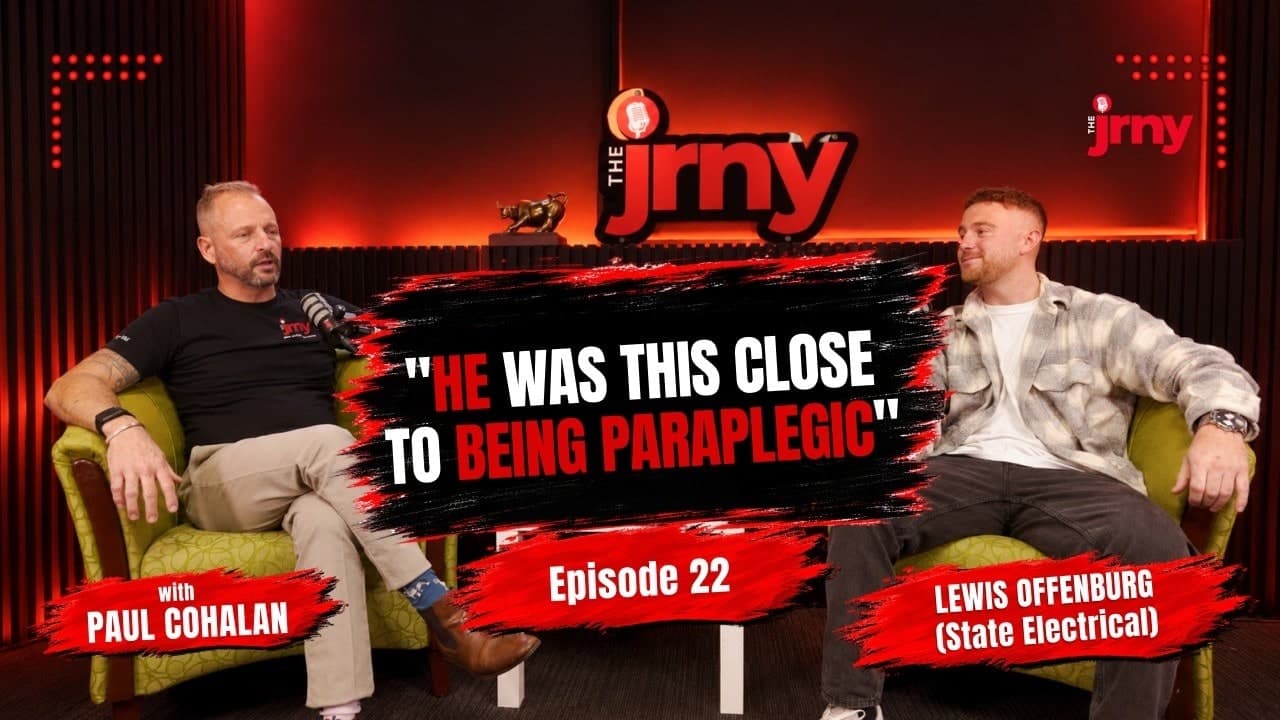
Meet Lewis Offenburg
Owner of State Electrical Company and co-founder of Trade Guru
Lewis Offenburg is a Perth electrician, the owner of State Electrical Company and, with developer Jamal, the co-founder of Trade Guru, an app that helps electricians fault find, keep learning on the job and find the right products. The youngest of seven, he left school in Year 10 at 14 and went into business with his dad Wayne, an electrician and firefighter who by then only did electrical work on the side. Lewis was running the company at 15 while doing a full time apprenticeship, and was qualified at about 17. At 17 a spinal injury playing football for Claremont, two fractured vertebrae and four and a half months in a neck and back brace, ended his plan to play AFL. Now in his 12th year as an electrician, his company does residential, commercial, light industrial, solar, battery and data work, and around 90 percent of its clients are repeat customers. He also develops property, and is building two custom NDIS homes in Girrawheen.
Episode summary
In episode 22 of The JRNY podcast, Paul Cohalan sits down with Lewis Offenburg, a 26 year old Perth electrician Paul first met at a barber in Wembley about four years ago. They start with Trade Guru, the AI app Lewis has been building with his business partner Jamal, whom he met when Jamal was teaching piano to Lewis's mum and sister. The first version took two years to build around the Australian standards, so an electrician could ask about a job and get the relevant standard back, and then hit a wall on the regulation side and could not be released to the public. After a month or two deciding whether to scrap it, they pivoted to fault finding, product manuals and materials for electricians on site, and at the time of recording were a week from a soft launch to between 30 and 100 users. Paul, who worked alongside them for a period and is now building AI agents for insurance broking, makes the case that a roadblock in tech is a reason to find a workaround, not to stop.
Then the story goes back to the start. Lewis has ADHD, although he was never diagnosed, along with dyslexia and short term memory problems, and he was out of school at 14 after spells at Newman and Churchlands. His parents only ever cared about his effort, never the grade, and he credits that with most of what came after. He told his dad he wanted to be an electrician, and Wayne, who had only done electrical work for beer money, told him the business was his from day one. By 15 Lewis was running it, catching buses and trains to business meetings in the suit from his Year 10 ball while doing a full time apprenticeship. The first year lost money and the third broke even. At 17, making a tackle in a preseason game, he compressed his spine. He was cleared at emergency, went to work at five the next morning, and was driving down the freeway when a doctor rang to tell him he had fractured two vertebrae and snapped a ligament. He spent four and a half months in a neck and back brace, still crawling through roof spaces to get jobs done, and says losing football taught him that what you do is not who you are.
The back half is about the business he runs now and what sits behind it. State Electrical Company has four employees, around 90 percent repeat clients and, as far as Lewis knows, no bad reviews, and he wants to bring in management so he can put his time into Trade Guru and into training young electricians. He treats every employee as an expiring contract, teaches his team to quote and invoice, and has had former staff come back to work for him. On his first property, bought at 18, he paid a man who claimed to be a builder and architect a little over $30,000 and knocked down the house on his advice, then found the plans would never have complied. Lewis takes the blame, calls the lesson priceless next to the $1.2 million he believes the build would have cost him, and has let it go rather than go to court. That block is finally getting a slab, and he is building two custom NDIS homes in Girrawheen, well above the minimum standard, for people he says deserve better than the housing he sees on maintenance jobs. He and Paul also talk about his partner Hayley, his high school sweetheart, about fighting the problem rather than each other, and about learning to feel content with what he has already done.
Key takeaways
A roadblock is a reason to pivot, not to quit. Two years into building Trade Guru around the Australian standards, the regulation side meant it could not be released. Lewis and Jamal took a month or two to decide whether to scrap it, then rebuilt it around fault finding. Paul's point: the time was not wasted, it is the foundation the new version stands on.
Fear is a mile wide and an inch deep. Lewis says the biggest shift for him was letting go of the result and working on the problem in front of him each day. Big goals are overwhelming from a distance, but take one or two steps and it keeps turning out not to be that bad.
A label, not an excuse. ADHD, dyslexia and short term memory problems made school a poor fit, and Lewis is open about all three. He calls them a label, never an excuse, and credits his parents for treating an A and a D the same way as long as he had tried.
What you do is not who you are. Losing football at 17 after a spinal injury was an identity shift as much as a physical one. Lewis learned to keep what he does separate from who he is. He also tells anyone who is hurt to get it checked, and to double check even when a doctor says it is fine.
Every employee is an expiring contract. Lewis teaches his electricians to quote and invoice, knowing it makes them capable of leaving. His view is that your job as a leader is to make each person the best they can be while you have them, and that getting angry when someone moves on only breaks a relationship. Some of his former staff have come back.
Give yourself credit for the steps. Lewis admits he set the bar so high that even hitting goals felt empty. Paul's advice was self compassion: slow down, take stock of what you have already built, and recognise how much of what you once dreamed of you already have. Lewis left saying his cup is already full.
Resources mentioned
Transcript
Read the transcript
This transcript was generated automatically and lightly edited for readability. It may contain minor errors.
Lewis Offenburg: My number one goal is actually go and play AFL. That was all she wrote after that. So basically was this close from being paraplegic. They scanned it, then they said, oh, look, something's not looking 100% right here. Go to emergency. Went to emergency. And I was driving my car down the freeway. Get a call from a number, and the doctor's like, hey, mate, you've fractured two of your vertebrae and you've snapped the main ligament, gone up your spinal cord. You've got to kind of get. Get into hospital now.
Paul Cohalan: How close were you to being a paraplegic that you probably thought you weren't going to get over? So a little intro. I don't get too formal on this either, but I got Lewis. Is it Offenburg?
Lewis Offenburg: Offenburg, yeah, yeah, Offenburg.
Paul Cohalan: We've probably known each other probably about four years now, I would say.
Lewis Offenburg: Yeah.
Paul Cohalan: A bit of a guess. I always throw numbers out there and I'm probably miles off. We actually met in a barber in Wembley in the corner one day. I was getting a haircut and we just started bouncing business. And the young guy in there, actually, Moe. Moe, which I haven't spoken for a while. We text again the other day. Yeah, we just don't catch up. We've got a little legend. And he was actually. He's actually great when we met.
Lewis Offenburg: He is, yeah, he was. I think he was like 15, 16, something like that.
Paul Cohalan: Now he's driving around and he's a hard worker, too. Anyway, met. Met Lewis and we caught up, reached out and we started talking business and stuff. And we done a little bit of AI together, which I believe you guys continued with, called Trade Guru. Don't know whether I can say it, but I have now. Yeah, you can edit it out if you want.
Lewis Offenburg: No, that's right.
Paul Cohalan: I reached out to him not long ago and said, mate, get on. He's young, he runs a sparky company, does AI, loves to hustle the grind. Got a beautiful partner.
Lewis Offenburg: Still, still, still beautiful partner.
Paul Cohalan: Yeah, yeah.
Lewis Offenburg: She hasn't left me yet. So we'll.
Paul Cohalan: Yeah, we'll get into it and pull back his. The story, the risk, roadblocks and resilience. And he's just giving you a little bit of inside. I'm too hot for this.
Lewis Offenburg: That's right.
Paul Cohalan: He's got a bit coming on.
Lewis Offenburg: Yeah. Thank you very much for having me. So.
Paul Cohalan: So where do we start? Do we start on the let's go with the AI stuff? What you can say, because obviously you've been working pretty hard on it since, what Is it me and you? Me and you? Probably parted ways 12 months ago.
Lewis Offenburg: Yeah. So it's probably been about a three year process so far. So three to four. Well, I mean, I started off four years with obviously me and Jamal. We first started just playing around with AI, kind of really started to come out and we obviously build just little tiny baby apps and everything like that and it kind of just. Yeah, just kind of excelled from there, you know what I mean? So, yeah, so, yeah, we're definitely getting into it right now. So, yeah, Trade Guru, I'm more than happy to say we're obviously doing our soft launch next week, so that's really exciting. Yeah.
Paul Cohalan: So what's that doing?
Lewis Offenburg: So basically the soft launch is just obviously, as you know, with tech, you know, there's so many possibilities for it to go wrong, you know what I mean? And variables and whatnot. So we're just doing a soft launch to probably, about, probably 30 to 100 people just to get feedback for the first month just to make sure, you know, all devices are working, making sure there's no glitches or just anything that we haven't picked up in our rigorous testing.
Paul Cohalan: So, yeah, basically that's coming on after, in one sentence. What's Trade Guru do?
Lewis Offenburg: Trade Guru is a electrical app that basically allows electricians to fault, find, to be able to find product manuals, materials, basically everything. So when you're on site or your boss doesn't call you know, you can't get a hold of him. You can basically have a. Basically from start to finish closing a door.
Paul Cohalan: So yeah, so when we, when me and Lewis and Jamal and actually Damien's another one which I'm going to try and get him on here. He's a. He's a cool dude. Different cat, but a cool dude. He's. He'll have a wicked story.
Lewis Offenburg: Yeah.
Paul Cohalan: So when we got together in my office and we worked together for, I don't know, six to 12 months, whatever it was the biggest things I remember were the problems in the industry that Lewis come up with. Being a sparky and living and breathing, it is the whole regulation, like who reads the books, they sit on the dash. And it was more about the regulation piece. But Lewis always come back to the problem solving and fault finding. But another key bit and I think I've spoke with this actually with Dan Bailey I had on the other day from Tradie HQ. He was on here.
Lewis Offenburg: Yeah.
Paul Cohalan: And about like the old school, tradie to the new school and how things have Changed and that, that was one of the pieces we used to discuss a lot how like be modern, be up to date, you know, search the right information, the right regulation and not do it the old way. And you used to give me some examples about the switch things on the side of the road and yeah, you don't put back properly, there's 20 grand fines like there's just so much implication on infrastructure, massive people safety injury and getting the job done right. And it's hard enough to get really good tradies and get jobs done efficiently, never alone having any of these challenges or issues and the whole regulation piece, the body around it all is a big beast and they can't shift as quick as we can and they're not as nimble and I, I took a lot out of that. There was a lot of learnings in that. Everything we always do along our journey, there's there' earnings out of it. And so you've pivoted a bit because the regulation was really hard, correct?
Lewis Offenburg: Yeah.
Paul Cohalan: They're probably already spending millions on AI and stuff, like everyone. And it was probably early. Timing's everything. It was probably too early.
Lewis Offenburg: Yeah, yeah, definitely.
Paul Cohalan: And you've gone and pivoted to the whole problem solving, troubleshooting.
Lewis Offenburg: Correct?
Paul Cohalan: Yeah. Which is probably number one problem, right?
Lewis Offenburg: 100%. Yeah. So as I said, it was a real pain because obviously we spent two years building it for building up the standards. So basically you ask a job, it pulls up the standards. We got two years down the track built it was in, you know, working with, you know, the Australian standards and basically at the end of it they just said, look, we're not going touch it, you know what I mean? So it was a bit, you know, gut wrenching at the start because, you know, you obviously spent two years building something, you're passionate about it worked, it looked great. And then not being able to release to the public was a bit of a pain, you know what I mean? But that from that point, you know, as you always told us, you know, you got to learn the pivot. And so we basically, it took us probably maybe a month to two months to kind of think, you know, what are we going to do? We just scrap the whole idea together or do we go, okay, well what can stands at loan or what can they not touch basically, you know what I mean? And about fault finding.
Paul Cohalan: So, you know, so just on this, right, like from a business perspective or knowledge or experience or doing a startup, they never go to plan. And it's the market what drives it. And the market at the time was the regulation.
Lewis Offenburg: Yeah.
Paul Cohalan: It wasn't. It wasn't the mum and dad or the guy down the road or the sparky. It was the regulation was actually the client, the market. And it drove it basically, to say, we don't want it. So. But what that means, it doesn't. It doesn't mean put your head in the sand and get upset about it and go, we've wasted all that time. Because the knowledge I learned, and I was only involved for a certain period, but the knowledge you guys would have learned over the AI, and let's be honest, AI was emerging anyway. Like, it's still emerging, but it was emerging, like, right at the beginning kind of thing in our world anyway. And it's probably a good outcome because you've got all this foundation and body and learning and pivot.
Lewis Offenburg: Yeah.
Paul Cohalan: You put the hours in, and this is what people don't get, like, in six years when overnight they become millionaires and kill it. It's not about that week. It's about back two years ago when you started. That's all correct. That's how you got there. That's all part of the journey, right?
Lewis Offenburg: 100%. Yeah.
Paul Cohalan: And the risk, the roadblocks and resilience, like, the resilience this guy's got is unbelievable. He was doing two or three things at a time and not sticking their head in the sand, like spending that two to three months just resetting. And then now they've pivoted and they're about to do a soft launch, like.
Lewis Offenburg: Yeah.
Paul Cohalan: 12 months later. Wow.
Lewis Offenburg: That's it. Yeah. So now it's been a massive journey, as I said. Yeah. Just learning all those little things and all those hurdles. I think the biggest thing you told us with, like, tech as well is that, you know, you always double it.
Paul Cohalan: Yeah.
Lewis Offenburg: And then, yeah, me and Jamal were always like, oh, almost done. And then, you know, even it was only like, a couple of weeks ago, we had, like, another little. Just bump in the hurdle.
Paul Cohalan: Yeah.
Lewis Offenburg: Literally every time.
Paul Cohalan: You always curse me.
Lewis Offenburg: I absolutely love it, man, because, like, it's just those little. Little bumps and hurdles that you take, but it makes you kind of. And build something, you know, special and proper, you know? So I'm really excited with what's coming.
Paul Cohalan: Up, and I think if it was easy, everyone would do it.
Lewis Offenburg: 100.
Paul Cohalan: And if you have the bumps, like, the bumps is what filters out, let's say, tire kickers or most people that give things a Go. Yeah, because things aren't meant to be easy, man. Like, but like you've stuck through it. You're not getting paid for it, you're funding it yourself. You're putting the time in yourself. You're jeopardizing family, the missus, you know, all the stuff. Your own business.
Lewis Offenburg: Yeah, yeah.
Paul Cohalan: But in that you will springboard out and everything will become healthier.
Lewis Offenburg: Yeah. 100. Yeah. No, it's been. I think that's the biggest thing for me. I just kind of learned to let go of the results and just focus on the day to day.
Paul Cohalan: So, you know.
Lewis Offenburg: Yeah, I just love it. You know what I mean? So I just, just literally just work on day to day, try to get better every day, figure out what the problem is for that day. Because I mean, you can get pretty overwhelmed sometimes when you're looking at these massive problems or what you're trying to achieve in life. You know, fear is basically like a mile wide and an inch deep. You know what I mean? So you just got to take that one, two steps and then once you start feeling, oh, it's not that bad and you just keep finding out that it's never that bad. So that's probably the biggest thing for me definitely going down the tech journey because, you know, I'm not a very technical guy, you know what I mean? I just kind of, you know, I'm an electrician, you know, from when I was younger. I kind of built myself up as I said. Yeah. I started my electrical company when I was 15. So my old man was a sparky and he basically kind of just threw us into it. So that's how I got into more than electrical space, which was really exciting.
Paul Cohalan: Just on that also.
Lewis Offenburg: Right.
Paul Cohalan: Like these key nuggets. Like he used to always say to me, I'm not a technical dude, I'm just a sparky, the tradie. Yeah. But you're the guy that come up with the problem, that wants to find a solution. And also when you're too techie, you don't understand the logic and the common sense behind it. It's like when I used to work with engineers. Sometimes you want to reverse engineer it.
Lewis Offenburg: Yeah, yeah.
Paul Cohalan: Fit to make it first and then get the engineer to reverse it. Because when you either do it on computer or it looks good on paper, it doesn't always work for the daily use or operational utilization.
Lewis Offenburg: Yeah.
Paul Cohalan: Now you've got you and Jamal's self taught dev, all that kind of stuff, which most are these days. And he's A wizard man. He's unreal. He actually teaches kids piano. He's just such a kind gentleman and I'd actually love to say g'day to him again. But, but the yin and the yang with. Used to. Yeah, you had a wicked formula.
Lewis Offenburg: Me and him, we're like, you know, thick as thieves basically. You know what I mean? So we complement each other really well.
Paul Cohalan: You wouldn't want two of you to be doing the dev.
Lewis Offenburg: No, no.
Paul Cohalan: Because you look at it and go man, that's not going to work logically. Or when I pick my phone up in the morning or when I go to do a job, it just, you know what I mean? You're looking at the steps and the physical use of whatever it is. He'll be in the background going, we can't do that, Lewis. Fuck off.
Lewis Offenburg: Yeah, yeah, no, he's actually, he's a wizard man. As you said before, like. Yeah, I'm really glad I've got a really great running mate. Like it was funny how we literally met because it was literally just he obviously doing piano with. With my parents, with my mum and my sister.
Paul Cohalan: Is that what it was?
Lewis Offenburg: That's what it was. And so randomly this guy's just in my house and then I'm literally just like he just comes in and then we just started chatting and you know, obviously when you meet. And so I'm so used to having people at my parents place always, just always someone there. So we started chatting and then we just started chatting more and more and then next minute, you know, we're in business together and we've been, you know, running together for a long time. So it is massive having like a running mate because no matter what, like even if one of us gets a little bit down, we're always pick self up, you know what I mean? So husband and wife basically.
Paul Cohalan: Yeah, yeah.
Lewis Offenburg: He's literally my work husband.
Paul Cohalan: But yeah, that's good man, that's really good. Just, just on the, just going back, you said something before and I just want to make a note of this also so. And then we'll go into you a bit deeper. I'm doing five agents at the moment for insurance broking.
Lewis Offenburg: Okay.
Paul Cohalan: No one really knows but I'll talk about it. So I've got a guy that's been doing AI for probably five years. He sold everything gone into it.
Lewis Offenburg: Yeah.
Paul Cohalan: And we're building a chief insurance officer.
Lewis Offenburg: Nice.
Paul Cohalan: And then that's the one agent, main agent. And then we're building the four operational agents, new business renewals, claims and ad hoc.
Lewis Offenburg: Right? Yeah, yeah.
Paul Cohalan: Now it's going to be agentic. They're going to have their own email addresses that they're going to be. They're integrated with our CRM risk wise and it's pretty special actually.
Lewis Offenburg: Yeah.
Paul Cohalan: And, and it takes a lot of effort and time. But like something you said just before about tech, you hit a roadblock. Like my strength is knowing the business process, the insurance, the problem I'm trying to solve. So the other day we couldn't connect with. To do with Claude and to do with our CRM, Microsoft and our IT company ever nimble, which they're fantastic as well. And we're trying to get this thing over the line and I'm like, guys, move on. Even if we do 80% of it and that 20% or 10%, we work out later or do a workaround, no problem. I'm like, don't stop because of tech because there'll be more bumps on the road. So keep moving. Do a workaround. Because even if like this process saves 60% time.
Lewis Offenburg: Yeah, yeah.
Paul Cohalan: And then I replicate it to every broker I've got.
Lewis Offenburg: Yeah.
Paul Cohalan: And, and because the thing with AI, it's still emerging. So the solution will probably come out in two months.
Lewis Offenburg: Yeah, yeah.
Paul Cohalan: I actually think we're there. I think we've got this MCP connector this close to working. Yeah, yeah. So then it'll actually connect with Microsoft and my CRM I built three, four years ago, it'll connect and do most of the work.
Lewis Offenburg: That's awesome.
Paul Cohalan: It's next level, that is. And then I can replicate it in the brokerages. Yeah. And with brokers. And so what it will do just on the tech, it'll save my remote team a lot of time. Then my remote team and then my brokers will do 10 being the risk advisor relationship and.
Lewis Offenburg: Yeah.
Paul Cohalan: So anyway, but just the tech thing keep moving like pivot and keep moving. Right.
Lewis Offenburg: 100.
Paul Cohalan: Yeah. It's tech. Right. You'll be able to work around, you'll be able to do. Yeah.
Lewis Offenburg: So man, Jamal will probably kill me for saying it, but we're. We've also got another app coming out very soon, towards the end of the year. It's called Surface Y basically. It's basically like a. You can fully customize AI You know what I mean? So from everything from start to finish, the best thing that we've did with it is all the memory and everything like that is actually stored on your local Device. So it's not going out to ChatGPT, Claude, everything like that. So one of the biggest reasons why we're also putting it out there is that it allows basically like companies that have really private, secretive information, they can't just, you know, be willy nilly giving out to people. It allows them to have an AI that works, but even better to the same as Claude and ChatGPT but locally on their device. So it's not actually getting sent out to any of the data centers, anything like that. So all that information is getting stored on their computer. So all your clients information, everything like that. We're kind of calling it like compassionate AI, you know what I mean? So it's AI for you know what I mean? And not going out, all your data is not getting sold to all these massive multinational companies and stuff like that. So that's. I won't say too much more on it. But Jamal will kick your ass. He will kick my ass. I've already fear. But no, we're looking to release that towards of the year as well. So lots of stuff coming on, which is exciting. So.
Paul Cohalan: All right, cool man. So we got the AI thing out of the way and I really wanted to because I was a big part of it at one point and I love what yous do and I reckon to be honest, like it'd be wicked to get you in and we just have a catch up and just talk on the whiteboard what we're doing 100% because I've gone a different avenue to focus on the insurance broker and stuff. Yeah, you guys have gone down that rabbit hole, pivoted because of the regulation. It'd be wicked just to fucking have a chat or a beer or a lunch or a. You know.
Lewis Offenburg: Yeah, we're always keen for that. I know Jamal loves a beer. So we're always keen for that.
Paul Cohalan: And he's to talk to and you know, the other thing is we could turn around and go, well you do. You and I will do us and not tell each other, but when you collaborate and you're good mates as well, you know, we've got a lot of trust between me and you.
Lewis Offenburg: Yeah.
Paul Cohalan: You never know. Like Jamal could think about something that I'm not thinking about. You know what I mean?
Lewis Offenburg: 100%. Yeah. Yeah. We're always happy to have sit downs and collab and stuff like that because I mean that's where everything, you know, everything starts a small room. So we're always very keen to get into those Small rooms, start chatting about things because it just brings up so many ideas.
Paul Cohalan: So I usually ask at the end, who do you think I should get on? Yeah, Age of miles. I'm already going to drag him on. Yeah, yeah. All right, let's. Let's talk. Let's talk you, man, your journey and like, how old are you now?
Lewis Offenburg: So I just turned 26. So, yeah, so I just turned 26, which is exciting.
Paul Cohalan: 26.
Lewis Offenburg: 26, Yeah.
Paul Cohalan: So still good on you, man.
Lewis Offenburg: Thank you very much.
Paul Cohalan: You should be so proud, like.
Lewis Offenburg: Thank you. It's been a long journey, you know what I mean? But I started really young, which is probably the first part of my story.
Paul Cohalan: What do you mean start?
Lewis Offenburg: Well, I mean I got put into, obviously I was a high school dropout. What year did you drop out? Year 10. So year 10 dropout. I basically wasn't going anywhere in school.
Paul Cohalan: Where were you born?
Lewis Offenburg: Whereas I born here. Here in Perth?
Paul Cohalan: Yeah. What school did you go to?
Lewis Offenburg: I went to Newman. I didn't make it too long there. I kind of accidentally got myself kicked out of there and went to Churchlands and then.
Paul Cohalan: Any good stories you can tell us?
Lewis Offenburg: Oh, I mean, it's the past. I mean, even on my last day, I kind of, you know, one thing I learned about school was all about who, you know what I mean? And so I kind of learned that from a young age. So I used to always get really good with all the ladies in the office and everything like that. So even when got in trouble, I'd come out with like lollies and sweets and stuff like that, you know, so sweet talking. So, yeah, basically even like last day of school, I ended up running out because I tricked a teacher because I was meant to go for my Thursday after school detention. I told her like for like weeks and weeks I was meant to go and I knew I wasn't coming back because, you know, I wasn't allowed to come back. So I just told her, oh, look, you know, I got, oh, it's my nan's birthday, I can't come on this Thursday, blah, I made up all these stories and then the last day she goes, you're not coming back. And she literally chased me out the school. I was just piss bolted with my backpack on. And yeah, off I went. But yeah, I got in a bit of mischief at school, but all in good fun. So, yeah.
Paul Cohalan: And you know what, like this is a pretty common thread or chat is.
Lewis Offenburg: Yeah.
Paul Cohalan: But right now, when I met you're like When I met you're probably 22, 23.
Lewis Offenburg: Yeah.
Paul Cohalan: Roughly.
Lewis Offenburg: Yeah, yeah, so.
Paul Cohalan: But mate, honestly, out of a 22, 23 year old, you're a kind gentleman, you got your head screwed on, business minded, you got partner. Yeah, like there's a huge flip there, man.
Lewis Offenburg: Yeah, yeah, I mean, well, I definitely had to, you know, as you like, you know, quote unquote, say, you know, I had to kill myself to let my new self come available, you know what I mean? And that came through a lot of, you know, self development, learning journeys, you know, a lot of.
Paul Cohalan: Basically like, tell me school, tell me a bit more about school. Why, why were you a medicine school? Why'd you get kicked out? Like, not what happened, but deep down, like, did you struggle to learn? Yeah, ADHD thing we go on about, or is it dyslexic? Like, what?
Lewis Offenburg: Yeah, that's what it was. So I had, obviously I didn't get diagnosed for ADHD, but I've got ADHD. I had dyslexia.
Paul Cohalan: Oh, you did?
Lewis Offenburg: Yeah, I got dyslexia. Short term memory. Yeah, I got short term memory loss. So all these kinds of things. I had like a hearing problem as well when I was a kid. Like, I could, like, I had like, it's called an Aussie bite. So like, can you beaten with a bat anymore? Yeah, no, mate, these are just, I, I, I'll always have a laugh, like, you know, I get in a bit of trouble for saying this stuff but like, I love when people just try to find an excuse for things and they always use it as an excuse. It's like, yeah, it's a label but it's not an excuse. You learn it, you know what I mean? So, yeah, I literally, I just, yeah, that was probably the reason why. One, I wasn't interested. I knew I focused, couldn't focus. And also I wasn't interested. Like, you know, I didn't care. I knew it wasn't going to be valuable to me in my life. Like, I've always kind of been a big thinker and yeah, I've always kind of just like knew that I wasn't going to doctor, I wasn't going to become a lawyer, I was going 100% go down the entrepreneurial path and I knew that everything in school was conflicting with actually what I wanted to know and learn. You know what I mean? They say don't, don't share answers. But when you're in business, what do you do. You're always sharing with people, learning everything and. Yeah, a lot of. A lot of, Yeah, a lot of. Yeah. Just I think the school kind of contradicts it almost.
Paul Cohalan: It does, right. And I always said that too. Like, I want to get out of school. I'd done year 11, didn't pass it. I think I didn't do homework. But I think you get more out of school than, you know, like, probably in my 30s. I'm like, some things do come back. Like, let's say, oh, why would I use algebra? Why would I use this? But it's like the replacement. I think we get a lot more out of school than we know. But I also wouldn't want to go school uni. That wasn't me either. Right. And I think it's the way our mind works. And this is a common conversation. Right. The troublemakers, the menaces. You know, if you really wanted to and you're interested, you'd probably nail the grades. Like, I was the same.
Lewis Offenburg: Yeah, yeah.
Paul Cohalan: Did you want to? Did you? Like, you couldn't focus attention, but it's become your superpower. Like, you got all these roadblocks thrown at you.
Lewis Offenburg: Yeah, yeah.
Paul Cohalan: You took the risks a lot away. And look at your resilience now, and.
Lewis Offenburg: Look where you are 100% now. I definitely also give it to my parents. They were really good when it came to it. So they always. Obviously, my report card was pretty average, you know what I mean? But they never got upset with it. For me, the only thing they cared about was the effort. And I guess that was a big thing that kind of taught me. So I didn't actually care about what results I was getting. You know, if it was an A or a D, they'd treat it the same way. You know what I mean? So they'd go, as long as my effort, like Lewis was trying. If you did. If I didn't come up short, that was fine. I think that was probably one of the biggest lessons I learned as a young, you know, young guy, is basically, it's not about the. It's about. Not about the result. It's about the effort. And I think that's a very big thing to kind of teach your kids. And I commend my parents for that.
Paul Cohalan: That's wicked, man. Because we get so caught up in results. And let's be honest, go back to the school system, Someone could be really good and go to a test and they fail.
Lewis Offenburg: Yeah.
Paul Cohalan: Cause they're not good at sitting there doing tests and pressure and anxiety And a million different reasons. And it could come back to the way they eat, the way, like dyslexic, all the kind of stuff. Right. But when you get allowed out to do what you want, all this stuff shines if you allow it. Or you've had the good support, like your parents.
Lewis Offenburg: Yeah, yeah, no, I'm very thankful for them. And obviously all my siblings and stuff like that, you know, I'm one of seven. So as I said, we come from a big family. TVs yeah. Yeah, I'm the baby boy seven. So I got to learn all their. Their shortcomings. Oh, you guinea pig. I am now. I was the one that. The. The final product, as they say.
Paul Cohalan: So, yeah, the runt of the litter.
Lewis Offenburg: Yeah, 100%. Yeah.
Paul Cohalan: That's cool. So what. So how old were you when you left school, man?
Lewis Offenburg: So I was 14 when I left school because I was the youngest in my year, basically. So I think there's only. In my year anyway. I think there's like two other people that were younger than me in the whole year. So I was like the baby of that year. So that split year.
Paul Cohalan: So when you split. When you. Sorry, not split. When you left year 10, right at the end, before we go forward, where were your brothers and sisters, like? Because you would have been like, what do I do next? Probably you get your ass kicked to go into a trade.
Lewis Offenburg: Well, no, it was actually kind of different. I was the one that actually initiated it, so I was the one that was like, as I said before, I knew from a young age, like, I was young, but I always knew what kind of wanted to go. So obviously my old man was an electrician. And so I basically came to him one day when I was in year 10, you know, flunked out, and I basically just said, hey, Dot, I've got a great. Dot's my nickname for my dad.
Paul Cohalan: Yep.
Lewis Offenburg: Another story. And so I basically went, hey, Dot, look, you know, I want to become an electrician. And he was like, oh, geez. Because he was kind of semi retired because he's a fireman as well. But he's also. But he's also, you know, worked on the side, but he didn't do it for money, he just did it for beer money for. For the weekend. So, yeah, basically I, I basically told him from the start, I was like, hey, Dot, you know, I want to become an electrician. He said, look, mate, if you want.
Paul Cohalan: Can we talk about the Dot thing? This is what it's about.
Lewis Offenburg: Yeah, all right. So my Pop. All right. He was, he was a G. He had a lot of freckles. So in the fire brigade, they called him Spot. And then when my dad came into the fireground, we call a little Spot Dot. So Spot and Dot. Spot and Dot. And then. Yeah, and then I'm spec. So is that right? Some of the boys have put it up there. I'm just, I'm keeping that one away from me.
Paul Cohalan: So Spec. We'll put that on the label, on the thumbnail for the podcast.
Lewis Offenburg: Yeah, yeah. So, yeah. Where was I at? So, yeah.
Paul Cohalan: So what dad, did he, did he agree? Did he back you or did he what?
Lewis Offenburg: He basically just said like he wasn't. That he wasn't that keen on it because he didn't do it for money. I mean, he just kind of did it for a bit, beer money. So he basically said, look, from day one, if you want to do this is up to you. I don't want to borrow it. I'll teach you what you need to learn. But from day one, this is yours. I don't want to buy. We had no clientele. I think we had one client that he kind of just did a little bit of work for here and there, but we had no clientele at all. So I'm this, you know, 14 year old kid, stepped out of school, got no idea what I'm doing, jumping into the world of business. And man, I got my ass kicked a fair bit, you know what I mean? But I also had some really great people as well because, you know, I'm 14, 15, going to, you know, going to business meetings, stuff like that. You know, I, you know, dress myself up in a little suit that I probably had from like my Year 10 ball and long sleeves. Long sleeves, yeah, kind of all bit funky all over the place. And yeah, I basically just kind of started going to all these business meetings and meeting business professionals as a 14, 15 year old kid. And they're kind of half looking at me like, you know, this isn't daycare kind of thing, mate. Like you got to kind of get out of here. But then other people really wrapped their arms around me and kind of, you know, really kind of taught me the rope. So it was a great thing because, you know, a lot of the time I literally was catching buses to places, catching trains, all that kind of stuff just to be able to get to these meetings, just to be able to kind of get into around, you know, successful people as such, to kind of learn the, learn the rules of the game. So, yeah, it was a massive learning curve. Yeah. And I said, well, all my mates were still, you know, at school and everything like that. I'm literally starting to run a company, starting to do that, learning all the pitfalls, you know, Obviously the first couple of years we barely, you know, scratched the surface. I think first year we lost money. Second year started to, you know, do a little bit. Third year I think we broke even. Fourth year.
Paul Cohalan: So let me just clear this up. So was that working with your dad?
Lewis Offenburg: Yeah, so working with my dad.
Paul Cohalan: So were you being an apprentice or were you just learning as a TA or something?
Lewis Offenburg: No, so I was an apprentice. So I was a full time apprentice. I mean, I think I finished my apprenticeship when I was. I was about, yeah, 17, I think. So I was basically three and a.
Paul Cohalan: Bit years or whatever.
Lewis Offenburg: Yeah, three and a bit years. So I was basically could fully qualified for since I was about 17, so. And I was running the company since I was 15. So that first year, he obviously gave me grace and stuff like that. But even my old man, he's a great guy, but he had no idea about what he was doing at all. So like, even the invoices and quoting and stuff like that, we'd used to do a job and he'd be like, oh, how much is the part? He's like 20 bucks. I'm like, why is it 20 bucks? He's like, oh, just because, you know, that's what it is. He just. No margins, nothing.
Paul Cohalan: That's the business side that tradies aren't that crash hot at.
Lewis Offenburg: Right, correct.
Paul Cohalan: The old school tradies.
Lewis Offenburg: The old school tradies, yeah.
Paul Cohalan: And the problem is the old school way just doesn't pay off anymore. It used to. That was their way of doing it. And you know what, we've got a lot to learn from that and it's got us where we are 100%. But these days you've got to be efficient and you know, it's too commercialized to. To do the whole $20.
Lewis Offenburg: Yeah, just. Just make it up on the spot. Hey, because. Yeah, I mean, that's probably why the first year we didn't make any money because I think he didn't realize how much were buying it for, how much were selling off for.
Paul Cohalan: I think he was doing the business well, the business was getting done for a different reason now.
Lewis Offenburg: Correct.
Paul Cohalan: It wasn't just for beer money or, you know, which didn't matter to him.
Lewis Offenburg: Yeah, yeah.
Paul Cohalan: And. And you're coming in and you're doing heaps more work like.
Lewis Offenburg: Yeah, yeah. It was crazy. So, yeah, I guess so. Yeah, that was the. The start of my journey. And while I was doing that, I was obviously playing Claremont footy. I was actually. You know, I love my football, so I was actually. I was actually. My number one goal is actually go and play AFL, so that was the plan. So I trained my ass off for a long time, and then that got cut short in my first reserves and league season. I fractured my spine two in the second preseason game.
Paul Cohalan: Oh, did you? Yeah.
Lewis Offenburg: So, yeah, that was all she wrote after that. So I basically was this close from being paraplegic, which is kind of crazy. So.
Paul Cohalan: Talk about jerk. Journey in roadblocks. Yeah.
Lewis Offenburg: Smashed her 100.
Paul Cohalan: So how old were you then, when you fractured your spine?
Lewis Offenburg: I would have been probably at 17, I think. 17. So I would have just been coming out of my apprenticeship. Apprenticeship. And then obviously I was full time into footy because as of the same thing for me, like, the electrical wasn't always my full time. Like, it was. It was like. It was what I. Dude, it was good for money. But I wasn't like 100 into it. I was obviously into my footy, so I was going down that path to try.
Paul Cohalan: And how old were you when you started playing football?
Lewis Offenburg: Football, I actually started pretty late, so I played soccer when I was a young fella and then I think I started. I didn't like Auskick because you wouldn't let tackle. So I was kind of like, what's the point? I might as well just be playing soccer. So I was played soccer up until that point, which was really good for my development because, you know, left, like the soccer players, I do have to give it to them left and right.
Paul Cohalan: Right boot.
Lewis Offenburg: The skill. The skill set with your feet is phenomenal. You know what I mean? And with, you know, Auskick, it's still a bit, you know, clumpy and stuff like that. There's not like a designated program. Like with soccer, they really kind of are nailing on your skill set, even from a very. So, yeah, I did that. I played all sports, played rugby, did a bit of boxing, mma. Just done. I've just done everything, really. Done so many different sports. I love my sport and my gym and everything.
Paul Cohalan: That's awesome.
Lewis Offenburg: So, yeah. Yeah, it's been good fun.
Paul Cohalan: So. So, yeah. How long? What? Tell us a little bit about fracturing your spine. That would have been a pretty intense few months.
Lewis Offenburg: Yeah, it was so, yeah, it was. It was pretty. It was pretty hectic because at the start I didn't even realize I did it. So I basically went into. It was my fault. The guy was a lot bigger than me and I was a. I was a bit of a dirty player. So I basically just went. I took out his legs and my neck got caught to the side and just compressed my spine. I did my thing, my T3 and T4, I think. So I didn't realize at the time, but I felt like a shooting pain down my legs. And then I was like, oh, like, didn't feel too good. I felt really winded. One of my mates came and picked me up off the floor and then I was kind of like, oh. I went into the next, you know, next play, got the ball, got the hands out, and then I was, like, feeling a bit, like, dizzy and a bit. Bit, you know, a bit rocked. Rocked?
Paul Cohalan: Yeah.
Lewis Offenburg: So I went to the bench and I was like, oh, like, you know, not feeling. Feeling the best. They kind of asked what happened, and then, yeah, they're like, oh, look, you. You shouldn't kind of come back on. I was like, okay. And then I went, yeah. There's actually so many moments that led up to it. I could have been fully paraplegic because after that I felt really stiff. The game was on a Saturday. On Sunday, I went to a chiro, and he actually cracked my back that day.
Paul Cohalan: Wow.
Lewis Offenburg: Yeah, so that was. It was pretty bad. So luckily nothing happened. Then I went to training on the Monday night and I even had, like, mates come up behind me, like, pick me up from the back and, like, got like that. I did a whole day's worth of work. I was lifting up sleep like big sleepers. You're lucky.
Paul Cohalan: Lucky man.
Lewis Offenburg: Yeah, very lucky. And I get to training and then the coach. Have you been to the doctors yet? I was like, oh, no, it's just a bit of a stiff back. And he's like, no, mate, you gotta. You gotta go kind of a thing. I went to the doctors, and I was really lucky. They even opened up the clinic for me. So it was actually closed. They opened up the clinic for me. I got to go in. They scanned it. Then they said, oh, look, Something's not looking 100 right here. Go to emergency. Went to emergency. Emergency then cleared me saying, nothing. You're all good. So I was like, oh, jeez. All that for nothing. Then got home, and then I was driving to work the next morning. I think I got in the hospital at 12. I went to work like 5 the next morning and I was driving my car down the freeway, I get a call from a number and the doctor's like, hey, mate, like, you've fractured two of your vertebrae and you've snapped the main ligament, gone up your spinal cord. You've got to kind of get into hospital now and then. Yeah, so I went into there and then. Yeah, four and a half months in the neck and back brace. So, yeah, that was pretty rough, I'm not gonna lie. And since were so busy at the time, because I was just starting to, you know, really grow the business and there was. I didn't have any, like many employees. I think I had one guy at the time and my, me and my old man, I was literally like crawling in people's roof spaces and neck and back brace on, just trying to smash it out, get all the jobs done and everything like that. So. So yeah, it was a bit of a. It was a bit of a. Bit of a mission, that's for sure.
Paul Cohalan: So a couple of things on this one is you still would have, you wouldn't have done as much electrical work as you normally do. Right. So you would have done a lot. It probably helped you learn more about business because you would have had no choice but to be on the laptop, on the phone.
Lewis Offenburg: 100% Correct me from me. No, 100%.
Paul Cohalan: So that window probably helped you there expedite your learning in business because you would have spent more time on it than working and doing it at 10 o'clock at night. Because that's what normal traders do.
Lewis Offenburg: Yeah, yeah.
Paul Cohalan: The other piece is that, yeah, what if someone come to you now, injured, hurt and goes, oh, she'll be right.
Lewis Offenburg: Yeah, no, I mean definitely go get that checked out.
Paul Cohalan: Yeah.
Lewis Offenburg: Like, even if it's small and even if the doctors say it's all good, you know, you really want to make sure you double check that.
Paul Cohalan: So think about the business side, what you would have learned from here, right? Say an employee comes to you and they're on your watch and they've gone and injured themselves. Would you let them keep going or would you send them to the doc?
Lewis Offenburg: I mean, I'm pretty hard on my boys now. I'd make them sure though, they get sent over.
Paul Cohalan: If you didn't have your back thing, not condoning it shouldn't have happened. But, but that's the positive out of it. That's the learning out of it. Right. You're now running a business and you're like, you know, you could save someone Else from that. Because how close were you to being a paraplegic?
Lewis Offenburg: Yeah, very close. I mean. Yeah, any movement, any like, left or right turn that could have, you know. You know, that could have been literally just.
Paul Cohalan: You had these four or five things straight after it before you even got checked.
Lewis Offenburg: 100%.
Paul Cohalan: It could have just like. It only takes one little bit of nerve or, you know, the vertebrae.
Lewis Offenburg: Correct.
Paul Cohalan: Yeah.
Lewis Offenburg: And, yeah, it's terrifying, to be honest with you, but I was just. Just lucky, you know what I mean? But I was very fortunate, you know, very fun fortunate because of it. I learned a lot from that time, you know what I mean? Even four and a half months. I'm very active. Not even being able to, you know, I was literally my peak, my fitness, obviously, at that time playing, you know, WAFL football and then going to literally, you know, being nothing. Yeah. Bed for nothing. Yeah, it wasn't that great, that's for sure.
Paul Cohalan: So, yeah, what was. You would have just touched on. There would have been a pretty emotional piece to the first few weeks of doing that, like. Yeah, your whole world's just been smacking smashed, biggest roadblock you probably thought you weren't going to get over.
Lewis Offenburg: Yeah, yeah, it was. It was a. Definitely a changing identity, I think, because, yeah, from obviously that, you know, the doctor's saying, you know, it's probably not best to go back to footy and stuff like that. I guess it was a bit of an identity shift as well, because obviously your whole identity gets caught up in the things that you do. And that was probably a big lesson for me, is not to be so caught up in what you do. And that's not who. That's not who you are as a person. You know what I mean? So the things that you do are. The things that you do, they're not you as a person, you know what I mean? And kind of learning how to keep that stuff separate. So that was a big one for me, is just making sure. Yeah. Because I did get. I got lost in that for a bit, to be honest with you.
Paul Cohalan: You would have. Of course you would have been.
Lewis Offenburg: Yeah, yeah. So obviously, you know, always, you know, wanted to play football, all that kind of stuff my whole life.
Paul Cohalan: Humbled you.
Lewis Offenburg: Yeah.
Paul Cohalan: And I'm guessing you're a cocky little too, because you're probably good at football and you love doing all your shit. So I'm guessing it humbled you a little bit.
Lewis Offenburg: Yeah, definitely. I think so. Yeah, I think it definitely did humble me a bit because.
Paul Cohalan: And I meant that in a good way as well, because you've got to have a bit of that when you're confidence and cockiness and. Yeah, especially when you like, I'm going to be a sports player.
Lewis Offenburg: Yeah, yeah. Well, that's the thing. You got to have that. You got to have you back. Back yourself. You know what I mean? I've always been one to back myself. I used to be a lot more vocal about it, obviously. Now I'm a bit more. A bit more tamed down. But, yeah, definitely the. That injury definitely changed the trajectory for me a lot. So.
Paul Cohalan: So going back to like year 10, getting out at 14. Yeah, out of 14 at year 10. Where?
Lewis Offenburg: Yeah, yeah. Or 15. 14. 15.
Paul Cohalan: Somewhere there.
Lewis Offenburg: Yeah, somewhere.
Paul Cohalan: So you left school, you ran out the gate, teacher chasing you, cocky little menace, but sweet talk to them all.
Lewis Offenburg: Yeah, yeah.
Paul Cohalan: And then you're like that, I'm doing a trade. You do a trade, you Finish. When you're 17, you also play football and then you get just this big wall smasher.
Lewis Offenburg: Yeah, yeah.
Paul Cohalan: And I reckon that leaving school to going into business for a year or two with your dad and then that being in a brace, them two moments would have been pivotal to where you are today.
Lewis Offenburg: Oh, massive.
Paul Cohalan: The resilience you got today.
Lewis Offenburg: 100%. Yeah. I think at that moment in time I kind of realised I was like, hey, I can go all in. So I think the confidence of footy was really good because it taught me about, you know, professional structure and, you know, again, you know, making sure you. You're intentional with everything that you do. And then I kind of found out after that, you know, I said, you know, I wasn't that great at business at the time. And I said, you know, if I.
Paul Cohalan: Can be really good at footy, no one is.
Lewis Offenburg: Yeah, I know. Yeah. I said, you know, I kind of was like, you know, if I can't. If I'm really good, I can be really good at one aspect, I can kind of move that into another aspect in life. And that's when I kind of went all into business and that's when I started to kind of go down my more motivational and, you know, business driven, you know, so.
Paul Cohalan: So you said to me earlier, Paul, you taught us with it that, you know, you hit a roadblock then pivot, mate. You're already doing it back then.
Lewis Offenburg: Yeah, no, I appreciate it. It's just good to get those reminders, you know. Yeah, it is. Sometimes from someone else's perspective and how they word it is a great way.
Paul Cohalan: For me, that's Cool, man. Like. And mate, that's the reason of this big time. And your learnings from that, being in bed four and a half months and then you would have. Did you bond a lot more with your old man as well? I'm not saying you didn't have a good relationship, but, yeah, it would have been a different dynamics. You were starting to mature, get older. You're going to turn 18, I'm guessing, you know, being in your brace and whatnot.
Lewis Offenburg: Yeah.
Paul Cohalan: And then when you got out of your brace, what kind of happened then? Was it like.
Lewis Offenburg: Yeah, so after that, I was obviously real skinny, hadn't been able to do too much gym, anything like that. So I was. I was kind of just straight back into the gym and then. Yeah, from there. Touching back on your thing. Yeah, I think it definitely did really bring a good relationship with me. My old man, like having those years where we worked together, we. We absolutely. Yeah. I wouldn't, I wouldn't trade it for the world. I mean, like, all my other siblings, they never really got to have that with my old man, you know what I mean? So I'm jealous, I reckon.
Paul Cohalan: Good on you. That's wicked.
Lewis Offenburg: Yeah, very happy for it. But yeah, I mean, we butted heads all the time. It was, it was good fun. But like, we just got to the point we're just always arguing each other, but, like, you know, jokingly argue. We never got like that upset with each other.
Paul Cohalan: But any heated moments. Moments. He would have had a couple.
Lewis Offenburg: Yeah, we had. We had a couple of hate. I think it was once I started to actually understand because as I said, my old man's really great electrician, but he's terrible at explaining things. He'd be kind of like telling me, like, I'll go do that, I'll just do it myself. And I'd like, yeah, mate, you haven't even strung a sentence together. So I used to get it in for that, which we've talked about now, like, in that.
Paul Cohalan: But he's not going to change.
Lewis Offenburg: No, no, he actually. We actually sitting down, having a few beers and he actually told me how pivotal that was for his life as well. Wow. About, you know, me kind of telling him, mate, like, just communicate, like, use your words to tell me these things. And him learning how to actually teach me and stuff like that was probably one of the best things that he. He had for himself. So when he went to fire brigade,.
Paul Cohalan: That would have been unreal.
Lewis Offenburg: Yeah, yeah. 100. And even as he said, when he Went to the fire brigade. It actually taught him how to better with the. The younger guys in the. In the team and stuff like that and communicate. Because me and him were just button at each other the whole time. And I was like, I was always keen to learn, but, like, when you're not explaining things to me, like, it's very hard to learn. Yeah, yeah.
Paul Cohalan: And when you're young, you don't understand. They only know what. Correct. It's all right for us now to talk about it, but back then I can imagine 17, 18, 16, and you're like, dad, just tell me. And you don't understand that. You only know what you know. He's never had to either.
Lewis Offenburg: Yeah, yeah, 100%.
Paul Cohalan: So he's never had to communicate. And then old school.
Lewis Offenburg: Yeah.
Paul Cohalan: When they know a job, they don't like teaching anyone else. Fuck it, I'll do it myself. It's quicker.
Lewis Offenburg: Yeah, 100%.
Paul Cohalan: Even though it compounds and then that you can't help them. But he must be, as of today, must be a proud man.
Lewis Offenburg: Yeah, I think so. I mean, I think he is. I mean, that's my whole goal, is to obviously, you know, try, you know, the things that he's taught me, the. The person that I've become, you know, I want to definitely try and honor him in that. You know what I mean? I definitely have a lot of.
Paul Cohalan: What's your dad's name?
Lewis Offenburg: From Wayne.
Paul Cohalan: Wayne, yeah. Cheers, Wayne.
Lewis Offenburg: My absolute champion. So, yeah, no, I love. I love. Love my old man and all my family, obviously, but, yeah, definitely want to, yeah, kind of honor them and the legacy that I'm kind of trying to build, I want to be able to honor them and, you know, obviously help out as much as I can with that, so.
Paul Cohalan: That's wicked. So. So from, say, AD qualified out of your neck brace back at the gym, got some strength back on. So you're back at work full time?
Lewis Offenburg: Yeah, back at work. I basically head down. Always work. I mean. Yeah, even when I was in the neck and back brace, I literally was still going jobs. It was pretty funny. Like me rocking up to client's house, my tool bag, neck and back brace, straight, stiff. You know what I mean? Yeah, it was a bit of an odd look, that's for sure.
Paul Cohalan: So one thing I did learn about you, and I think this is why me and you clicked, even when we just first ever chatted at the barber. But then we spent a fair bit of time in the office together and all that. When I had the other. The office and is Your it no matter what. Like I'm gonna work and get done and we have a bit of common ground and I still don't have a license.
Lewis Offenburg: Oh, no.
Paul Cohalan: I don't know if you know the story. So I don't have a license. But I got done driving out of Subiaco last March. April.
Lewis Offenburg: Yeah.
Paul Cohalan: So I got extended nine months. I was meant to get it back in August.
Lewis Offenburg: Jeez.
Paul Cohalan: Yeah, so it was the one before. Sorry. Yeah, I was meant to get back July. Then they extended it. So anyway, it was meant to be August 22nd.
Lewis Offenburg: Yeah.
Paul Cohalan: But in February I was riding my electric scooter which I bought because I got no license.
Lewis Offenburg: Yeah, yeah, yeah.
Paul Cohalan: Great. And I was cruising down to go to the physio in Jolimont and the cops pulled me over and they took it off me.
Lewis Offenburg: You're joking.
Paul Cohalan: And I had no helmet on. But that's $200 fine.
Lewis Offenburg: Whatever.
Paul Cohalan: But they took it off me. He looked up the regulation on it and it was two kilo over whatever the spec. Like I still wouldn't know what the spec is.
Lewis Offenburg: Yeah.
Paul Cohalan: So he treated it and like I only had four months left.
Lewis Offenburg: Yeah, yeah.
Paul Cohalan: Treated it as a motorcycle.
Lewis Offenburg: You're joking.
Paul Cohalan: So I'm unregistered, unlicensed. I like, I got four, five, six motorcycles at home.
Lewis Offenburg: Yeah.
Paul Cohalan: I don't need a scooter motorcycle. So I'd done it for the right reasons. I stopped going to the gym far away. Done all the right things. Anyway, they confiscated it, Right.
Lewis Offenburg: Wow.
Paul Cohalan: Sent me a bill for it. Now I tried to get it back by an application.
Lewis Offenburg: Yeah.
Paul Cohalan: And they declined it. They squashed it. Sent me a bill for that.
Lewis Offenburg: You're joking.
Paul Cohalan: And then I did. I heard nothing else. I'm like, oh, my fault, you know, you got to cop it. What do I do?
Lewis Offenburg: Yeah, yeah.
Paul Cohalan: Anyway, 22nd of August I was over east, right. No one really knows this story. I only got friends and I was with my brother in law and I'm like 7am this morning, 9am this morning, which is 7am Perth. I'm gonna ring up and pay the $50 for the license and I'll get my license back and on the weekend I can take the kids because I was flying back.
Lewis Offenburg: Yeah, yeah.
Paul Cohalan: I rang up and they're like, no man, you don't get it back till January 27th. This is the 22nd of August, man. I'll never forget.
Lewis Offenburg: Wow.
Paul Cohalan: And it was funny. Nathan, my brother in law, he's a legend. We're very close. He on the way to the getting brekkie. He's like, imagine if you didn't get it back. And then as, yeah, I've lost it. Yeah, yeah. There's certain limits these days. I don't lose it as much as I used to years ago. But yeah, this pushed me.
Lewis Offenburg: Yeah.
Paul Cohalan: And I'm like, I've waited to this moment. It's like 901.
Lewis Offenburg: Yeah, yeah.
Paul Cohalan: And he's like, no, man, something happened. You got a fine or whatever. They couldn't, they couldn't pick what it was. Anyway, I spent hours on the phone. I was with Nat, my ea. At her house and we ended up pulling it apart. And what it was the scooter, they reckon. They sent me mail for court, fine me everything and extended. Because I didn't go to court, they put an extra nine months on it.
Lewis Offenburg: No.
Paul Cohalan: From August. So 22nd of January, I get it back. Right.
Lewis Offenburg: You poor guy.
Paul Cohalan: I'm like. And I, like lost it. And Nathan's like, maybe I shouldn't have joked about that too soon. Anyway, that day I was like, max, got no work done. Like half a day trying to work out why. Because I'm like, I done all the right things.
Lewis Offenburg: Yeah, yeah.
Paul Cohalan: And my fault. But anyway, so I spoke to lawyers and that it was going to cost like six, seven, eight grand and yeah, pull it back out and say that I never got it. Which I would have got my license instantly.
Lewis Offenburg: Yeah, yeah.
Paul Cohalan: But I still probably would have got something.
Lewis Offenburg: Yeah, yeah.
Paul Cohalan: And in the end I'm like, just leave it, mate. I. I get Ubers heaps and I've got a driver that's ad hoc and I get heaps of work done. I'm like, I'll just cop it.
Lewis Offenburg: It's not so bad.
Paul Cohalan: The biggest thing is the kids, man. But what made me think of that and your resilience for getting shit done is I believe you lost yours for a little bit.
Lewis Offenburg: I did lose my license.
Paul Cohalan: I don't know how much you wanted.
Lewis Offenburg: To say, but that's all right. Yeah, no, I was.
Paul Cohalan: I think Waze helped.
Lewis Offenburg: Yeah, Waze didn't help me. Yeah, no, that was my. That was my bad. I stuck. I'm a Google man and I. I live and die by going on Google. I should have gone on Waze. But look, no, it was a silly mistake. It's a. It's almost like a coming of age thing, you know what I mean? A lot of young guys get into it. Yeah. It was after Grand Final day and I wasn't Even meant to go that way, but I was dropping off a mate of mine to his house and I. As a kind thing. Cause I'd actually stopped drinking for two hours before and I didn't realize your blood alcohol level rises for the. So I was apparently the most pissed that I was at that time that I got pulled over. So I was actually drinking water. I thought I felt fine. You know what I mean? I didn't know breath on myself. I had a few throughout the day. Grand final day is a big day. I stopped drinking. I was like, I feel fine. Like if I knew I was pissed, I wouldn't have drove.
Paul Cohalan: Yeah.
Lewis Offenburg: But I actually, I generally felt.
Paul Cohalan: So we're not condoning use Waze and get around it. Yeah, it's not worth it.
Lewis Offenburg: No, it's definitely not.
Paul Cohalan: Pay Ubers, pay whatever. Go pick your car up the next day. And I think I probably didn't learn that until I was in my 30s.
Lewis Offenburg: Yeah, yeah.
Paul Cohalan: You know, the whole drink driving thing,.
Lewis Offenburg: It's a silly thing. You know what I mean? But even now it's like, you know, a 20 Uber at the end of the day. Yeah, I mean it's, you know,.
Paul Cohalan: It's way better than I, I spend heaps now. Even if I've got to go south, I've got, yeah, I've got an Uber or whatever. Right. So. Yeah, man, I spent like four or five hundred bucks going to Dunsborough the other week because I didn't meet a mate there to go see another mate.
Lewis Offenburg: Yeah, yeah.
Paul Cohalan: And I'm like in the end. Yeah, it's way cheaper than driving or anything like that. And you know, I'm not paying for you, I'm not paying all that kind of stuff over a year. You know what I mean? It's just, it's totally not worth it. And it takes us a while to learn that, I think. And you know, the biggest piece out of all of it. And yeah, and you sometimes push the limits, but it might not even be your fault. But if a kid jumps out and you. And you hit the kid, even though it's the kid's fault or even anyone for that matter, bicycle, whatever. And there's always stories of this stuff you've been drinking, you're going to be crucified. Plus, what if it could have made a difference for that, you know, for that year. Disabled or the worst. Yeah. So I think I spoke to a couple of young people. Whenever I hear a young person driving, I always kick their Ass a bit. Yeah. I'm speaking from experience. Like, I lost DD 20 years ago.
Lewis Offenburg: Yeah.
Paul Cohalan: And I used to be a bit of a menace in the car, burnouts and all that when you're younger, but like, you not now. And I hardly ever. And ride. Yeah, riding's probably my bit.
Lewis Offenburg: I love to give a little bit.
Paul Cohalan: Yeah. It's my vent.
Lewis Offenburg: Yeah. Yeah.
Paul Cohalan: But even that, like, I think I'm probably more fearful these days and scared of getting on a bike, being older.
Lewis Offenburg: Yeah.
Paul Cohalan: So. So how long did you lose it for your license?
Lewis Offenburg: It was nine months. Yeah, it was nine months.
Paul Cohalan: So you walk?
Lewis Offenburg: Yeah, I got myself a nice bike and cruised around. Yeah.
Paul Cohalan: Okay. We'll leave it at that.
Lewis Offenburg: You'll leave it at that.
Paul Cohalan: He knows exactly why I brought this up.
Lewis Offenburg: Yeah.
Paul Cohalan: So anyway, you still got all your work done?
Lewis Offenburg: Yeah, I still got all my work done.
Paul Cohalan: One of your workers drove you around?
Lewis Offenburg: Yeah, yeah. So that's actually how I hired one of my boys now. So I didn't tell him I'd actually lost my license. He was. I hired. I got a new apprentice.
Paul Cohalan: You were driving? Yeah, yeah. I got work to organize.
Lewis Offenburg: That's it. And I think you didn't find out for probably like three or four months. And he's like. She's like, no, mate, I'm real tired. Can you drive today? I was like, look, man, I can't actually drive. Like, I don't have a license.
Paul Cohalan: He put the pressure on you.
Lewis Offenburg: So, yeah, that was. That was my bad. But yeah, as I said, it was a cheap Uber, that's for sure.
Paul Cohalan: Are you. Are you a good driver now? Are you a bit of a lead foot or cruise control or Waze or.
Lewis Offenburg: I just try to drive slower cars now. You know what I mean? Like, you know, I think when I. When I was younger, I had a Holden Calais and yeah, I lost my license basically straight away, you know, having that. So lucky the old boy took a couple of points for us and, you know, it was always sweet. But, yeah, I'm just trying to drive just big four drives now. So that way, you know, I'm slow because I do like to kind of. To go for it. I'm not good in fast cars because I can't help it and I can't afford the.
Paul Cohalan: Knowing me, you've got in common. Yeah, yeah. So. So let's. Let's. Mate, you've shared heaps. I love it. Is there. Is there anything to share when you're a toddler? Any cool stories? And if I asked your mum, what would she tell us, man.
Lewis Offenburg: I was. Yeah, I was always real. I mean, I think she said I was walking at, I think, six or seven months old. Running, like, running there. Yeah, yeah. And obviously all my old. Obviously, I'm the youngest of. So there's three boys, three girls. I'm the baby boy of them all. Yeah, man, I was just a. Just a little menace, really. Hey, just running around, just like, super. No one ever had ADHD. I don't know how, but, yeah, I guess wasn't a thing that was really talked about back then, you know. So, yeah, I was just. Yeah, running around. I was always just high energy, loved people, always, you know, chatting with everyone, talking to people.
Paul Cohalan: So today, like, you got five. Five siblings? Yeah, six siblings.
Lewis Offenburg: Six siblings, yeah.
Paul Cohalan: Yeah, three of each. So who are you closest with and who aren't you?
Lewis Offenburg: It's a bit of a mix. I've got a different relationship with every one of them. You know what I mean? I said my siblings are not all in Perth, so I think. Think, you know, one's in Miami, one's in Melbourne. I've got two, three that are here, and then one that's in New Zealand as well. So we're kind of all separated everywhere, all the time. So it is tough because, you know, I'm obviously really busy with life as well sometimes. And sometimes you just don't get to reach out all the time. So I do try and make a conscious effort to try and reach out.
Paul Cohalan: You know, this is why I bring it up, because I had a couple. There's probably two people recently that are on, and I don't think they're launched yet, but, And they stopped at the end of this and they're like, yeah, maybe I should reach out, like, because the age thing doesn't matter now. Like, if you got seven of yous. I think the biggest thing even, like, doing this is like, you got your head screwed on right. Yeah. So you'd be a bit of a mentor, maybe for one or two of them, depending on where they're at. Right.
Lewis Offenburg: I don't think they would admit to.
Paul Cohalan: That, but, yeah, they won't admit to it, but that's the point of you sharing. And, you know, even if they got to watch this, like, 100%, we get caught up in life so much that, you know, it's very easy just to. And. And you just said it is. And that's what comes to your mind straight away when I mentioned your siblings is, yeah, you know, we're busy and I'm caught up in Life. But yeah, mate, once health or anything like that goes out, like comes in or goes out the door. Yeah, all that stops. So it's times like now, before things happen that, you know, connection's really important and 100. Yeah, mate, you're pretty lucky to have six siblings and you know, there's always going to be somewhere there to lean on and you probably don't have the best with relationship with all my guessing, because there's so many. The ratio and the odds. Yeah, yeah. And then some that you're probably closer with.
Lewis Offenburg: Yeah. 100. Yeah, I think. And that's the thing about. All my siblings are also different from each other. Like, they're all, you know, you got everything in there. You know what I mean?
Paul Cohalan: All same Mum and dad.
Lewis Offenburg: Nah. So mum and dad. So I got basically three adopted siblings and then I got two real brothers and sisters. And then I've also got. She's like a sister to us, Tay. She's. She's from Melbourne. She lived with us for numerous years and we lived with them and then, yeah, it was just a big family.
Paul Cohalan: So everyone's. Even now, everyone's like, yeah, they're all your brothers and sisters.
Lewis Offenburg: Yeah, that's how I look at it. You know what I mean? So we all grew up together. I mean, they've, you know, I've literally been together since we're, you know, children, so before I was even born, basically, they were part of the family, so.
Paul Cohalan: Oh, yeah, you've been the youngest.
Lewis Offenburg: Yeah, yeah, yeah. So, yeah, a lot of them. Yeah, I wasn't even here, so they're.
Paul Cohalan: Around longer than you.
Lewis Offenburg: Yeah, that's it.
Paul Cohalan: So tell me any stories or close connection or, like, who's the one you'd probably tell talk to more.
Lewis Offenburg: I mean, me and. Me and my brother Jesse, we talk a fair bit and what's he do? He's. He's up in the mines and he's also won the four for Eternal, so.
Paul Cohalan: I did know that.
Lewis Offenburg: Yeah. Yeah. So probably him, because we just got a lot of similar interests, you know what I mean? Similar minds.
Paul Cohalan: How old is Jesse? 28.
Lewis Offenburg: No, he'd be in his 30s, I think. Yeah, he's in his 30s now, so I think he's about getting to it. Maybe close to his 40s, actually. So. Yeah. Yeah.
Paul Cohalan: Is he really?
Lewis Offenburg: Yeah.
Paul Cohalan: Okay.
Lewis Offenburg: Yeah. So now that's. I think he retired, I think about two years ago now from. From fighting. So. Yeah. Yeah. But I probably made him get on. Probably. Probably one of the most.
Paul Cohalan: Where'd he Train.
Lewis Offenburg: He fought at a few different. He first started off at Evolution, when Evolution was really kind of coming through, and then he was at. He's at four or five different gyms now.
Paul Cohalan: Was he at Mac1?
Lewis Offenburg: No, he was never at Mac1.
Paul Cohalan: Was it you that went there?
Lewis Offenburg: I went to Mac1.
Paul Cohalan: I just remember talking you about back when.
Lewis Offenburg: Yeah, yeah. What was it? Which one? L Road up, down south. And then there's a couple of other ones as well that he's kind of just jumped around to now. He's not taking it as seriously. So he's. He lives up north, so he kind of just kind of, you know, just trains around a few gyms up there.
Paul Cohalan: Whereabouts? Like north of Perth or north of Perth?
Lewis Offenburg: North of Perth.
Paul Cohalan: Yeah.
Lewis Offenburg: Yeah. So it's obviously a bit of a far drive to get to.
Paul Cohalan: Where is he?
Lewis Offenburg: It's near Burns Beach, kind of way.
Paul Cohalan: Oh, yeah, yeah.
Lewis Offenburg: So, yeah, he's just out there, which is good. So. But he's. He's the oldest brother of them all, so. Yeah, me and him kind of really like, tick on really well. Just got very similar interests and whatnot. So.
Paul Cohalan: Yeah. What's he doing? The mines.
Lewis Offenburg: I know he's. I think he's a supervisor up there now. Supervisor. And I think he's doing some fire training and stuff like that as well. So. Yeah, it's really good. And he's got three kids now, which is exciting for him.
Paul Cohalan: So you love being an uncle?
Lewis Offenburg: Yeah, I love it. You know, it's good fun. I've got lots of little nieces and nephews and stuff like that, so must.
Paul Cohalan: Be a few over the. All the siblings. Yeah.
Lewis Offenburg: Oh, there's actually, there's. So my sister, she's. She's got two, my brother's got three. And then obviously my partner's sister has two as well, so. Yeah. Awesome. Good. So good fun.
Paul Cohalan: So just touching on that, your partner. What's going on? Have you proposed yet?
Lewis Offenburg: Not yet. Not yet.
Paul Cohalan: So I think last time I seen you, I asked you the same question.
Lewis Offenburg: Yeah, no, definitely. It's definitely in the cards for sure, man. She's. She's. She's been amazing, you know what I mean? Like, putting up.
Paul Cohalan: You've always said that.
Lewis Offenburg: Yeah, putting up my shit all the time.
Paul Cohalan: I think she might have tamed you a bit. I didn't know you beforehand, but yeah, this might be a big part of you having your head screwed on 100%.
Lewis Offenburg: Yeah. Nah, she's. She definitely kind of. I think, to be honest with you, man, she. She's allowed me to, you know, grow into the person I never thought I could be.
Paul Cohalan: That is so amazing.
Lewis Offenburg: She's really kind of, you know. Yeah, no, she's been great, you know.
Paul Cohalan: Yeah. So, yeah, it's funny, you know, like one of our main reels that nailed the other day, and we had a technical issue. Jackson England, the boxer.
Lewis Offenburg: Yeah.
Paul Cohalan: And the best reel out of all of it. We talk box when we talk growing up families and all that, but he's like, she's. And it was like, you know, he's had other relationships, kids and all that kind of stuff, and he. He. I sat with him after the podcast for an hour and a half, and all he done is speak so highly of her and. And she just allows him to be. Yeah.
Lewis Offenburg: 100%.
Paul Cohalan: And I think, you know, being divorced and, you know, holding a mirror up to myself and learning a lot the last couple of years.
Lewis Offenburg: Yeah.
Paul Cohalan: And I think that's what I look for now, like, and. And I. I envy and bit jealous of you guys that you're already in that space. Cause you've always said the same. Yeah, she's allowed me to grow up. Probably kicked your ass a bit, probably kept you aware, but just allowed you to do that. Not tell you how to do it, not. You know what I mean? And she's obviously evolving too. How old, your Mrs.
Lewis Offenburg: Same age as me.
Paul Cohalan: Same age. So she's going through the same, you know, correct maturing and it's just that Women mature way.
Lewis Offenburg: 100 Now. She's been. Man. Like, to be honest with you, like, we obviously, we're all high school sweethearts. We got together when were.
Paul Cohalan: So she was with you when you ran out?
Lewis Offenburg: Yeah.
Paul Cohalan: And had the teacher chasing you?
Lewis Offenburg: Yeah. Oh, no. Well, no, she. That was, that was. That was when I got kicked out of my first high school and then. Then Churchlands, I kind of just left my own accord. But yeah, so that was before. I think that was that.
Paul Cohalan: So you met at Churchlands?
Lewis Offenburg: Met at Churchlands, Yeah. So, yeah, obviously we. We went through our things when were younger and, you know, obviously learning and trying to, you know, just. Just understand who you are as people and stuff like that. I think that's a big part of it is when. When you get together so young, you're still developing and you're still learning so much. So it's been actually really special just kind of going through that pathway with. With someone. You know what I mean? Going through that kind of that. That young adulthood together. And obviously not always seeing eye to eye. You know, obviously having your, you know, your fights and whatnot, but always kind of coming back to each other is something really special.
Paul Cohalan: Mate, what you just said, then coming back to each other. I was just chatting to a mate yesterday and all of us in our 30s, 40s, we either getting divorced or we're having rough trots. So it's always good to lean on a couple of close mates.
Lewis Offenburg: Yeah.
Paul Cohalan: And I was just saying to him, man, like, it's not meant to be perfect but a relationship. My divorce taught me. But even a relationship last year is the repair. The repair. Like I wish I'd, I was too immature. I didn't know that enough then like the rep and understanding and that. That piece is huge. Right?
Lewis Offenburg: Massive.
Paul Cohalan: Like, like absolutely. And, and just stopping and listening and understanding. And I, I always say the reason people end up splitting and I say this all the time and everyone actually relates to it. You don't because you're in a beautiful relationship.
Lewis Offenburg: Yeah.
Paul Cohalan: Is the guy just wants to be validated and the woman just wants to be heard.
Lewis Offenburg: Yeah.
Paul Cohalan: 100%. Like let's go back to 50 years ago. It's the same thing, right?
Lewis Offenburg: Yeah, yeah.
Paul Cohalan: Guys got validated by the woman putting the plate on the table. The guy coming home from work. You know, like, you know, there's more to it than that. But these days it's such a fast paced world and we create it. And men. I'm a big problem is you end up in this fast paced world and you probably don't allow the validation.
Lewis Offenburg: Yeah.
Paul Cohalan: Instead of blaming the other side, you probably don't allow it. Especially in your 30s, 40s, because everything's business and you want to put food on the table and prove yourself and then, and then you go tit for tat. And I think it's the other way. Like we don't listen to the woman enough. And I didn't believe this for a while, but I do now is go back to old school hunter and gatherer. The guy should be the man still and the protector and listen and allow that for the woman.
Lewis Offenburg: Yeah.
Paul Cohalan: And it took me a long time to learn that and to hear you speak about your partner like that. And every time actually I've spoken to you're like, man, she's my rock.
Lewis Offenburg: Yeah.
Paul Cohalan: That's cool.
Lewis Offenburg: Yeah. I think the biggest thing for us is that, you know, we kind of understood together as a collective of just kind of like now as long as the moon comes up and the sun comes up after that, you're. There's problems are going to arise. It's about us learning how to deal with them together. And we're never kind of of on. We're never trying to fight each other for it. You know what I mean? Like, we've kind of been able to create a really safe space where we can sit down, have these conversations open communication. I mean, we're always talking each other, planning out. Like even this year, I was telling at the start of the year, I said, hey, look, this year we're going to basically knock on any holidays, not going to do anything like that. This year is just straight dedicated sacrifice for the future, for this. You know what I mean? And I guess she's really supportive and understanding of those things, which is, you know, I'm really thankful for because I do hear a lot of times that the partners, they're just on two different wavelengths. And it's really tough because, you know what I mean? It's really tough because a lot of the times that it's something so simple that you can easily talk about, communicate with, but whether it's ego that gets in the side or, you know, defensiveness that comes in from women's side as well, and when you kind.
Paul Cohalan: Of just peel it back, you don't feel heard. Yeah.
Lewis Offenburg: You don't feel heard. Yeah. And I think a lot of like my self development, you know, I think a great book I read is Men Are from Mars, Women Are from Venus.
Paul Cohalan: I've never read that. A mate told me to once. I should actually read the audiobook and listen to it.
Lewis Offenburg: Yeah, really great. So, yeah, just kind of understanding from the person's perspective and you know, Hayley understands like there's a thing in the book called like, you cave and as a man, you know, when you got, let's say, you know, something happened, hits the fan and you're basically just trying to figure out, you know, what you're trying to do. You go back into your cave. So you don't want to talk to anyone. You're not ignoring her. And Hayley understands now that when you know, something happened in business or something's happened to me, you know, during the day, she sometimes just gives me that, you know, 10, 15, 20 minutes to just.
Paul Cohalan: At this age.
Lewis Offenburg: Yeah, yeah. And then just allows me to kind of process myself to be like, able to figure out and come together.
Paul Cohalan: So something you just. All that you just said, you actually touched on it. Before, but then you've just backed it up with a foundation and your learnings for 26. I say this because I'm 43, but maybe it's the norm now, but for 26 and to have that understanding now. The piece I was going to say is the thing I learned after my divorce and separation is. And I was trying to do it before we split, that's why I sent voice messages, actually. So. Because when you send a voice message, you listen to every second. But when you're arguing and you're in the moment and, like, we've done it for 12 months, you know, like a bit longer, me and the ex, and you just. You're on different pages and it comes back to the herd and validation piece. It really does. It's not about the dishes or the clothes or the shopping or the.
Lewis Offenburg: Yeah.
Paul Cohalan: And all that. But the problem is you're fighting each other. So do I.
Lewis Offenburg: Really.
Paul Cohalan: And this I can't remember. I think it was an audiobook I listened to. Do I really want to win the fight so my wife loses? No. And does she really want to win the fight? So. So I lose. Once again, what you just said before, come together and fight the problem together.
Lewis Offenburg: Correct. Yeah.
Paul Cohalan: That blew my mind when that clicked. When I really realized that. And a few other things that I've said. Mate. I'm like, I'm excited about a relationship moving forward. Right.
Lewis Offenburg: Yeah.
Paul Cohalan: And maybe I wasn't mature enough. Whatever the it was. Didn't understand. I just thought going to work 10, 15 hours a day is a thing, you know, building whatever. But. And the other one is what you just said before about going back into your cave. It's so relevant. But it's like what we try and do as men is fix things.
Lewis Offenburg: Yeah.
Paul Cohalan: And it's not always. What? Well, most of the time, they don't want that. All the time. They like you being alpha and looking after them.
Lewis Offenburg: Yeah.
Paul Cohalan: Yeah. Protection 100. But they don't tell you a problem for you to turn around and go, this is the logic solution. Because they're emotional.
Lewis Offenburg: Yeah. Yeah.
Paul Cohalan: I just want you to listen.
Lewis Offenburg: That's it.
Paul Cohalan: Yeah. And do it together. Yeah. And I'm like, wow. Yeah.
Lewis Offenburg: No, that. It's been a big one. I mean, Hayley's pulled me up on that a few times.
Paul Cohalan: We're fixers, right?
Lewis Offenburg: Yeah. Yeah. Because I like to fix things. But, you know, she doesn't actually need her to be fixed sometimes. You know what I mean? Sometimes it's just. Just. Just literally being there, giving her a Hug.
Paul Cohalan: Being present.
Lewis Offenburg: Yeah. Being like, look, this is it. Let's. Let's talk about it. You know what I mean? Let her vent. You know what, she's got a vent. And then, you know, just move on.
Paul Cohalan: I've spoke with a mate recently. Right. Like lengthy. Lengthy. I said one thing that I wish I did before I separated and not saying it would have changed because I'm really happy now.
Lewis Offenburg: Yeah, yeah.
Paul Cohalan: But when you go doing this, you're trying to fix the other person and complain or say you do this wrong. The number one thing I should have done is do what I do now and just work on me.
Lewis Offenburg: Yeah. 100%.
Paul Cohalan: And just go to the gym, do breath work, put your hand up, hold a mirror up and do all that stuff. So there's probably like, you're in a really good space. But if you will, there will be cycles and you know, there's a seven year cycle, there's all that shit.
Lewis Offenburg: Yeah, yeah.
Paul Cohalan: Mate, if there's any tip I give, just work on you because then you both come back and meet.
Lewis Offenburg: 100%.
Paul Cohalan: But if you just do this, it can actually disconnect really easy because you get a little bit of results. Resentment, you get. You know what I mean? So I learned so much, man. And it's after the fact I needed the ass kick into the separation in the house. Yeah. But I, I love hearing someone in their 20s and obviously we spoke over the years.
Lewis Offenburg: Yeah.
Paul Cohalan: Just how mature you guys are. I wish I was at that age.
Lewis Offenburg: Yeah. Well, I think at the time it took a lot of development for it. Like this is very intentional. You know what I mean? Like, this wasn't just something that's just, you know, come about.
Paul Cohalan: Like, do you want to know where it comes from that your great values on this, where. And this is why I love doing this.
Lewis Offenburg: Yeah.
Paul Cohalan: Your mum.
Lewis Offenburg: Yeah.
Paul Cohalan: 100 Mark my words.
Lewis Offenburg: Yeah, yeah.
Paul Cohalan: That value you started the podcast with. Yeah. And go. My mum backed me. It wasn't about results. It was about support and effort. Yeah.
Lewis Offenburg: 100. Yeah.
Paul Cohalan: You know it. Straight away.
Lewis Offenburg: 100 Now more than, more than. Can admit that for sure.
Paul Cohalan: That's so cool. Sorry. Keep going. But yeah, that, that safe space and all that.
Lewis Offenburg: Yeah, yeah.
Paul Cohalan: That comes from your parents, man.
Lewis Offenburg: 100. Yeah. My family's always been, you know, like a big open fort. You know what I mean? Like always just, you know, anyone can come in. My parents have always kind of tried to, you know, help as many people as possible and I guess I've kind of just learned and grown that from that as well. You know what I mean?
Paul Cohalan: That's cool. Yeah.
Lewis Offenburg: And then now for me, it's just. Yeah. Again, being very intentional with my learnings and being very on top of. You know, for me, I think personal development is something that everyone needs to go through whatever level that is. But I think a lot of the time people get stuck is that they. They haven't evolved from that current level of thinking. So to get past that level of thinking, you've got to kind of elevate yourself, which is doing new things.
Paul Cohalan: So how do comfort zone you're very good at, Right?
Lewis Offenburg: Yeah.
Paul Cohalan: That's the biggest part of growth, right?
Lewis Offenburg: Yeah.
Paul Cohalan: If you stay in your comfort zone or you're fed, you're not hungry.
Lewis Offenburg: 100. Yeah.
Paul Cohalan: Yeah.
Lewis Offenburg: It's been a. It's been. Yeah. So it's. One of the. The things as well was, I guess. Yeah. One of the biggest things I was kind of, like, reflecting on this year, actually. I think you'll like this one is obviously I was getting so caught up in, like, results and. And, you know, kind of being exactly 100 where I wanted to be yet and stuff like that, and almost just slowing down because I. I got to this point where I'd achieve things, you know, like buying houses, developing houses, doing all those kinds of things. And I guess I just never really felt, like, content with it either, so. Yeah. Yeah, I never felt content with it. So it was a big. It was a big learning lesson at the moment of just kind of learning how to be happy. Because if I don't succeed, I don't look at it as success. Like, kind of success is the bottom benchmark of it, if that makes sense.
Paul Cohalan: So there's. There's two. There's one. One thing I put up yesterday, and it was as you start to walk on the way appears, and that's so relevant to me. Right. Like, now where I'm at. And the other one is don't judge yourself too early in the process. Great things take time. And there's one more quote, and I. And this one here gets me. And it's about. Don't. Don't be. I'm gonna make this up, but I am gonna find it, actually.
Lewis Offenburg: Yeah.
Paul Cohalan: It's to do with time. It's like, don't be. Don't be frustrated or angry with the time it's taken to get where you are, to realize where you should be or something like that. Yeah.
Lewis Offenburg: Yeah.
Paul Cohalan: It's about having patience.
Lewis Offenburg: 100%. Yeah.
Paul Cohalan: Number one thing that I wasn't good at. And I won't keep saying I'm not good at it because I actually am now. I've got a lot of patience now.
Lewis Offenburg: Yeah.
Paul Cohalan: And I still seem on the go and flat out, but I'm like, I've taken a big change with that.
Lewis Offenburg: Right.
Paul Cohalan: It's when I want.
Lewis Offenburg: Yeah.
Paul Cohalan: And the whole it's not meant to happen tomorrow, going back to what you said, this is what triggered me in my mind is you've just realized and you're like, hey, we'll do this, this.
Lewis Offenburg: Yeah, yeah.
Paul Cohalan: And do it properly.
Lewis Offenburg: Yeah.
Paul Cohalan: 100 And you've got time, mate. You got time. You could fail 10 times, you get bankrupt. You could do this, mate. You got so much.
Lewis Offenburg: 100. Yeah. Well, I guess I'd even like to even, like, you know, see your perspective on it. Because I mean, like, this is one thing that I was kind of struggling with again, you know, like, even when I was hitting goals and the markers, never been like 100 fulfilled with it because I kind of just. I have such a high benchmark for myself of this is anything that's not success is. That's. That's the bottom. You know what I mean? And I started to feel kind of almost empty within the successes.
Paul Cohalan: So, yeah, enjoy the process and slow down. And I, I say that now. It is come to me every quarter or month now.
Lewis Offenburg: Yeah.
Paul Cohalan: It's kicking my ass even more. And I just realize it even more. It's like, yeah, just. It's like now doing this. And this is not monetize at all.
Lewis Offenburg: Yeah. Yeah.
Paul Cohalan: I'm getting more out of everything. Insurance, the whole, like, everything's kind of coming together, like. And I've just slowed down a couple of gears. And honestly, that's why that saying is, I'm gonna send it to you.
Lewis Offenburg: Yeah.
Paul Cohalan: I'm gonna pick it up. Yeah. It's like. And look, you're not meant to realize it till you realize it. Like, you're only 26, because that's starting to click with you. Because, you know, we're heaps alike. The hustle, the resilience, the work hard. But it's like what actually fills our cup.
Lewis Offenburg: Yeah. Yeah.
Paul Cohalan: Right. And if you do 20 things, which, you know me, I'm bad for that as well. I'm just like, even a couple of decisions I made in the last three days.
Lewis Offenburg: Yeah.
Paul Cohalan: I'm like, let them do that because that's their focus, like, just to do with business. I won't go into it at the moment, it will come out later and it's like me do this and just focus, you know, like Tony Robbins says where the energy, where the focus goes, the energy flows.
Lewis Offenburg: Yeah.
Paul Cohalan: And it's so true. And it doesn't mean don't go do five things and test it out.
Lewis Offenburg: Yeah, yeah.
Paul Cohalan: But it's like doesn't all have to be done by tomorrow. Like what's, who says it's gotta be here?
Lewis Offenburg: What's the rulebook?
Paul Cohalan: So give yourself some self compassion.
Lewis Offenburg: Yeah, yeah. I think that's one thing I've definitely struggled struggle with is you know like being kind of 100% proud in my own self of, you know, the things that I have done. You know what I mean? Because obviously you're looking at this big mountain of what you want to be able to accomplish. But then you know, even those little steps, you got to kind of slow down again. What? You said slow down again. You know, congratulate yourself for the steps that you've taken. So I think that's probably like a big one for me.
Paul Cohalan: Appreciate it man. And take it in as of today. Yeah, that's why we're sitting here.
Lewis Offenburg: Yeah, 100%.
Paul Cohalan: You'll leave here and you'll be like you've done a lot man.
Lewis Offenburg: Yeah, I appreciate it.
Paul Cohalan: Like go to a 40 year old wouldn't have done 10, you know, some. And no judgment like everyone's different. We need everyone in the world. Right. Give just take a moment. No, I appreciate if there's any nugget, it's like you've got the missus, you've got the business, you're doing tech.
Lewis Offenburg: Yeah.
Paul Cohalan: You're on the forefront of all this. You got really close people around you. You got wicked parents like. Yeah man, what else do you want to fill your cup? Money doesn't. You can put 10 million in your bank today, it will not change. It might for a week or two and buy Lambo and do all the shit.
Lewis Offenburg: Yeah.
Paul Cohalan: You've got what fills your cup.
Lewis Offenburg: I appreciate that.
Paul Cohalan: Because if you go too focused and kick your own ass too much, you still end up buckling. And I know like my life coach last year taught me that give yourself some self compassion of what you've done, where you've been, you know and I, let's be honest, right. I reckon not being great at school, being the runt of the litter, I'll say the youngest and your back injury is the dream driver of you always trying to hit here and be hard on Yourself?
Lewis Offenburg: Yeah, I'd say so.
Paul Cohalan: Them three things.
Lewis Offenburg: Yeah, yeah, I think. Yeah. I just have a, you know, very high expectation of what I want to accomplish.
Paul Cohalan: You're driven from somewhere, right?
Lewis Offenburg: Yeah, yeah. And yeah, I definitely. I'm definitely. Yeah. I need to be a bit more compassionate.
Paul Cohalan: But don't change it, though. Like, it's your superpower also. This is the balance. This is why when people used to tell me, slow down, don't do so much, I'm like, no, because you're like, you don't want to lose it. But it's identity as well, right?
Lewis Offenburg: Correct.
Paul Cohalan: And we struggle because of our subconscious mind to change our identity the moment you start being conscious about it or something happens. Even. Even your identity from being an AFL player.
Lewis Offenburg: Yeah, yeah.
Paul Cohalan: It took to be in a back brace to probably shift your identity after the emotional bit. First month of it.
Lewis Offenburg: 100.
Paul Cohalan: And it usually takes something significant. Mine was a divorce.
Lewis Offenburg: Yeah.
Paul Cohalan: Mine was my kids. Mine was like, slow down and be present.
Lewis Offenburg: Yeah, yeah.
Paul Cohalan: It takes significant shit to shift you 100%.
Lewis Offenburg: Yeah. And I think it's what carves you out to be the person you are today. And, you know, I wouldn't change any of it for the world. You know what I mean?
Paul Cohalan: You've always had your values in there, you know?
Lewis Offenburg: 100.
Paul Cohalan: Do they learn and evolve? This is my belief and opinion. Yeah. Know if they do.
Lewis Offenburg: Yeah.
Paul Cohalan: And it's usually ass kickings that teach us.
Lewis Offenburg: Yeah. 100. I love it. Yeah, I love it. That's awesome. So.
Paul Cohalan: So that's wicked. Like, I love you. A beautiful relationship and no matter where it goes. Just, just before we end that, though, where's the kids scenario? What's going on there?
Lewis Offenburg: The kids.
Paul Cohalan: Now, are we allowed to talk about this or not?
Lewis Offenburg: Yeah. Oh, yeah, we can. Yeah. No, definitely.
Paul Cohalan: Or is it just practice still?
Lewis Offenburg: No, no, I think I'm definitely excited to have kids. It's just for me, it's always just kind of finding those. Those right moments, you know what I mean? Because again, for me, I'll probably be honest, we'll probably start probably maybe looking towards maybe next year or something like that. Yeah. So I definitely want to have kids. Very excited to be a parent. You know what I mean?
Paul Cohalan: You are going to be an amazing old model.
Lewis Offenburg: Yeah, I appreciate it. Yeah, yeah, I'm excited. You know, I think, you know, the best thing that you can do is obviously teach and on going to the next generation so that they learn what.
Paul Cohalan: We do, not what we teach them.
Lewis Offenburg: What's the best advice that you Would give a couple of that one.
Paul Cohalan: Yeah.
Lewis Offenburg: Yeah.
Paul Cohalan: And be present as much as you can. You've got to sacrifice. I don't take back what I've done.
Lewis Offenburg: Yeah.
Paul Cohalan: Like to get and do and prove and drivers. But probably just try and find that balance. Like you've still got to show. Like I've been too soft with my kids. Being a single dad. It's emotional. It's all that.
Lewis Offenburg: Yeah.
Paul Cohalan: But lately I've been a bit harder on and draw the line in the sand and that's been more effective. It's like finding this balance. Right. Would I change the. There's a lot of things I probably regret when I was married and with the kids because between zero and eight, man, that's where they take it in like that there is their learning and it's communication. But you're already learning it, mate. It took me probably, I learned so much when I had kids to change my attitude, my communication, my response. My ex wife taught me a lot and we taught each other a lot I think. Cause opposites just keep being you man. You're you. You got an amazing mindset.
Lewis Offenburg: I appreciate it.
Paul Cohalan: And like your values from your mum and the cascade down.
Lewis Offenburg: Yeah. Yeah.
Paul Cohalan: I, I my unbelievable values.
Lewis Offenburg: Yeah. 100 Yeah.
Paul Cohalan: And they learn what we do. Lead by example, not what we teach them or tell them.
Lewis Offenburg: Yeah.
Paul Cohalan: Like you think about that.
Lewis Offenburg: Yeah. Yeah.
Paul Cohalan: What do you, what do you do? You go and do the. That you watched your parents do.
Lewis Offenburg: Yeah.
Paul Cohalan: 100 They'll tell you, go learn, go do that. All I've told my kids every day going to school, have fun, be kind.
Lewis Offenburg: Yeah. Beautiful.
Paul Cohalan: Don't be a bully because I will rip your head off. 100 Because one of the worst thing in school is, you know, but have fun, be kind. We all learn at different, you know this.
Lewis Offenburg: Yeah. Yeah.
Paul Cohalan: We all learn at different stages.
Lewis Offenburg: Yeah.
Paul Cohalan: Have fun, be kind. Because if you're having fun it means you're learning.
Lewis Offenburg: Yeah.
Paul Cohalan: You're in your element. So if you work out how to have fun and you be kind to people, it will come back. Yeah.
Lewis Offenburg: No, I love that. Yeah. I think one of the other best lessons my old man taught me was actually from one of his uncles or. Yeah. One of his uncles or something like that about just kind of helping people out. You know what I mean? So if you have the capacity to help, just do it and don't expect anything in return. And I've kind of lived my life always about that. So if I can help someone out, you know, don't Expect anything, don't. Don't need anything in return for her. But if, like, you know, I got a job sometimes and a little old lady, she just needs a light bulb change, she can't get up the ladder, you know, I'm not going to charge her for that. You know what I mean? So, yeah, it fills your cup as well and I guess. Yeah, I've always just kind of just tried to help as many people as possible. That's kind of my biggest goal in life is to. To be able to help and bring up as much.
Paul Cohalan: Can I just say on that? And I was bad at this. I love helping people, but I think what I learned is a lot of it was like making me feel good, but a bit of an avoidance of my own shit. Right.
Lewis Offenburg: Okay.
Paul Cohalan: Now you gotta be selfish to be selfless.
Lewis Offenburg: Yeah.
Paul Cohalan: Because there's no point helping someone if it's a detriment to you. Now, probably the old school generation, they always give the shirt off the back. That old, you know, my family and all that, like. But then you don't get now the reason I do this now. And people always ask me about money, you know, how am I going to make money? I'm like, it fills my cup indirectly. I'll get value.
Lewis Offenburg: Yeah, yeah.
Paul Cohalan: But I'm not looking at it. I love connecting you with someone else or whatnot. Now, I just done a reel the other day, Friday, one of the guests had a phone call.
Lewis Offenburg: Yeah.
Paul Cohalan: And it was from a guy he hadn't spoke to in a few years. And he. He spoke for an hour and a half and it was about separation and not seeing his kids.
Lewis Offenburg: Wow.
Paul Cohalan: He's seen a real. He's seen some stuff on here.
Lewis Offenburg: Yeah.
Paul Cohalan: And it resonated with him. And he called him and spoke for an hour and a half. Now that gu. I only went through this in the last 10 days.
Lewis Offenburg: Yeah. Okay.
Paul Cohalan: And he reached out to him and like, he couldn't wait to ring me, this guest and tell me. And we spoke for an hour about it.
Lewis Offenburg: Yeah.
Paul Cohalan: And I'm like, mate, if I get nothing else out of the year, yeah. That nugget fills my cup now. The same morning. And I spoke to Chris yesterday, he doesn't mind me saying, because now. Yeah, he reached out to me from Sydney. He googled us, Ben. He's doing a great thing with our website, JRNY website.
Lewis Offenburg: Yeah.
Paul Cohalan: So we're actually starting to show up to do with adversity and like, you know, all to do with risk, roadblocks and resilience.
Lewis Offenburg: Yeah.
Paul Cohalan: And Giving and all that. This guy I spoke to, Chris chesto for about 20 minutes now. He, he loves helping people and he googled us and he just, he watched and he felt that man, I should come on. He reached out.
Lewis Offenburg: Yeah. Wow.
Paul Cohalan: With no, like usually people who I know at the moment, we haven't been going like we got followers, whatever. And it's like for him to reach out and go, can I come on? Because I've wrote a book and I'm in wellness and I. And I'd love to help. He does disability and we spoke for ages yesterday. He goes. And he still asked me at the call. I'm stoked. Yeah, yeah. Telling me how good it was. He goes, so can I come on?
Lewis Offenburg: Of course you can, mate.
Paul Cohalan: And I'm like, man, you're on. I'm like, let's do a really good like remote one because I'm about to do it with Josh Guts. Another mate.
Lewis Offenburg: Yeah, yeah.
Paul Cohalan: And I've done it with Shane Hasler before. And then I said in about a month I'll be over because I've got to go for business. Maybe we can do a check in after it and do it in person now for someone. Reach out because they see it.
Lewis Offenburg: Yeah.
Paul Cohalan: And that feels my calm. But what go. When you give like this. And I think I'm using my strength, people skills and networking connections. Yeah, yeah. To get people in the seat. So then people see like, even you. Yeah. Like people are like, what names you getting on? And I'm like, I want us everyday people on. You're 26. Yeah. And the nuggets out of this today. I can. I already know.
Lewis Offenburg: Yeah, yeah.
Paul Cohalan: Like, like unbelievable. Like, because another 26 year old will relate or a 40 year old and like you got a lot of stuff and I hope you walk away going, I have got all the shit that I dreamt of having.
Lewis Offenburg: Of course. Yeah, yeah.
Paul Cohalan: And there's someone dreaming they can have what you have in the next year or two. Do you know what I mean?
Lewis Offenburg: Yeah.
Paul Cohalan: And you're going to the next step. So giving and doing. And you know, I give to the charity thing. I bought another camera the other day. I donated to his mum. His mum passed. He's part of the cancer council. I said, I'll tell you what, I'll buy the camera.
Lewis Offenburg: Yeah.
Paul Cohalan: And I'll give the. Because you gave it to me cheaper. I said, I'll give the difference. I actually gave more to the council.
Lewis Offenburg: Beautiful. Yeah, yeah. Just that, you know, the flow On a flex.
Paul Cohalan: Yeah, the flow on effect, you know, if you're gonna go and have a meal for a hundred bucks, why can't we donate to a charity at the right time and place and not want nothing in return, you know?
Lewis Offenburg: 100%. Yeah.
Paul Cohalan: And you build relationships and connections by that 100%.
Lewis Offenburg: You do. Yeah.
Paul Cohalan: So. So kids on the horizon next year, which would be amazing. And so let's go back to business. When did your dad jump out of it, or do you still make him do something?
Lewis Offenburg: No, he's My only thing he does is spend the credit card. That's about him.
Paul Cohalan: He's heard that, right?
Lewis Offenburg: Yeah, he's. Yeah, that's how I know where he is each time. I just follow where the credit cards go, like. Nah, nah, I'm really messing. Yeah, so, yeah, so he kind of jumped out probably after I'd finished my apprenticeship because obviously I needed a tradesman, you know.
Paul Cohalan: So you're 19.
Lewis Offenburg: Yeah. Probably 17, 18, something like that.
Paul Cohalan: Okay, so when you. He jumped out then.
Lewis Offenburg: Yeah. Yeah. So he kind of was still around. Around a little bit for, like, helping hands. He still sometimes jumps in every now and then if. Let's say, like, we're super busy and I just need just an extra hand or something like that, or if we need to split a few of the extra.
Paul Cohalan: He must enjoy jumping on and helping you out. Does he?
Lewis Offenburg: I think so. I think so.
Paul Cohalan: I think probably never. He probably won't admit.
Lewis Offenburg: Yeah, I think he. I think.
Paul Cohalan: Do you actually pay him or does he just come? It's making up for all the credit cards, clubs.
Lewis Offenburg: That's it. Yeah, no, he's. He's lucky. I was actually. Yeah. Probably one of the best things I was able to do a couple years back was actually buy him a car. So that was.
Paul Cohalan: Oh, that was.
Lewis Offenburg: That was a big. A big moment for me. I was stoked with that. And then obviously kitting it out for him and everything like that. And he's got a full. He's actually gone away right now. He's gone up north. Up north at the moment with his brothers. So, yeah. Got to, like, put all your.
Paul Cohalan: How old is that?
Lewis Offenburg: He'd be 62 or 63, I think.
Paul Cohalan: Yeah. So he's still young. That's wicked, man.
Lewis Offenburg: Yeah, no, it's awesome. So, yeah, he's. He's gone up north at the moment, but yeah, it's great to just do those little bits and pieces for him, you know what I mean?
Paul Cohalan: So you wouldn't be where you are without him, right?
Lewis Offenburg: No, 100%. I definitely owe everything to him to be able to throw me in at such a young age.
Paul Cohalan: From chasing your mum around to showing you electric, you know, electrical, and then button heads and then actually overcoming the old school and actually both years coming together, like.
Lewis Offenburg: Yeah, it's very beautiful. Like, I want to change it for the world. So.
Paul Cohalan: Yeah, that's wicked.
Lewis Offenburg: Yeah.
Paul Cohalan: So, okay, so 17, 18. So let's just say 18. Right, so you're 26 now. So that's eight years ago.
Lewis Offenburg: Yeah, yeah, it's long time.
Paul Cohalan: Yeah, we're in 20. 26, Yeah.
Lewis Offenburg: So you're born in 2000.
Paul Cohalan: 2000, Yeah. Yep. What went on in the business then? What was the hurdles then? Your dad jumped out. You take it all on.
Lewis Offenburg: I'm the man. I mean.
Paul Cohalan: And then what?
Lewis Offenburg: Yeah, I mean, I think. I think just the level of rejections and stuff, like obviously being so young still and people not, you know, obviously not taking you seriously. So trying to build rapport for yourself at a young age was something I had to overcome.
Paul Cohalan: Yep.
Lewis Offenburg: That was probably one of the biggest things I had to do because as I said, you know, when you're young, you know, people look at you because you're young. You know what I mean? So I think building rapport and kind of learning how to communicate was probably one of the biggest ones for me. So being an effective communicator, understanding how to read situations.
Paul Cohalan: Were you always effective communicator, though? You just got better or did you struggle a bit?
Lewis Offenburg: No, I was always good at communicating with people. Yeah, no, always good. But I think refining it more and actually bring it down to like, actually understanding people's personality types, what triggers and stuff like that to get people going from a management. From a management point and then, you know, being able to lead an organization and people and deal with receptionists and all that kind of stuff, it takes a bit. And just those little hurdles along the way, because having I talk to one guy and how I train one guy is completely separate how I train another guy.
Paul Cohalan: So getting the most out of them.
Lewis Offenburg: Correct, that's my job, as you know, I guess the boss is to get the maximized out of each individual person and get them to be the best person they can be as well.
Paul Cohalan: Yeah, the number one thing you gotta do is get the. And get rid of that word boss. Swap it out for leader.
Lewis Offenburg: Leader. Leader, yeah, yeah, 100%.
Paul Cohalan: No, that's just me. I've always said that I love the word boss. I buy boss clothes. He's the Boss of my HiLux.
Lewis Offenburg: Yeah.
Paul Cohalan: Then when I started to learn about people in culture for my own learning and putting out energy, I'm like, not a. So I always actually say I run an upside down org chart.
Lewis Offenburg: Okay. Yeah.
Paul Cohalan: Like, and now I'm a bit. I always say I work for Jackson now as a lackey.
Lewis Offenburg: Yeah.
Paul Cohalan: Yeah. You know, I just. Problem solve.
Lewis Offenburg: Yeah.
Paul Cohalan: And soon as I started saying, you know, be a leader in management or have an upside down org chart, like, I go to work to support my team.
Lewis Offenburg: Yeah. Okay.
Paul Cohalan: And it just flips all that boss shit on its head.
Lewis Offenburg: I love that.
Paul Cohalan: And the ego and the, you know, and we do have ego. I always had more ego than I thought and it was probably what drove me. Not just confidence.
Lewis Offenburg: Yeah.
Paul Cohalan: And. But I like, I can just picture put a big line through the word boss and then, you know, it's leader or support or problem solver or, you know. Yeah. That's just my mind and it helped me with my mindset over the years. Yeah.
Lewis Offenburg: Yeah. No, I love that. That's awesome.
Paul Cohalan: Yeah.
Lewis Offenburg: Yeah. That's phenomenal. Yeah. I think some of the other ones is, I guess. Yeah. Learning. Obviously I. I bought my first place when I was 18, so that was another big learning moment.
Paul Cohalan: That was my next topic with you.
Lewis Offenburg: Yeah, yeah. Screwed over on that one. So you did? I did, yeah. What happened there? So obviously I was young, you know, first development, first time ever. Kind of doing a build before.
Paul Cohalan: And then.
Lewis Offenburg: Yeah. Basically met a guy on site and, you know, he told me all the, you know, like, I'm a builder, I'm an architect, you know, I can build these houses. I did see one of his houses go up. Went up. I think there was like the walls. So two story house, walls, middle floor and roof on in three days. And I was like, far out. This is insane. Started having a chat with him and then went down the process. Ended up paying him about a bit over 30 grand. He told me to bulldoze my house as well. So I bulldoz my house that was on there because he said, you're ready for demolition. Bulldoze the house. And then he didn't even know what the R codes were. Couldn't bloody do anything. It was shocking. So.
Paul Cohalan: Wow.
Lewis Offenburg: And then I realized that he didn't have a proper contract in place. That was another big learning lesson for me is learning contracts. And.
Paul Cohalan: And so in the end, whose fault was it?
Lewis Offenburg: My fault. 100. Yeah. A thousand percent.
Paul Cohalan: That's number one.
Lewis Offenburg: Yeah.
Paul Cohalan: And then what'd you. The best thing is what the. Did you get out of it?
Lewis Offenburg: Yeah, well, yeah, I got. I mean, I learned so much. I learned all about law and obviously contracts and. And also just not taking people for face value as well. You know what I mean? You. You always wish the best for people, but you always got to cross, you know, cross your eyes and cross t's.
Paul Cohalan: So when you're 18, the. The reward, the excitement of doing something at 18 probably outweighed your gut feel, I'm guessing.
Lewis Offenburg: Correct.
Paul Cohalan: Because your gut's usually on the money. Right? Yeah, but it would have. It would have. It would have been like the excitement and the do it and it sounded really good.
Lewis Offenburg: Correct. Yeah.
Paul Cohalan: You probably learn it now when it sounds too good to be true.
Lewis Offenburg: Yeah. 100%. Yeah. Yeah. But I mean, I actually got out pretty unscathed.
Paul Cohalan: Oh, did you?
Lewis Offenburg: Well, in. In a sense, I did lose 30 grand, but if I did the build, how. How I did, I would have end up losing 1.2 million. Oh, wow. So, yeah, I lost it because even the builds that he was trying to get me to do wouldn't have complied for this particular building.
Paul Cohalan: Yep.
Lewis Offenburg: So I actually dodged a massive bullet that I didn't actually start construction. Yeah. I look at it, and it taught me so much about, you know, business and.
Paul Cohalan: And what you learned. You couldn't go pay 30 grand for no 100%. There's no way in the world.
Lewis Offenburg: It's priceless. It's priceless. Yeah. I wouldn't trade again. It's annoying, it's frustrating. I can still go to court over it, but I kind of just go, you know, like, the karma's gonna come back to em in another way, shape, or form.
Paul Cohalan: I can't believe you say this shit at 26. I've only just learned this last few years.
Lewis Offenburg: Yeah.
Paul Cohalan: Like, the win is winning. And the windscreen's bigger than the rear view mirror for a reason.
Lewis Offenburg: Yeah.
Paul Cohalan: So it's like. And what people don't get. And I'll tell you a little story. So I tell people, just pay, move on, whatever. You know, if it makes sense.
Lewis Offenburg: Yeah, yeah.
Paul Cohalan: Because your energy and focus and stress will cause you more issues and it can cause sickness and all the rest of it. And take your focus off where you make money or time and all that.
Lewis Offenburg: Yeah.
Paul Cohalan: Now, I had it with an employee in the construction company I had with a mate five years ago. Whatever.
Lewis Offenburg: Yeah.
Paul Cohalan: I remember a mate rang me for some advice. I'm like, dude, just pay the five grand and move on.
Lewis Offenburg: Yeah, yeah. Yeah.
Paul Cohalan: And he's like, but the point. I'm like, dude, do it.
Lewis Offenburg: It.
Paul Cohalan: Anyway, I had this employee and they wanted an extra couple of grand and the point of the matter was they don't deserve it. Right?
Lewis Offenburg: Yeah, yeah, yeah.
Paul Cohalan: And I was talking to him and I was angry and pissed off. He goes, man, I remember a guy telling me about a year ago, yeah. It's not like. Because I'm like, I'll pay 10 grand not to pay the two. Yeah, yeah. You really get that ego, that point that.
Lewis Offenburg: Yeah, yeah.
Paul Cohalan: No one's me over 100%. And Anthony Mercer, actually Queensland, he's like, I remember someone telling me a year.
Lewis Offenburg: Or two ago, yeah.
Paul Cohalan: Don't waste your energy and focus. Move forward and just pay it. And then it's because the moment you agree and done, obviously, sign the document, do whatever.
Lewis Offenburg: Yeah.
Paul Cohalan: Close out, move on, you're happy.
Lewis Offenburg: Correct.
Paul Cohalan: It's about being happy when you wake up in the morning.
Lewis Offenburg: That's it.
Paul Cohalan: Yeah. You just kind of said it. You're like, I could go back, but it's not worth. Yeah, it's not the energy focus. You're in court for 12 months, you're like, yeah, it's not.
Lewis Offenburg: It's not worth it. You know what I mean? And as I said, there's no point kind of dwelling on it and stuff like that. It's at the end of the day, you know, I lost money when I was 18. I was always going to recover, you know what I mean? Like, I'm always. If I was. Maybe if I was in my 50s, 60s, and that was my first time, maybe it's a bit of a different story because, you know, you don't have those years to compound, you know what I mean? Where for me, I was very lucky I started so early. So I've got such a long time to be able to compound what I'm doing.
Paul Cohalan: You still do.
Lewis Offenburg: Yeah, yeah.
Paul Cohalan: Like. Yeah, Unreal, mate, that's really cool. And you know what? If that's the worst thing that happens to you. Yeah, yeah, mate, you're a lucky man. Yeah. No, no, that means you've done something right.
Lewis Offenburg: Yeah. 100. There's definitely, you know, I've definitely had other shortcomings and falls and everything like that, but it's just. Just keep trying to just.
Paul Cohalan: So let's go back into this year and next year soon, and property, but let's talk about the business. So you just told me before, when went and got a water, you got four employees Now, Yeah, you've got it running really well. You've got the receptionist, admin and yourself.
Lewis Offenburg: Yeah.
Paul Cohalan: Tell us a bit about the business as of today, where it's heading, what's going on.
Lewis Offenburg: Yeah, so the boys are going really, really well at the moment, which is good.
Paul Cohalan: So what's the name of it?
Lewis Offenburg: State Electrical Company.
Paul Cohalan: State Electrical Company. What's your kind of market and work?
Lewis Offenburg: We do literally everything. So we do solar battery, we do data Internet, we do resi, commercial, light industrial. We do a bit of everything, to be honest with you.
Paul Cohalan: What do you reckon is majority? What do you reckon, like.
Lewis Offenburg: Yeah, probably commercial and resi. We've got a couple of big projects coming up. Like, we've got a block of 10 units we're doing. We've got a block of new build. New build. So I generally don't like to do new builds. I don't like working for builders generally,.
Paul Cohalan: Because I thought you might have been the other way around, so.
Lewis Offenburg: Nah. So I generally do a lot more maintenance work and a bit of everything. Like, we literally do so much stuff because I get bored of doing the same thing. So I couldn't just be like a house basher, which is just doing houses every day. No, I couldn't do it. So, yeah, I'm always just chopping and changing and just kind of elevating my skill set because, you know, what's the point of getting it? You know, if you've got to do something, you might as well be good at it. So, you know, I've always kind of looked at trying to elevate myself in whatever industry I'm in and etc.
Paul Cohalan: So how much, just this just curiosity. How much out of your clients to repeat clients?
Lewis Offenburg: Oh, probably 90% of them.
Paul Cohalan: Are they really? Yeah, yeah, Same relationship. Yeah.
Lewis Offenburg: Our retention, we barely. I don't think we've ever had a bad review. So that's good, you know, it's really good thing. We've obviously had moments that we've could have been better, but I've always been able to kind of, you know, understand.
Paul Cohalan: So walk us through that, man, because I know your values and your mindset, so I probably know the answer to this, but it's really good to share. So say one of your workers went there, they or they damaged something or the job didn't get done on time and I rang you up and we all have it. Like, I got challenges as well because of resources, whatever. Like, what do you do about it? What's your instant reaction?
Lewis Offenburg: Well, first, obviously, I understand Both sides of the story. If I'm not personally involved, if it's me personally involved, I understand.
Paul Cohalan: No, it's one of your workers. You didn't know it happened.
Lewis Offenburg: Yeah. You didn't know clients ranging your. So what I do is I just go, hey, look, you know, thank you very much for giving me buzz. You know, let me just have a chat with the guy and figure out the whole, like, the story, and then I figure out both sides of the story. And then basically then from then, I can kind of make a plan of what I'm trying to accomplish and achieve. So if we're in the wrong, I take one ownership on it. I want to fix it as soon as possible. So if we get back there the next day, or I'll even go back there that night if I have to. You know what I mean? If it's something that we can fix, obviously. Yeah, yeah, of course. For me, it's all about, you know, your reputation and making sure you do right by people. Because even if I've got to stay back behind a job and lose money on it, I'd rather do that than do a poor job.
Paul Cohalan: Yep.
Lewis Offenburg: Because, you know, reputation takes years to build and moments to lose.
Paul Cohalan: Yeah, yeah.
Lewis Offenburg: So that's probably my biggest thing, is just making sure we take ownership on any parts that we're 100% accountable for or if there's a breakdown in communication, just kind of ironing out that communication with the client and just letting them know.
Paul Cohalan: So, yeah, that's great, man. That's good to hear. I knew. I knew that'd be your answer because, you know, we're all different.
Lewis Offenburg: Yeah, Yeah.
Paul Cohalan: I had something recently where it was a mechanic, actually. And they're like, no, it must have happened after the service, like the day later.
Lewis Offenburg: Yeah, yeah.
Paul Cohalan: Like something happened. And you know what it taught me? And this is only yesterday I found out about. It was the Ford Ranger I got and a hose split after. But it was as it come out of the service and someone else is driving it because I don't know license.
Lewis Offenburg: Yeah, yeah.
Paul Cohalan: And it wasn't Ford because I didn't want to go to Ford. Right.
Lewis Offenburg: Yeah.
Paul Cohalan: Now I sat there yesterday or last night, and I'm like, they charge an extra 220. If it was me, I was pissed off. I would have gone, man. Because there's young guys in there. No doubt it was over tightened or something. I'm a fitter. They don't know I'm a fitter. And I'm like, no doubt over Tightened rubber or whatever. Right. Split. Because it happened as it left.
Lewis Offenburg: Yeah.
Paul Cohalan: Now, but instantly they're like. Must have happened after the service, like, instant to the guy driving the car. Now, there's two sides to. To this. There's. You come out of the service, you should service. But then again, if he is a small mechanic and most of them are getting taken over by big mechanics, there's not many of the small guy anymore. The family business. This is honestly where my mind went. Empathy, right?
Lewis Offenburg: Yeah. Yeah.
Paul Cohalan: And I'm like, he must need that 220 to get that hose.
Lewis Offenburg: To get that hose. Yeah.
Paul Cohalan: And. Cause if he's got kids in there or young guys, and he was instantly like, he needs the money. He doesn't want to. Because where's all your profit go? Usually in rework.
Lewis Offenburg: Correct there. Yeah, yeah.
Paul Cohalan: And honestly, by the end of my thought pattern, Cause I was gonna ring him up and go, hey, man, I come out of the show, I don't want to pay 220. Yeah, it was already paid. I'm like, if he's got to charge that, it's like someone jumping in front of you when you're driving.
Lewis Offenburg: Yeah.
Paul Cohalan: If he had to jump in, he must be in a hurry. Let him go. Yeah. Go back five, 10 years. Probably would have been a different conversation. Even this guy.
Lewis Offenburg: Yeah.
Paul Cohalan: So I just always like, if he's got to charge 220, if it was a grand or something, to be a different story.
Lewis Offenburg: But yeah, yeah.
Paul Cohalan: And I. I try and really empathize for the other. The other side for that.
Lewis Offenburg: Correct. That's massive power.
Paul Cohalan: Yeah, it is, man. And I feel good about it. Once again, it's cool. If you need that bad, that's on you.
Lewis Offenburg: Yeah, yeah.
Paul Cohalan: And, like, that's why it's funny, like, asking you about, like, have you had clients, like, blow up and have a crack and, like, doesn't matter that you're apologized or not really, because you have a good relationship with them.
Lewis Offenburg: No, I'm generally pretty good. Like, again, the biggest thing I try and make people is feel seen, heard, and understood. You know what I mean? So I just try and understand.
Paul Cohalan: It's not even about sparky work.
Lewis Offenburg: It's not about sparky work. Because, you know, like, again, I've had clients that have been really aggressive at the start, and it's very easy to take people's, like, you know, aggressive aggression down by just simply asking them. You're just diffusing it. And now I have had one client, but that was because she Tried to rip us off for money. So that was.
Paul Cohalan: You always get it.
Lewis Offenburg: You always get that. So that's why she was overreacting, because she was trying to. She was literally just trying to do the wrong thing and she knew she had no valid points.
Paul Cohalan: They bur up more and they play more correct.
Lewis Offenburg: They get more aggressive, get more angry. But like, I understand, like, just because you're yelling in a situation doesn't make you actually win the conversation. You know what I mean? It just shows you don't have the valid points to back up what you have to say. So, yeah, you know, I've had some, yeah, very interesting clients and Some, but not 99 of them are all really good. You know what I mean? And I generally get a feeling like if I go to a job and I'm like, look, this is not worth my time. If I look at a client go, red flag. Yeah, red flags. I, I don't need, you know, I'm not desperate for work.
Paul Cohalan: So they've quoted with three others and they're trying to save $10.
Lewis Offenburg: Yeah, yeah.
Paul Cohalan: They don't understand the time and that's okay.
Lewis Offenburg: That's it.
Paul Cohalan: Yeah, they just don't, they don't know what they don't know. Yeah, but you gotta pick and choose that. And when you first started, you would have done them jobs, right?
Lewis Offenburg: Oh, man, I was doing anything. I was going from like bloody Rockingham to everywhere.
Paul Cohalan: Now make no money.
Lewis Offenburg: 50 Cents.
Paul Cohalan: But that's business, right? That's the learning phase. That's not the profit phase.
Lewis Offenburg: 100. Yeah, well, I mean, I was more grateful for that 50 cents back then than I am for, you know. Yeah, just we get now, you know what I mean? Like that extra five bucks in the bank account was huge, you know, so.
Paul Cohalan: So where's it going now? Where's state electrical going now?
Lewis Offenburg: Yeah, so to be honest with you, the kind of, the plan is I'm going to start getting small management in and start getting the company to run more of itself.
Paul Cohalan: So step back a bit.
Lewis Offenburg: Yeah. Because I think my biggest passion is definitely with, you know, Trade Guru. I think it's definitely been a big evolution for me. Like, I'm really passionate about the industry, but I feel like I've done, you know. Yeah. I've done it for. What is this my 12th year being a. Yeah. 12th year of being electrician. So I guess I've kind of. I feel like I've given everything to the install side that I could possibly give, you know what I mean? I think now it's time to start looking towards what I can actually bring to the electrical community and helping, you know, young fellas come up and get them really great, good training and all kinds of things. I think. Yeah, that's kind of where the plan is to get more managed industry impact. Industry impact over just install work, you know what I mean? And that's really important. Like, don't get me wrong, the install work's really important that it gets done well. But I think I want to kind of evolve out of that and get more into, you know, actually into the electrical community helping out.
Paul Cohalan: And I think what you've learned, you've been. You've done business a lot now, man, like for a long time. Over 10 years.
Lewis Offenburg: Yeah, yeah.
Paul Cohalan: And. And that's pretty cool at your age. But I think what you've probably learned in most donors tradies is you can step back, but from your brace would have taught you that because you would have had no choice. But you being a bit of a hustler, an entrepreneur, whatever you want to call it, and working over hours and doing other stuff, you indirectly learn that, hey, I'll get that guy to do the job. Now if you didn't do any of that, some most tradies are a bit like your old man, I'll go and do it.
Lewis Offenburg: Yeah, yeah.
Paul Cohalan: But you know, we're a different mindset, different generation now, right. So when you've got that mindset, you're like, I can hand it over. And if you train them well, if they do it 80% or better, let them do it.
Lewis Offenburg: Yeah, 100%.
Paul Cohalan: As long as it's safe for them.
Lewis Offenburg: As long as it's safe for them. Yeah, yeah, I think. And it's also almost. You're almost diminishing your guys by always doing it yourself as well. Because you're empowering them. You're not empowering them to better and do better. Because when you're doing a job, you know, you don't. 90% Of people want to do good job and feel satisfied with their work that they do. You know what I mean? And I think, you know, giving them the power to be able to do that. I tell my guys all the time, you know, like, I'm here to make you the best version of you and I'm willing to help out in whatever way. You know what I mean? That's awesome. And the first couple of years, it takes a bit to Me, understand them, learn them, figure out how they learn what they like what they don't like, but then, you know, being able to empower them to do. To do better and give them more responsibility. So I've always pushed more responsibility on my guys than I probably should by even teaching them how to invoice, quote, all that stuff, because I actually want them to. Because this is one thing I've learned about business is every employee you've got, it's an expiring contract. You hope that they're with you forever, but you got to be humble enough to know that there's going to be a point. They leave you, and your job is to make them the best person that you can possibly be. That's how. How I look at it.
Paul Cohalan: Wow. And if they leave, like, I have people leave and they're like, really sorry. And I'm like, it's a feather in my cap.
Lewis Offenburg: Yeah. Yeah.
Paul Cohalan: Because I know what I've taught you or what you've been part of.
Lewis Offenburg: Yeah.
Paul Cohalan: And the best version of yourself, you know, whatever it is.
Lewis Offenburg: Correct. Yeah.
Paul Cohalan: That's cool, man. Hearing that from you, especially trades. Trades are hard because it's a high churn on trades.
Lewis Offenburg: There is. Yeah. But I don't get, like, the. I see a lot of, like, tradies and stuff. Like, get real angry with people when they leave, and they're like, I've just dedicated for you. It's like, look, I understand that, but you've now just broken a relationship. Like, I've got boys that used to work for me that come back and work for me still.
Paul Cohalan: How often does that happen?
Lewis Offenburg: You know what I mean?
Paul Cohalan: Yeah.
Lewis Offenburg: And it's like. And I empower them to, you know,.
Paul Cohalan: Start their employees or subcontractors employees.
Lewis Offenburg: So. Yeah.
Paul Cohalan: And you might have one come to you tomorrow and go, hey, I want to go out my own.
Lewis Offenburg: Yeah.
Paul Cohalan: You keep the relationship.
Lewis Offenburg: Yeah.
Paul Cohalan: You still work for you. Well, that's working out as a contract base. But he wants to build his own world.
Lewis Offenburg: Correct.
Paul Cohalan: And you've helped him build his own world, put food on his table for his kids.
Lewis Offenburg: 100%. Yeah.
Paul Cohalan: Like, I'm not feathering the cap.
Lewis Offenburg: Yeah. Like, you can't be upset with that. But people have a very. And I've seen a lot of trades get real angry with their employees over wanting to do something different. And that's why. That's why they don't teach them. They basically teach them enough to just be good enough for their job, but dumb enough to start, not be able to start A business.
Paul Cohalan: That's a people and culture thing, man. And what you're creating is a bit of a roadblock or a wall up.
Lewis Offenburg: Correct.
Paul Cohalan: And then they'll never be in. In the chance of them leaving is more.
Lewis Offenburg: You're correct. Yeah.
Paul Cohalan: Because they're not embedded.
Lewis Offenburg: Yeah.
Paul Cohalan: Would you ever let anyone come in as a shareholding or give profit shares?
Lewis Offenburg: Oh, possibly. I mean, with the company. I mean, I possibly would. You know what I mean? But I haven't definitely looked into it.
Paul Cohalan: When you want to step back is what I found. Like, it gets really. When you want to step back and not be around. So I'm guessing one of your guys might step up a bit to be a manager.
Lewis Offenburg: Yeah, I'm looking at a couple. Yeah. There's a couple of candidates I'm thinking about. Yeah.
Paul Cohalan: And that's a really good consecutive, like, succession plan and consecutive, you know, because they know your business and all that.
Lewis Offenburg: Correct.
Paul Cohalan: The problem is still the expiry date. Right. Like at some point. The other way to get around that is either really good money.
Lewis Offenburg: Yeah.
Paul Cohalan: And give them a lot of flexibility and ownership. As in ownership is in the day.
Lewis Offenburg: Yeah, yeah.
Paul Cohalan: Or embed them with a bit of shareholding or profit share.
Lewis Offenburg: Yeah, yeah.
Paul Cohalan: And I think nearly every business has to do that. Yeah. I don't, especially trades. If I had a trade company, I'd want everyone to make shitloads of money. Because if they're making shitloads of money and they're embedded and the trust is there and there's no churn.
Lewis Offenburg: Correct.
Paul Cohalan: I am.
Lewis Offenburg: Yeah. 100%. Yeah.
Paul Cohalan: Yeah.
Lewis Offenburg: It's the biggest thing. It is a tough balance here in Perth, though, because there is a lot of electricians and it's like you start trying to offer those higher tiers and then, you know, you just don't get any work. It is a bit of a balancing act that I've found.
Paul Cohalan: Yeah. I don't know that well, but yeah,.
Lewis Offenburg: It is tough because. Because, like, I mean, I have go to some jobs and some people are charging as a business, like, 70 an hour to go do jobs and I'm like, how are you?
Paul Cohalan: How do you stay afloat?
Lewis Offenburg: How are you saying. Yeah. You know what I mean? It doesn't make any sense.
Paul Cohalan: Who are they? I'll pay them.
Lewis Offenburg: Yeah. I'll literally try to grab their numbers so they can do my work for me, you know? Yeah. It is crazy. I just don't. I don't get it. But, like, a lot of people are undercutting and stuff like that. In the trade sector and it just doesn't make sense.
Paul Cohalan: But deep down usually it's. It's probably they're trying to. They're not good at people skills, not good at winning work.
Lewis Offenburg: Yeah.
Paul Cohalan: And they probably don't have repeat work and they haven't built the foundation correct. So they're trying to get their foot in the door.
Lewis Offenburg: Ye.
Paul Cohalan: The problem is it won't keep the doors open forever if there's a little bit of a method to it. But also what it does it the industry a bit.
Lewis Offenburg: It does.
Paul Cohalan: And then you're like, are you getting quality work or you're not getting quality work?
Lewis Offenburg: Yeah, yeah, 100% and well that's the problem. I think we did the exercise when were doing the original Trade Guru about how much non compliant work was in the building industry. I think it was about 90%.
Paul Cohalan: Wow.
Lewis Offenburg: That 90% of people that have worked in the industry found that they come across non compliant work on almost a day to day basis. Fuck. So it is crazy. You know what I mean?
Paul Cohalan: It means there's a lot of opportunity out there.
Lewis Offenburg: There is massive opportunity.
Paul Cohalan: Opportunity.
Lewis Offenburg: Yeah, yeah.
Paul Cohalan: That's all I got.
Lewis Offenburg: Yeah, it's an amazing, you know, it's amazing industry but I think, yeah, we desperately. There's gonna be. It's time for a change I think in the industry and that's what I want to try to help push and deliver to the, you know, to it. So yeah, that's the kind of next goal for the next couple years anyway. For sure. Yeah.
Paul Cohalan: Wicked man. So do you reckon you'll grow more people or.
Lewis Offenburg: It is tough. I did hear from a guy I met in my, in Miami and his name was Uncle Itchy and he basically said from. I'm in a bit of a sweet spot at the moment where like money's good, you know, bills are still, you know, relatively low, stuff like that. I could probably go maybe one to two more. But once you get to that level, you got to jump basically to 23 employees. Like that middle ground can. That's when you kind of get stuck with. You're kind of like a bigger business. But you turn over wages, turnover, you're making more revenue but the profit's not there. So if I'm going to do it, I'm going to have to commit to jump to like to big, you know what I mean? And go get up to, you know, 23, 40, 50. Go, go big, big. You know what I mean?
Paul Cohalan: But can you. And I don't know this yeah. But can you break the business into three or four divisions so one does aircon, one does solar and treat them as the four people. So you're not going over your four or five employees.
Lewis Offenburg: Yeah, yeah.
Paul Cohalan: Treat them separate.
Lewis Offenburg: Yeah, I mean, yeah, it's a great perspective.
Paul Cohalan: I haven't actually thrown it out.
Lewis Offenburg: Yeah.
Paul Cohalan: So it's still a. Still a four person business. That one.
Lewis Offenburg: That one. Yeah, yeah. Now that's. That is, that's.
Paul Cohalan: And then you get better at the niche.
Lewis Offenburg: Yeah. Because I was thinking of aircon.
Paul Cohalan: State.
Lewis Offenburg: State, yeah, State solar.
Paul Cohalan: Anyway, that's my brain.
Lewis Offenburg: Yeah, yeah. No, it's definitely a thought process. It's just. I've just got to really see how this next kind of phase goes. Especially at the launch of Trade Guru. Just make sure I don't try overboard too much.
Paul Cohalan: Yeah.
Lewis Offenburg: I mean like right now I'm in a comfortable stage.
Paul Cohalan: Otherwise you put everything at risk.
Lewis Offenburg: Yeah, that's it. Yeah.
Paul Cohalan: So talk to me about property and then we'll probably wrap it up. It's been a bit.
Lewis Offenburg: Yeah, yeah. So yeah, property building a couple of NDIS houses which I'm really excited about.
Paul Cohalan: How many properties you done since first 18. That taught you when you're.
Lewis Offenburg: So I've obviously got. I've got. So basically that 18 one got me for a couple of years. So 18. So I lived. I paid off that house when I was. So I went hard.
Paul Cohalan: Who ended up building it for you?
Lewis Offenburg: Huh?
Paul Cohalan: Who ended up building it?
Lewis Offenburg: It's getting built currently at the moment. So the slab goes down next.
Paul Cohalan: The original one.
Lewis Offenburg: The original one. So that's the block I built. So that's my first block I bought and then I basically.
Paul Cohalan: So you knocked it down and sat on it?
Lewis Offenburg: Yeah, I had to sit on it for two years because. Because that's how long that thing happened and build back.
Paul Cohalan: So then you're 20. So that's six years ago.
Lewis Offenburg: Yeah. So yeah, so I bought it. I went on and then I think yeah, I paid it off when I was 24. 23 I think. I think I was 23 or 24. I paid off the house so no debt. Owned on it. And then now obviously I bulldozed it which is kind of good because obviously since there was no house on it wasn't really costing me anything. Cause it already paid it off. So it wasn't too bad. But yeah. So from there we. I paid off the place. It sat for two years because I thought I was ready for building. Got screwed over by the architect and then from there I've now only just got the slab so the stubs going back now. So that's.
Paul Cohalan: So leave that one aside because that's been a thorn. But probably it'll probably, you know, very, you know you own the.
Lewis Offenburg: Yeah. 100%.
Paul Cohalan: So that there would help you with everything. Leverage, equity, you know, everything. Yeah. What happened after what other property you done after that?
Lewis Offenburg: So I then bought. I just recently bought another place in Greenwood as well. So that. That's been a great project. So I've been doing heaps of development. A bl. I know like a blocking house. It was a. I'm not gonna lie, it was literally like a crack house. When I got. It was shocking. So like the wall. I think one of the whole walls had like come down. So I basically went through and I've just completely revamped the whole place now.
Paul Cohalan: Are you doing a lot of hands on yourself? Yeah, yeah.
Lewis Offenburg: I love it. I love, I love building trading things.
Paul Cohalan: So like you got plenty of time in your schedule 100. I'll just go and fucking do some physical work.
Lewis Offenburg: I mean. Yeah, I mean I literally get home sometimes and I'll work on the house like you know, 10, 11 o'clock at night.
Paul Cohalan: Yeah.
Lewis Offenburg: Because I actually just enjoy it. You know what I mean?
Paul Cohalan: That's your, that's your zen event.
Lewis Offenburg: Yeah, yeah. And it's great to like look back at the end of the day and you're like, you know, I've created this. You know what I mean? I think the house now we've just got it painted. So house has just been painted. We've got the last little bit of touch up work to do but just kind of coming home took a place and it looks great. It's been awesome because as I said the whole wall would had come down. I removed a bunch of internal walls. I've done the back. I've done so much stuff now to it. That's all been in a year period. So yeah, everything. So it's good fun. So after that then I think after we get these, I'm just waiting two houses to be built. Then after that we'll probably maybe jump in the more commercial sector and so.
Paul Cohalan: We have some commercial.
Lewis Offenburg: That's what I'm thinking. Yeah.
Paul Cohalan: Yeah. I'd love to get in the commercial. I've been talking to a close mate of mine that's a builder, Adrian for ages. He's actually the second podcast.
Lewis Offenburg: Oh wow.
Paul Cohalan: Yeah, him and his wife. Yeah. We always talk about. I think he's got a solution Now I'd love to get a commercial space for sure.
Lewis Offenburg: Yeah. 100. Yeah, I think it's that. That's what we're kind of planning for. So.
Paul Cohalan: Yeah. Cool, man. Yeah.
Lewis Offenburg: Definitely want to get into the commercial building. I love building and, you know, the art of it. So I definitely want to. I want to probably start doing a bit more developments and whatnot. So eventually I just want to start just compounding and going from there. So I'm going to build like a. Probably a little bit of a syndicate and start putting some people together and start building other commercial or some more NDIS housing and stuff like that. Yeah.
Paul Cohalan: So do you reckon the NDIS housing will be really beneficial?
Lewis Offenburg: Yeah, I did it also more on a like a level because I mean the people that get to live in it, like I do a lot of work for NDIS housing and maintenance and houses are like just, they're just like Homeswest houses. There's nothing wrong with Homeswest house. But they're not like a beautiful place. And I look at some of the people that are in there and they're already having a pretty tough life and you know, some of them are bedridden and.
Paul Cohalan: And so this is what's filling your cup.
Lewis Offenburg: Yeah. 100. So we're building these two beautiful custom built homes that it's going to be. It's going to look magnificent.
Paul Cohalan: Is it really above standard?
Lewis Offenburg: Yeah, but way above standard.
Paul Cohalan: Not the minimum.
Lewis Offenburg: No, not the minimum. We're. We're good on you out on it. So again, we want to build a really good product for people to basically make it their favorite home. So that's the plan.
Paul Cohalan: So why should they have seamless. Because there's a disability.
Lewis Offenburg: Yeah, correct. And like, why should they live in just like a tiny house that's, you know, that they can't do anything, they can't move anywhere. Like we're putting like, we got all these like beautiful little gardens.
Paul Cohalan: Where are they getting built?
Lewis Offenburg: Girrawheen. So that's when I first bought my place in Girrawheen and then. Yeah. So there'll be two blocks in there. It's a, it's a great neighborhood. There's in the spot. The little pocket that we're in is actually quite, really quite nice. There's lots of parks and everything like that there. Shopping centers around the corner. I got the, a couple of hospitals as well, which is really good. So it's really close to everything as well, which is really good. Yeah.
Paul Cohalan: That's unreal, man. That was really cool. That's. That's a nugget right there. You know, you're going over and beyond for, of course, for people that need it and not asking anything in return, but in return, you might set the new standard.
Lewis Offenburg: Correct. Yeah.
Paul Cohalan: They come to you. So you've done the numbers, the payment and the rent and all that will work.
Lewis Offenburg: Yeah, it works really well. I mean, like, the a. It is a great. It is a great scheme. You know, obviously there's plenty. There's a. Plenty of money in it. I mean, because they've basically got two participants per. Per house. So it'll be four. Four rooms plus an overnight carer in each house. So there'll be two. They're kind of like two shares.
Paul Cohalan: Yeah.
Lewis Offenburg: House. Because were looking at building apartments, but then, I don't know. I just feel like if you're trapped, you know, in your house and it's a smaller house and you're all by yourself, I feel like a bit of community and having, you know, people together is a really good, beneficial thing. So the biggest. The next biggest stage is actually finding a pair that are gonna really bo in that house. So that's what we want to do, is make sure it's a really great livable space. Yeah. Yeah, I'm excited for that bit because that's it. It's a long time coming.
Paul Cohalan: So you can answer this. You don't have to. Is it you or is it you and the missus? Or is it you and the parents? Or like, what. Where is it? How. Who's doing this?
Lewis Offenburg: So me. So my missus kind of. Does she kind of. More on the outside of all my business activities, she kind of just supports me in. In. In that way. We don't really. We haven't cross over too much in that kind of perspective. Like, she really kind of takes care of the household and makes sure.
Paul Cohalan: What does she do?
Lewis Offenburg: She's actually for admin. For a psychology clinic. Oh, wow. Yeah, so she's kind of just ticking on doing her thing. So super proud of her for getting that sorted. She just.
Paul Cohalan: Awesome.
Lewis Offenburg: She just got offered the. To take the top spot actually to be that. The head. Head chief of that psychology clinic. So, yeah, very proud of her because.
Paul Cohalan: She's come a long way and that's what she loves. And that's what.
Lewis Offenburg: Yeah, yeah. She loves it. Yeah. We work really good, you know, together, which is. I'm really happy.
Paul Cohalan: So just like, you know, we talk all this business and all this. This. That's what fills our cup or makes Us happy or, you know, whatever. But it doesn't mean that you have to do all that.
Lewis Offenburg: No, no.
Paul Cohalan: If it's career and you know, supporting an industry or, you know, going through the levels, that's just as important.
Lewis Offenburg: 100.
Paul Cohalan: It's whatever fills in here every day and get you out of bed.
Lewis Offenburg: Yeah, definitely.
Paul Cohalan: If your ass is above the ground, everything else is a bonus.
Lewis Offenburg: Yeah. 100%. I love it. Yeah.
Paul Cohalan: Yeah.
Lewis Offenburg: I think, you know, I think you've got to, if you really want to kind of, you know, with business and if you want to run a couple of things, you got to almost be kind of insane, you know, a little bit. You got to be on the spectrum of some sort.
Paul Cohalan: Whatever word it is. Yeah.
Lewis Offenburg: Ye. Yeah. You just gotta. You gotta be willing. Like this really makes me excited. I love this stuff. You know what I mean? And I think if you don't have that kind of passion of like, even like the stress and anxiety of it all. I love it.
Paul Cohalan: Like adversity.
Lewis Offenburg: Adversity, yeah, the adversity. Just like it gets so. I love it when I've got a massive problem, I've got no idea how I'm gonna get out of it. And just coming up with a solution.
Paul Cohalan: It's something I've learned a lot lately, and this is why I've got to slow down is.
Lewis Offenburg: Yeah.
Paul Cohalan: When I work myself up about that shit.
Lewis Offenburg: Yeah.
Paul Cohalan: Like, I've had some hard combos the last two weeks. Actually the last 12, two few years. But last week or two, I get off and I even said it on the call, I'm like, this not right.
Lewis Offenburg: Yeah. Yeah.
Paul Cohalan: But do you know what it's done for me? I just dig my heels in even more. Let's go. And it's like I Woke up at 2:30 this morning. I started writing to Nat.
Lewis Offenburg: Yeah.
Paul Cohalan: And Jackson at like 5:36, actually about four different chats, different business people.
Lewis Offenburg: Yeah. Yeah.
Paul Cohalan: This is what went through my mind for the last three hours.
Lewis Offenburg: Yeah.
Paul Cohalan: And I'm like. And I've got a few challenges at the moment.
Lewis Offenburg: Yeah.
Paul Cohalan: And all. All my fault.
Lewis Offenburg: Yeah. And.
Paul Cohalan: And I just wake and I'm like, let's go. I didn't go to the boxing because I'm a bit sick. So I was gonna go this morning. I didn't go, yes, sir. But I'm like laying there since like probably 2:30, 3 o'clock. And my brain's going 100 mile an hour. I'm like, all right, so forget it. Listen to my body. Don't Go to boxing because it's what we're not good at.
Lewis Offenburg: Yeah, yeah.
Paul Cohalan: Don't go, but tick these boxes 100%. And I said, I rang that just before the podcast and I'm like, did all that make sense? She goes, I haven't even got to it all yet. Like, I was writing about four, five different chats. Yeah, yeah. We're doing this, this, this next week, this meeting, this. And I'm like, I love it.
Lewis Offenburg: Yeah.
Paul Cohalan: And it's like, I'm in a really good spot still. One or two big rocks to sort.
Lewis Offenburg: Yeah, yeah.
Paul Cohalan: And I'm like, it's just going to make me a beast after 100%. Now, what I was saying before, what I've got to be careful of. And more and more I'm mindful of this. I used to just go, go, and like, my energy, I end up. People love it.
Lewis Offenburg: Yeah.
Paul Cohalan: But I push them away. They can only take it for a certain bit. Right?
Lewis Offenburg: Yeah, yeah.
Paul Cohalan: And I'm learning a lot about that now. So I've got to like go hard, work myself up, like. Because that's what gets you going.
Lewis Offenburg: Yeah. 100. Yeah.
Paul Cohalan: But I've also got to know when to. And I always thought I did, but I probably haven't because whether it's even. Even dating chicks, but business. Having a conversation in a meeting, like, you know how passionate I am. Like.
Lewis Offenburg: Yeah, yeah.
Paul Cohalan: And I gotta be careful because you push people away by it as well. Even if. Whatever you're talking about. 300%, 100%. But it's like. And I think maybe it gives people uncertainty, but I just. Do me. Yeah. I don't. I don't. I'm not apologizing for it. And like talk about Alphabet letters, ADHD. Yeah. Yeah. I'm like, that's a superpower.
Lewis Offenburg: I love it.
Paul Cohalan: Yeah, yeah.
Lewis Offenburg: 100.
Paul Cohalan: But also you gotta. And I always thought I was good at reading the room, but you gotta learn to read the room also, you know, because the person actually a close mate I'm having lunch with today, he can't handle my drive and conversations. And he's taught me so much because we're mates 25 years and he and I only learned probably five years ago, he gets anxiety a bit.
Lewis Offenburg: Okay.
Paul Cohalan: And like my driveness, he. He can't compute it.
Lewis Offenburg: Yeah. Okay.
Paul Cohalan: Even if it's. We're. Even if we're both on the same page. Yeah, yeah. So it's like, it's huge learning for me. And it's like reflecting and being mindful but don't get rid of it. Like, dig the heels in, because that's what motivates me.
Lewis Offenburg: Yeah, yeah. Well, I think the thing I've learned, it just depends on, you know, I always look like. Depends on what I'm trying to get out of the conversation. You know what I mean? Or something like that. I kind of adapt myself to being. Being adaptable, I think, and being like, freely like some people. I understand if I go. Go give them my full. The conversation's not gonna go like, me.
Paul Cohalan: And you can do it.
Lewis Offenburg: We can do it.
Paul Cohalan: But we'd probably be doing cartwheels down the road,.
Lewis Offenburg: Yelling on your scream. But now, you know, the other one.
Paul Cohalan: Is sitting here and I was talking to someone because I. I'm my own worst critic. Right. Go back to being hard on yourself.
Lewis Offenburg: Yeah.
Paul Cohalan: And. But you still, you gotta be that a bit because you've got to always improve, right?
Lewis Offenburg: Yeah, yeah.
Paul Cohalan: So it took me three years to do The JRNY because of probably self judgment, clients, whatever. But now when I do The JRNY, I don't try and perfect it every single one. Otherwise I'll stop. I'll be a bottleneck.
Lewis Offenburg: Right? Yeah, yeah.
Paul Cohalan: So I just do it.
Lewis Offenburg: Yeah, yeah.
Paul Cohalan: But I do reflect and like, I'm. I'm very active when I talk.
Lewis Offenburg: Yeah.
Paul Cohalan: And I'm like, I watch a lot of podcasts and they're all like this. But then I'm like, do I keep being me?
Lewis Offenburg: Yeah.
Paul Cohalan: Or do I find the medium ground, depending, you know? Cause you don't want to be on camera fucking doing this.
Lewis Offenburg: But I do.
Paul Cohalan: Yeah. Yeah. So I'm like, I sit here sometimes and I hold this and I try not to let go, but then I get talking and I'm like, yeah, yeah.
Lewis Offenburg: So.
Paul Cohalan: And I noticed you're a bit similar to me. You're like. And it's nerves, usually for the guests a bit, but you get into something, you talk about something.
Lewis Offenburg: I do. Tell you what, you got some very comfy chairs here, though. I'm not gonna lie. These are great chairs.
Paul Cohalan: I love what you just said because I've had these since the day I started insurance. No, everyone hates them. And they tried to get me to get rid of them.
Lewis Offenburg: Really.
Paul Cohalan: And then I had them in an office and we didn't use them much.
Lewis Offenburg: Yeah.
Paul Cohalan: And when I'd done this and this, they just suited and everyone's like, get rid of the green chairs. I'm like, we're tripling down.
Lewis Offenburg: No, we're tripling down.
Paul Cohalan: They're part of my journey. 2000 2016, April. We bought these.
Lewis Offenburg: Yeah, yeah.
Paul Cohalan: Moved into a 50 square office. Me and my business partner at the time. Irish lad.
Lewis Offenburg: Yeah.
Paul Cohalan: And how are you, John? And it was called Sonar Insurance and it was all green. So we bought these.
Lewis Offenburg: Yeah.
Paul Cohalan: They're like 550 chairs back then. Yeah. And everyone's like, get rid of them. And I nearly did.
Lewis Offenburg: No.
Paul Cohalan: And then a chick I was with not long ago, she's like, cover them up in black and put The JRNY on them. And I nearly did.
Lewis Offenburg: You nearly did. No.
Paul Cohalan: These are great.
Lewis Offenburg: They're great.
Paul Cohalan: Fuck everyone.
Lewis Offenburg: They're great chairs.
Paul Cohalan: I do mean. Yeah. So it's a story, right?
Lewis Offenburg: Yeah, yeah.
Paul Cohalan: It's. Yeah, it's unreal. But I might cable tie my hands next. Next.
Lewis Offenburg: Next podcast. Yeah, yeah.
Paul Cohalan: So I don't move around so much. But you got to self reflect on a lot because it's not just about you. It's the empathy and understanding the other side. And there you go again. So I go again and. But I. I've been watching back these po. I don't always watch the podcast. The team do a wicked job.
Lewis Offenburg: Yeah.
Paul Cohalan: Yeah. But I always watch them back now and I just. I love it. I watch the whole lot. It traps me in, actually.
Lewis Offenburg: Yeah.
Paul Cohalan: And. And then I'll look at myself and I'll be like, leave them hands down. Stop moving your legs.
Lewis Offenburg: Yeah, yeah, it's good. I think it's good to have a bit of movement. But I don't know. I mean, my leg. You just see my leg pulsate. You see throughout the whole video, just one leg.
Paul Cohalan: We won't highlight it. Circle it. Yeah. All right, so we'll wrap it up now. We've been going probably close to an hour and 45 minutes. Two hours, mate. I suppose I always ask a few questions. One is, who can I get on here? And you know, like to say Jamal. Because I think probably.
Lewis Offenburg: Probably Damien, I'd say. I reckon he'd be great.
Paul Cohalan: He's on my list. Who's someone I don't know because it's about Compound Network here. Right. So obviously I know them too and they're on my list.
Lewis Offenburg: Yeah. Yeah.
Paul Cohalan: And I know you intro me to Damo, but he's mine.
Lewis Offenburg: Yeah.
Paul Cohalan: Who's another business owner or someone that, you know, goes through the journey and it doesn't have to be a business owner. It could be anyone that you go,.
Lewis Offenburg: I'm just trying to. There's a few that's coming up.
Paul Cohalan: I'm just Trying to think because what I do is probably even my brother actually.
Lewis Offenburg: Jesse. Jesse would be a great one, I reckon, to be honest. He's got a crazy story of how he grew up and everything like that. If he's willing to share.
Paul Cohalan: Yeah, yeah, definitely Jesse will reach out. I'll get this guy to intro us because after this, what I've been doing, I've been getting better. This is what I mean by. I used to worry about the process but now I send an email after, put some points into it, make sure you're happy with the podcast and then we also go, who are you going to intro me to? And I'll put it in the email and then my team will follow you up and we'll go like intro and perfect. So I'm nearly booked out by the end of the year actually, to be honest. Which is wicked. One a week.
Lewis Offenburg: Yeah.
Paul Cohalan: And we've got an event at the end of November as well. So I want you to come to that for guests and future guests. So I think it's a Thursday 23rd of November or something like that.
Lewis Offenburg: Yeah, perfect. Send me the date.
Paul Cohalan: I'll send it through to you, mate. Love to have Jesse on this is what I mean. Yeah, that'd be wicked.
Lewis Offenburg: I think you would hear. Yeah, you'd have a great story for sure.
Paul Cohalan: Yeah, yeah, that's wicked. And the other one is what'd you get out of today?
Lewis Offenburg: I think. Yeah, I think there's so many great points and I think, you know, just honing in on again, just, you know, being a bit more self reflected and, and happy with myself where I'm kind of going and everything like that and having, you know, my cup is already full kind of a thing. So. Yeah, I think that's probably one of the biggest takeaways I'd say for sure.
Paul Cohalan: Sitting in it and just going, yeah, what you got?
Lewis Offenburg: Yeah, yeah.
Paul Cohalan: And being present in it 100. That's wicked, man.
Lewis Offenburg: Awesome.
Paul Cohalan: So one last thing I usually ask is first I want to do a check in six months.
Lewis Offenburg: Yeah.
Paul Cohalan: I don't want to just get you on. Yeah, that's it. So if we do a check in, where could we do it? I'm trying to do, I'm trying to start to do remote.
Lewis Offenburg: Yeah, okay.
Paul Cohalan: Could we do a building site or could we do like something or one of your houses maybe?
Lewis Offenburg: I mean in six months time I'll bring these. I reckon my, the NDIS houses will probably be getting.
Paul Cohalan: That would be a wicked chat.
Lewis Offenburg: Six. Yeah, I mean in six months. Yeah. So I'm just trying to think because the obvious slab goes down. I mean, we can just see where it's at.
Paul Cohalan: Yeah. It doesn't have to be finished.
Lewis Offenburg: Yeah, yeah. We just.
Paul Cohalan: It could be on a slab.
Lewis Offenburg: It doesn't matter. Yeah, yeah. There's no rule book 100%.
Paul Cohalan: So. So, Nat, what we'll do is. Is in the email, we'll just. I'll send you a meeting invite for. In six months.
Lewis Offenburg: Yeah, yeah.
Paul Cohalan: Just so it's in.
Lewis Offenburg: Yep.
Paul Cohalan: So we're starting to get that compound perfect. And. But I'm trying to do remote. You know, I got Nadia from Cookie Loaded. She's gonna come in, but we're gonna go into her store in Mount Hawthorn next.
Lewis Offenburg: Yeah, yeah.
Paul Cohalan: And like, just. Just trying to get people back. Yeah. The other way. In their environment.
Lewis Offenburg: That sounds great.
Paul Cohalan: Yeah. And a recap. Yeah, that sounds great. Say it was the NDIS. We'd probably end up talking about that topic.
Lewis Offenburg: And.
Paul Cohalan: And it's probably one of the biggest things you've shared today, which is amazing.
Lewis Offenburg: Yeah. Perfect. I'm looking forward to it. Cool.
Paul Cohalan: Y else you want to share?
Lewis Offenburg: No, that's it, man. I think I'm talked down.
Paul Cohalan: It was wicked, man.
Lewis Offenburg: Awesome.
Paul Cohalan: How good.