
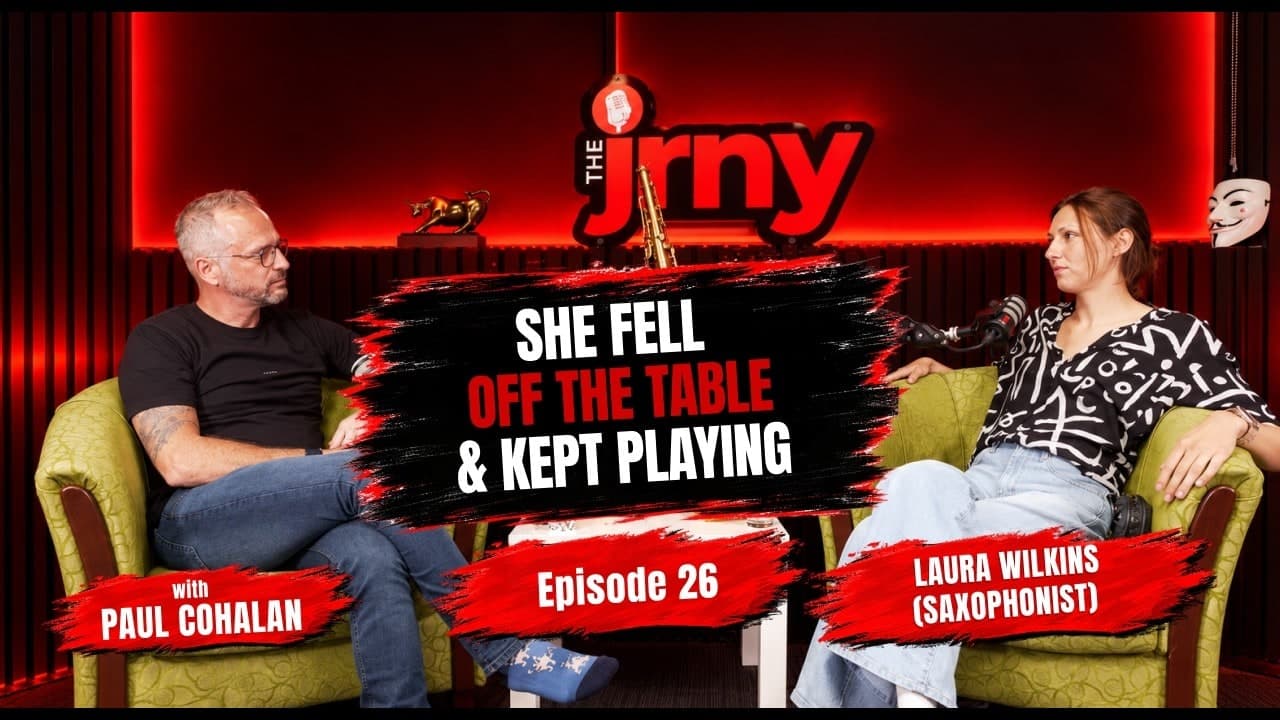
Meet Laura Wilkins
Saxophonist, playing with DJs and the Junkadelic Brass Band
Laura Wilkins is a saxophonist who grew up in Devon in England and lives near Fremantle, Western Australia. She learned flute at primary school, took up the saxophone at about 15 because of the ska music then big in the UK, and studied jazz music performance at college before arriving in Perth as a 20 year old backpacker in 2008. She started performing live in Perth close to 10 years ago with an original band, and now plays alongside DJs at weddings and private events and with Perth's Junkadelic Brass Band. Music is now most of her income.
Episode summary
In episode 26 of The JRNY podcast, Paul Cohalan sits down with Laura Wilkins, a saxophonist who grew up in Devon in England and now lives near Fremantle. Paul first heard her play two years ago at a charity night he helped launch at Fremantle Prison, and he has a soft spot for the sax because, growing up, it was the one instrument his dad always loved. The recording itself came together on the day. Laura had a cancellation and offered to catch up for a coffee, Paul suggested they do the podcast instead, and an hour and a half later she was in the green chair with her shoes off, because, she says, she cannot wear shoes and be vulnerable at the same time. She learned flute at primary school and took up the saxophone at about 15, mostly because ska music was big in the UK at the time. After her GCSEs she stayed on for a year of A levels, changed her mind, and did a two year full time course in jazz music performance at college. Then, not knowing what she wanted to do next, she went to Koh Samui in Thailand to do a TEFL course and volunteer as an English teacher in schools. Her parents steered her there rather than Ecuador. She was meant to stay three months and fly home. Instead, at 20, she bought a one way flight to Perth because it was the cheapest place to get to, with no accommodation booked and no research done.
She landed in 2008 at about 10.30 at night, was questioned at the airport for having no return flight and nowhere to stay, and found there was no train into the city. She had about £250 in her bank account and was not going to spend $50 on a cab. In the baggage hall she got talking to a girl from Cornwall, not far from where Laura grew up, whose friend was picking her up, and Laura got a lift with them to a backpackers, arriving after midnight. The next day she printed resumes at an internet cafe, walked around Perth with them, and had a job at a cocktail bar in the city within three days. It could have been a disaster, she says, and Paul calls it the roadblocks, risk and resilience the show is built on. A string of jobs followed, from admin at a cabinet maker's that turned into sanding and building kitchens, to cleaning barnacles off oyster shells on a pearl farm at Monkey Mia while travelling in a van. Her instruments were shipped over a couple of years later, once she knew she was staying, and Fremantle, with its old buildings and stories in the streets, felt like home. The turn back to music came while she was working Monday to Friday in an office. After a breakup she went through what she calls the reinventing yourself stage. As a kid she had always wanted to be an artist, a musician or an actor, and watching other people chase their dreams in music gave her a pang she could not place at first. Journaling, she worked out why: it was what she wanted to be doing. Close to 10 years ago, at 28 or 29, she started playing in the Perth music scene with an original band, took lessons as she got back into it after years of not playing much, and has been performing ever since. Along the way she made a decision she still lives by: fear on its own is never a reason not to do something.
The rest of the conversation is about the working life of a saxophonist. Laura plays alongside different DJs at weddings and private events, usually without a set list, because she prefers to play to them and leave the DJ free to read the crowd. It might not always be perfect, she says, but it is real. She also plays with the Junkadelic Brass Band, a Perth band of about 20 years whose percussion is made from junk, with a bass drum made from an old barrel and drums from paint buckets. When they recorded, she had just come back from nine days up north playing Exmouth and Coral Bay, with rhythm workshops in schools on the way up and a drive home from Coral Bay of 12 and a half to 13 hours. She has played in Broome, on Cocos Island, at a wedding in Vietnam and at shows in India. She talks about falling backwards off a wet, wobbly bar table after kneeling to solo, bending things back into place on her alto with her house key and climbing back up to a cheer, and about why a small, quiet group staring at her is more terrifying than a lively crowd of a couple of thousand. She talks too about the flow state she is always after on stage, and the phases, almost every year, when she wonders what she is doing with her life before remembering that she loves what she does. She brought in a secondhand tenor sax that Paul puts at over 100 years old, and plays a little of it on air. She works week by week, and was heading to Esperance that weekend to play a wedding. Next, she wants to finish writing original music, something that has been on her list for close to five years, and she is learning to DJ, though she likes working with people because it can get lonely up there on your own. Her parting thought: no matter how old you are, you can always pivot.
Key takeaways
Fear is never the reason. Laura says she has never managed to stop caring what people think, and still struggles with it at times. But when she was younger she made a conscious decision that she would never not do something because of fear. If something is scary, that alone is not a reason to say no. She needs a reason other than fear. And if you skip the things that matter to you because you might fail or be judged, she says, the people you were worried about are not the ones who have to live with it. You are.
Listen to the pang. Working in an office after a breakup, Laura kept feeling a pang whenever she saw people working in music or chasing their dreams. At first she was not sure whether it was jealousy or just discomfort. She was journaling at the time, wrote about it, and realised she felt that way because it was what she wanted to be doing. She was not unhappy, but there was more she wanted to do, so she joined an original band. Paul calls the journaling the nugget: when you are going through a bad time, write it down.
It could have been a disaster. Laura arrived in Perth at 20 with a one way ticket, nowhere booked, no train into the city and about £250 in the bank. A chance conversation in the baggage hall got her a lift to a backpackers, and within three days she had a job in a cocktail bar. Everything worked out really well, she says, and it could have been a disaster. Paul's point is that moments like that sit behind the risks you take later in life, the sense that there is not much you cannot handle.
Play to the DJ, not a set list. When Laura plays with a DJ she usually starts quietly in the background to orient herself to the music, then plays to whatever they put on rather than to a fixed list. If the DJ is locked into songs she has chosen, she says, they cannot do what they do best, which is read the crowd and get people on the dance floor. A wedding couple might ask for a few songs, but the rest is vibed out on the night. It might not always be perfect, but it is real, and you get something different each time.
Chase the flow state. The gigs Laura enjoys most are the ones where she gets into a flow state, where everything else disappears and she is just there doing the thing. The harder nights are usually the ones where she struggles to get there. It comes in phases: a great run of shows, then a few that are not, and the imposter syndrome that comes with them. She goes through it almost every year, she says, swinging between wondering what she is doing with her life and remembering that she loves what she does.
You can always pivot. Laura's career did not follow a plan. She ended up in a band with a DJ who knew lots of other DJs, people kept asking her to play, and years later that was simply what she did, to the point that people now ask her for promotional material she never needed. She does not think a failure is a failure if you learned something, pivoted and tried again. Her message to anyone listening: no matter how old you are or what you are doing, you can always pivot, and if you do not like the next thing, do something else again.
Resources mentioned
- Feel Estate, the video DJ and live band act Laura plays saxophone with
- Feel Estate on Instagram
- Junkadelic Brass Band, the Perth band with drums made from junk
- Junkadelic Brass Band on Instagram
- Benny's Bar and Cafe, Fremantle, where Laura played monthly for a couple of years
- Metropolis Fremantle, home of Feel Estate's monthly residency
Transcript
Read the transcript
This transcript was generated automatically and lightly edited for readability. It may contain minor errors.
Paul Cohalan: So how many times in your life have you gone? There's not much I can't handle.
Laura Wilkins: I bought a one way flight with basically no planning. I only had about £250 in my bank and I ended up chatting to a girl from Cornwall and she had a friend who was already in Perth who was coming to pick her up and we're going to the backpackers. Everything kind of worked out really well and it could have been a disaster.
Paul Cohalan: Could have been, but it wasn't. All right, so we've got Laura on and little funny story here, but where we're going to start with actually is the shoes. So I'm going to do the same. Now I'm going to tell you about. She just asked if I take my shoes off. She's a little bit nervous now. This is someone that plays the sax, goes to events, flat out, just traveled north, plays with bands, everything. And she sits in the green chair after setting up and goes, I'm a little nervous, I'm actually dumbfounded. But anyway. And then she asked, if you take your shoes off, I'm going to just be you. And this is after having a wine across the road at the Foreign Exchange together.
Laura Wilkins: Whenever I go and see my psychologist, it's the first thing I do. I take my shoes off and I sit cross legged and I put a little cushion behind my head and I get ready and go, okay, I think I can talk now.
Paul Cohalan: That's cool if that's what. But once again, there's no rulebook, right? So I'll tell you why it was cool that you said take your shoes off now for about three.
Laura Wilkins: Oh, you're not wearing matching socks.
Paul Cohalan: No, no, no, let's talk about, you know, I haven't talked about this yet. This is one thing I wanted to do on socials right now. I, I was like regimented, Navy, all that. So it was always same socks, bed, you know, all the shit right now, I reckon, and this is why I learned you can change is I reckon five years ago my daughter, no, six years ago my daughter gave me two odd socks.
Laura Wilkins: I couldn't deal with that. I couldn't leave the house.
Paul Cohalan: I know I was the same.
Laura Wilkins: And I'm an artist, I'm a creative. Yeah, you should be, personality.
Paul Cohalan: So I, so one day I go, hey, daughter give me two socks. And she gave me two socks. And what I did is I told a story with them, I swear, I swear to God, since that day, unless it's a wedding or sport. So if I get up in the morning and Go running, white socks, ankle, whatever. No. Or I go to a wedding, black socks, you know, whatever. Every other day since. Probably five years ago, six years ago. And no. And this is no shit. I wear odd socks.
Laura Wilkins: And it's a conscious decision.
Paul Cohalan: And I'll tell you there's more to it. And I've been. I was going to do this just.
Laura Wilkins: As you feel uncomfortable.
Paul Cohalan: Love it. And I was going to do it. I'll tell you why. Because I was going to do it as a single social page separate to my own. I tell a story every time I put a sock on. When I pick my socks, I got a draw. I just had a cleaner come and do some of my clothes, right. Because I'm a lazy. And I got chatting with her and I'm like, them socks that you don't have to match my sports socks. And you know your black socks, you do my socks. Just bought. My kids just bought me these for Father's Day the other week. I got shitloads of these style socks, all different stuff. Now I woke up this morning, I'm like now I had something that was really crucial today. So I went through and I just quickly. Every morning I could actually do a social post every morning on the story of putting my socks on for the last five, six years. No word of a lie before that. You will never get me to wear odd socks now. Just think about how I think about that. It's huge, right?
Laura Wilkins: I love how.
Paul Cohalan: But you just made me tell you.
Laura Wilkins: It's a part of your life.
Paul Cohalan: Because my daughter shifted me. My daughter shifted me big time. And yeah, because there's a lot out of that. A lot out of it is that we can change. And because we're. Our mindset set on something, it doesn't mean it can't shift. So let's go back to our mind being the most powerful thing, negative or positive, which we all know, you know, there's a reason we see psychs. I see what. Cause our minds, either they're there or hang on. If we're diagnosed undiagnosed, it could be there, there, there, there, there.
Laura Wilkins: Yep.
Paul Cohalan: We just spoke about this over a while, but anyway, I had, and I had a big spreadsheet and something to happen. I still haven't handed it over, but it's done now. And I kind of touched on it with you earlier and it kicked my ass a bit today. And I knew now what do you think the dogs were. This is crazy. This is crazy. I'm so glad we told you because I'm Actually going to do this every month now. Huh?
Laura Wilkins: Okay. Did you have pug puppies?
Paul Cohalan: No, I got French bulldogs, but my kids love dogs now. When I bought these, they bought me two or three pairs of different dog socks. I never wear the same one together, but when these go on, they're just a random. They're like the joker or the ace card. They're just the good luck. So they're like, I need luck today. So I knew I had two or three things on, but there was a couple of big rocks that I had to get done. And it was off the back of this spreadsheet I had to do to do with business. And then this. And then I've got a couple others that have got insurance on them. Some have got dollar things. So it might be like an accountant meeting my whole day. Honestly, I swear to God, every morning, if I'm wearing boots and socks like this and not activewear, there is a story every morning. And you. I've always wanted to kick it off. Even 12 months ago, I spoke to one of my team members. I'm like, I really want to do this because I reckon it'll like. It'll relate. Right. It's just different. And I have not done it until just then. I have not done it till then. No one knows this.
Laura Wilkins: So even though they're odd, you choose them.
Paul Cohalan: You choose the specific ones. I choose it. I choose it. I'll go through me draw. It'll be quick, though. I make quick decisions. It'll be like, what have I got on today? Yep, that needs some help. So it'll be either good luck. So it's like, there's no help. It's just like, hopefully something comes together. Cause it's a bad day or a good know, whatever.
Laura Wilkins: Yep.
Paul Cohalan: Or it'll be like, I tell you, I got. I got ones with pelicans on it. Is it pelicans? No, not pelicans. Stalks sit up, right? So it might be a corporate event or meeting. And I'll be like, gotta be wearing prim proper. Honestly, no one knows this. This is what goes through my head. And they're pink socks and they got long legs and they sit upright.
Laura Wilkins: Love it.
Paul Cohalan: So I'll put one, only one, though. And the other one will be like, I don't know, whatever the it is. And I've got some that I wear on Fridays and I've got like, I got funny ones. I've got dad joke ones. So there'll be a Friday one usually. I got lunch today. It'll be like, I can relax a bit. Or it'll be like, had a big win yesterday or a big loss, or get your ass into gear. It'll be like. Could be a picture of. I don't know. I've got Vegemite ones. I got. It's cool. It's actually cool.
Laura Wilkins: That's so. Okay.
Paul Cohalan: And I have not done it. This is the first time I spoke about it, but.
Laura Wilkins: So I want to know this, Right. What happens if you don't have any odd socks?
Paul Cohalan: I do.
Laura Wilkins: And you have to.
Paul Cohalan: I'm gonna send you a photo.
Laura Wilkins: What happens if the laundry gets behind? For example, like, you've never seen your photo where. Okay, you just got too many socks.
Paul Cohalan: Yep. And then they're not folded together, they're thrown in. And that's hard for me. Cause I'm regimented and I'm full clothes. But it makes sense for me now. So what that teaches you is you're only trapped into what your mindset and what your belief is limiting belief.
Laura Wilkins: But it's still like a rule. Right? Like, so my rules change. So it's your rules changed, but it's still about flowing.
Paul Cohalan: Yeah. Yeah, that's true. It's still a regiment there. Yeah. Because I can't wear same socks now.
Laura Wilkins: Yeah.
Paul Cohalan: You will not get the same sock on me.
Laura Wilkins: That's why I was brand new. You will not get the socks. That's why I was curious if you ran out of odd socks and you were stuck.
Paul Cohalan: I won't. I'm going to send you a photo.
Laura Wilkins: Like, would that be as uncomfortable as it would have been beforehand?
Paul Cohalan: Probably.
Laura Wilkins: Do you know what I mean?
Paul Cohalan: Probably. But not if it's black or sports socks. No problem. Put them on. Boom. Go for a run. Oh, I wouldn't wear odd socks running.
Laura Wilkins: But like, Friday morning comes and you've only got matching white socks.
Paul Cohalan: Trust me. I'll send a photo of you.
Laura Wilkins: Do you have a panic attack?
Paul Cohalan: No. Gonna.
Laura Wilkins: Eggs.
Paul Cohalan: I go back in the washing and take one dirty one just to mix it up.
Laura Wilkins: You can't wear a dirty one and a clean one.
Paul Cohalan: I do that over the same. No problem.
Laura Wilkins: So I have to hang them up on the washing line facing the same way.
Paul Cohalan: This is a whole different conversation.
Laura Wilkins: I know, right? And I didn't realize it wasn't normal until my.
Paul Cohalan: What do you think everyone did until my.
Laura Wilkins: Well, I just thought that that was how you would do it.
Paul Cohalan: I love that you said, I want to take my shoes off because I'll do the same.
Laura Wilkins: You gotta get comfortable. Yeah.
Paul Cohalan: You do.
Laura Wilkins: You do I don't know what we're going to talk about here. It could be, you know.
Paul Cohalan: I do, I do. Well, I know how we're going to start.
Laura Wilkins: I can't wear shoes and be vulnerable at the same time.
Paul Cohalan: Oh, you can't. Yeah, that's true. Thanks is for one. And the thanks is that Laura, we only organized this an hour and a half ago when I was eating some lunch down the road after I'd already recorded, after I already had claims meetings and insurance meetings and client meetings. This because this morning, a couple of months ago, I'm going to throw her under the bus here. But she doesn't mind. Yeah, I messaged her because. Okay, I'll go back a step. Again, we don't know each other well, but two years ago, I helped launch Night at the Doghouse charity and the Fremantle Prison. And Laura was there playing the sax. And I was just telling her, before growing up, my dad always loved the sax. So I got a soft spot for it because I really do appreciate it because my dad drummed it into me goes one instrument. Not that he didn't play music, but one instrument he always loved was the sax. And the moment it got mentioned that you could play it there, we locked you in, like, at the Fremantle Prison. And it was amazing. It was wicked. And I remember texting you after saying thanks, if I went back through my chats. I'm like, thanks for the other night. It was wicked. Blah, blah, blah. And then about two, three months ago, I think I messaged you because I always had you in mind of what I. Long list. I probably still haven't got to some. Laura, I got a podcast, be wicked for you to sit in the green seat. I think that's what I say to the people now. Anyway, I haven't heard from her because she's busy playing the sax, traveling around bands. We'll talk about that soon. It's so funny, actually. I love it. Anyway, I get in an Uber this morning after a meeting. She texts me, hey, sorry, I haven't got back 300 days, however long it is. Hey, it was six weeks.
Laura Wilkins: It was six weeks.
Paul Cohalan: Six.
Laura Wilkins: I remember. I remember going, oh, damn, I left it six weeks. Whoops.
Paul Cohalan: Okay, so I'm saying three months. So, all right, six weeks. So I'm like, you know what the timing is. And I'm a bit like, like, let's just do it now. Otherwise you don't get it done, you know, go back to Elon Musk and all that. So I'm like, I try and do Shit things in the moment if I can. You texted and I'm like, I just dialed your number as basically as you texted.
Laura Wilkins: I did. I'd barely hit send and I'm like,.
Paul Cohalan: Sorry for ringing so quickly, Laura. I thought that was a bit. I said, but I just got in an Uber and it was perfect timing. I said, tell me a bit about what's going on. And you touched on. You just done nine days going up north, playing in Exmouth, Coral Bay. You play with a few different bands. We had a really quick chat and it was really cool. And I'm like, only last night when I went to bed, I was like, I haven't got anyone for tomorrow and I want to keep the couple up my sleeve recordings. And I didn't worry about it today because I had a busy day. But then it just. Once again, the universe, it made sense. Later on, I'm sitting at lunch and I'm like, so I sent you a voice message. I think I'm like, hey, how about, hey, do you want to catch up soon? You're like, I've had a cancellation today. I could catch up for a coffee. And then I'm like, why don't we just do the podcast today? I had to feel you were that kind of person.
Laura Wilkins: Yeah, well. And it was also good for me because when you first said that you do the podcast Normally at 8am on a Wednesday, I was like, I'm. I'm not a morning person. I don't become human until I have my first coffee of the day. I don't even like driving until I've had a coffee because I'm scared that's cold. And I don't normally have my coffee until a little while after 8am in the morning. So this works for me. I get an arvo.
Paul Cohalan: I love it.
Laura Wilkins: I get an arvo slot. I have to explain myself initially.
Paul Cohalan: Coffee first, then drive. So you know what? It's worked out really well. I love it. We just caught up quickly for a wine across the road because I need a little break. And she was just coming up through the city and it's worked out really well. So I think Sax Lady in it. Lady. Sax. Sax Lady. Laura.
Laura Wilkins: Sax Lady. Laureli.
Paul Cohalan: Laureli. Amazing. Gonna hear heaps about her. I know at the moment and it's informal and I hope she's relaxed now. Cause that's what she was a bit worried about. But. But she obviously entertains in front of many more people than I ever do and does an amazing job. And we're about to find out about it. So thank you and welcome.
Laura Wilkins: Thanks for having me.
Paul Cohalan: And. And also on a fly, I know she probably needed it, but I said can you bring something with you? Because I love having something in the picture that relates. And we have here a saxophone that is over 100 years old. Now. Let's start with that. Please tell me about that. I'll chop and change, but that I want to know about. That's. That's awesome.
Laura Wilkins: Okay. Yeah, I. I bought this secondhand a few years ago when I decided I wanted to start playing tenor ten.
Paul Cohalan: So I'm gonna butt in here. Sorry.
Laura Wilkins: But yeah, yeah. So this is a tenor sax.
Paul Cohalan: Yep.
Laura Wilkins: And the one that I often play, which I would have been playing the night that couple years ago me, a couple of years ago, is an alto sax.
Paul Cohalan: Okay.
Laura Wilkins: And then I decided I wanted to start playing tenor sax for a bit of fun.
Paul Cohalan: There's alto and then tenor sax.
Laura Wilkins: Yeah. So. Well, there's. There's a few more. There's also soprano, which is even smaller than the alto. There's baritone, which is even bigger than the.
Paul Cohalan: So their length are they. Or style shape.
Laura Wilkins: So the biggest. The instrument is the lower in tone it is. So they've got different pitch ranges. So if you were in a choir and you were singing soprano, you would be the. The high. I'm not going to do it, but high pitch. But yeah, you would be the high. You about to do it about it. But I only had one wine across the road, so you should have got a bottle.
Paul Cohalan: We got Japanese whiskey here.
Laura Wilkins: Yeah. So I bought this one secondhand from. From someone who was dealing in. In vintage saxes. Someone. Someone actually found it for me, a guy I was getting lessons with in Perth at the time.
Paul Cohalan: So only a couple of years ago, you said two, three years ago.
Laura Wilkins: Do you know what I say? A couple. But it was probably a lot longer than that. It was probably.
Paul Cohalan: So you're doing a me five times.
Laura Wilkins: I mean, my. For me, five minutes is 20 minutes and it probably translates to. To years as well. So I love it. Yeah. So. So I mean, I don't know the story of it, but yeah, I mean it's got a few.
Paul Cohalan: Like what's the brand? What do you call the brand?
Laura Wilkins: There's a new New Zealand penny.
Paul Cohalan: Oh, is it. Is that what that is?
Laura Wilkins: Yeah, I'm not even. I'm not even quite sure why, but I really like that.
Paul Cohalan: That's cool.
Laura Wilkins: And yeah, so it's an American brand. It's an old Conn. Yeah.
Paul Cohalan: Oh, so it's American. Yeah, yeah, it's it's got wear and tear. It's actually really cool.
Laura Wilkins: Yeah, well, I like the.
Paul Cohalan: I've never seen one up close.
Laura Wilkins: Probably had this, this huge interesting life. Well, I mean, it might have had a really boring life, but it doesn't look like it's got it.
Paul Cohalan: It's got to be something.
Laura Wilkins: Looks like it's been through some stuff. The first time I saw it, I was like, looks like it's been through some.
Paul Cohalan: So, you know, obviously for you to. For us to sit here on the podcast and have this and then you buy this, let's say 10 minutes ago, but five years ago. What, what. So what made you. When did you first put your lips around one of them sax things and whatever it was called. And what was the first one? And when was it like, what got you into it? What goes. Was it school? Was it later?
Laura Wilkins: I first started playing sax when I was about 15.
Paul Cohalan: Okay.
Laura Wilkins: Mostly because of ska music, which was really big at the time in the UK. ska music? Yeah.
Paul Cohalan: So tell us a bit more about that. I don't know much about what's ska music?
Laura Wilkins: I don't know like enough to comment. You would have heard it, I'm sure, like Madness. That was one of the old British. British ska bands. It's very much about up strumming and horn instruments. Predominantly sax.
Paul Cohalan: Yep.
Laura Wilkins: There's been a few. Few new waves of ska over the last few years.
Paul Cohalan: I love learning video games.
Laura Wilkins: I think there's.
Paul Cohalan: What.
Laura Wilkins: I think a lot of guys have gotten into ska because of video games.
Paul Cohalan: Is that right?
Laura Wilkins: I think there's some video games that. That have ska music in the background. I don't know. I don't really play video games, but.
Paul Cohalan: I have to ask my boy.
Laura Wilkins: Yeah. So that was why I got into sax in the first place. But I grew up. I grew up learning flute from primary school.
Paul Cohalan: So are they. Obviously to me it's similar. But is it similar? Is it. Would it be a reason you go to sax from flute?
Laura Wilkins: Quite similar, yeah. A lot of the, like the key work and the. And the fingering. That's quite similar.
Paul Cohalan: Yep.
Laura Wilkins: Flute doesn't have a reed. Sax has got a reed.
Paul Cohalan: Yeah, that's that bit. Sorry, excuse my naiveness.
Laura Wilkins: But so. So this is a reed. Oh, I've actually got a synthetic one.
Paul Cohalan: Oh, actually I do know.
Laura Wilkins: But it's normally a little piece of wood.
Paul Cohalan: You know why I know what a reed is? You know why I know what a reed is? Because there's a reed valve in a two stroke motorcycle and it's and it's the same reed. So it must read. Must mean fine tuning noise.
Laura Wilkins: Yeah.
Paul Cohalan: Wave. Something to do.
Laura Wilkins: Yeah.
Paul Cohalan: Two pieces.
Laura Wilkins: So if I. It vibrates and. And makes the reed valve. Yeah. I recently bought some synthetic ones because I kept chipping my other reeds because I always end up dancing around and being a larrikin when I perform. And I was sick of chipping my favorite reed, so I got this for when I'm.
Paul Cohalan: I just look at it. It's the only thing that resembled. But that's cool. So you're saying. What were you saying? Doesn't have a reed. The flute.
Laura Wilkins: The flute doesn't direct. Yeah. So the flute, you blow over the top of the. The mouthpiece.
Paul Cohalan: Yep.
Laura Wilkins: Just like. Have you ever played, like a bottle flute? You know, you get an empty beer. Bottle.
Paul Cohalan: A bottle I have.
Laura Wilkins: Yep.
Paul Cohalan: And you fill it up with water.
Laura Wilkins: And you blow over the gumnut. I haven't done the gum nut. No.
Paul Cohalan: You make a whistle.
Laura Wilkins: Well, I. I didn't grow up here.
Paul Cohalan: Oh, that's true.
Laura Wilkins: Gumnut. Yeah. You're quick.
Paul Cohalan: You're good. All right, so read. And what else is different about these things? Like, tell us a bit more about it. Like, what are all these things like? To me, it's. Yeah. You hit your fingers. But obviously to you it means a lot. Yeah. Is it like a piano or. The keys are different sounds.
Laura Wilkins: I mean, I don't even know what some of the keys do, to be honest. I think there's like 25 to 30 keys on there, but you don't press all of them. Some of them you press one key and it opens or closes something else. I don't know. I didn't.
Paul Cohalan: How long have you played here for? Or have you played for? Like, going to events and private gigs?
Laura Wilkins: I got into performing live in Perth probably about close to 10 years ago.
Paul Cohalan: Yeah, I'm going to say it. You said you're 38 now, so 10 years ago. 28. When did you come to Australia?
Laura Wilkins: I think I was 20 when I first came to Australia.
Paul Cohalan: Oh, wow.
Laura Wilkins: I came here as a backpacker. You did?
Paul Cohalan: And you started playing when you were 15?
Laura Wilkins: Yeah.
Paul Cohalan: So five years later, come to Australia, backpacking. Did you have saxes you were carrying around or a flute?
Laura Wilkins: No, No, I didn't have any instruments with me at the time. I did get them all shipped over a couple of years later when I was.
Paul Cohalan: Yeah. Cool.
Laura Wilkins: When I figured out I was gonna be here. More development.
Paul Cohalan: So let's go back. I said this to you earlier. We'll talk about what you do and then we'll no doubt end up in your journey. So you come over when you were 20, so where'd you come from?
Laura Wilkins: I came from Thailand.
Paul Cohalan: Oh did you?
Laura Wilkins: Yeah, yeah.
Paul Cohalan: Why were you there? You're not Thai. I don't think you're born there.
Laura Wilkins: No. So I went there to teach English to be a volunteer English teacher in schools, do the TEFL English teaching course and I was originally meant to be flying back to the UK after that I was meant to be there for three months and then, and then I just decided not to go back and I bought a one way flight to Perth.
Paul Cohalan: So hang on a sec, let's just before we jump there because it's going to be a whole story I reckon. UK to Thailand 3 months prior Yep, yep. What made you go to Thailand to teach and volunteer? Just as a. I want to try out a bit of volunteer. I want to give back or was there a reason or you didn't know what the fuck you want to do? You want to get out of UK and where were you in the UK?
Laura Wilkins: It was the last one. I didn't know what I wanted to do and I wanted to, I wanted to go traveling and yeah, I started looking up, you know, what could I do to just anything, just something to.
Paul Cohalan: Throw yourself under the bus. Try something.
Laura Wilkins: Yeah, exactly.
Paul Cohalan: That's cool.
Laura Wilkins: And I started looking at TEFL courses and I decided that was what I wanted to do and I think I was looking at either doing it in Ecuador or Koh Samui in Thailand and my parents were a bit worried about the thought of me going to Ecuador.
Paul Cohalan: By myself, maybe understand.
Laura Wilkins: So they steered me towards Koh Samui in Thailand and yeah, I mean, I guess that was probably one of those real. What do you call them? I want to say sliding doors or.
Paul Cohalan: Yeah, one closed, one open.
Laura Wilkins: Well, I mean if I didn't go to Thailand, I wouldn't have ended up in Perth. If I wouldn't have ended up in Perth as a traveler, I probably wouldn't be here now or I mean I might have found my way here another way, but I might not.
Paul Cohalan: So. So just, just while we touch on it. So your parents UK still UK, yeah. All my family's whereabouts in UK.
Laura Wilkins: Devon.
Paul Cohalan: Okay. I have no idea.
Laura Wilkins: But anyway, cream teas, clotted cream scones, that's the home. Devon. Yeah, Devonshire cream teas. That's the, that's what we're known for.
Paul Cohalan: Look that up, Nat. We'll look that up.
Laura Wilkins: Scones.
Paul Cohalan: When I think of scones, my nan that passed Last November, Ozzy. That was the thing. I remember her making scones when we were growing up. Jam and cream. Is it jam and cream then?
Laura Wilkins: Scone with jam and cream? Yep, yep.
Paul Cohalan: She used to make it grown up, flat out. Yeah, that was her thing.
Laura Wilkins: Hey, Ned, some people put butter on instead of, instead of the cream to do the healthier version.
Paul Cohalan: Who said? Butters?
Laura Wilkins: It's more criminal than in my mind.
Paul Cohalan: But we had to bring out the. So, so you left at 20. So how was school and all that? Let's go back there quickly.
Laura Wilkins: How was school? Diving in the deep end.
Paul Cohalan: Yeah, yeah, While we're there, because I might not get you back there. Yeah. So you would have left when you were what, 18? School. How long would you go to? I don't know what goes on in the UK, how it works, but yeah.
Laura Wilkins: So in the UK you do like GCSE exams when you're 16.
Paul Cohalan: Yep.
Laura Wilkins: And then you can either leave school and go and work or do an apprenticeship or go to college or you can stay on, stay on and do A levels. I stayed on to do A levels and I did that for a year and then changed my mind and decided I wanted to study music. So I only have AS levels. I have half, half A levels only.
Paul Cohalan: But it's better than not doing any of it.
Laura Wilkins: Yeah.
Paul Cohalan: And, and look where you are, doing music.
Laura Wilkins: So I, I, I do everything.
Paul Cohalan: Yep.
Laura Wilkins: Like this.
Paul Cohalan: So there's no rule book. We can do whatever the fuck we want. Makes us happy.
Laura Wilkins: Well, exactly. You've chosen your own rulebook with the socks.
Paul Cohalan: And I don't think we're gonna let this go through the whole. I love it.
Laura Wilkins: No, I, Yeah, no, that's cool.
Paul Cohalan: Good on you. And obviously you're a bit of a spontaneous or trust your gut or go with it. And you probably haven't changed, I'm guessing, right?
Laura Wilkins: No.
Paul Cohalan: Even just from meeting you properly today. Cause we didn't really know each other, but that's really cool. So you left, you tried it. You're like, I wanna do music. And then did you have a bit of a gap there? Or did you just do music at home? And then at 20 go, I'm gonna find something.
Laura Wilkins: Did you? No. So I applied to, I applied to college and did a, it was like a full time two year course at college doing jazz music performance.
Paul Cohalan: And then because that just quickly sax and all that's jazz, isn't it. Like that. That's the, I mean, it doesn't have to be, it doesn't have to be.
Laura Wilkins: Like you can, you know, you can play sax in ska music or punk.
Paul Cohalan: Or any of it really pop. Once again, no rulebook blues, the Commons.
Laura Wilkins: But it's so well known for jazz that I think a lot of people,.
Paul Cohalan: The foundation think of and talk of,.
Laura Wilkins: Talk about the saxophone and jazz interchangeably.
Paul Cohalan: Just quickly on that. And I do this a bit. Tell me where you would go in Perth to watch jazz. Cause I actually like jazz. Cause I like the sax. I don't know nothing about it. And I was only talking to someone probably three, four weeks ago about, like, where in Perth. There's actually a few jazz places in Perth, but is there one that comes to mind with you or not, or you stay clear because you play your own.
Laura Wilkins: So if I'm not out performing, I often don't go out. So you are like. Well. So I spend so many of my weekends and nights out performing that if I have a night off, I'm like, I'm gonna stay home in my pajamas and wine.
Paul Cohalan: Yep.
Laura Wilkins: And order pizza and you watch a movie. The basics or, you know. And I do, you know, I do seek it out when I go on holidays.
Paul Cohalan: Oh, do ya?
Laura Wilkins: Yeah, yeah. So if.
Paul Cohalan: And you're like, what's this? Where's the jazz place or the sound?
Laura Wilkins: I like going to Ronnie Scott's famous jazz club in London. So when I go to the UK to go and visit my family. Yeah, I usually try and try and get there.
Paul Cohalan: How long. How often do you go back to the theme?
Laura Wilkins: I try and do it every two years, but the last couple of times it's ended up being a little bit longer. Especially with COVID Yeah, of course. Because I was planning to go that year and then everything shut down for a few years and it ended up. It ended up being about five years.
Paul Cohalan: Yeah.
Laura Wilkins: Four or five years.
Paul Cohalan: Time goes though, doesn't it, Seeing my family. Especially when there's English.
Laura Wilkins: Yeah, it's strange. Yeah.
Paul Cohalan: Yeah, it does. Heaps cool. All right, so. All right, so 20, you hit Perth, you hit Thailand. Three months there teaching English. How was that? Did that teach anything? What'd you learn from that in Thailand? Teaching English? There's a whole world out there. I've left the UK.
Laura Wilkins: I don't know what I learned. It was so long ago.
Paul Cohalan: You learned that it was a stepping stone to Perth.
Laura Wilkins: I learned that it was a really fun place to be.
Paul Cohalan: Did you party?
Laura Wilkins: I did a little bit, yeah.
Paul Cohalan: Full Moon Party. Koh Samui.
Laura Wilkins: I did, yep. Yeah.
Paul Cohalan: Okay. We'll never hold that against anyone.
Laura Wilkins: I was just happy to be out of the UK. And out doing my own thing and you know, I, I remember walking down to the beach near the accommodation and there was no one on the beach and there was just a palm tree sort of hanging over the sand like in the movies, like in the postcards and the movies. And I walked out into the ocean just by myself in this like warm paradise and was like, I've made it.
Paul Cohalan: Yep, I'm done and I'm 20.
Laura Wilkins: I don't care what happens now, I've made it. Like you grow up in the UK and it's cloudy every day, you, you see a, you know, picturesque tropical paradise and you're like, I made it, I'm there. It doesn't matter what happens now, I'm there.
Paul Cohalan: The rest is a bonus. Yeah, yeah, that's cool, that's cool. So what did you think when you landed in Perth after being in Thailand and you got this postcard and then you flew to Perth and did you land going I'm going to stay for a while or was it like another three month thing? Because that's what we all do and then we ended up staying here. But yeah, what was it when you landed? What was your thought pattern?
Laura Wilkins: When I flew here I bought a one way flight with basically no planning. Perth was the cheapest place to get to. I love this from Bangkok. So I bought a one way flight to Perth and I hadn't booked any accommodation or done any research before getting.
Paul Cohalan: On the plane as a 20 year old.
Laura Wilkins: Typical. Yeah. And so I arrived in Perth at about 10, 10:30 at night and I just thought, yeah, I'll just, when I get there I'll just catch the train into the city and I'll find some accommodation and I'll, you know, and then you get here sort of. I mean this was, this was a little while ago a little bit. There was no, no train into the city then and, and I arrived and I got questioned because I didn't have a return flight and I didn't have anywhere booked to stay. So I got, I got questioned at the airport about all of that.
Paul Cohalan: You didn't have a saxophone full of drugs or anything, did you?
Laura Wilkins: No, no. I mean if I did I might be, I might be really wealthy now.
Paul Cohalan: Yeah,.
Laura Wilkins: But so that, so that was the first thing and then I got through and then I realized, oh, this is kind of in the middle of like nowhere and there's no train to the city and it's like a 50.
Paul Cohalan: Where'd you go?
Laura Wilkins: Cab or whatever or our airport back 18 years ago or waiting four or five hours to get a standard coach into the city. And because I hadn't thought it out, like I only had about £250 in my bank account because I was a 20, 20 something.
Paul Cohalan: That would have been a lot for a 20 year old, wouldn't it? Traveler.
Laura Wilkins: That was. So I was like, I'm not going to spend $50 on a, you know, on a cab into the city. And so I, yeah, I went to baggage and I was thinking, I don't know what I'm gonna do, but I'll figure it out. And I ended up chatting to a girl from Cornwall, which is not too far from where I grew up.
Paul Cohalan: Oh wow.
Laura Wilkins: And she had a friend who was already in Perth who was coming to pick her up and they were jumping with us. We're going to the backpackers. So I did. We arrived there after midnight on. I was really lucky that I bumped into that.
Paul Cohalan: Do you still talk?
Laura Wilkins: So I, I saw one of them a little while ago.
Paul Cohalan: Yeah, I love that stuff. Like you know, 18 years ago, years ago.
Laura Wilkins: But yeah, it was one of those moments where I was like, everything kind of worked out really well and it could, could have been a disaster.
Paul Cohalan: So could have been. But it wasn't.
Laura Wilkins: It wasn't. It was.
Paul Cohalan: And most of the time it always works out.
Laura Wilkins: Yeah, exactly.
Paul Cohalan: Yeah. So you got to Perth. That's wicked. So I say this is. These are the bits that I love. These are the bits where no one stops for a moment and thinks about all that piece. Not intentionally. And you know what, it's a. I reckon to be a big piece of why you've probably taken a risk later in life because when you're 20, you come to Perth, went Thailand, Koh Samui three months, went to Perth one way ticket 400, 250 pound. You landed, you're like, it went to baggage, you met a person, you went to backpackers and look, you're all right. So how many times in your life you gone? There's not much I can't handle because magic, subconsciously or consciously that would have come up. Now these are the bits why I do this. Love it.
Laura Wilkins: Roadblocks.
Paul Cohalan: Risk and resilience. So roadblock is. Got no money and I've got a one way ticket. I've got nowhere to stay at 10:30 at night because there's no train to the city. It only just come like what, two years ago or something. The train of the city.
Laura Wilkins: Yeah, I've never used it, but yeah, apparently, apparently we got one now only jazz.
Paul Cohalan: And 18 years ago you're like, I'll just get on the train to the city.
Laura Wilkins: Yeah, I just arrived there. I'm thinking it's like London or something.
Paul Cohalan: And.
Laura Wilkins: And it's not.
Paul Cohalan: Definitely not London for many reasons. So. So you done that, you went to backpackers? What. What happened the next day? Like, you, you. You must have been happy you got a bed or asleep, even if it was sharing or, you know, whatever it was. So what happened then? 20 Years old.
Laura Wilkins: Oh, I. I went to an Internet cafe. Yeah, you know, that's where we're at.
Paul Cohalan: Dollop.
Laura Wilkins: And I. And I printed out a bunch of resumes and I walked around Perth and because I had no money, I was.
Paul Cohalan: Not an English teacher. Still in Australia, were you?
Laura Wilkins: No. Well, I was just applying for, you know, hospitality, like. Yeah, whatever. Anything. Anything. Like, I've done. I've done a lot of randomness.
Paul Cohalan: How long you been here? I got in at 10:30 last night.
Laura Wilkins: Yeah, I had a job within three days. I did my first shift. Where was it it was in.
Paul Cohalan: And is it still around?
Laura Wilkins: What was it called? I don't think it is now. Box Deli. No, it was a cocktail bar in the city. Yeah, so I worked there. I worked there for a little while. Making cocktails. Yeah. Had a string of random, random jobs over the last few years and, you know, worked at a. At a cabinet makers, started in admin and ended up sanding things down and building kitchens, whatever else. And. Yeah, I worked on a pearl farm up north.
Paul Cohalan: Oh, did you go?
Laura Wilkins: Whereabouts? Monkey Mia, for a bit.
Paul Cohalan: Oh, yeah.
Laura Wilkins: Or just off Shark Bay.
Paul Cohalan: Is that why you got a bit of a soft spot for up north now, when you go out and play, travel like, you must have always liked it.
Laura Wilkins: Yeah, yeah, I. I do like it, yeah. Because I was traveling around in a. In a van at the time. And also a bit different to London. Sorry?
Paul Cohalan: Also a bit different to London, being up there on a pearl farm.
Laura Wilkins: Yeah, well, regional here has got a very different meaning to regional in the UK.
Paul Cohalan: What's the top differences?
Laura Wilkins: Well, I mean, regional here, like, I mean, you drive to Exmouth and it's what, 14, 16? I don't even know how many hours. I mean, I did. We did Coral Bay to Perth the other day. I think that was 12 and a half, 13 hours with no stops last.
Paul Cohalan: Week coming back from tour on the Tuesday, I believe you told me.
Laura Wilkins: Yeah, yeah, Full day. Yeah, full day. Coral Bay to Perth and that was a long day. But I mean, you could. You could drive from the south of England to Scotland, probably I would think. I don't know. I haven't checked, but I would think in that time. And you're gonna, like, constantly be going past shops, fuel stations, through towns, past cities, not here, whatever. You know, he can be driving for hours and then be like, I'm hungry. And then you realize there's no. No stop with a shop for like another. Another hour or two have planned that.
Paul Cohalan: Should have got some chips.
Laura Wilkins: You should have bought some snacks.
Paul Cohalan: How many times you must have done that trip a few times now, though.
Laura Wilkins: Yeah.
Paul Cohalan: Have you done Nullarbor? East? West?
Laura Wilkins: No.
Paul Cohalan: Don't tell me you've never been east.
Laura Wilkins: I. I've been east, but I haven't. I haven't driven.
Paul Cohalan: Driven?
Laura Wilkins: Yeah.
Paul Cohalan: That way.
Laura Wilkins: No, I. Yeah, I've been to Melbourne, Sydney.
Paul Cohalan: Do you like. You like Melbourne and Sydney?
Laura Wilkins: Yeah, yeah. I'm not a massive city person in general here. I live close to Freo. I like. I like to be close enough to the city that you have the benefits of the city, but far enough out.
Paul Cohalan: Of the hustle and bustle.
Laura Wilkins: Feel like you're living in the country.
Paul Cohalan: Yeah. And WA is good for that. WA is actually good for that.
Laura Wilkins: Yeah.
Paul Cohalan: WA's ideal for that. Yeah. Yeah. It's got that feel all the time. Even in the city. The city's not a city, let's be honest. Let's be honest.
Laura Wilkins: It's becoming more of a city.
Paul Cohalan: It is. It's getting. Last five years, but, I mean, it's.
Laura Wilkins: Changed hugely just since I've been here and I came here in 2008. So. Yeah, it's. Yeah.
Paul Cohalan: Pill farm. What'd you do on the pearl farm?
Laura Wilkins: Cleaning off the oyster shells. Yeah. So we would go out on a. On a boat and we would pull up these socks that had all of the pearl shells, oyster shells, kind of tied to them. And then we would clean all of the barnacles and stuff that was growing off them and put them back. That was amazing because we were. We were working off this little platform in the middle of the ocean.
Paul Cohalan: Yep.
Laura Wilkins: And we'd throw a fishing line in at lunch and jump in and. And have a swim and.
Paul Cohalan: Oh, good.
Laura Wilkins: Yeah, it was stunning.
Paul Cohalan: Do you swim? Do you swim much off the beach?
Laura Wilkins: Yeah. Off the beach.
Paul Cohalan: You do?
Laura Wilkins: Yeah. Yeah.
Paul Cohalan: What about sharks? Every see you go back five years, everyone's response is, ah, you better chance getting hit by a car. These days, nearly everyone swims in the waters, like.
Laura Wilkins: Yeah. I mean, I'd rather go shark by crocodile.
Paul Cohalan: That's a good one. I've never heard that. Way of putting it, that's true.
Laura Wilkins: There's always something that could be worse. Right.
Paul Cohalan: That's gold. I'd rather be shark by crocodile. I have not heard that.
Laura Wilkins: I mean, I've heard that normally it's quite quick. They just kind of bump you and.
Paul Cohalan: Does that mean you throw yourself out there or does it like just because you'd rather be by shark than a crocodile?
Laura Wilkins: Do you know, I do get a bit nervous sometimes. Most of the time I'm fine, but every now and again I'm out there and then I just go, how's the last couple of weeks?
Paul Cohalan: It's been a lot the last couple of weeks, you know, with that whale carcass and then the guy, what, two weeks ago, three weeks ago, 15 meters offshore.
Laura Wilkins: I didn't even know about that.
Paul Cohalan: I really, really sad.
Laura Wilkins: My theory is ignorance is bliss. Like I. I mean I. I decided 10 plus years ago that I wanted to learn to surf.
Paul Cohalan: Yep.
Laura Wilkins: And so I started going out and going out for a paddle and I mean, like I've never been very good, but I. I just enjoyed it and.
Paul Cohalan: Saxophone on the surfboard.
Laura Wilkins: I've never tried that. I have played. I have played on a skateboard.
Paul Cohalan: The saxophone.
Laura Wilkins: Yeah. Yeah. I. I used to do a bit.
Paul Cohalan: That's cool.
Laura Wilkins: In. In my band, Feel Estate. Do you remember the whole Ocean Spray cranberry. The cranberry juice skateboard. It was like a TikTok viral.
Paul Cohalan: So it wasn't long ago because it's TikTok. So I'll say yes and I don't really. And I'll search it later.
Laura Wilkins: Well. Well, there was a. There was a viral skateboarding Ocean Spray cranberry juice thing that was going around a few years back to what's the band. There was a specific song. I can't remember the band.
Paul Cohalan: I'm going to Google that.
Laura Wilkins: You'll find it if you look it up.
Paul Cohalan: I'll know it if I hear it and.
Laura Wilkins: Yeah, so we used to do a bit where one of the guys would push me along the stage on a. On a pink Penny skateboard.
Paul Cohalan: Oh, that's cool.
Laura Wilkins: And I would solo. And then when we got to the end, he'd hand me the bottle of Ocean Spray and I'd drink the cranberry juice on stage at Metros in Freo.
Paul Cohalan: That's cool.
Laura Wilkins: We did it in a. In a few random places. It was just a funny.
Paul Cohalan: Like, did it really hit? Did everyone know?
Laura Wilkins: Yeah, it was a fun moment.
Paul Cohalan: How long ago was that?
Laura Wilkins: Yeah.
Paul Cohalan: So it must have been only a Few years was it? I mean, here we go again.
Laura Wilkins: 10 Minutes exactly.
Paul Cohalan: Like who knows?
Laura Wilkins: To me everything is a few years ago. But yeah, maybe it was five years.
Paul Cohalan: Ago when you bought the tanks.
Laura Wilkins: Who knows?
Paul Cohalan: Yeah, that's cool.
Laura Wilkins: Yeah. So what were we talking about? Sharks? Yeah. Sometimes I'd be. Sometimes I'd be driving to the beach to go out for a paddle and. And then I'd have like a really fun time out there and I'd get home and someone would mention like a shark attack or a beach being closed that was really close by because the shark had been spotted. And I'd be like, oh, thank goodness I didn't have the radio on because I would have missed out on a really fun surf if I had heard that on the way.
Paul Cohalan: What a way to look at it.
Laura Wilkins: So, yeah, ignorance can be a beautiful thing.
Paul Cohalan: Until it's not. Until it's not.
Laura Wilkins: But I mean the chance chances, I.
Paul Cohalan: Think they're gone up. I, I agree, I agree. I love the water too. Right. So I used to like. Probably the bit that I wouldn't do now I don't think I might at the time is my father in law used to have a big boat. I used to go to Rottnest and stay for five days over in one of the bays like this like 10 years ago. I used to jump we. And we'd be at the, at the reef at the opening because it was a bigger boat. I used to jump at the back, swim around the reef, go on the lobsters, you know all the stuff. Yeah, I don't think I do that now. Off the back of a reef on the deeper side. Like I still go jump the ocean now. Like I jumped in the other night with a mate at five at night. I usually do it because of the cold and the freshness and whether it's five in the morning or. And you don't think you're that far out, but you end up getting a bit out. And then that guy got done a couple of weeks ago. 15 Meters offshore, that's where.
Laura Wilkins: That's. What's that? Which beach?
Paul Cohalan: That wasn't City Beach. That was. Was it Sorrento? I. I don't know.
Laura Wilkins: I'm guessing that's far enough away from where I go.
Paul Cohalan: Yeah, they don't go you. They don't go your way there they go Northern River. No R. Not sor. That's funny. But look, I. I am definitely more weary. I don't go in the water as much, but I still, when I'm there, I'm like, odds are I love the water.
Laura Wilkins: Yeah.
Paul Cohalan: And I love, like, just love the nature and being in the water. And I'm like, I'm coming off in the moment. But then you look and you're like, the odds are now. Like, it's crazy. And whether it's.
Laura Wilkins: What are the odds?
Paul Cohalan: No idea. But I used to talk to a mate that surf tips, and he actually got bitten by a reef shark. Adam. And I haven't seen him for a while now, but he. He. He said the reef shark got him because he speared a fish and it was shallow water and he held it at the front, didn't tail it. But he surfs a lot, dives and all that. And he reckons the odds. But he. I was talking to him, why? And he reckons the current around Australia, the temperature of the water, there's heaps of things. Then there's the commercial fishing and then. But in the end, I don't blame them. I'm like, it's their territory.
Laura Wilkins: Yeah.
Paul Cohalan: I'm like, I love nature.
Laura Wilkins: Yeah.
Paul Cohalan: They're part of the cycle somewhere, need to do something. And they're pretty cool. Until they're not.
Laura Wilkins: They are. Yeah. When I was in Coral Bay the other week, we went to the baby shark nursery.
Paul Cohalan: Baby shark, Dirty shark.
Laura Wilkins: Have you had that version?
Paul Cohalan: No, I have another one.
Laura Wilkins: The club version. No.
Paul Cohalan: Is there a club version? Is there a club version? Yeah.
Laura Wilkins: Yeah. It's wicked.
Paul Cohalan: I just know. I used to play the speaker with the kids when they were younger.
Laura Wilkins: Oh, yeah.
Paul Cohalan: And we used to crank it up. And now they don't want to listen to it when I put it on.
Laura Wilkins: Yeah. But now there's a version that you might want to listen to. So.
Paul Cohalan: Do you know, I'll tell you something. Left field. Right. I played it with my driver the other day and he played it to his wife and woke her up. But there's two songs I used to wake the kids up with in the house, and one of them is chicken techno. Now, who has time?
Laura Wilkins: I haven't heard this.
Paul Cohalan: To create this. It's actually a bit tapped when you listen to it, but it's. It's funny as. I'll send it to you. I'm not. I'm not making sounds or anything.
Laura Wilkins: You have to put it in the podcast as well. I will.
Paul Cohalan: I'm gonna have to play it at some point.
Laura Wilkins: One of the reels.
Paul Cohalan: Chicken. Techno chicken. Now, everyone on our show, they're like, that's. That's Friday. And this chook comes on and he starts techno Chicken. I'm like, but who's sitting there for that moment creating this? Who thinks of it now? I've played it hundreds of times. Obviously there's an audience, but I'll wake my kids up early in the morning with it. That one. And Pump it Up. So the chicken techno. Pump it up. Pump It Up. You know that one? That's.
Laura Wilkins: Yeah, that's.
Paul Cohalan: That's.
Laura Wilkins: I know that one very well.
Paul Cohalan: So baby Sharks in it when they come over. And next Thursday, baby Shark disco club.
Laura Wilkins: See, now the. Now the one everyone wants is Bluey.
Paul Cohalan: What? Is there a club one? Is there a club one?
Laura Wilkins: Well, I haven't looked it up, but now I'm going to, because I hadn't thought about it until until now, but maybe there's a.
Paul Cohalan: Maybe there's a club when we're driving. Bluey version. I've got no license three years. But when we're in the car, I. I always come back to Crazy Frog.
Laura Wilkins: Yeah, I see that one.
Paul Cohalan: You would know it.
Laura Wilkins: I know, I. I know it. But I.
Paul Cohalan: If I said I always put it for 10 seconds because it brings out memories. I used to hear it years ago.
Laura Wilkins: And actually Tank Engine. Love that.
Paul Cohalan: Normal, or is this. We're talking club version here. Either you're talking normal.
Laura Wilkins: Either it ends up. It ends up getting played in. No. Well, it ends up getting played in, like almost every. Does it band that I'm in. We always find a way to work it in. It's just fun. It's. Yeah.
Paul Cohalan: All right, so on that. Where are you playing next publicly? I've got to come watch now.
Laura Wilkins: I don't know.
Paul Cohalan: You actually don't know where your next gig is?
Laura Wilkins: Well, I.
Paul Cohalan: You just randomly. Because you do private a lot.
Laura Wilkins: Yeah. So, like this weekend, I'm traveling down to Esperance.
Paul Cohalan: I still haven't been there yet to.
Laura Wilkins: Play at someone's wedding. And then I. To be honest, I. I genuinely have no idea what I've got on the week after that. I. I go week by week, like.
Paul Cohalan: At the typical creative person.
Laura Wilkins: Is it bad that I'm admitting this?
Paul Cohalan: If it works in public, if it works for you, there's no bad.
Laura Wilkins: Yeah. Typically, like at the end of the. The previous week or on a Sunday or whatever, I'll look at my calendar and I'll go, oh, yep. Okay. So I'm doing this gig. This gig, and this gig is this,.
Paul Cohalan: Like six weeks out. You message me back and go, hey, yeah, I'll come on the podcast. It's like the same thing.
Laura Wilkins: Well, do you Know what? Okay. So the day that I was traveling back from Coral Bay, I was like, oh, okay. So what gigs have I got on this weekend? I was like, oh, I'm playing in Yallingup in two days. I haven't booked any accommodation for that. So, you know, I'm getting home and I'm like, okay. I'm on the laptop sorting it all out. Huh.
Paul Cohalan: No, no, I'm just trying to work out your whole creative not booking last minute. But it all works out for you. I love it.
Laura Wilkins: Yeah. It's a bit of a story of my life. I actually do it and I've been very lucky.
Paul Cohalan: I'm really structured, right. Like, really pretty structured. And I got my EA and a VA and I'm all this stuff. But one thing I don't get caught up on is accommodation and flights. Like, I'll, I'll book last minute and I got to get better because it costs extra money.
Laura Wilkins: It does.
Paul Cohalan: But I'm like, but it also costs extra money to book and then it doesn't work out. And I'm really about getting a lot done.
Laura Wilkins: Yeah.
Paul Cohalan: And like I, I'll be flying sometimes and book accommodation for that night. You can nearly always get accommodation. You just might not get what you want. And I'm, I'm really big on that and I, I like that a bit as well because I am so structured in other ways. So I'm like, some of it you just wanted to. Where the universe work out what's going on.
Laura Wilkins: Yeah, yeah, definitely.
Paul Cohalan: Like today. Yeah, we'll just book in an hour. Do you want to come at 4:30? So that suited you. That was normal for you?
Laura Wilkins: Yeah, yeah.
Paul Cohalan: It wasn't spontaneous. It was like, oh, yeah, I do.
Laura Wilkins: That all the time. Yeah. I never know what's going to happen in my day half the time.
Paul Cohalan: What's your partner like? Tell me, is he organized or does he just go with the flow or.
Laura Wilkins: He's got ADHD as well. He was actually diagnosed before I was. And he was the one that. Well, he was sort of my clue that maybe I've got it too, when he was being diagnosed. So between the two of us, we're not super structured in how we do things, but it works. It works. I mean, sometimes it probably would be helpful if one of us was a bit better at getting out the calendar and going, okay, what have we got coming up over the next, you know, week. Next couple of weeks. But, you know, it's often like, oh, by the way, I'm going away next Thursday. I'll be back the following Friday. Unless you both use it.
Paul Cohalan: It's not like one's.
Laura Wilkins: Yeah.
Paul Cohalan: Fully structured and one's not. And then you're like, you didn't tell me. You're like, we're both like it.
Laura Wilkins: Well. And you can't be mad at each other when you're both like, I've done that last week. Yeah, exactly. Exactly.
Paul Cohalan: Why didn't you tell me? Because I gave you more notice than you gave me last week. And we're both the same.
Laura Wilkins: Yes.
Paul Cohalan: What's he doing?
Laura Wilkins: So he's working in the disability sector now.
Paul Cohalan: Yep.
Laura Wilkins: NDIS support work and. Yeah, yeah, yeah.
Paul Cohalan: Hard industry. Take me head off to him.
Laura Wilkins: He's just started in that industry in the last couple of years and before that he was in the wine industry. Oh, you did say that's actually. Yeah, that's where we met because we were both working for a wine distributor.
Paul Cohalan: Ah.
Laura Wilkins: He was in marketing.
Paul Cohalan: And how come he got out of wine?
Laura Wilkins: He was in sales. How come I did or how come he did?
Paul Cohalan: Just a change.
Laura Wilkins: I think his story to tell.
Paul Cohalan: Ah, I won't pry anymore then. Or you used to drunk too much wine. One that too.
Laura Wilkins: It's hard when you like wine, isn't.
Paul Cohalan: Is. So I didn't know whether you drunk wine or not or drunk much. And when I rang it, I'm like, I'm going for a wine because I need a fresh air and a walk. And you're like, did you say wine? That's what you said to me.
Laura Wilkins: I'm like, well, you were like, do you want one before or after? And I was like, oh, before, before. And I felt this wave of relief. I was a little bit nervous and yeah, I was. Yeah. I don't know. Everything's a bit easier after a little.
Paul Cohalan: And then we had a little chat and a wine too. It was good. Nah, a little intro is always good because obviously we didn't know each other at all.
Laura Wilkins: Yeah.
Paul Cohalan: So, yeah. So where are we at? Where are we at? Let's go back to your partner for a sec. That's where I was going with this. Without prying too much. Obviously confidential. You were saying earlier you've been together 11 years.
Laura Wilkins: Yeah, I think 11. Yeah.
Paul Cohalan: And your Freo background, like area, which is pretty cool. You mentioned that before and you love it there.
Laura Wilkins: I've been Freo way most of the Time that I've lived in Perth and Freo felt like home to me when I came to Perth.
Paul Cohalan: Yep.
Laura Wilkins: Because Perth is. Everything's quite new in Perth.
Paul Cohalan: It is.
Laura Wilkins: All the buildings are quite new. Everything's quiet.
Paul Cohalan: Except Freo. Well, it's starting to be.
Laura Wilkins: And then you go to Freo and there's old buildings and I was like, oh, yeah, this feels like me.
Paul Cohalan: Yeah.
Laura Wilkins: There's stories in the streets.
Paul Cohalan: Yeah.
Laura Wilkins: And I like that.
Paul Cohalan: That's cool.
Laura Wilkins: I like that.
Paul Cohalan: You can tell by your style. Even the music. All that, you know, that fits. What's the craziest thing that's happened when you've been performing? Tell me that. Clumsiness or something happened. Tell me. Tell me a story. I want to hear a story.
Laura Wilkins: I fell off a table once.
Paul Cohalan: Did you? First off, how high was the table and what were you doing on the table?
Laura Wilkins: It was like a regular sized kind of bar table that you might be standing at and just put your drinks on while ch.
Paul Cohalan: And not you.
Laura Wilkins: I always like to get up on tables and play on tables and get the room. Yeah. I'm like, what. What might people have not seen before? And I'm like, what a question. You know, I'll get off in bars, tables, whatever. Yeah. So I was playing on this table. Like, the table was a bit wobbly and it was also quite wet. I think people had spilled a lot of drinks on it. And those two things together aren't unusual. I'm usually pretty careful, but yeah, I got down on one knee to solo to people that were standing.
Paul Cohalan: That's cool. I'm picturing how good that is.
Laura Wilkins: And then I put my back foot up to get up and I slipped on the water and I just went backwards.
Paul Cohalan: You hurt yourself much? Did you get back up?
Laura Wilkins: I did get back up for long, so I felt a little bit dizzy. So I kind of sat down in the corner for a bit and I was like, oh, that's a bit embarrassing. But probably no one noticed, you know,.
Paul Cohalan: No one was looking. And the person on the table with the sax.
Laura Wilkins: And I picked up my sax and I was like, I hope my sax is okay, you know, And I don't want. No, it was. It was another one.
Paul Cohalan: It was the.
Laura Wilkins: It was. It was one of my altos.
Paul Cohalan: Alto. I nearly got it.
Laura Wilkins: Yeah. And. And so I went to play it and I was like, oh, something's a little bit. A little bit off. Something's been a bit bent. I got my house key out and I. And I fiddled around and I. I bent some things back into place. And I got it to a point where it was workable. And I was like, oh, okay, I'll get back up. So I got back up on the table and started playing again. And then the crowd cheered and I was like, oh, they did notice.
Paul Cohalan: You honestly thought I didn't notice? She's here, she's back. How long did you play for?
Laura Wilkins: After I finished the set off. I can't remember how long it would have been after that.
Paul Cohalan: So now it's a story. It's a laugh.
Laura Wilkins: Yeah. It's the only time that's ever happened in years and years of doing it. But it did make me a bit nervous. Did it? Yeah. Yeah. I'm a bit more careful now.
Paul Cohalan: Well, you're still cautious more.
Laura Wilkins: It's long enough past that. I kind of feel like that kind of thing happened to me again, you.
Paul Cohalan: Know, five years ago.
Laura Wilkins: Maybe a bit less than that. It was a good, I don't know, 2, 3, 4, 5. I don't know. It was a few years ago. Yeah, I'm. I'm more careful now.
Paul Cohalan: Yep.
Laura Wilkins: Because it did scare me a bit. There was a concrete wall or something behind, and I was like, oh, what if I hit my head on them? So, yeah, so you do have to be careful.
Paul Cohalan: So what else you done? So I know you've done the little jobs. So when did you start playing here, did you say? 10 Years ago? Yeah.
Laura Wilkins: He's around 28, 29.
Paul Cohalan: Yep.
Laura Wilkins: Yeah.
Paul Cohalan: What. What kicked you off here? What goes, hey, I'm going to get a sax and start playing here. Was it a side gig to what you're doing? Or was it full time? Or like, is it full time now? Are you doing anything else? Or you're just playing? You must be just playing.
Laura Wilkins: It's sort of 3/4. Is it now? I think maybe a bit more. So, yeah. I often end up doing other little random things here and there.
Paul Cohalan: Do I?
Laura Wilkins: Yeah. But, yeah, it's probably most of my income these days. Initially, I was working Monday to Friday in an office. I'd gone through a breakup within sort of a year before, and I was just going through that sort of. You know when you go through a breakup and you go through that, like, reinventing yourself stage, and you go, oh, well, you know, you can do anything now. You got like, world's your oyster, it's.
Paul Cohalan: All up Jerry, Oyster King, oyster.
Laura Wilkins: Yeah, yeah, yeah. I was listening to the. To the Jerry one on the way here. Yeah. And so I was like, what do I want to do? You know? And when I. Like when I was a kid, I always wanted to be like an artist or a musician or an actor or.
Paul Cohalan: You always had that in you?
Laura Wilkins: Yeah, yeah. And then as an adult, you know, I'd see people working in the music industry or, you know, chasing. Chasing their dreams and I would get this little pang of jealousy or uncomfortability or something.
Paul Cohalan: Why the aren't I doing it?
Laura Wilkins: Well, that wasn't my first thought. My first. I don't know what my first thought was, but it was a pang of like. Oh, it was. I don't know, it was an uncomfortableness. I don't know if it was like a little bit of jealousy or something. And I lent into it at some point and went, well, why do I feel like that? And I was journaling a bit at the time and, you know, going through some stuff and so I was writing, writing down my thoughts a lot.
Paul Cohalan: That's cool.
Laura Wilkins: And I just wrote about it and thought about it and was like, oh, I feel like that because that's what I want to be doing. That's what I wish I was doing. I'm not chasing my dreams. I was enjoying what I was doing. I wasn't unhappy with it.
Paul Cohalan: But there was more.
Laura Wilkins: Yeah, there was more that I wanted to do. And so I started playing in the music scene in Perth in an original band first. And yeah, started. Started doing more and more gigs. That's cool. Falling more and more in love with performing and.
Paul Cohalan: Yeah, there's something I want to ask you in a minute, but first, so what I got out of that, right, and it goes back to the whole journey piece is you went through a really challenging time. You had a breakup, you had this 12 months of, you know, whatever the time was, doesn't matter of like this whole hit. You think you hit rock bottom a bit. There's a bit of that feeling and there's a bit of what do I do? And I've just spent time with this person. And you're married, I'm guessing it was after that. Is that right?
Laura Wilkins: Yeah, yeah. I got married super young when I was about 23.
Paul Cohalan: So it was all that. The biggest thing, I think we don't learn until we get older and reflect on it. Hence why we do this is like. It was probably a big part of like you growing and being where you are today and doing something that you love doing. Because if you didn't go split, you stayed there another five years and you weren't happy, you know, because we struggle to get out of things that we're not happy about. Because you're scared of change and what people think and, you know, especially when you're younger. But it was probably a big pivotal point. And the other piece that we don't do enough and I actually stopped doing a month or two ago, and on and off is journaling and how really important that is. Like, and I'm a digital guy. I'm all that. But just. Even if it's typing, even if it's in my WHOOP journal every night. I even didn't do that last night. Couple of weeks. But like, even just typing down how my day went.
Laura Wilkins: Yeah.
Paul Cohalan: How important that is. It's better when you write. There's something about writing in a pad and writing a journal. But obviously times have changed. Just putting down how my day went. Two or three points even. Or be grateful for what today was or what was a challenge. Makes you shift. Hey. And you can relate to it. Like you just said it basically naturally. And I think that is really key. Like, if anyone gets a nugget out of this, like that piece there, like going through a bad time, what do I do? Journal. And the other piece is like, when you. Doesn't mean you hit rock bottom, but when you hit a low because of whatever. What do you all of a sudden think it's like when you get sick, everything goes out the window. The only way is up. And I think. I think that's kind of must be where you're hitting to a certain degree.
Laura Wilkins: Yeah.
Paul Cohalan: And you're writing down and then you're admitting that you got this little bit of jealousy or why the aren't I doing that in your head or whatever. Yeah, but what'd you end up doing? You gave it a crack because you got nothing to lose.
Laura Wilkins: Yeah.
Paul Cohalan: Like, you know, you can. You can fail, not be good at it. Try it doesn't work. But if you don't try it at all, you'd have regret.
Laura Wilkins: Yeah, exactly. Exactly.
Paul Cohalan: You'd be still sitting here. You'd be more pissed off with the jealousy now if you never tried it than back then. Yeah, that's cool. That bit there is a huge nugget.
Laura Wilkins: And if you don't do things that are important to you or that you want to do, you're the one that has to live with them later.
Paul Cohalan: No one else gives a. No one else or is going to know.
Laura Wilkins: Yeah.
Paul Cohalan: Yeah, it does care. And you.
Laura Wilkins: And you could not go for something that you want to do because you're worried that you might fail or that people might judge you or you might not be good at it or whatever. If you don't do it, they're not the ones living with it. You are so.
Paul Cohalan: And they don't know. And it's. Yeah, that's right. You haven't followed what you want.
Laura Wilkins: You don't know what's going to happen. Like you, you could die at 30, 40, 50, 60,.
Paul Cohalan: When we had a wine. The other bit is like, I won't go into it, but like I was saying to you how my last couple of years lost clients and all that kind of thing, numbers and whatever, and like, I'm pretty good at challenging adversity. Like, I'm like, let's go throw myself under the bus. Always still care what people think to a certain degree. But I think I'm probably on the lesser side. And now more than ever, I don't give a. But I say that and there's probably moments where I do. But now even older again and really challenging myself out of my comfort zone over the last 10, 15 years. Like, even now, losing clients and money and numbers and all this shit and going backwards after going hard for eight, nine years, I still don't my resilience against it now because my focus is not the money or the loss or the failure. It's like, I'm just crossing the starting line. I can't wait to the next stage. So you build that over time, that resilience piece, I think. And you're like, imagine what I've learned now. Yeah. Really. You only say you're failing because you were trying to get this number or this amount of clients or personal trying to do something. So give it a crack like you did. You, like, journal it down.
Laura Wilkins: You're like, yeah, well, if. If you didn't. If you fail, you might have failed at the thing, but if you've still learned something, pivot, try again from it. Then is it a failure?
Paul Cohalan: No, definitely.
Laura Wilkins: You know. You know, you said before about, you know, caring what people think and like, it's not that I've managed to stop caring about what people think at any point. I totally struggle with that at times. I think I made a conscious decision when I was younger that I didn't want to ever not do something because of fear. So I think it's like, for me, I decided at some point that if something's scary, it's not a reason to do something.
Paul Cohalan: To not do something.
Laura Wilkins: Yeah, it's not a reason to not do something. Like, I've got to have a reason other than fear to not do it.
Paul Cohalan: Yeah. Like to do. Or it's whatever. Something else. Yeah, that's really cool. Yeah.
Laura Wilkins: Yeah.
Paul Cohalan: Because fear, never fear, never fails you. Fear is just a feeling before you go into it because of what may happen. But you don't know what's going to happen until you execute, do you? So let's go back to that. And I was going to ask you about this going up on stage. So you'd be heaps different now compared to what you were 10 years ago, even though you might have played before. But 10 years ago, roughly, you got a sax and you started playing it. You were 28, 29.
Laura Wilkins: I did play years before that, but I had a bit of a break in playing it. Yeah. So.
Paul Cohalan: So. And when it was then or when you got it, like the feeling then to now, is it easier? Is it different? Is it like. Cause you're older now, you're probably. And you're in your motion a bit more, or do you still have that butterflies or depending where you are, like, what's it feel like now when you perform? Like, because it's hard for me to talk, be confident now, but go stand up in front of people. I can do it. But like, to do what you do, not many people can actually do it. You are a minority. And it's cool.
Laura Wilkins: I get nervous sometimes.
Paul Cohalan: Is it till you start playing? It's like talking. The moment you start, you kind of forget. Is it the same, like, before you start, you, like, got the butterflies, but once you're into it and break the ice or.
Laura Wilkins: I think it depends on the crowd for me as to whether I feel nervous or how nervous I feel. So, like, there are. There are times where I've performed to, you know, like a couple of thousand people and it's a. And it's a good lively crowd and people are drinking and having fun and I don't feel as nervous as if I'm playing in front of a small group of people and everyone's quiet and everyone's staring at me. To me, that is atmosphere. So much more terrifying.
Paul Cohalan: I get you.
Laura Wilkins: Yeah.
Paul Cohalan: Because when everyone's in it and you got that feeling, it's a momentum, the atmosphere. Have you ever like backed down from a gig or anything? Have you ever been that nervous beforehand or you don't get like that, or as one of your band partners or. It always pays off in the end.
Laura Wilkins: Yeah. I don't think I've ever sort of wanted to back out of a gig for nerves other than, you know, there's probably been a couple of times where I've not been feeling that great in myself on a day, just in general. And then I know I've got performing to people later and I've had those thoughts of like, oh, I don't know if I can be out in public today.
Paul Cohalan: What about like, have you gone and drunk too much from nerves? And I mean, there's no disrespect because fucking, we've all up. He's talking on the piss. But have you kind of like had too many beforehand? You're like, maybe I've like, maybe to drown nerves or anything like that. Or been too pissed on a gig. And I think nearly everyone that performs might have been there if they drink.
Laura Wilkins: So I've got one funny story which I'll tell you after the podcast for not on air.
Paul Cohalan: That's cool. That's cool.
Laura Wilkins: And in regards to drinking before going on, like, I. Yeah, I often do have a couple of drinks when I'm performing and sometimes I'll have a couple of drinks before.
Paul Cohalan: You said that you love being in the. In the.
Laura Wilkins: Yeah.
Paul Cohalan: In the groove with everyone else.
Laura Wilkins: Yeah. Because like when I'm performing, I'm not doing like serious classical whatever. Like, I want to give people a good time. I want people to.
Paul Cohalan: Yep.
Laura Wilkins: Enjoy it and. And party and feel the vibes and. Yeah. So I'll. I'll often have a couple of drinks whilst I'm playing as well and be in it. Yeah. I was at. I was playing with a band once, an original band, and we were outside of Perth for a show and we all had a few drinks that day and I remember someone saying, oh, you seemed really drunk. And then as soon as you guys started performing, I couldn't even tell. And I think you just get into that kind of same zone that.
Paul Cohalan: So you might have been a little bit. But it changed the whole.
Laura Wilkins: But then you get on stage and you're doing your thing and it.
Paul Cohalan: I don't know, I think I took it away and you nailed it.
Laura Wilkins: Yeah.
Paul Cohalan: So. So something that you got away with the first thing you did. Dodged a bullet.
Laura Wilkins: I mean, it wasn't a super serious.
Paul Cohalan: Where's the fun. Yeah, I want to go into your road trip recently, but where's the funnest place you played? Like, in Perth? Like, what's not. Not this week. We'll talk about that in a sec. But where's the funnest place? Like, what's. What comes to mind when I'm like, what's your favourite gig? Or besides, you know, when you've done it for us at the Fremantle Prison.
Laura Wilkins: I did that one this last year at 2.
Paul Cohalan: Oh, you did that one as well? Yeah.
Laura Wilkins: I don't know. I'm terrible at these questions. I always just go blank.
Paul Cohalan: Is there local ones in Freo that you go to regularly or where do you. I know you go to Benny's and stuff, which is Freo, right?
Laura Wilkins: Yeah. So I like. I've been doing monthly at Benny's for a good couple of years.
Paul Cohalan: Oh, you do monthly?
Laura Wilkins: I'm not doing it at the moment.
Paul Cohalan: Yep.
Laura Wilkins: I don't know if we'll be doing that again or not. But. Yeah, I mean, it can be hard to do regular venue sort of stuff when you also do private events and. And weddings.
Paul Cohalan: Timings.
Laura Wilkins: Yeah, exactly. Because. Because then your availability isn't as good as, you know.
Paul Cohalan: Yep.
Laura Wilkins: Yeah. So.
Paul Cohalan: So is that on your side or the venue side? So if they try and lock in the same date every month or day, can you do that or is it. If they don't book ahead, it gets hard to do the same one?
Laura Wilkins: It's more that my money and all.
Paul Cohalan: That as well, wouldn't it?
Laura Wilkins: Yeah, my. My calendar gets a little bit crazy certain times of the year and like.
Paul Cohalan: Two days before and you haven't booked accommodation, so it's like, hey, I better play at Benny's because I can't stay anywhere. Benny's gonna play.
Laura Wilkins: What was the question? I can't remember.
Paul Cohalan: I went back. Where'd your favorite place to play? Where's a cool place that you've been in? Perth. Or a cool wedding or a cool party.
Laura Wilkins: Do you know what? I'm going to segue the question because.
Paul Cohalan: Okay, yeah, go for it. I'm just doing it because I'm curious.
Laura Wilkins: Because to me it's not about the venue, it's about the crowd.
Paul Cohalan: Yeah. So the wedding, the place. That's kind of what I was asking.
Laura Wilkins: Yeah, I mean, weddings are fun because everyone's having a great day. Everyone's excited about love and their friends and family are there and you know, everyone just wants to have fun and dance and make memories. Everyone's in a great mood, you know, so weddings can be really fun like that. It just depends on the crowd because I think that if the crowd's into it and the crowd responds, they get more out of me than.
Paul Cohalan: Yep.
Laura Wilkins: Than otherwise.
Paul Cohalan: Yeah. What's easy to number? What's the common number for a private. Is it 100 people people or a couple hundred? Like I. I don't know what freight the Fremantle thing had this year. I didn't go but. Or is it like the wedding. 150 People. 100 People. Doesn't really matter to you.
Laura Wilkins: Right. Once again, atmosphere, like I've done. Yeah. I've done smaller, like private events where there's, you know, 10, 20.
Paul Cohalan: So when you.
Laura Wilkins: And I've done.
Paul Cohalan: When's too small, like I said, you know where we were today? Can you play in there with 50 people? Would it make sense, or is it too small?
Laura Wilkins: No, that'd be fun.
Paul Cohalan: Because I'm saying at that event, it'd be wicked to have you there and play for a short period. Obviously, be there because you're a guest on The JRNY.
Laura Wilkins: Yeah, yeah, yeah, yeah.
Paul Cohalan: It'd be wicked.
Laura Wilkins: Yeah, for sure.
Paul Cohalan: Yeah, that'd be awesome. So we'll have a speaker. We'll have the videographer go around. We'll have Jerry, they're doing oysters. Hopefully we can lock it in and.
Laura Wilkins: Awesome.
Paul Cohalan: And then you do a bit of the sax.
Laura Wilkins: I'll go anywhere where there's oysters done.
Paul Cohalan: That's cool. Yeah, that'd be a wicked. The evening will be. Go like that. It'll be awesome. We got that guy. I said Chris is flying over for it to speak. So it'd be a good little combo without getting bored, without sitting around just drinking and just. You know what I mean? Like, I don't want it like that.
Laura Wilkins: Yeah.
Paul Cohalan: And we want to do, like, little mini questions, like mini podcast. Walk around with a lapel mic with the videographer. It'll be cool. All right, let's go back to your road trip. I want to know about the road trip. So you've done nine days in a van with a band. This band you play with commonly. I think you said you got a couple that you play with regularly.
Laura Wilkins: Yeah.
Paul Cohalan: Yeah. Tell us how that works.
Laura Wilkins: This particular band or just.
Paul Cohalan: Oh, just in general. But this road trip you just did, which is last week, must be fun. You must talk some shit. There must be fun things that happen.
Laura Wilkins: Yeah.
Paul Cohalan: Drink, piss, play. You go into Exmouth and Coral Bay, which is three days at what, Whalebone Brewery or whatever it's called.
Laura Wilkins: Yep, yep. Bill's at Coral Bay. We do some school workshops on the.
Paul Cohalan: Way up that there. When you told me that today, that really triggered with me. So tell me how that goes, because that's really cool.
Laura Wilkins: Yeah, so we. We do, like, rhythm. Rhythm workshops with the kids sometimes making instruments or shakers or.
Paul Cohalan: And then it's about fun.
Laura Wilkins: We'll often do some songs with them or parade around or, you know, show and tell with instruments. And how many kids depends on The. Yeah. Sometimes smaller groups, sometimes bigger.
Paul Cohalan: Do they have heaps of fun? Yeah, they must.
Laura Wilkins: Yeah. I mean, if you're a kid in school and, you know, being knocks up maths or English, you can go and hang out and make instruments and stand in a circle and play.
Paul Cohalan: We've got a band at school today.
Laura Wilkins: Yeah. Yeah.
Paul Cohalan: That's cool. And then what's the other instruments in the band?
Laura Wilkins: There's some trumpets, trombones, percussion drums. So this particular band, Junkadelic Brass Band. So all of the percussion instruments are made out of junk.
Paul Cohalan: Oh, wow.
Laura Wilkins: Yeah. So the bass drum's made out of like an old barrel and the drums are made out of.
Paul Cohalan: How long have they done that for? A long time.
Laura Wilkins: Paint buckets.
Paul Cohalan: That's cool.
Laura Wilkins: Yeah. Yeah. So, yeah, they've been doing it for like 20 years or so.
Paul Cohalan: Where they from? Perth.
Laura Wilkins: Yeah. Yeah. So so many of the musicians in Perth, like, horn players especially, I reckon, would have gone through Junkadelic at some point.
Paul Cohalan: Oh, is it a phase or something, is it?
Laura Wilkins: There's a lot of people who play in the band, but not everyone does every show. So they'll reach out and go, okay, this gig's on.
Paul Cohalan: Who's available and what music do you play? Like? It must be common music.
Laura Wilkins: It's like funk.
Paul Cohalan: Yep.
Laura Wilkins: Predominantly. But some, like New Orleansy jazz vibes.
Paul Cohalan: That's cool as well.
Laura Wilkins: It's fun. And it's fun getting to play with other horn players. Yeah.
Paul Cohalan: Do you get much sleep along the trip? Is it like, do you get to close out and have your own time or is it driving? I suppose when you're in Exmouth for a few days, you get to chill a bit there when you get a bit of time.
Laura Wilkins: Yeah, it's up and down. Sometimes there's chill time sometimes, like. We did go out and go snorkeling.
Paul Cohalan: Oh, you did?
Laura Wilkins: In Exmouth?
Paul Cohalan: Yeah. Wicked.
Laura Wilkins: We end up rehearsing a bit.
Paul Cohalan: Have you gone north? Have you gone north more? Have you before played anywhere else up north?
Laura Wilkins: I've played in Broome a few times up north. Where are those islands? Christmas Island and.
Paul Cohalan: Oh, you been in Christmas Island?
Laura Wilkins: No, no, but there's one near there. Yep.
Paul Cohalan: The islands off Cocos. Oh, Cocos.
Laura Wilkins: Yeah. We did one in Cocos Island once. I've done a few over east.
Paul Cohalan: I was about to ask you, have you gone over east?
Laura Wilkins: I played for a wedding in Vietnam once. Played for some shows in India.
Paul Cohalan: That'd be cool. Hey, what's the difference there? What are you gonna know? Different, like, music wise, like, everything's quite loud. Is it?
Laura Wilkins: Yeah.
Paul Cohalan: Are you mingling in or solo?
Laura Wilkins: I was playing with a DJ like I do here. Yeah. And in Vietnam, I was playing with a band and that was for a wedding, and I actually got really sick at the end of that one. I got food poisoning. That's awful. For a flight home.
Paul Cohalan: Shit. How many days did it wipe you out or.
Laura Wilkins: I was sick for like a good week after that. And then I was. Do you know what? My suitcase got stuck in Singapore for some reason, the airline didn't put it on the plane. And I was only back home for about four days or so. And then I was meant to be flying to. To Cocos after that, and I had all my gear in my suitcase and so I was like, oh, I really hope that my suitcase arrives before I. Before I fly out again. But also, I was just. I was just super sick.
Paul Cohalan: So that week, how long did it last?
Laura Wilkins: I. I think I was good by the time I'd been back in Perth for about three or four days.
Paul Cohalan: Yep.
Laura Wilkins: Yeah. But that. That day of travel, getting back to Perth was not a fun one at all.
Paul Cohalan: Being sick never is. Everything goes out the window then, doesn't it? Like I was saying earlier, as soon as you seek health, nothing matters. Then everything you're worried about.
Laura Wilkins: Oh, yeah. I was going through security in. I don't know if it was Ho Chi Minh, and I was like, just trying not to vomit. I was thinking, how bad would that be?
Paul Cohalan: Does your partner ever go travel with you or does he come to the gigs or. He's a bit past it now. He's probably. When you play hips.
Laura Wilkins: Yeah, he comes to some of them.
Paul Cohalan: Yeah.
Laura Wilkins: And he comes to some of the travel ones.
Paul Cohalan: Oh, cool.
Laura Wilkins: But he doesn't. He doesn't come to all the gigs anymore and he plays hockey as well, so he's often doing that on the weekends.
Paul Cohalan: He doesn't play an instrument?
Laura Wilkins: No.
Paul Cohalan: He leaves that up to you.
Laura Wilkins: He loves music.
Paul Cohalan: Does he?
Laura Wilkins: But he. No, he doesn't. He's more. More into sports.
Paul Cohalan: What else besides hockey? He's fallen into that.
Laura Wilkins: I don't know. I've gone blank. And it's not that there's nothing. I'm just. I feel like a terrible partner.
Paul Cohalan: Actually, you know what's really sad? Speaking of sport, I don't follow sport a lot. I was only talking about this today. A guy I know played rugby. Yeah, he played for Wallabies. I don't follow rugby, by all means. I don't follow AFL much. Even though I went in the grand final. But Nathan Charles, that guy, just. He's diagnosed with MND.
Laura Wilkins: What's MND?
Paul Cohalan: Puts a bit of dampener on that chat. I probably shouldn't have brought it up, but. Motor neuron disease. So that Jai, he's a rugby player as well? Ex. And Nathan Charles, he lived here in Perth. We're good mates with him.
Laura Wilkins: Yeah. Right.
Paul Cohalan: And I just sent it on a reel like two days ago. Wow. Go back to talk about life being really short, like MND, nausea. Like some people live with it for a long time and some they don't. But I was only having a beer with him at Subiaco in December and he's. Your speech and, you know, you go downhill. I don't know the severity. If I fly to Sydney this week, later this week, I might. I texted him yesterday. So. It changes your world. Go back to, you know, live life where it's at, Take some risks.
Laura Wilkins: Yeah. You just don't know what's going to happen.
Paul Cohalan: He's. He's younger than me, I think.
Laura Wilkins: He is.
Paul Cohalan: Yeah. He's younger than me. He wouldn't be 40 yet. I don't reckon I'd have to look that up, but. And his whole world's just flipped upside down big time.
Laura Wilkins: Yeah.
Paul Cohalan: And it's like, you know, taking the risk, throwing yourself out, you know, that really, people don't care. But stop judging yourself. All that stuff why I talk about this all the time is like, live life, you know, it's too short.
Laura Wilkins: Yeah.
Paul Cohalan: Siblings.
Laura Wilkins: Siblings.
Paul Cohalan: Have you got any?
Laura Wilkins: Yeah, I've got. I got an older brother and a younger brother.
Paul Cohalan: Yeah. Where are they?
Laura Wilkins: I'm Piggy Piggy in the middle. They're in the UK. Both.
Paul Cohalan: They ever come here?
Laura Wilkins: Yeah, my younger brother came out here for. For a year or so and then ended up in New Zealand for a few years. But he's back in the UK now. They're all pretty settled.
Paul Cohalan: What do they do? Wife, kids, all that stuff.
Laura Wilkins: Or my older brother has got a wife and three kids and they just got a puppy, which is pretty exciting, getting all the kids.
Paul Cohalan: You get more excited about the puppy than the kids. You're like, got a puppy?
Laura Wilkins: Well, I've met all the kids, but I haven't met the puppy yet.
Paul Cohalan: Oh, what kind of puppy?
Laura Wilkins: I just saw the pictures.
Paul Cohalan: How cute.
Laura Wilkins: Yeah. So they got three kids, they live in Cornwall and he's a civil engineer and my younger brother is a carpenter joiner.
Paul Cohalan: It's pretty common over there. I think both them trades are actually. Because a lot come Here to Australia. I do a lot of insurance, you know, whether it's Irish, UK, whatever.
Laura Wilkins: Yeah.
Paul Cohalan: And you know, a lot of it's carpenter joiner. Yeah. Civil engineers, stuff like that. It's really, really common. Pretty popular over there. So you're pretty close with them even though you run away to Thailand?
Laura Wilkins: Yeah, I miss them.
Paul Cohalan: Does your partner like going back there or what background's he?
Laura Wilkins: He was brought up in Perth. One of his parents is Scottish.
Paul Cohalan: Yeah.
Laura Wilkins: Or part Scottish or.
Paul Cohalan: Yeah, there's some Scottish. But he was brought up here though, not like.
Laura Wilkins: Yeah, yeah, yeah, yeah.
Paul Cohalan: Does he like going back?
Laura Wilkins: Yeah, yeah, he likes going over and we try and stop somewhere different in Europe.
Paul Cohalan: Yeah.
Laura Wilkins: On the way or on the way back. Oh, that's cool as well. And trying to. Somewhere new and.
Paul Cohalan: Yep.
Laura Wilkins: Yeah.
Paul Cohalan: I. I never traveled until I married. I went with my ex wife and then I proposed to her next time we went 2010, then we got married in Split, Croatia in 2012. Which all that stuff I don't regret. It was wicked. The history, the knowledge, you know, traveling's so good for you.
Laura Wilkins: It opens your mind.
Paul Cohalan: Yeah, yeah, yeah, definitely. All right, I want you to tell me, show me a bit about this. And you're taking off the stand and show us and play a sound.
Laura Wilkins: Come. I knew this was going to be your secret little like. Or bring something in. We can put it on the table.
Paul Cohalan: We know. But you have to show us the. Come on, play a sound, do something. I. I see something like this, anything like that, I'd be like. That's what I think would happen. What's the trick to it? I know you do it naturally. You just grab it and do it because you've been doing it for a long time.
Laura Wilkins: But it's really cool for anyone who has played a recorder.
Paul Cohalan: Yeah.
Laura Wilkins: It's kind of not dissimilar to that in. You know, you got your. Your left hand for those.
Paul Cohalan: Yep.
Laura Wilkins: Those same, same kind of notes and then right hand down here. So I mean similar key work to it to the flute.
Paul Cohalan: Yep. And mind you, I'm putting her on the spot here. Right. But I watched her play and she's amazing. We had the best time and the sound was wicked. And it was awesome. But it was wicked. The first time I heard you play, it was awesome.
Laura Wilkins: Thank you.
Paul Cohalan: So I got her on the spot here and mind you, booking the podcast but asking her about it all, but it was awesome night. The sax is a whole different sound. Hey, you can have bands, guitar singers and all that. I just reckon When I don't know whether it's like. What do you. Would you call it again? What kind of instrument?
Laura Wilkins: A tenor saxophone.
Paul Cohalan: Yeah, but like that style. What'd you call it, bone? Horn. Horn.
Laura Wilkins: Well, it's typically woodwind, but horn. Horn players.
Paul Cohalan: Horn players, yeah, they're just the sound, it's really cool and when someone plays it. Yeah, really cool. Are they much different now? If you go buy one now that's 100 years old or.
Laura Wilkins: Yeah, I've got a couple of modern, modern saxes. Yeah, the ergonomics are better.
Paul Cohalan: Are they any of them digital? Is there anything digital that comes on them or is it just tuning?
Laura Wilkins: Yeah, you can get, you can get. You can get digital ones. I don't know if many people use them for performing with or just as like a practice. Yeah. Like hotel rooms.
Paul Cohalan: Couldn't be the traditional, could you?
Laura Wilkins: Whatever. I thought about getting one for, you know, if I want to play.
Paul Cohalan: Yeah.
Laura Wilkins: Late at night or something.
Paul Cohalan: Ah, yeah.
Laura Wilkins: But yeah, I haven't. Haven't gone down.
Paul Cohalan: Are you going to show us how sound comes out of it?
Laura Wilkins: Yeah. Okay. Let me get a strap.
Paul Cohalan: Yeah, I suppose holding it up that time. I wouldn't even know you wear that, but yeah, holding up for it. How long do you play for normal? Like, I can't even remember how long you played for us.
Laura Wilkins: I think I played for you guys for an hour.
Paul Cohalan: Yeah.
Laura Wilkins: Hour and a half, something like that. But yeah, sometimes I do longer, sometimes I do a few in a day and.
Paul Cohalan: Ah, that'd get. Get you by then, wouldn't it?
Laura Wilkins: Yeah, well, especially with a. Like a normal neck strap. I used to get neck pain from the neck strap, so I switched to one of these. It's kind of ugly, but.
Paul Cohalan: Oh, okay. So it supports you, right?
Laura Wilkins: Yeah, yeah. It rests on your shoulders instead of around your neck.
Paul Cohalan: That's cool.
Laura Wilkins: So. Yeah,.
Paul Cohalan: That's cool.
Laura Wilkins: Not really warmed up, but.
Paul Cohalan: That's cool. I know nothing. That's cool.
Laura Wilkins: So, yeah, I'm not really.
Paul Cohalan: I'll put you on the spot.
Laura Wilkins: Yeah, yeah. So I had a horrible feeling you were gonna do that.
Paul Cohalan: Yeah. So. So when, before you go play, what do you got to do? Like obviously warm up and that is it. Like singers, do they get their voice going or what? What do you do? Do you just play it a little bit or can you get straight into it or. You said you play with a DJ. That was the other thing. You just mentioned that before.
Laura Wilkins: Yeah, I play with different DJs. I know. I usually just play quietly in the background to whatever Is playing just to orient myself to the music.
Paul Cohalan: When you go play somewhere, do you pick what you're gonna do for an hour? Like, so the DJ flows with you, or do you just collaborate or, like, what do you. How do you know what you're gonna play?
Laura Wilkins: I prefer to play to them.
Paul Cohalan: So is that what you do with it? So you don't know? You just go and pick up the tune and then start playing?
Laura Wilkins: Yeah.
Paul Cohalan: I would have never guessed that.
Laura Wilkins: I mean, some people do it differently.
Paul Cohalan: Yeah.
Laura Wilkins: And. And sometimes I've got an idea of what's coming up, and sometimes I don't.
Paul Cohalan: What about weddings?
Laura Wilkins: Majority of the time I don't.
Paul Cohalan: What about weddings and stuff? Is it.
Laura Wilkins: Yeah, they might have some songs that they know that they want. And. Yeah, the rest of the time, we vibe it out, and it might not always be perfect, but it's real. And you're gonna get something different each time and kind of feel like that's something that you don't get a lot these days. Everything's so perfect and, you know.
Paul Cohalan: Yep. Instead of just going with the flow. Yeah, that's cool.
Laura Wilkins: And if you know everything that you're gonna be doing beforehand, then the DJ can't be a DJ. Right. Because, like, a DJ will play to the crowd, and if they're stuck to playing a certain amount of songs that I want or whatever, then they can't do what they do best and read the crowd. And read what the crowd wants.
Paul Cohalan: Yeah, yeah, yeah.
Laura Wilkins: So that's why I prefer to play to them, so that they have the freedom to read the crowd and get the crowd on the dance floor. I can do my thing over the top.
Paul Cohalan: Yep. I love it. It's actually the same reason I don't give questions before the podcast. Most people wouldn't just on the whim, do a podcast. I'll, like, plan it, and I'll do the questions. And maybe, like I said to you earlier, I have to do that. But the best is going with the flow, because you don't know. Otherwise you're directing the room or people get nervous. People already get nervous enough sitting in the spot and me putting them on the spot. But when you set questions, people stew on stuff. So when you plan it, you know, you've got to plan some things, obviously, but that's really cool. I would have never guessed that, though. But so with the sax, you can play to the tune. Not all the time, but you can obviously get in the groove.
Laura Wilkins: Yeah.
Paul Cohalan: Do you play with many others that play the sax a lot? Do you Play two. Two at the same time or is it too strong? Is it usually only one sax player?
Laura Wilkins: No, I've done that before and, like, I do that a bit with a trombone player and.
Paul Cohalan: Oh, that'd be cool.
Laura Wilkins: And a trumpet player.
Paul Cohalan: Yep. What kind of settings that.
Laura Wilkins: That's quite fun.
Paul Cohalan: Is that like private gig or is that.
Laura Wilkins: We've done. We've done a few different things. We've done festivals and we've done privates and I think we're doing a wedding at some point soon.
Paul Cohalan: Yeah, cool.
Laura Wilkins: Yeah, it's good fun having. Having two or three of you to bounce things off.
Paul Cohalan: Does it feel really good when you get in a group? It must be like.
Laura Wilkins: Yeah, yeah. Like. And so when you've got more people, sometimes it is a bit more planned or structured.
Paul Cohalan: Yeah.
Laura Wilkins: And you might get a bit more of an idea of what's coming up and what you might do, because otherwise it can get a bit crazy if you've got a few people all doing their own thing.
Paul Cohalan: So what's with the wedding? Like, say, like, next week you're going down for a wedding, right? Is it a wedding at Esperance? So, like, what do you know about that? Like, you've been asked to go down there, right, for a private event. What do you ask? What. What's your. Is it. How many people. What kind of music do you want? Or do they say you just come play? I can't remember what we asked you originally. So what do you know? Or you don't know much, you just chat with them before you.
Laura Wilkins: I know a few things. I generally just say, you know, if there's anything specific you want from me or any. Any requests, or are you playing with anyone else down there, let me know and. And we'll do it. I'm playing with a DJ down there. Yeah, cool.
Paul Cohalan: One you played with before?
Laura Wilkins: I don't think so. But his name rings a bell.
Paul Cohalan: Yep. Because you get to know each other, wouldn't you?
Laura Wilkins: Yeah, sure.
Paul Cohalan: Like Perth, spread out, but it's 2 degrees, like, between everyone.
Laura Wilkins: Yeah. There's definitely, you know, ones that I'll play with time and time again and other random ones that pop up here.
Paul Cohalan: And there's some you really don't like playing with, but sometimes you gotta. And you're like, I'll do it. But they're much better. You don't have to mention any of them, obviously.
Laura Wilkins: I know. I'd never. I'd never mention names or anything. Anyway, there. There are DJs who play stuff which I like to play. To more than others or people who play more intuitively to how I do than others. Yeah. There's no one that I just don't enjoy working with. It's just. It's different. Yeah, there are. Because they will play differently and our sax players all play differently like there were. There are other sax players who do the same thing that I do and work differently. Yeah, I do get a bit more nervous sometimes when. When I'm playing with people I haven't worked with before. Well, I used to. I. Not so much these days.
Paul Cohalan: You said before you, a few years ago you got lessons. Do you go back sometimes and get lessons off someone? Or was that a while while ago?
Laura Wilkins: I haven't for. For a few years.
Paul Cohalan: There was something you said and you go, yeah, yeah.
Laura Wilkins: When I was. When I started getting back into music again as an adult and hadn't played much for years and did it help a lot? Oh yeah, yeah. Heaps. Because when I was studying back in college and playing music back in the UK, I probably wasn't focused as much on. On it in a way that I have been as an adult when I decided I wanted to get back into doing it.
Paul Cohalan: Yeah. Well, you said it's about three quarters of what, if not nearly everything you do now, which is pretty cool. It's pretty cool to do what you love doing.
Laura Wilkins: Yeah, it's.
Paul Cohalan: And when you're more older and mature, I think you make them choices and your mindset's a bit different than when you're younger, I'm guessing. And now you get to please all these people. It's pretty cool. It's like I went to Dom Dolla last week.
Laura Wilkins: Oh yeah?
Paul Cohalan: How was that next level? Yeah, like unbelievable. Marvel Stadium, his backyard. I. What? I. I don't go to many festivals. I want to go to Tomorrowland next year if I can. I'm scared I won't come out of there. That's what I'm worried about. But I'm like one person has that many people. It's like even what you knew, like, it's like one person gets the room and everyone's like minded for that moment. Moment. Like even though we're all different people, I think that's so powerful, so amazing and like.
Laura Wilkins: Yeah.
Paul Cohalan: When did Dom Dolla and that absolutely blew my mind.
Laura Wilkins: Yeah. There's a really beautiful experience of a group of people all experiencing the same thing at the same time together and feeling that moment, feeling the moment and.
Paul Cohalan: They all go like that. We all live a different book and chapter in life and you never know because they're strangers. Yeah, we'll come together. And then you start talking thousands. And like, Dom Dolla was saying the other day something about. I can't remember. It was something he used to do in pubs and clubs when he played. I can't remember any. And it happened with the 60,000 people. I can't remember. It was something specific. But he's like, you never thought you'd get that many people, and to be whatever, but like, to have that amount of people and the light show and now with technology and the amount of effort they put in is absolutely crazy. And I've been watching heaps of festivals now, like, overseas. Amazing what they do, and the tech now and the. The graphics and the, you know, all the stuff. And then still go back to old school and they're still DJing, and then. Yeah, it's pretty special. Do you. Do you ever go to much of that stuff? I've never really been to many festivals.
Laura Wilkins: Yeah, I've been to. Yeah. Some things over the years. I always get blank when people ask me for, like, specific things, and I don't know why I only went to a couple, but I do and I have.
Paul Cohalan: I went to a couple here over the years. I think they used to have the one down south. What was that called? Southbound.
Laura Wilkins: Southbound, Yeah. I went to Southbound years ago.
Paul Cohalan: Fifteen, 20 years ago or something. I never went to many even. I think David Guetta's coming in next year. He was sold out. He broke records. I think the seller.
Laura Wilkins: Yeah.
Paul Cohalan: In Australia. Going to Doc.
Laura Wilkins: Yeah.
Paul Cohalan: Gigs and all that.
Laura Wilkins: Yeah.
Paul Cohalan: Yeah. Pretty cool.
Laura Wilkins: Yeah. I'm starting to learn to DJ.
Paul Cohalan: A lot of people.
Laura Wilkins: I'm not really quite sure why yet.
Paul Cohalan: You just give it a crack.
Laura Wilkins: I.
Paul Cohalan: If you don't know, you don't know. Give it a crack.
Laura Wilkins: I'll figure it out at some point. I mean, there's. There's a lot of. There's a lot of musicians in Perth who are, you know, who've been learning to DJ and then doing, you know, wedding packages and all that kind of stuff. I don't know if that's something that I want to do. Like, I quite like working with a DJ. I just like working with people. I think it can get a bit lonely sometimes if you're up there on your own.
Paul Cohalan: Do you think you get the same feeling as when you're in the moment with the sax, like, DJ?
Laura Wilkins: I don't know, because you've done this.
Paul Cohalan: A long time now, so it's like.
Laura Wilkins: I always figure everything's about, like, getting into the flow state of whatever you're doing. Like, you are in it and you're not thinking about other things or whatever else that you know. And the gigs that I often end up enjoying the most are the ones where I get into that state. And the ones where I might find it a bit harder or get a bit nervous or. I don't know. Those are often the ones where I'm struggling to get into that state in the same way. And so, yeah. I don't know. I don't know what it's like for DJs, whether they get into that flow state or. I mean, I imagine it would be different for everybody.
Paul Cohalan: Yeah.
Laura Wilkins: As well. And different gigs. But, I mean, that's the best. Right. When you're doing something and it just.
Paul Cohalan: Yep.
Laura Wilkins: Everything else disappears and you're just there doing that thing.
Paul Cohalan: Yep. And I bet you that's how you get in that. In the moment, without a doubt. Play, close your eyes, boom, you're in it. In the zone.
Laura Wilkins: Yeah. Yeah. Those are. Yeah, that's always the goal. And when you struggle to get into that place, I think those are the ones that. It might feel a bit harder that day.
Paul Cohalan: Does it happen often or you're okay most of the time, or sometimes it just takes longer.
Laura Wilkins: Sometimes it seems to go in phases and I don't know exactly when you're.
Paul Cohalan: Done, you hurry up, get in.
Laura Wilkins: Yeah, yeah. Sometimes it'll just be like a great run of shows where I feel like I'm constantly in that.
Paul Cohalan: Yeah.
Laura Wilkins: In that, I think. And then I might have a few where it's not. And. And then you go, oh, what am I doing with my life?
Paul Cohalan: Question yourself.
Laura Wilkins: Yeah, yeah, yeah.
Paul Cohalan: I.
Laura Wilkins: The imposter syndrome.
Paul Cohalan: You said something. You said something earlier, and you're like, if I don't feel right with myself and usually even work, everything we do, even this, if I'm not. If I've had a bad day the day before, you're like, you're not in the groove. But if you push through, you end up in the groove anyway because once again, you block everything else out. Right.
Laura Wilkins: Yeah.
Paul Cohalan: It's the same with work. We all have them days, I think. And then you question yourself, am I doing the right thing? Should I be doing it?
Laura Wilkins: Yeah.
Paul Cohalan: Even this. I do work insurance. Been doing it over 10 years. But I think that's why you gotta love what you do to get through the hard days.
Laura Wilkins: Yeah.
Paul Cohalan: You gotta.
Laura Wilkins: I mean, I go through those phases, like, almost every year. You know, I've given up multiple times. Multiple times a Year there's like, oh, I love what I do. Oh, what am I doing with my life? I love what I do. You know, it's.
Paul Cohalan: And then you think about going back to the office and you're like, fuck that, I'm not going back to the office. I'd rather play the sax.
Laura Wilkins: Yeah.
Paul Cohalan: When you talking, jeez, there's no way you give that up. Go back, work for someone in an office. Would you?
Laura Wilkins: Yeah, it would be hard.
Paul Cohalan: You get a pretty hard. Because now you're. Now you got. What do you call it, freedom. Well, it's yours to obviously go to do it for people, but it's your thing. So with a gig and you don't have to talk about this if you don't want, I can cut it out. But costs, like, I can't remember what we paid that first time you went. But what's it cost? Like I ring you up, I'm like, come pay for. Come to a wedding for a couple hours or where's all that sit? How's it sit? Are you transparent about that? Or you pick and choose at the time, depending on the people someone wants you. How do we. So standard rule of thumb, it kind.
Laura Wilkins: Of depends on like location and. And how long and so if you.
Laura Wilkins: Work.
Paul Cohalan: Yeah.
Laura Wilkins: Each gig is going to be. And how much is going to need to be put into it beforehand.
Paul Cohalan: Yep.
Laura Wilkins: So I don't. Yeah. I don't typically change it, apart from all of those things, but. Yeah.
Paul Cohalan: Well, what's the longest you play? Usually it'd be two hours. You wouldn't play much longer than that, would you?
Laura Wilkins: I've done some where it's like three or four.
Paul Cohalan: Yeah. Wow.
Laura Wilkins: Or. But I'll usually come in and out, so I won't play constantly for that whole time.
Paul Cohalan: Have a break and.
Laura Wilkins: Yeah. Like, if there's songs where it doesn't suit as much, I'll choose those ones to have a little break and come back out. Because otherwise. Otherwise I worry that it's going to get annoying or too much. Too much. And you want it to stay like a novelty.
Paul Cohalan: Yeah, yeah, yeah. So, yeah, I got a photo. Emmanuel. Actually, it was really cool up on the mezzanine, I think. Selfie over everyone.
Laura Wilkins: I remember that.
Paul Cohalan: I think so. I think I have. Yeah, yeah, yeah. It was cool. It was wicked. All right. I've put it on the spot enough. A couple more things. Future. What's going on? Is there any future? Are you just playing it by ear still at the moment? Is there any big changes? Dreams with the sax or personal? Anything I need to know about? And then. I don't know. I have to ask. That is obvious.
Laura Wilkins: I'd like to work more on writing music, I think, which, like, I've often messed around with lyrics or melodies, chords, riffs, et cetera, here and there, but I've rarely finished things and I ended up doing this sort of. In a roundabout way. Yeah. Like, I. I mean, I was focusing on music, and I knew that I wanted to pursue music and do as as much as possible. Yeah. I ended up in a band with a DJ, and he knows lots of other DJs, and then, you know, people would be looking for a DJ, and then, you know, ask me, and I would end up doing it, and then other people kept asking and I would do it, and it just. Yeah. So I didn't exactly, like, put it all together and go, I'm gonna.
Paul Cohalan: Do we ever.
Laura Wilkins: Yeah. And so, yeah, I think at a point now where I'm sort of trying to think, oh, what do I want to do?
Paul Cohalan: So the story's still unfolding.
Laura Wilkins: It's always unfolding. Who knows?
Paul Cohalan: I don't think it's ever unfolded.
Laura Wilkins: Yeah. Yeah. Maybe it never gets there.
Paul Cohalan: I think it just keeps like.
Laura Wilkins: It's like a book that's always on a cliffhanger.
Paul Cohalan: But isn't that always good?
Laura Wilkins: Is there another one coming out?
Paul Cohalan: I think that's a good thing, though. I think that's what we. When you start to get older, I think you start to realize that, like. Yeah, there's no rulebook. There's no set.
Laura Wilkins: Yeah.
Paul Cohalan: And. And you. You've shown that a lot. And you, like, go with the flow and then this, and you pivot. Like, nearly every podcast is like. It's like starting a business. You think you're gonna go there. You end up over here because the market drives it, the world environment drives it, variables, life, all that stuff. As you just said, someone asks you to come play and keep playing.
Laura Wilkins: Yeah. And then. And then years later, it's like, shit,.
Paul Cohalan: That's what I do.
Laura Wilkins: Everyone thinks that you've got this professional business and people are asking you for promotional material, and you're going, oh, I never really had to do that because people just asked me and. And, yeah. And that's one of those things that, you know, I'm good at doing that kind of stuff for other people, but terrible at doing it for myself. Yeah.
Paul Cohalan: Like a plumber with a leaking tap. Same thing. So you. So you might do a bit more writing.
Laura Wilkins: I'd love to get into writing music and making some original music and. Yeah. Something that I've done a little bit of here and there, but. And played in other original projects and. But, yeah, something that I would love to try and pursue more in the future, I hope.
Paul Cohalan: Sitting here in this chair for this amount of time, me asking you mean questions and putting you on the spot, that maybe you've thought about it a bit more and might bring it up on your priority list because once again we want. There's heaps of things we always want to do. And this is what I was saying to you earlier. When you sit here and actually talk about it, it's like I really want to do that.
Laura Wilkins: Yeah. It's been on my priority list for years.
Paul Cohalan: Is that like two years? But five years,.
Laura Wilkins: I reckon probably closer to five years.
Paul Cohalan: We won't say that out loud but then when the time's right, it'll happen. Because what happens on here is I get people on, especially industries. This is why I love having you on and you've taught me so much and shared so much. It's really good, especially being last minute on the spot. I know you're a bit nervous but the great thing is you got a whole network and industry right. That I don't know. And that's the great thing about it. Now if I said the one or two names, it would be wicked to get on here. Who would come to mind without thinking about it too much?
Laura Wilkins: Oh, you should get Ken Allen.
Paul Cohalan: Who's that? There you go. That's what I love.
Laura Wilkins: He's the guy who started Junkadelic. Junkadelic Brass Band.
Paul Cohalan: Yep.
Laura Wilkins: And so Ken Allen.
Paul Cohalan: So I'm going to email you and try and hit you up to an intro because I love this. It's good.
Laura Wilkins: And Nic Owen and he is, he is the DJ who is in the other bands that I played in. Who. Yeah, that's probably how I ended up doing all this stuff in the first place. Yeah, he's. He's an amazing DJ. Video DJ.
Paul Cohalan: Wow.
Laura Wilkins: Yeah, crazy talented and skilled.
Paul Cohalan: Probably got plenty of stories.
Laura Wilkins: Yeah, he's been in the industry for a long time and yeah, he, him and another guy that I play in. In both bands with. Actually there's a couple of them. I lost my train of thought.
Paul Cohalan: What was the first one?
Laura Wilkins: Where was I?
Paul Cohalan: Ken Allen and Nick.
Laura Wilkins: And Nick.
Paul Cohalan: And you said there's another one.
Laura Wilkins: Oh yeah, yeah. So he used to have, he used to have a band in Perth that was, that was pretty successful for years, the Brow Horn Orchestra. Orchestra. And they made. Yeah. Some amazing music and he's got lots of stories and. Yeah, yeah, so those would be my two names.
Paul Cohalan: Yeah, Wicked. That's awesome. I'll hold you to that because I'll send you an email after with some notes and who. You said that's why I've been trying to do that now. So I'm a bit Intentional about it.
Laura Wilkins: Yeah.
Paul Cohalan: And then just however, however you would intro, it'd be really nice to do that.
Laura Wilkins: Yeah.
Paul Cohalan: And then because it's compounding then.
Laura Wilkins: Right?
Paul Cohalan: It's cool.
Laura Wilkins: Yeah.
Paul Cohalan: And then like what, what happens is we'll go and we do about 12 reels and the podcast and then the week that the podcast is going to come out comes out on a Thursday morning. So tomorrow morning I've got Nadia from Cookie Loaded. So retail shop, totally different. But on the Sunday, Monday we'll start the reels and the warm up on Insta and stuff and we'll collab with you, connect you, I'll message you and tag you and then if you can share and just, you know, if it works, if it doesn't, if you don't want to, that's okay. Also.
Laura Wilkins: No, this is good. This is going to force me back onto Instagram because of.
Paul Cohalan: Yep. You were like.
Laura Wilkins: Yeah, I was.
Paul Cohalan: You did say that.
Laura Wilkins: I don't know what happened. I just kind of developed this weird allergy to social media for a little while.
Paul Cohalan: Do you know how many people I've had on here, they've gone and taken a break either after or they just did. Honestly, it's common because especially when you're like entertaining or you. Yeah, socials drive a lot of whatever you do.
Laura Wilkins: Yeah.
Paul Cohalan: And I had one the other week and they're like, hey, I haven't checked for a month after the podcast. I went out and then they've got back on, but they got on different. They've had to think about it. They've reset. Yeah, it's crazy.
Laura Wilkins: Well, it's funny because the amount of people that I speak to who go, oh, I need to spend less time on social media. And I'm like, do you know how guilty I am constantly about the fact that I don't check mine enough?
Paul Cohalan: And they're like, I want to spend less.
Laura Wilkins: I'm like, can I have some of that? Can I have some of that time that you're on there?
Paul Cohalan: I want that. I've got to be different brands. But I'm trying to post every day personal, The JRNY and insurance business and I'm about to triple down on it all. And people, because what we think, we think everyone sees it and annoys everyone, but not as many people that you say say it. And I've learned lately like this here is helping indirectly like heaps and then have it different people and their network. It's crazy. And then how many synergies and common people you actually do know, you work out also.
Laura Wilkins: Yeah.
Paul Cohalan: So funny. Yeah. So the last thing. What'd you get out of today besides being nervous and being a champion and coming in last minute? What's a little bit of reflection on besides being nervous and me putting you on the spot? I think.
Laura Wilkins: I don't know.
Paul Cohalan: I think it's cool that you.
Laura Wilkins: I. I don't think I ever know until later. Until later on.
Paul Cohalan: Go process it.
Laura Wilkins: Yeah.
Paul Cohalan: Yep.
Laura Wilkins: Yeah.
Paul Cohalan: It's that creative mind.
Laura Wilkins: The amount of times that I've done things in the past and gone, I didn't get anything out of that. And I'm not saying that about this, but. But then years later, I will constantly refer back to that particular thing about it and it's like ended up being this massive thing that taught me so much.
Paul Cohalan: I am. And so it's funny you say that like, I think we all do that and don't realize it.
Laura Wilkins: Yeah.
Paul Cohalan: I'll have like. Like I just asked you then some talk straight away and go. Because a few light bulb moments, some take a bit of process.
Laura Wilkins: Yeah.
Paul Cohalan: And I'll either talk to them later that day or the next day or I'll get a long text message and it'll be like that. This moment, this nugget yesterday that we talked about and it's like, that's cool. I'm happy if someone's got something, even one thing out of the whole thing.
Laura Wilkins: Yeah.
Paul Cohalan: Do you know what I mean? Or like I think I told you earlier, like say in a week, someone sees yours. Maybe it was a young person that wants to go and try an instrument, like what we talked about earlier and they've seen it and they know you and then they're like, they might message you and go, thanks for sharing. Now that there is a huge nugget also.
Laura Wilkins: Yeah.
Paul Cohalan: It's not even about you then, but you. That social impact.
Laura Wilkins: Yeah.
Paul Cohalan: Which is cool.
Laura Wilkins: Yeah. And I just reckon, like, no matter how. How old you are or whatever you're doing, like, you can always pivot.
Paul Cohalan: Yeah.
Laura Wilkins: Always.
Paul Cohalan: As soon as you got baked beans.
Laura Wilkins: Try something else. If you don't like that, do something else again.
Paul Cohalan: Always put food on the table.
Laura Wilkins: Yeah.
Paul Cohalan: Yeah. Cool. What? What am I missing? Anything else?
Laura Wilkins: I don't know.
Paul Cohalan: No. You don't throw your partner under the bus for anything.
Laura Wilkins: No. No. Because revenge is an awful thing.
Paul Cohalan: So she both uses the house and you.
Laura Wilkins: Karma.
Paul Cohalan: All I'll say is thanks. Give us up.
Laura Wilkins: Yeah.
Paul Cohalan: You've done an awesome job last minute. It was amazing. Absolutely. Really amazing.