
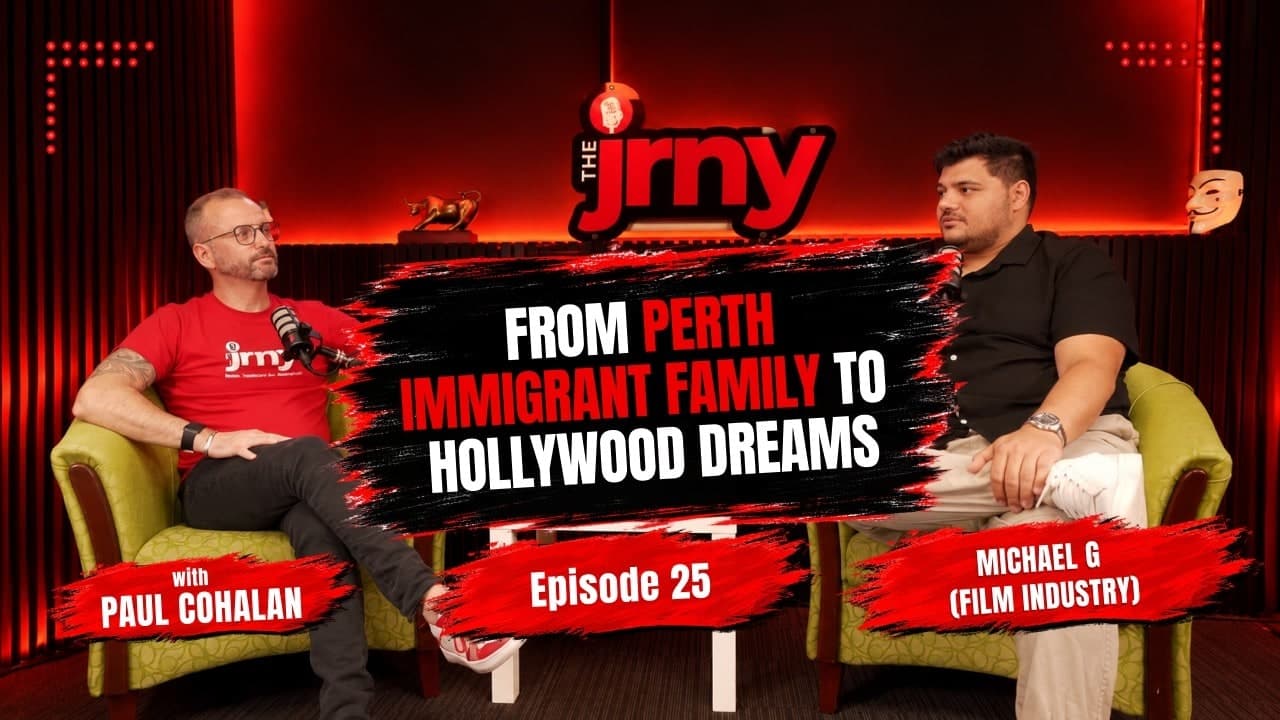
Meet Michael Guerrini
Filmmaker, actor and founder of YOTKO Productions
Michael Guerrini is a Perth filmmaker and actor, and the founder of YOTKO Productions. Half Greek and half Italian, he says his love of acting began at four or five, when his granddad took him to see Spider-Man in 2002 and told him that what he had just watched was acting. He studied media at Trinity College, then film at TAFE, finishing with an advanced diploma, and in 2017 started YOTKO Productions as a sole trader, shooting photos and video for bars, nightclubs and events and selling stock footage. COVID lockdowns in 2020 pushed him to stop waiting and make his own films, and the work of the American filmmaker Alex Ferrari showed him how to treat filmmaking as a business. His first short, the black and white noir Full Circle, was shot in 2022 and finished in 2023. He has since produced the horror short Eye Candy, is in post production on a feature length documentary about a female bodybuilder, and acts in commercials. He is 29.
Episode summary
In episode 25 of The JRNY podcast, Paul Cohalan sits down with Michael Guerrini, a 29 year old Perth filmmaker and actor and the founder of YOTKO Productions. Michael found the show when Tyler Wood's episode came up on his YouTube feed, and emailed Paul to come on. He is Paul's first guest from the film industry, and Paul admits he is a fish out of water, so the conversation becomes a lesson in how to make a short film and get it seen. Michael traces it back to 2002, when he was four or five and his granddad took him to see Spider-Man. He asked what he had just watched, was told it was acting, and says that lit his fire. Around the same time, he says, he met a young actor just back from America at a family Greek Easter lunch, a school friend of his uncle's, and three days later saw the same face on the cover of 10 Things I Hate About You at Myer. It was Heath Ledger. Michael says Ledger gave Perth actors hope that you did not have to come from Sydney or Melbourne to make it to Hollywood. After media studies at Trinity College he went to TAFE rather than university, and is now glad he did, because TAFE was practical and filmmaking is a practical craft. In 2017 he started YOTKO Productions as a sole trader, shooting photos and video for bars, nightclubs and events and selling stock footage on the side.
COVID changed the plan. With lockdowns in 2020, Michael decided to stop waiting for someone else and make his own work, and went down the rabbit hole on how films actually make money. His biggest influence on the business side became the American filmmaker Alex Ferrari, whose book Rise of the Filmtrepreneur Michael calls his filmmaking bible. The old model, he says, is to make a film, enter a big festival and hope a studio picks it up, and he believes many indie filmmakers do not realise how one sided the profit sharing in those deals can be. So he did it his own way. His first short, Full Circle, is a black and white noir of about five minutes about an assassin who realises something has gone wrong only when it is too late. The idea came from a recurring dream after watching Sin City. He spent a good few months in pre production on storyboards and the script, shot it in two days for $5,000 with about a dozen crew counting post production, wrote, directed, produced and acted in it, and colour graded it himself. For the premiere he hired a three hour session at Luna Cinemas, then invited other local filmmakers to screen their shorts if they chipped in for the booking, in return for a share of ticket sales. Their word of mouth brought in their own audiences, the cinema was about three quarters full, and he sold print on demand merch on the night. He paid the cast and crew their share, then sent the film to about 50 festivals. Six or seven accepted it, which he treated as a rite of passage rather than a payday. Then came a staged release: paid downloads first, subscription platforms next and free, ad supported platforms like YouTube last.
The rest of the conversation looks ahead. Michael is in post production on a feature length documentary following a female bodybuilder's bid to train and compete again through the COVID lockdowns, which he shot over about a year from 2020 to 2021 after answering a call out on Facebook. With a documentary, he says, it is like shooting the movie before you write the script. He has pitch documents ready for sponsors and investors to fund the audio mix, colour grade and original score, is aiming for a release around mid 2027, and wants to tour it around WA towns like Geraldton, Broome and Kalgoorlie, the way a band goes on tour. He also produced Eye Candy, a horror short that screened at festivals early in 2026 and went on sale on pay to download platforms in March and April. At the time of recording he was planning to release it on YouTube at Halloween, with Google and social media ads on standby. He talks about sharing what he has learned with other Perth filmmakers so they can earn a living from their work, why he wants the West to have its turn as Australia's film powerhouse, and how his parents met over a packet of Jaffas stuck in a university vending machine, which Paul reckons would make a good mini short film. His hope for the episode is that other filmmakers in Perth hear it and take something from his approach.
Key takeaways
Plan it before you shoot it. Full Circle came out of a recurring dream Michael kept having after watching Sin City. He spent a good few months in pre production drawing storyboards and writing the script, which itself took a couple of days and a couple of drafts. The shoot took two days, with eight or nine people on set, about 12 counting post production, and three actors including himself. Because he had planned everything and most of the crew were friends, he says, he could trust them with the equipment and with their jobs on the day.
Have the money before you start. Michael's first lesson from his $5,000 short was about money: he started with the first couple of hundred dollars and paid the rest of the cast, crew and equipment hire out of his next paydays. Next time, he says, have all or most of the money sorted first, locked away in a separate bank account, so you are ready when the invoices arrive. He is applying it to his documentary, and has told the post production crew he has in mind to wait until the funds are together.
Sweat the small stuff. With all the heavy logistics of a shoot, Michael says, it is easy to forget the simple things. His lesson from the set of Full Circle was to bring a spare costume, because he had only one white shirt for a scene where he gets bloodied up. For the first shot he thought he needed a crane that would cost $1,000 a day to hire, until it turned out his director of photography already had one made for DSLR cameras. When a couple of people pulled out just before the shoot, he put out last minute crew and cast calls.
Make the premiere pay its way. Michael's cinema booking ran for three hours and his film for about five minutes, so he filled the rest of the session. Other local filmmakers could screen their shorts if they contributed to the screening fee, in return for a share of the ticket revenue, and their word of mouth brought their own family and friends in. He ran paid and organic social media ads, sold print on demand merch on the night and later placed the leftover stock with a local store on consignment. The aim, he says, was not profit but proof to himself that he could make a living from this.
Release it in stages. Michael released Full Circle in phases. First came transactional platforms, where people pay once to download it, which he could run alongside festivals, because festivals want exclusivity and dislike films that are already free on YouTube. Next came subscription platforms paying pennies on the dollar, and last came free, ad supported platforms such as YouTube, Rumble, Dailymotion and Facebook Watch, backed by paid and organic advertising and appearances on filmmaking podcasts. Paul sums it up as timing each release to its market, and Michael agrees, because each stage naturally loses value with exposure.
Know your audience as you write. One thing Michael learned and carried into the horror short Eye Candy is to know who your audience is while you are still writing the script. Filmmakers tend to write what they know, he says, but any business does its market research first. For Full Circle he broke the audience into seven niches: crime drama, black and white, a throwback to the noir of the 1940s and 1950s, a hitman, a femme fatale, Australian and short film. He planned to use them to target his advertising. A broad release is like a shotgun, he says. Aim at one niche like a sniper and you are far more likely to hit.
Resources mentioned
- Full Circle, Michael's black and white short film, on YouTube
- Eye Candy, the horror short Michael produced, on Gumroad
- Eye Candy trailer on YouTube
- My first short film Full Circle took over a year to make, Michael's making of blog on Medium
- How to distribute and actually monetise your short films, Michael's guide on Medium
- YOTKO Productions on Instagram
- Rise of the Filmtrepreneur by Alex Ferrari, the book Michael calls his filmmaking bible
- Indie Film Hustle, Alex Ferrari's podcast and blog
Transcript
Read the transcript
This transcript was generated automatically and lightly edited for readability. It may contain minor errors.
Michael Guerrini: I was one of the last people to see Heath in the flesh in Perth. He said, like, what do you want to do when you grow up? And I said, acting. And he was like, oh, yeah, really? I'm an actor too. And then I saw his face on the front cover of 10 Things I Hate About You. It was Heath Ledger. He gave us hope and insight that, yes, we have the potential to achieve that Hollywood dream. One thing I did learn on the day was bring an extra pair of costume because there's a bit where I get 101, I get bloodied up.
Paul Cohalan: Something so simple, but makes a big difference. All right, so I got Michael Guerrini here. I absolutely don't know much at all about Michael. I know he's a friend of Tyler Wood's and Tyler's been. He was a great guest and he was the first one. Round two, kicking back off The JRNY. So, yeah, and a few people have reached out from Tyler, so thanks. Tyler and Michael reached out ages ago and we got the date locked in. Filmmaker. Actor. 28.
Michael Guerrini: 29, Yeah. 29, Yeah.
Paul Cohalan: 29, Yeah. Cool. So I'm looking forward to this. I like the ones where I don't know the person at all, or not much. You know, a tiniest bit. We've had a little chat, but that's about it. And then it actually puts me under my paces a fair bit. I'm getting my brain to keep going. As I've told everyone, you know, it's roadblocks, risk and resilience. It's all about the guest journey, the book and the chapters they've got. And there's no questions, there's no pre questions last night, there's no prepping it, we just get into it. And that's kind of my gig, is to get to know you better. And I think something I've learned from most people, they're like, you're good at making it flow, Paul, and it's probably because you care genuine. And. And I really want to get to know the person, which I think I do normally. And I think this is why I've got the momentum on the podcast and. And Michael's going to put me through me paces here because I know absolutely nothing. So. So where do we start, man?
Michael Guerrini: Like, yeah, pretty much.
Paul Cohalan: Let's start with Tyler. How long you known Tyler and how do you know him?
Michael Guerrini: Look, I've known him for, like, for the first year I known him, it was a bit on and off, more so from mutuals within the film space that he happens to know.
Paul Cohalan: How does he Know people in the film space. What's.
Michael Guerrini: Because, look, Tyler being Tyler, he knows everyone, sort of knows everyone amongst all other sectors. And he and I realized that, funny enough, I've got a mate, two mates of mine, one's also named Michael, another one's mate, Mason. They are members at Devlin's just down the road. And I've been. They've invited me over many times. I've been a regular. I met with. I met Tyler there because, you know, very social, very chatty, Started talking to each other a little bit more. And then when he. When we shared. When we exchanged socials, Instagram, I found out that he's good friends with a bunch of other mutuals within my sector.
Paul Cohalan: So, like, nice.
Michael Guerrini: Isabella and Imogen, who actually I'm gonna be seeing a little bit later for a coffee.
Paul Cohalan: Yep.
Michael Guerrini: But yeah, funny enough, I was like, oh, hang on. And then I started seeing him more frequently at Devon's. Yeah, Devlin's. Sorry. And just kept talking and talking. Then I sort of broke the bridge by saying, like, oh, how do you know, Like, Imogen, how do you know Isabella? And all that stuff? And then I told him how I know them from my filming background. And that's how we got a bit more. He also knew another filmmaker by them, I believe, called Brad Newland, who I was involved with in a couple other productions and vice versa of his. And we saw him in same sort of film events. I've already saw him there and then just got to know each other a little bit more. Pretty much.
Paul Cohalan: Nice. I think it's really cool. I love it when people reach out and I don't know them. There's a little bit of a connection here, but obviously it's pretty. We obviously don't. Me and you don't have a connection at all. So it's pretty cool. And. And I think even for yourself to throw yourself out there and just jump on the podcast, like, it's like. And you don't know it. So you said you watched the Tyler one, you watched it, you went down the rabbit hole. That's what I pretty much just went.
Michael Guerrini: Down the rabbit hole. So when I first bumped in, like, I just saw it as a random video based on my algorithm on YouTube. And I saw Tyler Wood there. I'm like, oh, what the hell? What is he talking about here? So I just watch it and listen to on Spotify, on and on again just to see what. What his yarn was and talked a bit more. And then the more I started, I started getting a little bit hypnotized. About the. Just the more so the nature of your and your ethos of The JRNY podcast. I decided to. All right, I'll go down the rabbit hole, I'll watch a couple of more videos, see what this guy's about.
Paul Cohalan: Yep.
Michael Guerrini: And then I saw a couple like the. And there's a good amount of like rags to riches sort of stories and I've got a bit of a soft spot for that to be.
Paul Cohalan: Yeah, cool.
Michael Guerrini: But yeah. And realized. Okay, yeah, I gotta. I gotta get involved.
Paul Cohalan: Yeah, cool.
Michael Guerrini: I wanna, I wanna have a chat with this bloke. So I'm just like, nice. So I'm just like, okay, I sent you the email.
Paul Cohalan: Yep.
Michael Guerrini: And then we just got on.
Paul Cohalan: The team's gone back and forth locked in the date. It was good. And like to be honest now once again, it's just like I just got started. So back when you emailed, like I probably didn't have the process right. I was just like, let's get recorded. I had a few people lined up now. I'll like as it comes in like they come in every day now and it's like I'll. My team will book like a 10, 15 minute call just to put a face to name in. A call.
Michael Guerrini: Yeah.
Paul Cohalan: I'm starting to get some other ones reach out that I think. I don't know whether it's more of a sales or whatever. So we just got to be careful of that now that it's getting momentum.
Michael Guerrini: I mean like it for. For other people. Yeah, I can understand it for. For myself. It was. I was kind of lucky that it was just email and text only because prior when I. At the time that I emailed you, I was in the middle of shooting a short film of mine that's in production right now. Plus I left for Greece for a month.
Paul Cohalan: Oh, did you? So we would have worked out well.
Michael Guerrini: We wouldn't have been very communicable in. In August at that point because.
Paul Cohalan: So tell us about Greece.
Michael Guerrini: Yeah. So like as you could probably see the tan, you probably think how you. This tan like in. In our winter. That's not my natural skin tone, but pretty much, yeah. It was awesome. I got. I'm half Greek, so I got family there obviously. My granddad has got a. He just bought an apartment in a neighborhood in Athens called Sepolia.
Paul Cohalan: Yeah.
Michael Guerrini: And in Sepolia, it's not like here where there's townhouses and houses and all that stuff. They're very, very rare. They're pretty much. And over there they're priced the same as Like a mansion here.
Paul Cohalan: Is that right?
Michael Guerrini: Yeah. Everything else is like, I pretty much imagine be the same kind of like in Croatia where they're all got like one story apartments kind of flocking towards each other. They're all, they're all one story apartments. That's the main sort of housing they've got over there. He bought an apartment. There's. We stay there now so that whenever we want to travel back to Athens or whatever, we've got that place instead of paying through the nose for hotels. And funny enough, the unit, the apartment unit itself is literally right next door to the basketball court that Giannis Antetokounmpo was noticed from and got drafted in. He's from that area.
Paul Cohalan: Oh, cool.
Michael Guerrini: There's even a big mural like right next to where the basketball court is.
Paul Cohalan: That's really cool.
Michael Guerrini: And I only discovered it by accident when I was there. I'm like, hang on, there's a mural here, Giannis, and a basketball court. And then I just connected the dots, like, no, this can't be.
Paul Cohalan: So you like the basketball?
Michael Guerrini: Look, I, I know of its existence. I know of it. And like, because I've got a bunch of other friends that are obsessed with basketball, but basketball's not so much my thing. I don't have any distaste for it. It's just, you know, it is what it is.
Paul Cohalan: Yeah, I'm a bit the same. I got into it the last few years just going and watching it. My boy plays it. He's probably taught me more about it than I knew. And I was just saying to you before doing a bit of Wildcats thing with Tyler, actually. So we're going this Saturday night with the kids. I get the kids tomorrow and then. Yeah, Saturday night. Let's go back to the filmmaking. Yeah. Where did it start? How old were you?
Michael Guerrini: So if we're going way 29 now, you said. Yeah, I'm 29 now. So if we go, I'll be the big three zero next year.
Paul Cohalan: Yeah.
Michael Guerrini: But yeah, so, okay, so it pretty much started when I was like 4 or 5 years old. My granddad in question, the same one I just talked about. He took me to see Spider-Man, like the 2002 one with Tobey Maguire and Sam Raimi and all this stuff in the cinemas. And I was so captivated and so mesmerized by what I just saw, what I experienced. And when I left the theater with My granddad. In Greek, I called my granddad.
Paul Cohalan: So what year was that?
Michael Guerrini: 2002.
Paul Cohalan: Two? Yep.
Michael Guerrini: So four going on five. And I asked my granddad like, what's. Oh, what was that? And he said, that was acting. And then that got burnt into my brain. And for the past couple of months, indeed this is. The Internet is like pretty kind of prehistoric as opposed to what it is now.
Paul Cohalan: Yeah.
Michael Guerrini: But I was still researching about what acting was and the more I researched into it, the more I fell in love with it and the more I realized, okay, that's my, that's my fire that just got ignited within myself.
Paul Cohalan: That's awesome.
Michael Guerrini: And coincidentally around that time, about a month, month or two later, I saw. So I got to go backwards a bit more. My granddad's brother. So my grand uncle and auntie, they hosted Greek Easter lunch around that point. Greek Easter is usually a week or two after the regular Easter amongst all the other Orthodox churches. My uncle. So their son brought along his schoolmate that just came back from America. Now, me being five years old, I didn't know anything about him, but he was the life of the party. And I'm thinking, okay, what's up with this guy? Like, what's, what makes him so, so special? And then I started talking to him, he's like introduced, like, hey, how you going, little champ? Whatever. And I said like, what do you want to do? Like, what do you want to do when you grow up? And I said like acting. And he was like, oh yeah, I'm. I'm really, I'm an actor too. I guess he was probably impressed about the fact that a five year old just confessed to with such enthusiasm and like enough knowledge that was surprising for a five year old to know about acting.
Paul Cohalan: How old was he roughly?
Michael Guerrini: He would have been in his early 20s, I think 20, maybe 21. But I remember he had blond hair, unique sort of face shape. We start, we, after we talked about acting, we pretty much got on like a house on fire. We were inseparable for the most part. Even though everyone else wanted a piece of him. But I remember him being such a cool guy. When I dropped home, I forgot his name. And then I was like, oh no, what a, what a cool guy. You know, it's kind of sad that I'm not going to see him again. Three days later, I'm shopping with my nan. I went to Myer, right, the one in the city. And this is the. When they had DVDs and VHS. Remember those? When they had those corner. Yeah. My grandma was, you know, in some other corner shop looking for frying pans or whatever. And I was just having a wander, looking at the box art of the videos and the DVDs. And then I saw his face on the front cover of 10 Things I Hate About You. It was Heath Ledger.
Paul Cohalan: Yep.
Michael Guerrini: So pretty much at that time I realized, oh, that gave me hope in the fact that.
Paul Cohalan: So he inspired you?
Michael Guerrini: Yeah, he inspired me in the fact that it's possible to sort of achieve a Hollywood dream sort of thing despite being from a remote town.
Paul Cohalan: He went to Guildford Grammar. Did he?
Michael Guerrini: That's right. My uncle and him, they're only one year apart, but they were good mates. They. He would also come back every couple of productions because this is before Facebook wasn't was popular. He kept up with friends and family by traveling back and fro from LA or New York to home.
Paul Cohalan: Yeah. That's amazing. So he was your inspiration then and family for acting.
Michael Guerrini: Yes. But then it sort of, that passion evolved from acting to filmmaking. Like you got conjoined because they're, they're, you know, in the same sort of spheres.
Paul Cohalan: Yeah.
Michael Guerrini: And I became equally obsessed with filmmaking as I was with acting. Like I wanted to have the best of both worlds. That passion carried on throughout high school. I did the media studies and I went to Trinity College. Did the media studies there.
Paul Cohalan: Yeah.
Michael Guerrini: And then shortly after, I initially wanted to go into uni, but I didn't have the ATAR scores at the time for media studies over there. But I figured I'd. I'll just go to TAFE. I remember I was a little bit embarrassed about going to TAFE because of the negative reputation it being for dropkicks and all that stuff. Like the people who couldn't make it to uni at the time.
Paul Cohalan: Yeah.
Michael Guerrini: But looking back on it now with my experience, I'm actually like, thank God I went to TAFE as opposed to uni. Because uni is all theory based and filmmaking by definition is very practical, hands on, sort of industry. And with TAFE, the whole ethos with TAFE is that it's supposed to make you employable. So I learned and more so of the craft with things like camera, lighting, editing, storytelling, producing and all that stuff from there. Made my short films within my cohort from 2015 to 2017. Took a bit of a gap year in 2016 to make a bit of money for myself. And then after that I was like, okay, I got a bit obsessed with photography, so I figured I'd start out as like a photographer slash videographer. On my own 2017, I started as a sole trader, but my business name was YOTKO Productions. As in Y O T K O Productions. So I did photography, videography for things like bars, nightclubs, certain events here and there, as well as taking photos and videos for myself to sell as stock footage and stock photos. Yeah, just make a bit of passive income smart. It wasn't a lot, but it's like a. It's more of a quantity over quality sort of thing to a degree. Yeah.
Paul Cohalan: And you learn while you go, right?
Michael Guerrini: Yeah, you learn how you go. And then I started watching a lot of YouTube videos about cinematography and filmmaking and photography. The likes of like Peter McKinnon, Chris Hau.
Paul Cohalan: What year was this?
Michael Guerrini: This would have been about from the period would have been from 2015 to 2018.
Paul Cohalan: Okay, so when did he leave us? 2000.
Michael Guerrini: Yeah, 2008.
Paul Cohalan: 2008. So back in 02, when did you run into him and realized he's your cousin?
Michael Guerrini: We're not related but he's friends with my uncle.
Paul Cohalan: Oh, he's friends with your uncle. Okay. So.
Michael Guerrini: Yep, he was friends, yeah, he. And funny enough, I was one of the. Outside of his friends and family like Heath's talking about. I was one of the last people to see Heath in the flesh in Perth because after he finished playing the Joker in Dark Knight, he really, he came back to Perth for a little bit, say hi to friends and family and all that stuff and then went to London to act in his last film, The Imaginarium of Doctor Parnassus. And he died during production. That's when he went to New York, took pills, overdosed and passed away sadly. But yeah, and so at that I.
Paul Cohalan: Was going to say that because what are you? Greek and Italian.
Michael Guerrini: Yeah, Greek and Italian, yeah.
Paul Cohalan: So mum, dad, which your dad's mum's.
Michael Guerrini: Side's Greek, dad side's Italian.
Paul Cohalan: Ah, nice.
Michael Guerrini: I was going to ask you like sort of what was your background?
Paul Cohalan: I'm Aussie.
Michael Guerrini: Aussie through and through. Yeah.
Paul Cohalan: My last name is Go back, you know, generations comes from Cochlan, so it's Co. Ellen. It's Irish. Right. You know, not any recent generations of my Irish. I'm Aussie skip and. But I always look at. Look a bit wog or European and even my ex wife, she's long blonde hair and everyone said I probably look more woggy or European than she did. She was Croatian.
Michael Guerrini: Okay.
Paul Cohalan: But yes, you're half Greek, half Italian. Where do you lean towards? It's a really good mix with the family.
Michael Guerrini: I try to be as I'll be honest, I'm more so in terms of interaction.
Paul Cohalan: Chips in a souvlaki side or pizza pasta.
Michael Guerrini: Look, when I was younger, growing up, I was more so on the souvlaki side. But as I grew up a little bit more and more I tried to. I try to be in the middle as much as I can. I put my chips, souvlaki chips in the pizza. That's. But that ends up offending everyone. So. Yeah, screw it.
Paul Cohalan: So what year did you meet Heath Ledger? That's pretty cool.
Michael Guerrini: Yeah, this was about 2002. Ish.
Paul Cohalan: So that was when you went to the movies with your grandfather? Yeah, yeah.
Michael Guerrini: So I went to the movies of grandfather a few weeks ago. So after I saw Heath Ledger when he was in our family event because again, my uncle Heath Ledger mates.
Paul Cohalan: Yeah, yeah, yeah, yeah. Cool. So how old your uncle now?
Michael Guerrini: He'd be. I haven't seen him in a while, but he'd be in his mid to late 40s now.
Paul Cohalan: Oh, would he? Yep. Yeah, yeah. So what are you, 29?
Michael Guerrini: Yeah.
Paul Cohalan: So be. Yeah. Cool. And yeah, it's pretty sad about Heath, isn't it? And I think. I think the film industry and that really, you know, there's a lot of even performing industry, you know, singing, acting, all that, it can go the other way really quickly.
Michael Guerrini: It kind of. Yeah. I mean, there's a reason why the 27 Club is mainly associated with singers and actors and creative types, you know.
Paul Cohalan: Yep, yep, Yep.
Michael Guerrini: He was one year after the 27 Club. But yes, I mean, it's better documented with these ones because the nature of their work exposes them to a lot of media coverage over the years. And so news outlets, they get a focus on them, I think.
Paul Cohalan: I think a lot of good come from him, though, like, obviously being at local lad here, but just the inspiration. And like, even. Even the Joker, like, I don't think he. He didn't finish the film, did he?
Michael Guerrini: No, he finished the. The Joker one is The Imaginarium of Doctor Parnassus. That's the one where he died.
Paul Cohalan: Mr. Dr. Joker, I thought. I thought.
Michael Guerrini: A lot of people seem to think that was his last role, but that was his last significant role. The Imaginarium of Doctor Parnassus gets sort of overshadowed and swept under the rug because of Joker's infamy, his portrayal of it. Yeah.
Paul Cohalan: So. So about 08 or whatever it was, obviously he left us, but how much of an inspiration, impact did it sit in your mind? Obviously meeting him is pretty significant.
Michael Guerrini: He gave us actors in Perth hope that we're not just bound to only be. Think that our big break is only like you had to be from Sydney and Melbourne to get anywhere outside of Australia, like out of the Australian bubble for things like Neighbours and Home and Away. Because the fact that he came from Perth, he gave. He gave us hope and insight that, yes, we have the potential to achieve that Hollywood dream of being a famous actor and breaking out into Hollywood at the time.
Paul Cohalan: So the positive, you know, always trying to. The positive out of bloody everything, even if it is death and whatnot. And like, I think that's the big piece with him, right? He's. He's left a huge legacy and.
Michael Guerrini: And he helped put Perth on the map in terms of other creatives, like a good amount. Like even other famous actors from Perth known around the world. So the likes of Sam Worthington, Isla Fisher, Dacre Montgomery. I wouldn't be surprised if they all credit Heath Ledger as, like, as the. As the prime beacon of hope, so to speak.
Paul Cohalan: Yeah, definitely. I think so. And you know, there's even out of the negatives, there's a lot of positives. I think there's a lot, A lot of great inspiration from him that would have drove a lot of them other actors, like you're saying, definitely even like, say, going to Guildford Grammar. And then like people that would have went to school with him. Like, imagine how many people and nuggets they would. That would sit with them.
Michael Guerrini: That's pretty much like a lot of Guildford people's claim to fame in terms of like, who's the most notable alumni.
Paul Cohalan: But it would have gave like some of them that maybe were close with him. I'm kind of guessing here, assuming, but imagine like when some of them going through a bad day or. Or they want to go down that acting path or entertainment or performing how much they would sit in. He'd be that nugget for them. Probably go and like, give it a crack and. And maybe not go down the negative either. Like, you know, in the early to.
Michael Guerrini: Mid 2000s, I will. I do believe that would definitely be the case.
Paul Cohalan: Yeah, yeah, yeah, definitely. And we talk about roadblocks, risk and resilience. Imagine if someone like that, that we all see as being at the top of their game. It's like, you know, you look at Amy Winehouse, you look at, you know, a heap of people that aren't around, and you think they're at the top of their game. Even Robin Williams and it's like. But they've got so much roadblocks. Going on in the background that no one sees and. And they struggle. Right. Big time. Yeah, it's, I think, bit of a learning. You can take a lot out of that. Definitely.
Michael Guerrini: Yeah.
Paul Cohalan: Everything's not what it seems on the front end.
Michael Guerrini: And it was a learning curve.
Paul Cohalan: And it doesn't have to be a celebrity either. Even like us as everyday people, you.
Michael Guerrini: Know, it all could be our family members, it could be our friends or maybe like a local. When I say influencer, I don't mean in the modern context. I mean someone who influenced you as like a go to role model. It could be a teacher, could be a coach, could be. It could be some local businessman that you. That's in your industry that you want to aspire to be in the near future.
Paul Cohalan: I'm getting to know even, even guests on the podcast or friends or business people, clients like, say that some of them are a fair bit on social. And you see this and you perceive this space and it's not. And not that they're fake. You just don't see the other side that people struggle with behind the scenes.
Michael Guerrini: Yeah, pretty much. We all put a. We all put on some sort of a mask when we're in the outside world and on the comfort of our own homes as well as, you know, everyday strangers to. And you know, it's a bit of a evolutionary barrier that we subconsciously put in ourselves and it's only until we have to. We can slowly slip off the mask based on frequent interactions with other people as we become more comfortable due to whatever context.
Paul Cohalan: So I, I was actually pretty vulnerable on one of my socials the other week and it was to do with my kids and Father's Day actually. And I want to be a bit. Because when you're vulnerable, it's more authentic and you can tell whether it's not or not and you engage on stuff like that is a whole different ball game because we, no matter who we are, I think we all relate when we come to the challenging side. Not always the win and the shiny bit. Anyway, let's go back to your. The filming bit. So you inspired all that when you were young. You've met Heath Ledger at a family event and then what's next?
Michael Guerrini: So pretty much after I finished TAFE with an advanced diploma in film, I started as a YOTKO Productions as a sole trader for photographer and videographer for all occasions with the exception of weddings.
Paul Cohalan: Yep.
Michael Guerrini: And it wasn't until. And I was a bit content with that from 2017 to 2019, but when 20 and I was also. I did some acting things for like local commercials, so things like RAC and Cancer Council.
Paul Cohalan: So you're about 22 years old?
Michael Guerrini: Yep, 22, 23. Right then 2020. Covid hit. And because of the state of everyone being the lockdowns, that sort of, that was a bit of a wake up call to think like, hang on, if you want to achieve your filmmaking ambitions, now's the best time to do it because. Because of how fragile society was of being influenced by a virus and all of a sudden like straight into lockdown, you're isolated from the rest of the people. It just gave me that sort of motivation to like kick into gear and stop waiting around for some of that external factor and just to do it myself.
Paul Cohalan: So what, what, what expedited and what changed and what was the big shift in the last six years?
Michael Guerrini: So what shifted is the trigger moment was of course Covid and the fact that we, we had to be isolated and stay at home for a period of time. Some parts of the world more than others. In Perth we were a bit of a lucky break. But I figured, okay, how do I make this into a production business? How do I make it a sustainable model? How do I make it so that I can create my own art, like my own, my own productions for myself as opposed to just being a secondhand cast or crew to other people's external.
Paul Cohalan: Just with all this, I'm guessing, and I want to. I'm very naive to this of fish out of water. So it's good learning from someone like yourself that's in it. So I'm guessing along the way there where you're shifting, changing because I understand business and kicking off, there's never any money or revenue in it. What were you doing on the side to keep afloat? So like I'm guessing it would have been taken money, not giving it to you.
Michael Guerrini: Well, so pretty much like I work with my dad from time to time.
Paul Cohalan: What's he do?
Michael Guerrini: He's a lawyer. Yeah, so I work as a law clerk, you know, delivering subpoenas and serving process, serving to clients and going to court.
Paul Cohalan: Whereabouts?
Michael Guerrini: He. He was based in Mount Lawley but now he's based in Highgate on Newcastle Street in Leederville. So yeah, Lawley Legal and basically under his wing.
Paul Cohalan: What's it called?
Michael Guerrini: Sorry, Lawley Legal.
Paul Cohalan: Lawley Legal.
Michael Guerrini: And then I also do security.
Paul Cohalan: Shout out to dad. Lawley Legal.
Michael Guerrini: I also do security on the weekends. Well, did security on the weekends, yeah. As well as some few gigs here and there. Just wanted to Grow up. A bit of savings during that Covid period because pretty much the only form of content was self made. There was no outside work going on.
Paul Cohalan: Yep.
Michael Guerrini: Or very little of it. So people started to become a bit more sit home, watch Netflix, go on YouTube. So to become a bit more YouTuber esque.
Paul Cohalan: So. So 20, was it 20 or 21.
Michael Guerrini: Kicked in 2020. 2020 was when Covid officially locked in.
Paul Cohalan: Until 2021 I was in Singapore, February. I just come back with the ex and the kids and the in laws and I remember coming in and it had kicked in over there. But here we were a bit blase about it still, I think February 14th or 10th or something like that.
Michael Guerrini: Yeah.
Paul Cohalan: And yeah, so it would have been 2020. So 2020, 2021 obviously shut down all that start to come out of it. What'd you do in that 18 months?
Michael Guerrini: Two years like I basically just went.
Paul Cohalan: Down the foundation of the filming.
Michael Guerrini: Well, I just went down the rabbit hole and I just found a certain links to like, you know, things like how to make money from. From your own movies as opposed to making wages as a cast and crew. Right. And that led me into the rabbit hole about film distribution and I'm like, oh, actually I don't really have a good idea of how films get distributed and marketed and all that stuff. So I'm like. That piqued my curiosity.
Paul Cohalan: Yep.
Michael Guerrini: So there was a couple of people like Jason Horton and my biggest influencer in that space is an American filmmaker called Alex Ferrari. He talks about how to be entrepreneurial within the independent film space. He coined the term filmtrepreneur to like, you know, combine them together.
Paul Cohalan: I get it.
Michael Guerrini: And I became inspired by like how entrepreneurial it was. I also, my family comes a bit of is somewhat entrepreneurial in the sense that my mum's dad, so my granddad and his brother, the same people I just talked about before they. In the 90s, they started a water company called Salute in WA. Does that ring a bell to you at any stage? No, this is during the 90s.
Paul Cohalan: No, I wasn't here, so.
Michael Guerrini: Right. So during the 90s in Perth and WA, they were the first water. Because they just. They came from Adelaide originally. They immigrated from Adelaide to WA for this sort of business venture because they saw a gap in the market here where they realized, hang on, the rest of Australia, like Melbourne, Sydney, they sell bottled water. But Perth, the only access to water was from a tap. Whether you say you couldn't just go to the deli to buy a bottle of water elsewhere Right. Because they didn't ship, they didn't export there. So they created a water company and distributed and manufactured water bottles to. And those big 15 liter bottles for offices, right?
Paul Cohalan: Yeah, you flip them upside down and.
Michael Guerrini: Yeah. And so they. Because they were the. There were a couple other local businesses that tried to catch on to. That became successful. Then they. Then there's too much competition. Then the early 2000s, they sold that off and then with the settlement, not settlement, but with the closing deal money, I'm not going to disclose it here, but they further reinvested into things like stocks, property and all that stuff and expanded their portfolios there and there. So in terms of business entrepreneurship, I was. That rubbed off on me. I exist that in the youngest days or youngest years of my life, I sort of experience that going to their offices, watching them conduct business, doing all that stuff. And also on my dad's side, you know, he's. He was in a partnership in a previous law firm, but now he's been practicing law for 25 years, quarter of a century plus and started doing his own law firm as well. So they're very business and entrepreneurial. Yeah, minded, definitely. And oriented. So that just rubbed off on me. So I figured I got to implement similar techniques and principles and entrepreneurship into my ambitions, especially with filmmaking and. But the pro. But the principles and the technicalities that are different compared to those industries.
Paul Cohalan: Definitely.
Michael Guerrini: So I listened to Alex Ferrari in terms of how he made it, how he became entrepreneur.
Paul Cohalan: When you start listening to him around from.
Michael Guerrini: I still listen to him, but I started listening to him around 2020. I then bought a book of his called Rise of the Filmtrepreneur. That's my bible. That is my filmmaking bible in terms of not just filmmaking techniques, but also film business techniques, the business side. Because not a lot of that information is sort of disclosed to filmmakers locally here. The. The sort of expectation is same sort of expectation of success 20 years ago where you make a film, you go into some big festival like Sundance or whatever, hope to God it wins amongst all the other entries, and that some producer or some representative of a big film studio like Paramount or Universal Studios or Warner Brothers, whoever was impressed by your movie, so much so that they want to distribute it for you, where they'll release it, and then you can make money from your films by distribution deals left and right. And not a lot of filmmakers knew about how, at least in the indie film space, how predatory they were in terms of profit sharing and creative accounting that they implement to like keep it in the Book so that they hoard as much of the wealth that. Or money earned from people watching movies.
Paul Cohalan: So just on that point, then. So making money. So let's go back a step. So 2020-20, start at 22. What'd you do in that couple of years for yourself? You read, you followed, you learn a lot of principles, techniques. Now, what'd that do for you at the end of 21, roughly, or whenever it was. How did you set up your business and would you. What was the first thing you started doing? Where'd you first start making money? Who paid you?
Michael Guerrini: When I first started making money, I still did security and talking film. Yeah. But with film, I decided just the occasional odd jobs with, you know, things like crew, extra work.
Paul Cohalan: Yeah.
Michael Guerrini: Cool things from getting involved. Yeah. Get involved both in front and behind the camera as much as I can, because I love both sides of the coins pretty much. And they came right. There's websites called, like, StarNow, which is like Seek, but for that. Those kind of.
Paul Cohalan: Oh, is it.
Michael Guerrini: So I didn't. Even to this day, I don't have an agent for that kind of stuff. It's all freelance. And I just go look at the entries. Whatever's paid, whatever's happening locally. I just applied myself.
Paul Cohalan: Yeah.
Michael Guerrini: To do it this way. And look, I don't know what the ratio of success to failure in terms of getting there, like success to rejection. I knew that was going to come anyway, but that didn't deter me, and that still doesn't, because I know it's just the. It's just a part of the game. But the ones that I do get, I'm grateful for, to get the. And get a Bahama back. So just to give some experience.
Paul Cohalan: So. So just hang on a sec. So, YOTKO. Yeah. So you've got that sole trader, you've got that ABN. Yeah. So is that what you're using from 2021 on and you're doing this work through YOTKO?
Michael Guerrini: So, like my photography videography. Yes.
Paul Cohalan: Yep. So not. Not the film stuff. So that I now understand. So that was the videography and the photography.
Michael Guerrini: It initially started as photography videography, but then expanded into filmmaking.
Paul Cohalan: Yeah. Okay. So, yeah. So you do use that.
Michael Guerrini: Yeah, yeah.
Paul Cohalan: And then. And then you see, doing these freelance jobs, which would you say it was? Star.
Michael Guerrini: StarNow.
Paul Cohalan: Yeah, StarNow. And that's like the Seek for ad hoc freelance jobs.
Michael Guerrini: Ad hoc freelance jobs within the media sort of industries.
Paul Cohalan: Yeah.
Michael Guerrini: And that could be things for like writing scripts, acting, photography, videography, cinematography, editing, you name it.
Paul Cohalan: So you must learn a lot there because if you're doing like random ad hoc jobs like freelancing, a whole different. It could be different every day. Right?
Michael Guerrini: It could be different every day. But. But the, the equally as important byproduct of that is that it introduced me to new people within that space. So it further expanded relationships. Yeah. And it further. It further compounded. And because we all share the same ambitions, we all basically got to know each other. And that's when I got introduced to our film community here that I only knew from the fringes, but not fully dived in and that became exposed to a bunch of other people making their own stuff that I didn't know. It expanded my friendship circle, expanded my network knowledge about filmmaking communities here.
Paul Cohalan: Yeah.
Michael Guerrini: And I just became intertwined with everyone else. I helped them out, they helped me out. And you know, here and there, da, da, da, da. But one thing I noticed is that in locally here, they didn't. There was no entrepreneurship in the sense of how I learned to make money from my figures like Alex Ferrari and J. Horton and all that stuff. The sort of DIY distribution, self marketing, both organic and paid. How to structure it so that you can market in other forms to make money within your creative space as opposed to the traditional path of just make a movie, send it to film festivals, hope the distributors like it, hope you give you a good deal and then get residuals and royalties per watch when it's released in the cinemas and DVDs or now VODs or like streaming services like Netflix and whatever. So some examples was I did my first short film like under YOTKO.
Paul Cohalan: So when was that?
Michael Guerrini: This is. We shot it in 2022, but it fully finished in 2023.
Paul Cohalan: Nice. That's where we. That's where I want to get to. Cool. Talk to me about that. What was the process?
Michael Guerrini: So the process is, because I learned all that stuff, I became. I was prepared on how to sort of stick my head out of the poo compared to everyone else in terms of presence and viewership.
Paul Cohalan: So this is your first short film that you've done yourself?
Michael Guerrini: My first short film.
Paul Cohalan: Is it about.
Michael Guerrini: Yeah.
Paul Cohalan: What's the topic?
Michael Guerrini: So it's five minutes black and white.
Paul Cohalan: Yeah.
Michael Guerrini: Noir sort of crime drama. Like crime drama where apparently it's black and white. An assassin meets his target on the verge of. Uses a house balcony as a vantage point. And only up in that port that set up, that's when he realizes something has gone wrong. Only when it's too late. I can't Say too anymore because it's like five minutes long. That's still relatively pretty quick. But I shot it in two days. Had a crew, had a budget for cast and crew pay and all that stuff. I color graded it myself because I had my own vision. But the editing, I handballed it to a mate of mine because also in tandem with that I was also filming a documentary that I actually got from a Facebook marketplace. Funny enough like a film page.
Paul Cohalan: Yeah.
Michael Guerrini: I stuck my hand up. I knew I knew about bodybuilding and I had a little bit of a passion for it. We decided to meet them, they liked my work. We shot their stuff for a whole year. I'm still editing it bit by bit. Bit by bit as of now but okay.
Paul Cohalan: So when was the bodybuilding thing kick off in tandem in 2022.
Michael Guerrini: Yeah 20. So the filming of that took 2020 to 2021. But I handballed it to an editor, wasn't happy with the much of his head it for a whole year. So I took it back and that's when I figured I might as well start with a short film first.
Paul Cohalan: The bodybuilding piece.
Michael Guerrini: The bodybuilding is a documentary, full length documentary. And then I sort of.
Paul Cohalan: Cool hold.
Michael Guerrini: I paused post production on that to focus on my short film basically. Then when I. When it was done I released it. I had a marketing budget for and I hired out a theater. Luna Cinemas. Yeah, I was also my first time doing paid advertising for social media in relation to my stuff. So it's called Full Circle. That's the, that's the short film. I advertised it both organically and paid ads with like Facebook ads, social media ads for the premiere wasn't. I wouldn't go as far as to say it was a full house but it was like about 3/4 full which was cool. Very, very surprising. I didn't come in there could have.
Paul Cohalan: Been a quarter full.
Michael Guerrini: So yeah, I didn't come in with much expectations but I did because the booking for the cinema was three hours and my short film is only like five minutes.
Paul Cohalan: Yeah.
Michael Guerrini: So I figured like I was just maximize this. What if I invite other filmmakers to put in their piece? If they contribute to the screening fee, I'll give them a share of the revenue that I earned from ticket sales. And I also ordered some merch for my full.
Paul Cohalan: Very smart.
Michael Guerrini: I ordered some merch from a print on demand site called Printful. I designed it, imported a handful of there and sold merchandise to like family and friends and viewers that came in from there as well. Plus we had a couple of Other short films from locally produced creators and filmmakers, I put in their piece. And the good casual fact is because they get to, through their word of mouth, they get to forward my social medias to advertisements, to theirs. And that compounded the audience to come in more in droves because they'd be like, hey, I've got my short film screening at this. This ticket. And he's giving me like a 50% off sort of discount it for family and friends and all that stuff. So just, just to come in, of course. And like, because I use that one as an example to. Not to make profit, but just to create revenue from it, to prove to myself that I actually can make a living doing it. I could do it. I can make a living doing this. Right. When it comes to the excess of the merch, to selling that out, I thought, like, should I put it on ebay? Should I put it on my store and just even them out to there? There's actually another mate of mine now called Reg, and I've met him through my actress friend, the one I hired for my short film. We talked about it and I realized he talked about his business called Golddubs. And their business model essentially is they hire out, they get designers and they do consignment deals with them where they use their store as the hub for people to come in and buy their. Buy their wares, buy their merchandise or their T shirts or designs or whatever. They get a commission per sale. I'm like, oh, this is a good way to offload my existing stock of merch that went unsold during the night and I can get sold later on that way. So I signed a consignment deal, I gave the rest to. To them. And I've only got like a couple of like T shirts left from Nice. That is going to be.
Paul Cohalan: Let's go back a step. Let's go back to. Let's don't worry about the merch. Let's go back to the film. I want to understand more about this filming. Yeah, so the short film. Yeah, the five minute on the balcony. Talk to me about that. Like, tell me. Hang on, hang on. Let's slow down a bit. Let's slow down. I really, I'm really interested. This is not. I know nothing. This right now. You've got me really curious and I think it's amazing. Your thought pattern, you're piecing it together. You, you're being very resourceful, being a beginner in this right now. So it took two days to film. There's a few Things you said. I'm going to ask you a couple of questions. There was a budget. What'd you spend? Five hundred bucks. Five grand. Like what?
Michael Guerrini: The second one was legit, the spot on five grand.
Paul Cohalan: Okay, so five grand film, two days. Makes sense. You got some wages, you got to piece it together. But before that, say, say it was on the 1st of March, 2nd of March. How many days before that? And what do you, what do you, what, what's coming up to that? Five, like two day recording, which you end up with a five minute film. Right? Short film. Yeah, but what's the planning and the thought pattern behind did it go on for six months? Like what?
Michael Guerrini: Yes.
Paul Cohalan: What's entailed in that piece?
Michael Guerrini: So in films, right, there typically are multiple stages within the production of the movie, right? You've got pre production, that's when you piece all the stuff together to get ready to shoot the damn thing. Principal photography, that's your period of days where you're shooting it. Post production, that's when you're editing it and putting it all together. And then you got release, which is, you know, you release out in the cinemas and all that stuff. Right. The pre production phase, that took a good few months of me like drawing the storyboards, writing the script.
Paul Cohalan: That's the bit I was talking about.
Michael Guerrini: Yeah, writing the script, drawing the storyboards. That came to me in a dream of mine and I watched Sin City the night before. So I was like, okay. And. But the dream kept happening to the point where it was kind of annoying me because I'm the kind of person where if something in my head is, keeps, keeps repeating, that's a call sign for me to get it out.
Paul Cohalan: Yeah, yeah.
Michael Guerrini: So I'm like, okay, this has to make it, this sounds like a good premise to make us a short film. So I'm like, okay, I'll go ahead and do that. So yeah, writing the script took about a couple of days, a couple of drafts because I was just like, yep, just keep doing it there. Draw the storyboards. Not much of a drawer, but drew them, show, show them to my filmmaking friends. They all wanted to be a part of it. Different crew roles for, for whatever.
Paul Cohalan: How many, how many crew was there?
Michael Guerrini: It was about, including post production, about 12.
Paul Cohalan: And how many actors?
Michael Guerrini: So there's me as an actor and two other actors. That's it.
Paul Cohalan: Okay, cool. So you spent a few months pacing it, planning it, and then a couple of days writing the script, getting that right.
Michael Guerrini: Yeah.
Paul Cohalan: And then you showed it and then you got the crew together.
Michael Guerrini: Yeah.
Paul Cohalan: So don't worry about post. What was the crew for the two days? Like how many people involved in a two day to get a five minute film?
Michael Guerrini: Yeah. So in, in the. So minus the crusade, it was about 8 or 9.
Paul Cohalan: Yeah.
Michael Guerrini: So you had people like.
Paul Cohalan: Yeah, yeah.
Michael Guerrini: So you got. So me being the writer, actor, director, producer. That crunched a good chunkful. The others are 1st AD they're the ones that make sure they check the logistics and they keep the timing. Like the management of shooting of the day. They're responsible for that to make sure.
Paul Cohalan: We don't go over fad.
Michael Guerrini: First AD Yeah, yeah, first AD What's AD Assistant director.
Paul Cohalan: Yep.
Michael Guerrini: So then they go. Yeah, grip basically. I don't know if you've seen any behind the scenes footage of Hollywood films but you know there's like big cranes or like, like they're the people responsible for moving and lifting heavy equipment to and fro. A gaffer, that's what they. He's responsible for lighting. So making sure that the light looks.
Paul Cohalan: Gaffer. Yeah, yeah.
Michael Guerrini: A D.O.P. Director of photography. So in my case it was the camera guy. He's the one that shot it on my camera when I was on screen.
Paul Cohalan: Yeah.
Michael Guerrini: BTS photographer. So behind the scenes take. Just taking photos of shooting of the production and all that stuff. A soundy. So like sound recorders to capture the audio with a big boomstick.
Paul Cohalan: That's cool.
Michael Guerrini: So all of those. It takes a lot of people that. More people than you know.
Paul Cohalan: That's why I'm curious. That's why I'm asking. So a few months out, you would have had some late nights. Your brain's going, you're having these dreams, you watch Sin City, you, you know it would have evolved over. Over a few months. Right. I'm guessing the story and then you put the script together over a couple of days, drafts, whatnot.
Michael Guerrini: Yeah.
Paul Cohalan: Say it's happening on this Friday. You're doing the first day. Like what were the, what were the roadblocks along the way? Like what, what was a couple of things that happened in your life?
Michael Guerrini: Well the, well the roadblocks like I knew.
Paul Cohalan: Didn't say that coming.
Michael Guerrini: It was more. So how long it was going to take the post production for all this stuff because the editor is also a cinematographer as well. Cinematographer is his main gig so he's got a lot of gigs happening. So that. What prolonged it. But it was also.
Paul Cohalan: No, no, but let's go back to the physical day.
Michael Guerrini: Yeah. Well you talk about on the day itself.
Paul Cohalan: So day one's Friday. What is it Wednesday today, right? Yeah, I record on Wednesdays, mostly recordings. Friday you must be getting nervous. You're piecing together your first short film. You've got like eight people positions, all the stuff. You spend a few months doing it, you've got the script right. Like coming up. There's nerves. Like, I know it doesn't matter what you do, it doesn't matter who you are. The first time you ever do something, it's unknown. Like you don't know what you don't know.
Michael Guerrini: Right. What was the things that were concerning me on the day or what.
Paul Cohalan: What. What you rocked up. And they didn't have a certain crane or a light or a cord or like what were the things that were.
Michael Guerrini: Like you had to solve that we had to solve on the day One was the how the are we gonna get the first shot done?
Paul Cohalan: Yeah.
Michael Guerrini: And because I was like thought we needed like those big cranes that cost $1,000 a day to like hire. And I'm like, that's way out of the budget range. Yeah. But it turns out my unbeknownst to me or my DOP had a. Already had a crane for DSLR sort of cameras. So I'm like, okay, bring that. We're gonna use that. You know, do it ahead.
Paul Cohalan: Cool.
Michael Guerrini: That. That took an hour, about an hour to get all that sorted and shot. The main concern was like people. A couple of people were pulling out just prior to shooting. So I'm like, all right, how I need to get quick replacements. I put crew calls and cast calls. Paid or not casting calls because they're sort of a crew calls last minute. Thankfully people are pretty on board opportunists. But in the. In the best way to grab us on the all right place you let's just help you right then and now.
Paul Cohalan: So people were probably the biggest challenge, like getting it right until you start gelling.
Michael Guerrini: Yeah, yeah, pretty much people. But we got. But because I pre planned everything and I and the majority were my friends, I could trust them in terms of access to equipment, them doing them doing their job. The only outsiders like were the actors and I. But I already talked through them in terms of like, this is what I want from you. This is what your character is going to be like. I saw what you brought to the table from other experiences and other films. So I know what you're capable of. That's why I hired you guys and you fit my vision creatively.
Paul Cohalan: So what was a couple of the nuggets that you like, you really learned like what Are the couple of things that you like, you go do it again and we haven't even got there yet. But like what were they out of that short film? What was the quickest learnings you had?
Michael Guerrini: The quickest learnings was in terms of my budget was I had a fixed budget, but it was more like because of the nature of the production. I'll start with the first few. Like first hundred, first couple of hundred to access. Right. And then as I'm getting paid, divvy it up to pay the rest of the cast and crew and all that. So what I should have learned was already have the bulked up capital or the majority of the bulk up capital already sorted as opposed to waiting for the next paydays to divvy it up a portion of that to pay for the expenses like hiring equipment, paying casting crew and all that. So just wait until you've already got all of the capital first to acquired like in a. In a. In a nest.
Paul Cohalan: Okay.
Michael Guerrini: And then. And then do it. And then when you've got that sorted locked away, it's not going anywhere. In a separate bank account, whatever the. So that when you're ready, people are handing out invoices.
Paul Cohalan: What about the filming day? Like what would you do? Would you learn on the day? You must have learned something, you haven't done it before.
Michael Guerrini: Yeah, one thing I learned on the. One thing I did learn on the day was bring an extra. Bring an extra pair of costume.
Paul Cohalan: Yeah.
Michael Guerrini: So because there's a bit where I get 101, I get bloodied up and because that's my only white shirt, I'm like, fuck, let's just get this right.
Paul Cohalan: Something so simple but makes a big difference.
Michael Guerrini: Yeah. Because you're so compounded by a lot of the heavy logistical stuff that you seem to take. Forget the simple things to take into account. But yeah, it was all. It was pretty much all that. That stuff.
Paul Cohalan: Yep. How'd you. How was the feeling? You would have took a bit to get in. It would have been a bit awkward. And then you get into the motion of it. So day two would have like. What's day one consist of? And then day two. Is it a re. Redo of day one because you get in the groove and you get it.
Michael Guerrini: No, not a.
Paul Cohalan: Do you have the tape thing? You're like 231 when you say redo.
Michael Guerrini: Not redo of the same shots that we recorded the. The other day, but because just to continue the remaining shots that we have.
Paul Cohalan: You got one of them old school. Yeah.
Michael Guerrini: Yeah, we should have brought it with you. We caught. We caught a slate, actually. Just broke. We got us. We had a slate for. For that. Right. Where you write all stuff. Scene one, takes one. You know why they do that? It's because audio and video are recorded separately. So in the editing, when they.
Paul Cohalan: When they same as me, that's why I clapped earlier.
Michael Guerrini: Yeah. When they see the clap, same principle, same clap, they. That's the right period to sync up audio and video together.
Paul Cohalan: I only learned that the other week by young Keoni, actually. He goes. Which obviously I can say.
Michael Guerrini: Yeah, you can see the spike.
Paul Cohalan: Yeah. Because I record separate as well. Yeah, yeah.
Michael Guerrini: But basically, so what I learned was. Yeah, just become a bit more prepared in sort of the. Sort of the micro stuff along with the macro stuff.
Paul Cohalan: Yeah, yeah. Cool. All right, so you got that done. So what kind of impact did it have? Did it get out there? Was there two people that watched it? Was there a thousand? Like what? And what platforms you put it, like?
Michael Guerrini: Yes.
Paul Cohalan: Where would these. Where would these.
Michael Guerrini: Was the cinema that was the first release?
Paul Cohalan: I thought that was a longer video. No, no, the bodybuilding one.
Michael Guerrini: No, no, no, no. We're still editing the. The bodybuilding one.
Paul Cohalan: Sorry, A case. Yep.
Michael Guerrini: So the short film, I released that first because it took less time to edit and all that.
Paul Cohalan: Okay. So at least I released Luna Cinemas. Luna Cinemas launched with a couple other short vids. Three quarter full audience. Yep.
Michael Guerrini: What happens then after then, because of the. The agreements that I'm right up with the filmmakers and all that stuff, I calculated the revenue and the profit that I earned and I divvied up the equal parts to the rest of the cast and crew because I gave them royalties and then the rest I kept to myself. And then after that, I submitted it to a couple of film festivals in Perth, one in Slovakia. Funny enough, I was spreading them everywhere on FilmFreeway, but it got into LA, one in.
Paul Cohalan: So film. FilmFreeway is a. Is a platform, I'm guessing.
Michael Guerrini: Yeah. It's a hub where you as a filmmaker can submit your film into film festivals around the world.
Paul Cohalan: So early days, you green, you new, it's your first or second, and you can get on here and load it up, get it out there.
Michael Guerrini: Yeah.
Paul Cohalan: And then that what people watch a test or a teaser or watch it.
Michael Guerrini: Yeah.
Paul Cohalan: And they'll be go, I like it. I want to put it at my festival.
Michael Guerrini: Pretty much. Yeah, that's pretty much. It gets sent to. To them, the judges of the. Well, not the judges, but the advisory people that created the film festival. In question, like the founders, they review the entries just to make sure it's not completely dog. Then they see it and if they like it. Okay, we'll let you know. We let you know that you've been accepted.
Paul Cohalan: And so what happened there? How many people grabbed it or not? Did no people grab it or, you know, it's your first one. So it could be anywhere.
Michael Guerrini: So out of the 50 that I applied, about six or seven accepted it.
Paul Cohalan: Awesome.
Michael Guerrini: And so I got one from India, one in Slovakia, two in LA, one in Adelaide, one in Melbourne and a couple here. And I didn't know what the probability of that was. I was experiencing. I knew I was expecting rejection. I didn't know who from, I didn't know what the frequency was. But I treated it more as like a rite of passage because film festivals when, because I was young, just starting out, it was good exposure but I treated that as such.
Paul Cohalan: Definitely.
Michael Guerrini: I didn't expect it as like a money making sort of thing later on. It was just. I treated it more as like a rite of passage to do for my first one. So I did that.
Paul Cohalan: So when, when, when, what month in year was the Cinema?
Michael Guerrini: It was 2023 would have been October.
Paul Cohalan: October '23. Yep.
Michael Guerrini: Yeah.
Paul Cohalan: And then when did you get it out to the platform? Same time, by the end of 23.
Michael Guerrini: So base. So what I did was there's. So with VODs video on demands, there's three types, right? Yeah, there's transactional, basically you buy it once, you get a copy of it forever. That's cinemas, that's DVDs. That's pretty much, that's. And that's all other platforms. So the ones I use for was called Gumroad, my website, Altavod, Cubestream. You just submit it as an, as a file and you can put whatever charge you want.
Paul Cohalan: Yeah.
Michael Guerrini: And then promote it out there and if people like it, click the link. Oh, I want to see this, I want to buy this for a dollar. Click, there you go. And then they download and they can watch or whatever. Right.
Paul Cohalan: So that happened.
Michael Guerrini: So that, so that happened. I got a few dollars, you know, from doing that. Right. And I could do that in tandem with film festivals. Film festivals don't really like it when it's already free on YouTube and all that stuff to watch it because they want exclusivity. But when you're selling it like in the boot of your car or some niche obscure platforms, they don't give much of a shit. So anyway, so I did that and then the second phase after the month I put it into other self distributed to other platforms that are subscription based. So people have a subscription to it, they can watch it for, you know, according to their subscription. And I get sort of pennies on the dollar from viewership from that.
Paul Cohalan: So what I'm piecing together here and this is kind of where I was going with it. You were doing it in a timely manner to suit your market, your client, who's getting it first, who's second, who's third and distributing it in the right to try and get sweat it and get the best outcome and reach.
Michael Guerrini: You can pretty much. And because those three stages they naturally get devalued because any exposure time, if that wasn't the case, Avatar from 2010 would still be in the cinemas today. But it's. And then the final one was through advertisement, video on demand channels. Basically ads get put up, you get a source of revenue from the ad. So YouTube is the best example but there's also other ones like Rumble, Dailymotion, Facebook Watch all that stuff. Right. I collectively and Shotgun distributed Shotgun releaser to those ones periodically. And then I did paid advertising and organic advertising to my audience. And then I went on a bunch of other filmmaking podcasts to further expand my exposure, my presence, both for myself and for the short film in question.
Paul Cohalan: Nice.
Michael Guerrini: And then because it was the first time promoting for myself, it was a learning experience for me in terms of cold emailing. Who's the best people to go, where'd.
Paul Cohalan: You research or who'd you talk to to learn that piece? Because it's like doing the podcast, right? There's recording, there's the planning, there's the recording, there's outreach, then there's the actual recording, then there's the editing, then there's the putting it out there and I'm, I've still got low hanging fruit like I'm, I'm learning heaps about putting the podcast out there, right. And there's a whole method to that madness as well. What platforms, how, how to share, how to link, how to, you know, leverage.
Michael Guerrini: And CPM ratios and all that stuff. Yeah. So yeah, I was learning off that both from my previous influences, Jason Horton, Alex Ferrari, they go deep and dive into that and they with their podcast they interview people who already know that stuff. So I watch their podcast videos, I listen to their podcasts on Spotify and I would hear them and take notes how to do that so I can replicate a version of that, my production. Right. And I echoed the same similar prospects with a horror short film that I'm gonna release in Halloween this year called Eye Candy. And the one thing I learned is to know who your audience is when you're writing the script. Who. Who's your audience? If you can. If you can master that, then you're. It's that. That G.I. Joe thing. Knowing is half the battle. It's that. It's that technique, that principle, and to figure out who your audience is. Because a lot of filmmakers tend to write what they know from personally, which is understandable. But at the same time, like any businessman, whenever they're making a product or something, they do their market research, like, who's going to be the one that's going to favor buying this product.
Paul Cohalan: I talk about this a bit and it's like, if I'm selling this glass and I've done all the stuff on this is what business plans are here or there, right? If I say it's worth $10 and it's the best glass in the world because I've done all this work and I'm passionate and I've got all this thought pattern, but then you put it out there and no one buys it. Well, it's not really the best glass in the world, is it? But then I go and drop it to $4.50, and it's incomparable because of whatever reason, and the market buys it. Well, it's not where you thought it was, and maybe it's not the best one, or maybe it's in the wrong price range or, you know, going towards the incorrect audience. Right.
Michael Guerrini: And also that's where you're going with it. And when you. And if you, like, try to release it as a broad audience as opposed to us, if, like, releasing it to the appropriate niche that your film aligns with, it's sort of like that, you know, the inverse square law sort of thing where.
Paul Cohalan: No.
Michael Guerrini: So basically like light from this here, the further light travels, the more it dissipates.
Paul Cohalan: Yeah, right.
Michael Guerrini: And it's. It's a similar effect, like to your audience, if it's too broad, when you shotgun release it, it spreads out further and wide, basically greater the chance of missing a target. Whereas if you. If it's like a sniper rifle, you target to just one niche target, you make a beeline for it, and you have greater chance of hitting that shot 100%.
Paul Cohalan: Now, I'll tell you what I know about niches is. So for about eight years, I've had Combat Sports Insurance, Tradies365 on top of Connect, which is my main insurance broking brand.
Michael Guerrini: Yep.
Paul Cohalan: And. And I started doing niches like eight, nine, ten, ten years ago. Basically. Once again, the market's not as big, but you're getting who you want. Right now I've got high risk cover. We just launched alltrucksinsurance.au. I'm finding now like doing actually Levi that's coming in later. He is the digital side of a couple of them. More and more now the whole SEO digital space is niche like and people. We're rebuilding sites on AI now, right?
Michael Guerrini: Yeah.
Paul Cohalan: But to really get them going, you can build another five satellite sites beside them. And it's about the niche.
Michael Guerrini: We're focusing on the niche because the niche is a clear indication of who's, of what your audience is. It's a good, I don't want to say it's a ball and chain, but it's like the most accurate link to the kind of people that you can favorably sell your product or services to that your target audience is. So. And when I was writing the script, I did a breakdown alongside it. Who is my audience for this short film? So I broke and for filmmakers, the best way to do it is by genre. So it's like, okay, this is a crime drama. This is shot in black and white. This is a throwback to the noir filmmaking of the detective styles of the 40s and 50s. There's a hitman slash assassin, there's a femme fatale, it's Australian and it's a short film. Right. So that's seven niches or seven demographics, seven audiences that I've broke down and captured to. I'm going to use that analysis, that information in my advertising to funnel to those audiences.
Paul Cohalan: So go back to. We had the cinema you punch out in the platforms, festivals, your short film. You're gonna have to give me the link to the short film. I want to check it out.
Michael Guerrini: I will.
Paul Cohalan: And I'm really curious about it now. So talk to me about the bodybuilding. So you haven't, you haven't completed that. So what was it? Did someone reach out to you? You reach out to someone else, you're like, I wanna, I wanna do a bodybuilding film. Yeah, hang on, is it a five minute film? Is it a half an hour film? Like what, what's the difference? I know it's a doco, but what's it, you know, tell us a bit about it.
Michael Guerrini: Okay, so without giving too much away, there's a. It's based on a female bodybuilder who has got like. It's basically when you look from the outside looking in standard middle class family house with a mortgage, three kids share right next to them. Right. But then their interest with them and her partner is that they do bodybuilding together and she's a seasoned like bikini model, female bodybuilder. That's her past, that's her ambition. She wanted to train again and compete in a bodybuilding competition. But at the same time, in the midst of her training, she Covid happened. So COVID lockdowns inhibiting her. Her efforts and she was pregnant with her third child. So it's just. It's a sort of that underdog sort of story about overcoming those challenges that would definitely inhibit her efforts into achieving her ambition or training and competing in this bodybuilding competition and winning it. So. And it's just documenting that journey.
Paul Cohalan: Yeah. Cool. So how long did you document that for?
Michael Guerrini: So we shot it for 2021, you're saying, didn't you? Yeah, from 2020 to 2021. We shot it for a full year and year and a bit.
Paul Cohalan: How often? Like realistically, like obviously it went on for that long but like how often were you following her journey or.
Michael Guerrini: I was pretty much following her. It was a bit random. It wasn't like, oh, once I. Or twice a week or. It wasn't that structured. It was. She would give me sort of. Sort of days to shoot in advance for things like, oh, I'm going to be doing this on this day. I'm going to be training on this day. But yeah, so we've finished shooting for that. I shot the interviews both with her and other people as well. It's just. But what I'm trying to do is created a. With documentaries, it's a little bit different. It's sort of like shooting the movie before you wrote the script, if that makes sense. Because it's based on a real life subject.
Paul Cohalan: Correct.
Michael Guerrini: You don't know what the hell is going to be captured on screen.
Paul Cohalan: You're not making it up. Yep.
Michael Guerrini: Yeah. It's not manufactured in that sense. So you pretty much got to.
Paul Cohalan: So the authenticity out of. That's awesome. Like that's one of the biggest things we try and talk about here is the authenticity of our guests and everything. Like doing a doco. That's what you're getting out of that.
Michael Guerrini: And basically a good part of it was me reviewing the footage from everything so that I can write a script for the other people in post production for them. To be able to do their jobs.
Paul Cohalan: Yeah. Like the editor voiceover, obviously, at time. Like being a doco.
Michael Guerrini: Yeah.
Paul Cohalan: It's about as much as I know.
Michael Guerrini: Yeah. Because I narrated it as well.
Paul Cohalan: Yep.
Michael Guerrini: And basically talk about coverage of like COVID lockdowns around the world and in Australia, her bodybuilding past, her challenges in the modern day, going through her pregnancy because she was about a month pregnant when she gave the call out on Facebook.
Paul Cohalan: So me and you are very much alike. We speak very fast and whatnot. Did you have to like slow it down for the narration? You have to like come into a different space.
Michael Guerrini: Yeah.
Paul Cohalan: Pretty much. Think about the market.
Michael Guerrini: Well, I filmed multiple takes of the same dialogue but in different speeds and.
Paul Cohalan: Then work out what suits.
Michael Guerrini: Yeah. Just what. What works best with the flow of the editing. Pretty much.
Paul Cohalan: That's cool.
Michael Guerrini: Yeah. Because I talk very fast, obviously, is.
Paul Cohalan: So where are we at with it?
Michael Guerrini: So where we're at right now, I've put a. We've edited the majority of it, but to afford the rest of the post production crew to do the rest of their jobs with the audio mixing and the color grading and the. And the original music scoring. Because I'm getting. I've got an original music composer to do all that stuff, but I got to pay them. So my approach is to. I'm in the midst of targeting brands and businesses to sponsor and outside investors to come and invest in this project. Because what I want to do with it is I want to tour around Australia showing my. My documentary to, you know, like how bands go on tour.
Paul Cohalan: Yeah.
Michael Guerrini: Similar. Stretch around. Around WA. Like little towns like Geraldton, Broome, Kalgoorlie.
Paul Cohalan: How close are you with the. The lady that it's about.
Michael Guerrini: I was. We still talk to each other like we've got a. I see it as a duty of care, similar to how Louis Theroux does with his subjects and his documentaries. He still keeps in touch with them.
Paul Cohalan: Yeah, of course.
Michael Guerrini: You know all that stuff.
Paul Cohalan: You must have built a rapport, obviously, being new to this. This. You're giving this a crack. She's taken the risk. But also obviously there would have been a lot of learning along the way and building a relationship and getting to know each other. Because how. How can you be authentic and build this doco if you don't know each other? Right.
Michael Guerrini: And that was one of the learning curves about in terms of how to orchestrate the production of a documentary. Because this is my first documentary where I'm the head honcho as opposed to being a cameraman for hire. To shoot on a certain day for somebody else's project. Right. With little to no involvement besides for that. So. And the learning experience was. Oh, unlike film, where you've got a sort of a structured organization and a very structured methodology of. To making a film with documentary that's slightly inverted, where you gotta follow them around, you gotta shoot it, it's improvised, it's unscripted, and then you gotta review the footage and then you gotta create a story out of that.
Paul Cohalan: Is there any more recording to be done or is it all post stuff now?
Michael Guerrini: It's maybe one or two recordings that I. It's one of those ones where I would like to do it, but if I don't have time on the allocated resources, I can give it a miss. So safely to say it's just post production.
Paul Cohalan: So when we. When will this be finalized, you reckon?
Michael Guerrini: So look, I'm aiming about the travel and all that.
Paul Cohalan: When will the doco actually be?
Michael Guerrini: So look, it's a little bit up in the air, but in terms of official date. But I'm aiming to make it mid next year. So like May, June, July. Ish. And that's just to give me time to. I've already written up the documents to pitch to sponsors and brands and investors to get behind it to get the funding to pay off the rest of the post production and the marketing and the releases and all that stuff.
Paul Cohalan: Okay, so you can't just finish it now?
Michael Guerrini: No, not yet. Because like I said, I need to pay the. Yeah, because I need to. Because remember I said before, I need to have the collected finances in order before I can. Before I can get them to start their job.
Paul Cohalan: Mm.
Michael Guerrini: That's the lesson that I learned. So. But okay. I'm like, okay, I've already got people in mind. But I said to them, wait until I've got the funds together and then I'll contact you again to start.
Paul Cohalan: Yeah. Okay.
Michael Guerrini: Because I don't want them to chase me like, oh, where's. Where's my.
Paul Cohalan: What does something like a doco cost? Like, there's time, obviously, but like, this.
Michael Guerrini: Is one of those how long is a piece of string? Sort of questions. Because different documentaries and different projects have different budget amounts according to, of course, like anything.
Paul Cohalan: Yeah. All right, so let's say. Let's say that same for next May. What. What else has been going on since 2023 to now? So last three years.
Michael Guerrini: Yeah. So since then. That's also because of the success of Full Circle. That's also led me to other work from people Who've heard about it and who.
Paul Cohalan: So which one was Full Circle?
Michael Guerrini: The. The short film one?
Paul Cohalan: The short. Yeah, that was Full Circle.
Michael Guerrini: The black and white one.
Paul Cohalan: Yeah, yeah, yeah, yeah.
Michael Guerrini: And then, since then, when I came back from Greece in 2024, they wanted me to produce a horror short film because I. They basically want to emulate a similar success story that I did with mine to do theirs. And look, I don't mind because I like doing this shit. I like doing this. Well, yeah, so we've. We're gonna release it this Halloween, this October 2026. We shot it for a year. We had some challenges, like actors pulling out. How long will it go for the filming process? On and off for about a year because we. We could only shoot it on the weekends because other people got work like their main nine to fives on. On their. On their work. So that's what prolongs.
Paul Cohalan: Who's the main actor?
Michael Guerrini: So we've got two main actors. One is Ethan Powell, their local talent, and the other one's called Prakriti. Sorry, surname's a bit hard for me to say. Prakriti Rayamajhi. I think that's the name. Yeah. Correctly.
Paul Cohalan: I wouldn't be able to say that. So you're done?
Michael Guerrini: Well, yeah, we've already did a screening for it in film festivals, like early this year.
Paul Cohalan: Oh, you did?
Michael Guerrini: Yeah, yeah. So we. And I've already did the. The TVOD releasing where I charge people a couple of dollars. Did the promo for. For that.
Paul Cohalan: So how's the response on from that?
Michael Guerrini: The response was a bit of a mixed bag. You know, on average, like five to six out of ten in terms of.
Paul Cohalan: So what. What happens there? So you haven't fully finished, have you?
Michael Guerrini: No, no, we've already finished like editing and all right.
Paul Cohalan: Oh, you've done all of it?
Michael Guerrini: The. The YouTube and all that stuff? That's the fight. That's the last phase.
Paul Cohalan: Yeah. So it's not launched yet, is it? You're releasing it at Halloween.
Michael Guerrini: I'm releasing on YouTube for Halloween, yeah. Yeah, because that's the last phase. I've already released it on pay to. Pay to download platforms like March, April this year.
Paul Cohalan: So did you make money or did you go backwards on it or.
Michael Guerrini: So like, we're. We're pretty much in the. In the black now. I could. I would say in the green, but it's like if I ran down. Not too much much, but it's with you. When I release it on YouTube, I've got the. I've got The Google Ads and social media ads on standby. So when. And I've already scheduled release that. So when that's bound to release. It will release those. Halloween for the day because it's appropriate to that theme. As a horror short, its story is kind of similar to Obsession. So I'm sort of riding that wave on the success of that movie.
Paul Cohalan: That's good.
Michael Guerrini: And. And that's what led to the.
Paul Cohalan: Everyone love that, eh?
Michael Guerrini: Yeah, that's what led to the sales being released. Like everyone.
Paul Cohalan: Everyone watched. I haven't watched it yet but I think Tyler went to the movies with it. I was. I was gonna. I think it was Obsession and I didn't end up making it. But everyone thought it was awesome.
Michael Guerrini: Yeah, I mean look, I haven't seen it so I'm not gonna.
Paul Cohalan: Well you should. Yeah.
Michael Guerrini: That's one of my many sins. I definitely. It definitely should. But yeah. So final release of that. We're gonna shoot it in. Sorry, we're gonna release it on YouTube. Yeah.
Paul Cohalan: Okay, cool. So what. What else besides that? Obviously if you haven't released yet, that doesn't make you much money. Right. So what else have you been doing?
Michael Guerrini: So in conjunction with that production. So the standard thing like I did with the first one, merchandise. I also re export certain scenes from that short film as individual clips and photos. I sell them as stock footage and stock photos.
Paul Cohalan: Yep.
Michael Guerrini: So that's another money making revenue stream for that. I've written a couple of blogs about the process of making the film. Like the trials and tribulations. Well, the story.
Paul Cohalan: So much learning. Especially for someone like me. That's never. I'd never see that side of the fence.
Michael Guerrini: Yeah.
Paul Cohalan: So what. And what other new projects you got coming on? Are you just been doing a fair bit of freelancing or so?
Michael Guerrini: Yeah, there's. There's that. There's also a bit of freelancing for other people's projects. Both a bit of paid and unpaid. The unpaid ones is just for the love of the game.
Paul Cohalan: Yeah.
Michael Guerrini: But the paid ones, you know, like I do for corporate and all that stuff, both in front of behind the camera. I'm still doing that. I just did acting experience as a tradie for Cash Converters and for Curtin University.
Paul Cohalan: Yeah.
Michael Guerrini: Like there were the clients but I acted for their commercial videos.
Paul Cohalan: Yeah.
Michael Guerrini: There's also a feature film that unfortunately I just signed an NDA so I can't say too much but it's a feature film and it's sort of like action ish feature film. All I'm gonna say is it's unlike any production that's being shot that has been shot or it's going to be shot in Perth. So from there. Yeah, hopefully.
Paul Cohalan: When does that come out? What's the process of that?
Michael Guerrini: We're in the pre production phase, so we don't have much of a sale on the release date as of yet.
Paul Cohalan: Is it like a month thing? Is it 12 month thing? Two year thing?
Michael Guerrini: Oh, this is, this is a couple of years.
Paul Cohalan: Yeah.
Michael Guerrini: We've already been baking it. A couple of years of it has already been baked. But it's going to take a couple of more years to further bake it into. To be prepared out into the market. Yeah.
Paul Cohalan: Yeah. Okay. So. So put all that aside. So what's, what's, what else do you do? What is it? Is it more the videography and photography and the corporate or.
Michael Guerrini: So I do a mix and match of corporate.
Paul Cohalan: You still don't any of the security.
Michael Guerrini: Stuff and all that from time to time. But it's been less frequent because I've been paying more attention to my filming stuff.
Paul Cohalan: Yep.
Michael Guerrini: And the, the prospects that it's been given me because of what I've made. Right. And also because I've taught my tricks to a couple other local filmmakers. It sort of caught on and they see me as like, oh, okay, this is. This guy knows what he's doing, he knows what he's talking about. He's. He's shown us the fruits of his labor and he's. And he's opened our eyes into like in terms of how to make a living off doing what we do.
Paul Cohalan: Yeah.
Michael Guerrini: So that we don't have to treat it as more than just a hobby and get back to our 9 to 5 from Monday to Friday every week.
Paul Cohalan: So how many hours a week do you reckon you spend on the filmmaking side of things?
Michael Guerrini: It varies from day to day, week to week. If I really have to pull a number out of my ass to make an average, I'd say anywhere from 20 to 40 hours.
Paul Cohalan: Yeah.
Michael Guerrini: You know, it just depends.
Paul Cohalan: Cool.
Michael Guerrini: Because it's unlike a 9 to 5 where you got a rigid minimum amount of hours per week. It's like anything. Yeah. It's very flexible.
Paul Cohalan: So there must be. And this something definitely. I wouldn't have a clue is there must be a really niche community around this space. Right.
Michael Guerrini: Yeah.
Paul Cohalan: You have to really be growing. Yeah.
Michael Guerrini: Growing. We've got more talent and we've got more productions coming, both short film and feature films being released in the recent years. And look I don't want to take all the credit for that because that's hyperbolic. But the, because I'm, I've shown my principles and my techniques to other filmmakers. They took inspiration for that and they're succeeding from that. Because one of my ambitions is basically to turn film into pretty much Australia's Hollywood instead of over, over east. They've already had their ride in terms of being the media powerhouse for Australia. I wanted to come out to West.
Paul Cohalan: You're still pretty fresh though. You've only done a few, right? Or is there other stuff that I don't. What I'm, what I'm learning from you and you look at like the Hollywood movies, they take years to make, right?
Michael Guerrini: Yeah.
Paul Cohalan: What I'm learning from you is it's the same whether you're making a short film or whatever locally. It still takes time. Like, like I couldn't do this game, I'm too impatient. Like I'm like, like get in, get this done.
Michael Guerrini: All the results now.
Paul Cohalan: Yeah, move, move, move. But it's like still some of this stuff takes months, years.
Michael Guerrini: Yeah, you gotta, you gotta, you do have to have the patience of a saint to, to, to get through this whole.
Paul Cohalan: And, and you must be pretty lucky because. Or have good backing or obviously your other, your other revenue generating areas must be good because like how do you go for 12 months filming, editing and you haven't even sold a film yet. That's, that's the bit. I'm going back to my business mind.
Michael Guerrini: Yeah. Because if I, if I want to rewind it because I was more fresh in the game. I didn't know about how to talk to businesses to get, get sponsorship backing behind a project. I didn't know what I was still, at the time I was still learning about like oh, I need to take into account what's in it for them and how they going to benefit. And if I can master that's like all sponsorship and if I can master that based on who I'm talking to in accordance and if they aligned with the sort of niche that's relevant to the genre of film that I'm making, then of course it's going to favor them by giving them these financial and non financial returns and basically just throwing all the darts on the dartboard to see which one is closest to bullseye to amongst all of them. But I did my research in terms of who I'm going to speak to both as a private investor or as a sponsor.
Paul Cohalan: Well, so I'll go back to the bodybuilding thing, right? This is me just trying to piece it together as a business. Like yeah sure, if, if whatever the whatever. You need to know your dollar figure first, what you need to finish. Right. You need to know your timeline. If, if dollars wasn't an issue, what's the timeline on something like that to complete it. Like you're saying next May, but there's a few roadblocks there, right?
Michael Guerrini: Yeah.
Paul Cohalan: Like how long is this?
Michael Guerrini: That's why I said ideal because. Yeah, yeah, of course it's a soft lock because I know anything stupid.
Paul Cohalan: Let's put that aside. Let's say that the money is not an issue or resources or people. How long would it take to finish?
Michael Guerrini: I would give the post production an extra like three or four months for them to do the one. Because it's not just the editor.
Paul Cohalan: No, I'm talking from today.
Michael Guerrini: Yeah, that's what I mean. Let's say I'm starting from today. I would give the Christmas so, so by Christmas but by. And then during that phase I would work with them but I would also contact people like the cinemas and the. And maybe hire a seasonal manager to help conduct that for me and communicate with them so that we can book in the cinemas so that I can do maybe sort out some pre sales from a bunch of other platforms. Figure out what film festivals I'm gonna.
Paul Cohalan: I'm guessing there's businesses out there or people out there that do commission jobs or click on jobs. You wouldn't go hire someone full time to do that I'm sure.
Michael Guerrini: No, not full time.
Paul Cohalan: You're already trying to find funds. You're not going to go hire someone.
Michael Guerrini: But they would be on a project to project basis.
Paul Cohalan: Yeah, yeah. I'm just trying to piece together like obviously I don't know that side but you got done by Christmas and then you can launch. How long is this documentary going to go for?
Michael Guerrini: We're trying to film it like the final product will be anywhere between an hour to two hours.
Paul Cohalan: Oh it will be, it'll be that long? Yeah, yeah.
Michael Guerrini: Because we recorded like it took a whole year to film a bunch of stuff. Like a good, a good amount on the cutting room floor that's a bit unused is like 60%. If we used everything this would be like a 10 hour documentary.
Paul Cohalan: Yeah, yeah, yeah. Obviously you don't and people would get bored.
Michael Guerrini: So we're just like we'll just keep it an hour to two hours.
Paul Cohalan: Yeah, especially being a doco and, and the premise is normal life bodybuilding.
Michael Guerrini: Yeah. It's to show the contrast of Such a niche thing in life, in our reality and in juxtapositions to the sort of mundane, everyday Australian middle class lifestyle.
Paul Cohalan: I've got a friend that just. He was that strict and he, his wife supported him so much like prep all that he works up north, comes here. He just went to the bodybuilding comp from a few weeks ago, Benson, and he. I just can't believe how strict and disciplined he had to be to get, to get to where he did. Yeah. And I just take my absolute hat off to him because like there's discipline and then there's crazy and I think he was even above that, like how strict he was. And yeah, he's like just every single thing he taught me a little bit through it. I'm not over close with him, but he's a good lad and talk about hustle, grit, resilience like. And he talked about it a lot the last couple of months. Like just, he'll be like, I struggled today, but not far now. Not far because he's been doing, I think he's been prepping this for year or two. Like.
Michael Guerrini: Yeah. And like it sort of opened my eyes in terms of how not just the level of ambition in my subject, whose name's D, but also not just the drive behind it, but also the sort of disciplines that go in with fulfilling that ambition. Like, like the strict dieting and that contrast with, you know, how kids want to eat sweets all the time and discipline themselves to like and also put in a discipline in their kids to eat healthy stuff and not, not be prone to just like try and get.
Paul Cohalan: The family on board.
Michael Guerrini: Try to get the family on board and be, not just be prone to like, oh, I'll just get Maccas on the way home because it's easy or whatever.
Paul Cohalan: Yep. Okay, so let's, let's, let's get rid of the filming for a sec. You got any other siblings?
Michael Guerrini: Yeah, I've got my sister. She's in Greece right now. She's studying medicine and over there. There.
Paul Cohalan: Yeah. Oh, nice. Is she, was she born here and now over there?
Michael Guerrini: Yeah, yeah, she, she's born here. Born and raised here. She did your sister two years younger than me. She did a couple of years of studying here and then relocated to Thessaloniki to study there.
Paul Cohalan: So where were you guys born?
Michael Guerrini: We're born here.
Paul Cohalan: Yeah, yeah, yeah. Where about like, what area did you grow up in?
Michael Guerrini: So I, I started the first two years of my life at my granddad's house because my dad was building a house in Ballajura.
Paul Cohalan: Yep.
Michael Guerrini: From 2 to 8, 9 years old. Lived in Ballajura.
Paul Cohalan: Yep.
Michael Guerrini: Then my family wanted to relocate and renovate a house in Mount Lawley. So in the midst of that, four years of renovating that house, I lived in North Beach and then from North Beach, when the house was ready, lived in Mount Lawley.
Paul Cohalan: Yeah. Nice.
Michael Guerrini: And I still. And I still live there. Like, I'm. I'm relocating there as of this recording because my mum's in Greece and I got to take care of the dogs. But when she comes back, I'll reside in. In Morley.
Paul Cohalan: Yep. Oh, in Morley. Yep. Yep. Yeah. Cool. Girlfriend?
Michael Guerrini: Nah, no girlfriend. Never been in a relationship. But I don't care, to be honest.
Paul Cohalan: Yeah.
Michael Guerrini: It's just. I'm just too sort of ambitious and business driven to continue doing this. I still have friends, obviously. I don't want to come across as. Like, I have no social life whatsoever.
Paul Cohalan: Yep. So partners. Not on the. Not on the horizon. That's when they pop up. They'll pop up one day. Probably someone in the film industry.
Michael Guerrini: I get it. But, like, I never really get the. I just can't get the logic of, like, you know, when the people say, like, oh, you know, find someone when you least expect it or whatever. When you're in the thick of doing something and if they see interest in it, I'm like, sorry, my head is too thick in this game to. To accept your advances. Like, I'm sorry.
Paul Cohalan: We shift over time, though. We shift. Yeah, you're getting there. You're 29.
Michael Guerrini: I'm. So I'm sort of in that mental space. Maybe this is just me, but it's like, if you're not need. If. If you're not there when I needed you, I'm not gonna take you in when I no longer do. So sort of.
Paul Cohalan: Yeah. So mom and dad. How old is Mum and Dad?
Michael Guerrini: So they're Both in their 50s now, only two years apart from each other. Yeah, pretty much that.
Paul Cohalan: And what'd you say dad done? Sorry, he's a lawyer.
Michael Guerrini: Yeah.
Paul Cohalan: And what about Mum?
Michael Guerrini: So my mum worked for my dad's Salute Granddad's Salute water business. And then when that faded, and then Mum. My mum and my uncle, brother and sister together, they had a shop in the city called Paul's Provisions. Yeah, that was a good few years.
Paul Cohalan: What was that? Talk to. Talk to us about that.
Michael Guerrini: So Paul's Provisions, it's basically just like a normal sort of deli. Right. On St Georges Street. St Georges Terrace. And there was a good amount of foot traffic because, you know, CBD, I think it is. I think it's still a deli or tuck shop now, but something else. I used to go there very frequently because, you know, they started from the ground up and just. Oh, chucked it away and do it from there.
Paul Cohalan: So when. So when. When did Mum come from? Greece?
Michael Guerrini: No, no, she was. She was born in Adelaide. My grandparents immigrated from Greece.
Paul Cohalan: What year do they come over?
Michael Guerrini: I think I can't remember what year, but they came in 70s. They came in around them. More like early to mid-60s.
Paul Cohalan: Oh, that back even further.
Michael Guerrini: Yeah. And. And likewise on my dad's. My grandparents.
Paul Cohalan: On my dad's side, on the Italian side. So whereabouts in Italy is your grandparents from?
Michael Guerrini: So my grandparents, my grandma. Or in Italian we say Nonna.
Paul Cohalan: Yeah, Nonna. Yeah.
Michael Guerrini: She's from a port town called Vasto and the region is called, like the state is called Abruzzo. Two hours east of Rome.
Paul Cohalan: Oh, yeah.
Michael Guerrini: And my granddad, so my Nonno is from a village about 20 minutes away from the main port town called Rocca Scalena. I've been there before. Beautiful places, Very beautiful. I still remember seeing the old farm and that actually humbled me.
Paul Cohalan: This in Italy?
Michael Guerrini: Yeah, this is in Italy, yeah.
Paul Cohalan: So I've been to Rome, so. Yeah. So a couple hours east of Rome, you're saying?
Michael Guerrini: Yeah, about two hours east of Rome, if you drive there.
Paul Cohalan: Yeah. So I. Yeah, awesome. I've been. I've been Rome. I've been a Bologna. Because of Ducati. Because I love Ducati's bikes. I've got a couple of them. And I went there on my honeymoon, actually, because I got married in Split back in 2012, and then we traveled and. Yeah, I love Italy. It was wicked. And the coffee and pasta and all the. All the stuff that people think, yes, it is done very well, but just beautiful country and all that. I'd love to see a bit more of it, though. Yeah, definitely. How often are you being back?
Michael Guerrini: I've only been back twice, but I would like to. What I would like to do is if I'm. I'm in the headspace now where. If I want to travel somewhere, I feel like if I travel somewhere, that's time and days away from achieving my filmmaking ambitions, either back home or elsewhere. If I'm going to film something, I want to be a part of a production, either my own or for hire, whatever department, I don't care. But shooting there, yeah, that's one of my. That's one of my dreams. One of my goals is to film something both in Greece and Italy.
Paul Cohalan: Yeah, that'd be. That'd be cool. You know what, you know what surprises me when I was in Croatia a couple of times, how much they spend a lot of time and probably AI and everything are changing now in technology, but back then 2010 and 12, how much they go get shows and movies, change the language of them, like, heaps more than. More than anyone else.
Michael Guerrini: And the thing is, like, Europeans, they. Well, only certain countries in Europe dub their movies into their course, their native languages. The rest is like, if it's a Hollywood film, they. They showed it. They show it in English, but they put in their subtitles if it's.
Paul Cohalan: Yeah.
Michael Guerrini: I don't want to say a poorer country, but the ones that dub it are wealthy enough nations within Europe.
Paul Cohalan: It happens a lot. Like, you watch everything and it's like, really? There's a lot dubbed.
Michael Guerrini: Yeah. So like Italy, I know for sure Italy dubs it. Germany does D. French dubs, Spain, I think dubs as well.
Paul Cohalan: Yep.
Michael Guerrini: But all the other European countries, non English speaking ones, they. They show Hollywood films in English in the cinemas, but they just add subtitles because. And I thought like, oh. Because I watched a movie in GRE in Greece, like a Hollywood film. Can't remember what it was. I thought they were gonna come in Greek. And I know enough Greek to understand it, so it's not like I'm not gonna understand what they're saying. But it just threw me off that showing it in English. But in the bottom, they got Greek subtitles and it was. I had chameleon eyes, were like. One looks down, one looks to say, like, all right, I'm witnessing the action. But I also wanna. Yeah, I just want to know what the translation is in. In Greek from the context, the dialogue here. But in Italian, it was. They dub everything.
Paul Cohalan: Yeah, they do. They do. It's crazy. So, Greece, how often you been back there?
Michael Guerrini: Well, I just came back there. I stayed there for a month. My family wants to do a thing where they travel there annually.
Paul Cohalan: That's pretty common.
Michael Guerrini: Within their summer to spring months.
Paul Cohalan: Mm.
Michael Guerrini: And like, likewise for my dad. But I want to do a thing where, like, every year I, like, one year I travel to Greece and then the neck. Then the second year I travel to Italy and yeah, like, repeat that sort of pattern every corresponding year. But like I said before, my headspace is like, I just want to grow a bit more here. Maybe when I'm a bit more established here, I can. I can sort of piss off for a little Bit non film related. Outside of the country.
Paul Cohalan: What's your favorite place in Greece and where? A bit like what kind of place is your family from?
Michael Guerrini: So, okay, so on my mum's side, the Greek side, my grandma's from the island Samos and my granddad is from a little village called Dimitra. It's in the Peloponnese area. So if you look at a map of Greece, you got that, that's Athens. You got the Peloponnese, the three fingers. Dimitra would probably be like somewhere there.
Paul Cohalan: Yeah. Okay. I don't know Greece. Haven't been there. Love to go and check it out. Yeah, yeah.
Michael Guerrini: But my favorite place in Greece is probably Naxos, the island. It's got a little bit everything. It's beautiful. Unlike other Greek islands, they seem to concentrate on one certain niche thing for partying and the nightlife and the heat. Interesting lifestyle. That's Mykonos, that's Ios. If you want to calm down and relax in the beach, that's Paros, you know. But with Naxos they got a little bit of everything. They got the archaeology, they got the ruins, they got a bit of the nightclub in the town square, they got the surrounding beaches.
Paul Cohalan: What I love with Europe is the history, like where I got married or even just, just researching it, like it's pretty amazing.
Michael Guerrini: Yeah.
Paul Cohalan: You know, compared to Australia, obviously, growing up here and then you go over there and you're like just. Yeah, it's just the buildings, the, the pavements, the, you know, two worlds coexisting.
Michael Guerrini: Within the same sort of geographical space from a different bygone era. And it's sort of like. It is a bit. The contrast is a bit stark. People there, they get used to it because they surround themselves with it every day. But it's like we don't have like an equivalent in, in Australia.
Paul Cohalan: So when you, when you go home to Greece, like the other week, you would have had a lot of home cooked meal there. Old school.
Michael Guerrini: Yeah, like home cook there. Especially in the, in the village because there's a thing called panigiri. Every, every year. Every village does it, but they.
Paul Cohalan: So what's that?
Michael Guerrini: A panigiri? It's like. It's a bit harder to translate, but it's the, the. It's a day, it's a festival day, a day of festivities where.
Paul Cohalan: So full of food.
Michael Guerrini: We're in this. Yeah. Full of food, full of vibes, full of dances. Yeah. Lamb. Because lamb is not like. Lamb is not very common to eat as a meat sauce. It's either pork or chicken in Greece.
Paul Cohalan: Is it really?
Michael Guerrini: Lamb is for. More so for ceremonial things. So like a birthday or panigiri, as I said before, or Christmas or something like that.
Paul Cohalan: Wow. That's a bit of a learning curve. Yeah. Okay. We think here in Australia, I think lamb's a big piece, you know, from the Greece side.
Michael Guerrini: Yeah. They think that's synonymous with.
Paul Cohalan: So pork and chicken's pretty common on a daily basis.
Michael Guerrini: Yeah. Like, if you're gonna get a souvlaki or if you're gonna get a Utah from there, the primary meats are either gonna be pork or chicken.
Paul Cohalan: I reckon that might be lunch for me today. Now we're talking about.
Michael Guerrini: I love food and food. Fish and definitely.
Paul Cohalan: Yeah, yeah, yeah, yeah. Full fish.
Michael Guerrini: It's like all kinds of fish. There's things like, you know, like mackerels and sardines and octopus. That's very common.
Paul Cohalan: Yeah.
Michael Guerrini: In Greece, you can get the octopus legs where they grill it, sun dry, grill it, glaze it in olive oil. You're good.
Paul Cohalan: Yep. How good? So is it a real popular area where you go back to in Greece, or is it more regional?
Michael Guerrini: Are you talking about the villages or you talking about. Yeah, it's pretty remote. Like the population during summer? Because, like, during summer, I don't know if it's the same thing in Croatia, but in Greece, during the summer, everyone.
Paul Cohalan: Times five the population.
Michael Guerrini: Yeah, times five, the population. Because everyone leaves the main city states and just like.
Paul Cohalan: Yeah, yep.
Michael Guerrini: They. They travel.
Paul Cohalan: A lot of tourists as well.
Michael Guerrini: Yeah, and a lot of tourists, too. There was an American tourist that had no. He's not Greek. He has no affiliation of the Greek village whatsoever. But I just bumped into him on the night, like. And I'm thinking, like, how did you find this place?
Paul Cohalan: Where did you.
Michael Guerrini: Like, this is like. This is the middle of, you know, bum fuck nowhere.
Paul Cohalan: Yeah.
Michael Guerrini: In Greece. So it's like, how the hell. Out of all people did you find this spot?
Paul Cohalan: So who'd you go back with?
Michael Guerrini: So I traveled there by myself, but I already had family already there. So both family based in there and family that came from here.
Paul Cohalan: Yep.
Michael Guerrini: To there. So my granddad and my uncle and my sister. Those were the family members from here that I was expecting when I came there.
Paul Cohalan: So go back to your parents coming over here in the 60s.
Michael Guerrini: Grandparents.
Paul Cohalan: Grandparents, sorry. Yeah. Yeah. And then your parents. Your parents were born here? Yeah. Okay. So they're born here now. Both Adelaide.
Michael Guerrini: No, mum's side from Adelaide, dad's side from Perth.
Paul Cohalan: Okay. So when did they meet?
Michael Guerrini: So they met at. They met at university and it's actually kind of a meet cute sort of story.
Paul Cohalan: Yeah, tell us all about it.
Michael Guerrini: Where. This is what my mum and dad taught me, right? When I asked, like, how did you guys meet? When I was growing up, when I asked that question, my mum was. They both went to UWA in the same year.
Paul Cohalan: They here in Perth.
Michael Guerrini: My dad saw my mum walking. As he was walking past her, she was at a vending machine. She just wanted to buy some Jaffas, whatever. And my dad was like a pretty big unit in, like, from 17 years old to, like mid-20s, like, he was. I saw the photos. I thought he was exaggerating a little bit growing up, but then I saw the photos. I'm like, oh, holy shit, this guy's. He could have been a bodybuilder for all we know. That's where I get the sort of framing from. Large guy. This is where I get it from him. I get the framing from my dad's genetic. You know, farm boys, live off the land, grow all that shit. But the Jaffas got stuck in the vending machine. You know, the rings, lens, all the glass. Oh, shit. My mum just so happens to see my dad walking past him and a bit sheepishly, she asked him like, yes, I'm sorry, my Jaffas just got stuck in there. Can you help me? And he's like, yeah, sure, no worries. And then starts violently shaking the vending machine. Just like that. And then eventually comes out, he grabs it for her. So here you go. And she was like. She was probably a little bit scared and a bit intimidated. She's like, thanks. And then they just started frequently seeing each other and started to, like, history. Yeah, He. My dad actually went. Got a rugby scholarship because he played rugby in UWA. Probably some Bond. He went to Bond University in Queensland to further study his law. He got a scholarship to play for rugby for them and finished his degree in law over there. And then.
Paul Cohalan: Wow.
Michael Guerrini: Then came back, married my mum.
Paul Cohalan: So how long ago did they get together? You're 29. So were you.
Michael Guerrini: They got married in 95 and then two years later I was born.
Paul Cohalan: Ah, so you're. You were 97, were you?
Michael Guerrini: Yeah, two years later, they were diagnosed with me. So, yeah, bit sad.
Paul Cohalan: And their whole world changed.
Michael Guerrini: Yeah.
Paul Cohalan: So 95. Yeah, a couple of years and then into it. Yeah. Wow. And then when did your mum move from Adelaide?
Michael Guerrini: I think it was the. I can't remember what year approximately, but I think it was like. It was more so the late 80s. 88.
Paul Cohalan: Whereabouts. Whereabouts was she born in Adelaide, in the city.
Michael Guerrini: I. I can't. I can't remember what suburb approximately. But it's not too. It's not too far from the airport. Yeah, but then again, it's Adelaide. Everything is too close to the airport. Yeah, yeah. The structure, that is so terrible. But anyway, some suburb there. I can't remember the name of it, but I do remember how to get there from the airport.
Paul Cohalan: You do? Yep.
Michael Guerrini: And there's. It's so weird. Like, I don't know. I have an easier time knowing how to get to where I am as opposed to what the name of the place I'm trying to get to is. Yeah, I'm the. Like, you know when people give directions to people, like, all right, so you got to turn left on Rockaby Road, and then when you see Lane street, you got to turn left. I can't remember it that way. I just remember it as like, all right, so you go left here, wait a couple of stops, and then turn right. That's how my body, the other processes it.
Paul Cohalan: The other piece. These days, I actually did it. I actually contradicted myself the other day. I don't really. When someone tries to tell me directly directions, I don't really listen. I'm just like, just tell me the address and I'll Google it. Right?
Michael Guerrini: Yeah, yeah.
Paul Cohalan: Now, what I found myself doing the other day, I'm trying to tell someone where to go. And I never do that. Right. I don't know why I did. And I'm like, I'm actually contradicting what I normally do because when someone tells me, I'm like, I'm not going to listen. Really. Like, just give me the address. And like, why waste my time thinking about that? Like, just put it in Google. And then the other day, I'm sitting there trying to tell someone to turn left, turn right. I'm like, and I actually laughed at them when they laughed at me. And I'm like, but this is something I usually don't do.
Michael Guerrini: Was that the moment you caught on, like, oh, shit, I turned into my parents.
Paul Cohalan: So I really want to know how much do you know about your grandparents? Is there?
Michael Guerrini: Quite a lot.
Paul Cohalan: What's the huge roadblocks? This here really interests me because I learned a lot marrying into a Croatian family. Right. And they had hard times back in the day. And I'm really, really appreciative and grateful of, you know, even though they're from another country, it's a big reason why Australia's so multicultural. Why there's business, why me and you were talking and sitting in these seats and I think that's really, really important for us to reflect on that. And I just had Nadia in here last week from Cookie Loaded. She's not, it's not launched yet. Macedonian. And she, she started business at 2017, 18 actually she's 23 now and like one of the big pieces. She's like the reason I got the grit and that is like my parents sacrificed and then you know, come over here and you know, all that kind of stuff. I always love learning that piece. My ex father in law, he was amazing. He, you know, built a wicked, wicked empire. But he, the grit, couldn't speak English, had to redo his license, his trade, all that stuff when he come over in 70, whatever, you know, my mother in law's parents, I think they were up at Carnarvon and I think bananas and whatnot when they first come over. And then I think 79 floods, they got lifted out by helicopter, come back to Perth, are now in Osborne Park. Like, like these stories, you know.
Michael Guerrini: Yeah. The, the, the, the struggles within from.
Paul Cohalan: Their own stories and it ends up at us because you know, they want to do the best for their kids. And then it's a bit of a pattern. It comes down.
Michael Guerrini: But it, it's also a psychological thing where if you hear their stories, you want to make sure that all the, that they had to go through didn't like didn't go through in vain. You want to, you want to preserve.
Paul Cohalan: So tell me about your story. So tell me, tell me, tell me your grandparents love. Like what have they told you? What have you. Okay, what syncs with you?
Michael Guerrini: Well, all right. I'll start with my dad's side first, right? I mean collectively from both sides, I heard their horror.
Paul Cohalan: Yeah. Just overall.
Michael Guerrini: But so from my dad's side, my granddad or Nonno.
Paul Cohalan: Yep.
Michael Guerrini: There were poorest church mice growing up my. And then when my Nonno reached 18, he and I didn't figure this. I didn't find this out until after he, he passed away. He passed away from cancer like years ago.
Paul Cohalan: Sorry.
Michael Guerrini: But only, only my auntie told me so that he actually wanted to be an actor.
Paul Cohalan: Yeah.
Michael Guerrini: And he relocated to Switzerland for a little bit. He did a bit of acting gigs from there. Like the south of Switzerland, because the south of Switzerland is Italian speaking. So they can conduct business, do it. They sit on top of him anyway. And then he did a couple acting projects, but he also did building like he was a builder up. And he was apparently this close to star in a movie with Sophia Loren. And I'm like, Sophia Loren? Oh, shit. That's. That's pretty big. So I did my research on it to see, like, what kind of movie it was. It was Spartacus, the 1961. And apparently if he. If he took the role, what happened was that he had to make money, so he had to go to his building job and. Because the money that he would have earned from that movie would come later than desired.
Paul Cohalan: Yeah.
Michael Guerrini: So he just stuck to the. The building.
Paul Cohalan: Survival.
Michael Guerrini: Survival, yeah. In Spartacus, he was going to play as the Roman. You know that scene in Spartacus where the slaves come up? Because I'm Spartacus. I'm Spartacus. I am Spartacus. Monumental history in the film. He was gonna play as the Roman Legion general that asks the question, which one of you lot here is Spartacus?
Paul Cohalan: Whatever.
Michael Guerrini: So that was gonna be him. Who knows if he took that role? Who knows who I'll be?
Paul Cohalan: Yeah, yeah.
Michael Guerrini: God knows. Anyway, so that's my dad's dad. Dad's mum, Vasto. They suffered a lot, especially from the village life after the effects of World War II, especially post World War II. A lot of food shortages because of the rations and all that stuff and losing a lot of infrastructure from the against forces. And also it was in political turmoil because they were. Again, they overthrew Mussolini, so they're trying to restructure themselves.
Paul Cohalan: Mm.
Michael Guerrini: Whilst suffering from a war as well. So there was a little bit of hardship, but they took the chance both to immigrate to Australia as the meal ticket to get out. And sort of a similar. Basically a similar dynamic with my mum's parents side, where they were from. They lived in the. Their villages accordingly, in Samos and Arcadia. And that Australia needed a lot of immigration because they were expanding. They were growing. They reached the Mediterranean countries first, hence the Greek and Italian, and then they took their ships to come here and start new lives. My dad's dad, his sister was already living in Perth. He actually had three choices to immigrate to. One was Australia, the other was Canada. The other one was Argentina. He chose Australia because his sister was already there. So my chance of survival and quality of life increased by taking that chance.
Paul Cohalan: Makes sense.
Michael Guerrini: So. Yeah. Yeah.
Paul Cohalan: Wow.
Michael Guerrini: Similar. Similar story for my Nonna, as far as I know, or as far as I remember, my mum's dad and mum's mum, similar, very similar stories. I can't remember much of the details, but pretty much that they came to Greece, from Greece to Australia in the early to mid-60s. In Adelaide, there was already enough of a diaspora population both for Italian and for Greece in the respective cities in Perth and, and Adelaide that there was enough of a community there to sort of work together. Because if you come from one country to another to start a new life where the language is different, the culture is different.
Paul Cohalan: That's why community is so important.
Michael Guerrini: Yeah. Then that they all had the collective consensus that the way to get by or to improve the quality of life is to stick together and work with like minded people of the same culture, same languages. That's how Italian businesses, at least in Perth flourish. Because they, because they, they basically create their own macro economy by just conducting business with other Italians.
Paul Cohalan: Yeah, of course.
Michael Guerrini: And all that stuff. And just enrich each other that way. Same thing with Greeks as well. And as well as the diasporas and the next generation of the people within those diasporas, you know, grow up involved from boomer to Gen X to millennials.
Paul Cohalan: So what year were your parents born?
Michael Guerrini: Dad 1969. Mum 1970.
Paul Cohalan: Yeah, very similar. Yeah. Okay. And then obviously your mum come here and they met over some Jaffas. How cool is that? What a cool story.
Michael Guerrini: Yeah. I'll have to give a donation to the Jaffa company for being the inception.
Paul Cohalan: That's why you're around.
Michael Guerrini: Starting point.
Paul Cohalan: Maybe a mini short film. You could do a mini short film on your mum being at the Jaffa machine.
Michael Guerrini: Yeah, well, funny enough, I'm actually writing a script as a inspiration for a friend of mine, the one that acted in my Full Circle short film. Also funny enough, right now I'm filming a mafia short film called Wise Guys. Yeah, we've already shot some scenes in August and we're gonna shoot the rest in October.
Paul Cohalan: Nice.
Michael Guerrini: Anyway, to go back, to be honest, I'd make that for free, just as a thank you. Just as a thank you to Jaffa. That's why you're here, just to give back, you know?
Paul Cohalan: Yeah. Cool. All right, we, let's, let's wrap it up. We've been going on for a bit and there's a few things I want to ask you. What? One of the things is you've got to send me the links to all this stuff I've got to learn. I'm going to take what you said and what you taught me and go.
Michael Guerrini: Yeah. After this we'll exchange socials. I'll send you all the links so you can go down the rabbit hole. Yeah, of course.
Paul Cohalan: So if we do a check in in six, six months, that's what I'm trying to do. I'm just kicking it off now actually, with a close mate of mine, Adrian. A proper check in. I've done Dave Clare, but I think I it up and deleted it or something so I've got to redo that. But we're good mates anyway. It'd be good to do it somewhere else. I'm trying to do the check in at the guest location. So say whether it's in a studio, whether it's in.
Michael Guerrini: And is it like that, that documentary thing where they every seven years they document the same people to see how their lives turned out. Is that the sort of thing?
Paul Cohalan: No, I just want to do a check in in six months and go where the. Have you got that film out yet? Yeah, probably 30 to 60 minutes. Like a bit shorter.
Michael Guerrini: Okay.
Paul Cohalan: I think it's going to start happening on Fridays. I record this on Wednesdays. That's. That's the structure. Obviously I'm pretty flexible depending on the guests.
Michael Guerrini: Yeah.
Paul Cohalan: So that'd be cool. I'll get you to pick up, pick a spot. If you're keen to come back on and we do a check in on where you're at. I'll be really interested to see where the filming is. Obviously it takes time. The other one is who would you get on here?
Michael Guerrini: Like it could be anybody.
Paul Cohalan: Anybody. Oh, who has a story? Who can I pull apart? Who can I learn? Meet intro.
Michael Guerrini: Probably my granddad. Yeah, my surviving one. Yeah, my granddad.
Paul Cohalan: Yeah.
Michael Guerrini: He's got a good inspirational story and I think his.
Paul Cohalan: That'd be amazing.
Michael Guerrini: His story, based on what I've just said, he can go into further detail and I think he. I think he's the best anecdotal example of that contributes to the sort of idea behind your podcast in terms of amazing showcasing his grit, the resilience that he had to go through and the successes that came along.
Paul Cohalan: Yep, that's. That's amazing. I'd love that. I. I really respect the old school generation and the journey they've been on and obviously him coming from, coming to Australia, that'd be pretty cool. And digging down on that. So now we'll chat with Michael and work out how we're gonna get in contact with his grandfather. What's his name?
Michael Guerrini: Theo Cyrus.
Paul Cohalan: What a wicked name. We just have him on just because of his name. Theo. And what'd you get out of today?
Michael Guerrini: What I got out of the guys one is knowing you, of course.
Paul Cohalan: Fantastic.
Michael Guerrini: And what I got out of is the fact that I got pleasure in sense of showcasing my story and where I am now to you and to other people and hopefully other people within the film space in Perth hear about this episode and podcast. Maybe they catch inspiration and replicate a version of my prospects onto theirs and just to further enrich the community.
Paul Cohalan: What I, what I love. What I, what I really love out of today is meeting you. Obviously, I love the generation piece, as I always do with most people, whether it's Australian or Greek or Italian. But the other piece is I haven't had anyone from the film industry, so, so that's the, that's that network starting to happen now. So that'd be pretty cool and I reckon maybe, you know, definitely get your grandfather on. I'd love that because I'm a bit, I've got a bit of a soft spot for that European generational story. But also it'd be pretty cool to get to know the film industry a little bit more. I, I, I love learning other industries, getting to know other people and, and once again, like, it'll be The JRNY community, but from all different communities and networks. So. Yeah, and it's compounding. I love it, of course.
Michael Guerrini: Well, I'm always available.
Paul Cohalan: Yeah.
Michael Guerrini: So definitely, we'll definitely talk more about it.
Paul Cohalan: All my guests I stay in touch with, we, we chat, we talk and I, I learn a bit. I'll go away and think and process or maybe you will. So if there's any questions and whatnot. Yeah, it'd be awesome.
Michael Guerrini: Of course, man. Yeah, definitely awesome.
Paul Cohalan: Thanks, Legend. That was really good.
Michael Guerrini: Thank you.