
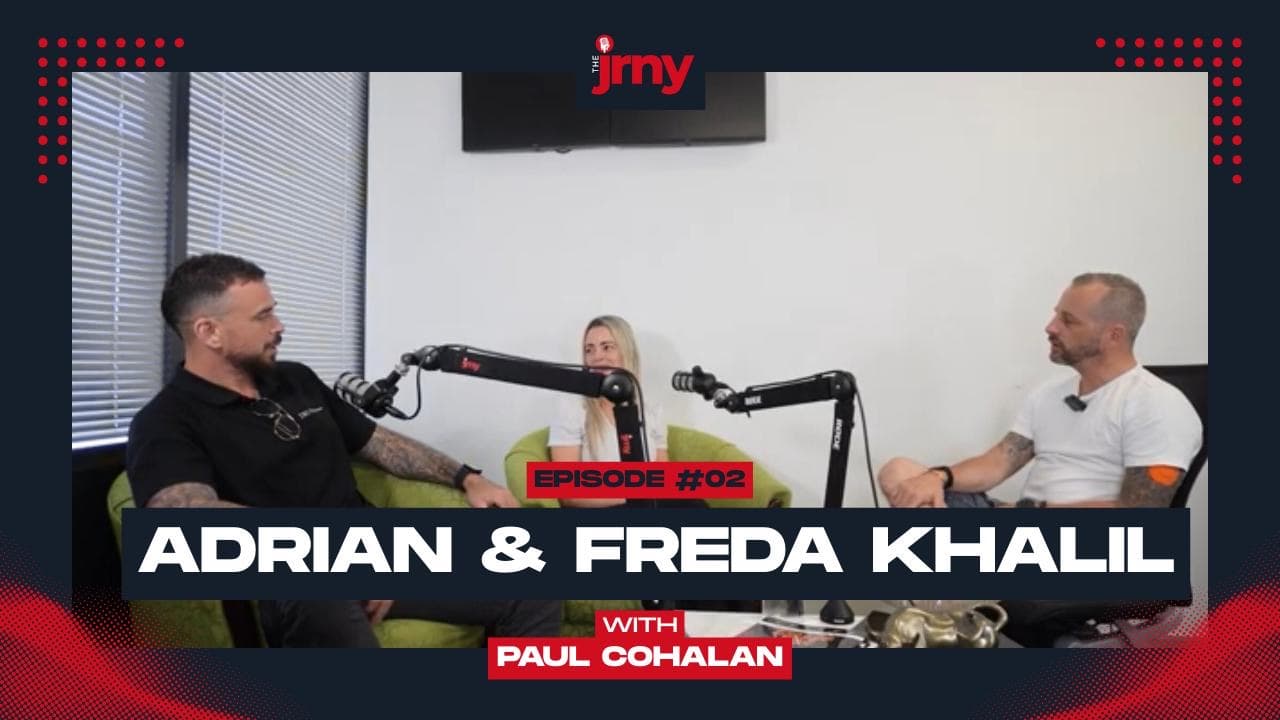
Meet the guests
Adrian Khalil
Builder and founder of Distinguished Homes
Adrian Khalil is the founder of Distinguished Homes, a Western Australian building company. He started out tiling floors after school and earned his building diploma at night, growing the business through early pressure, a partnership split and one of the most volatile periods in WA construction.
Freda Khalil
Co-director of Distinguished Homes
Freda Khalil helps run Distinguished Homes alongside Adrian, keeping the family business grounded through rapid growth. She is candid about protecting quality, trust and family while surviving the chaos of the industry.
Episode summary
In episode 2 of The JRNY podcast, Paul Cohalan sits down with Adrian and Freda Khalil, the couple behind Distinguished Homes. Adrian shares how the business was forged under early pressure, from tiling floors after school to earning a building diploma at night, through a partnership split and projects that forced him to grow before he felt ready.
Together they unpack the grants fuelled building boom of 2020 to 2022, the temptation to scale too fast, and why they chose controlled growth and honest client conversations over shortcuts and contract fights. It is a grounded look at resilience in the trenches: protecting quality, keeping trust, managing staff and surviving the chaos while still showing up at home.
Key takeaways
Protect your name. In construction your reputation is the business. Adrian built Distinguished Homes by refusing to trade integrity for a quick margin.
Controlled growth beats fast growth. When the 2020 to 2022 boom tempted everyone to scale, they chose steady, sustainable growth over overreach.
Transparency prevents fights. Honest client conversations up front beat contract battles later. Trust is cheaper than conflict.
Show up at home too. Surviving a volatile industry means protecting your family and yourself, not just the projects.
Transcript
Read the transcript
This transcript was generated automatically and lightly edited for readability. It may contain minor errors, and speaker labels are not yet added.
Hey guys, Paul Cohalan here. The Journey podcast episode two. I got um Adrian and Freda Khalil, close friends, client in Connect Business Insurance. Their company is Distinguished Homes, Family Business.
Awesome story. I I remember talking to Adrian about this. He's like, I'll never get on a podcast. And I and Freda was probably even worse.
Got them both on. It just flowed. Um we talked about the the roadblocks to risk and resilience at the start of the episode. There was nothing.
And by the end, we just peeled back his whole journey and he realized we're in. Even Adrian rang me afterwards and he and he was pumped getting back to the office. Watch this episode. It's going to be epic.
So, oh wait, you started distinguish. Yeah, it was in the pipeline. It was registered. Y So that transition was uh after finishing or wasn't actually quite finished the diploma or still was at the end of the diploma which which ended up getting signed off anyway.
At that stage I decided to go and start a business. So that big question that 5 months how is that made you evolve and create who you are today? All right, cool. Well, welcome to the journey.
Uh second podcast and um once again like last time we actually got two people, not not one. So not sure how long this will go for. Uh we've got Adrian Freda Cle. I always get this wrong.
Did I say that wrong? Oh, I got it right. All right. So, that they're familyowned company, Distinguish Construction, Distinguish Homes, and um we're going to have a chat with them today about their risk, roadblocks, and resilience.
Um when they started in ' 08, and how how they kicked off and then how we got to today in 2025. Brio, welcome. Nervous. You're as nervous as I am.
This is only my second one. Welcome, Adrian. Welcome, mate. Have you done one before?
No. Okay, so we're all green here, right? So, let's we'll let it all down. We'll double check it.
I don't even care if this is in it, right? But this is all about being really transparent and honest and not trying to make it perfect, right? Cuz I've been trying to do that. I haven't done it for 2 years.
So, now we're here, right? And I'm really glad to get you guys on. I had two people a week ago that were really good at doing this and then now we're all green. So, I'm It's helping me a lot as well.
Right. Obviously, we've known each other since probably the last seven years. Yeah. I'm sorry.
Seven, eight, 17, 18, something like that. Right. Really close friends now. But also what me and you realized over the last couple of years, we talk a lot about business when we're together, just us and personal life, you know, all that kind of stuff, kids, marriage, all that stuff.
And um we didn't realize how much on the same journey we are at points, whether it's employment, growth, going from here to here. Um setbacks. Yeah. Setbacks.
And and included in all them is risk, resilience, and robots. Right. That's it. That's the idea of the journey.
We've all got chapters. Some chapters uh all the chapters close and the new chapter begins. And um I suppose we'll go back for both years. Um but maybe Adrian kick off I think 08.
You kicked off Distinguished Homes, you and Freda. Yeah, it was 0809. Yeah. So So before we go into that bit there, tell me a little bit about what got you there.
Oh, so uh when I began work, I was actually a floor and wall tile. So Tyler, right? So after leaving school year 12, I was pretty much not sure what I wanted to do and I was just walking around the streets. But no, you Freda by then?
No. No, we weren't. No, I knew Freda, but yeah. I thought you high school sweethearts, but you weren't there.
No, we weren't there yet. Uh yeah. So yeah, I began my journey. I was at TA actually cuz sort of as you do, you follow your father's footsteps.
He was a builder. So yeah, I've started TA and throughout TA I was doing tiling as well. So working through the day, going at night school with TA and uh yeah, they got me in the in the path of building. So you were working with your dad at the point?
No, I was tiling. Oh, you were doing it was some somewhere else. Yeah. Residential work.
Yeah. How old were you then? What year would that been? That was 2003.
Oh, free. Yeah. Yeah. So I was tiling and then I went to TA to do the building diploma and that was the seven year we all together when you started doing the diplomas that start in 2005 2005 I was ting you were ting you were working 035 of working out what you want to do.
Exactly. Yeah. Cool. So that was the beginning of what got you here today.
Well that was a path the pathway that got you here today. Yeah. I was weighing it up still along the lines but yeah imagine um I just skip my phone. Imagine um you look back and reflect now and I do this all the time and I think we all do um is what you didn't know back then when you're green you're trying to work it out.
You're at TA and you're working and you only know what you've been shown right and you're trying to build your own path also. It's pretty pretty hardcore. Yeah, it wasn't um exactly that easy to work that out at the time but yeah I don't think it ever is. Um but the universe has a funny thing and we end up you know where we are today and um and everything in between.
I think that's what we want to talk about. So, so when when you're at TA between TA and then two years later 05, you're set. Yeah. You started a diploma.
Is that do I get that right? Yeah. Yeah. From work to to diploma.
Yeah. Yeah. Were you still working while you're on the diploma? Yeah.
Yeah. All the way through. Yeah. Yeah.
As a Yeah. Okay. Then 07 that's when the building crew. So just little nights as well to do your diploma.
You're going after work at night. Yeah. Yeah. Yeah.
So like you think you know the big decisions we we make now which they're really big I mean you talk about this we actually ask for it and then we binge about it when it's really hard% go back to that choice in05 of like I'm going to go do the diploma that would have been that big decision then even though now you look back and you're like that was just the start of it all the start comparison you know but it was still a big decision then eh 100% it was how how old were you I would have been 19 was it 19 or yeah you were 19 at the Yeah. Yeah. Yeah. Cool.
And it took you the seven years to do it? Well, it was part time. So, you know, you time two years ago I was doing it part times. Yep.
So, you guys got together. Adrian come sweep you up your feet. How did that all happen? How did that happen?
You can explain each other though. So, you know, Dan Adrian was one of my brother's mates. So, that went down real well. Yeah.
Yeah. Always does. real well. I know my end story is like that.
Yeah. Cool. And then 05 what how'd it look moving forward from there? Uh so 05 with Fredo or bit of both whatever comes to mind.
Yeah. Yeah. I would work and and that. Yes.
So I was working as a Tyler getting experience on site as I go. Um always looking at the jobs. Yep. Ting.
Yeah. Doing one task. But if I had a goal in mind cuz I was studying as well. So I'll be looking at the jobs seeing what I'm doing and you know what you're meant to be doing if you want to advance yourself.
Yeah. Look, so you had the patience there. Yeah. Been aware.
Been aware. Yeah. That stuff. So yeah, looking around and working doing six to six work on my own actually at some point.
So I was as a thologist. Uh actually I remember working in Alen Brook. Yep. Wow.
I didn't. Yeah. When I first started. Was it even a thing then?
It wasn't Bush still. No, there was and I was there working. See the beginner Alen Brook. Yeah.
So I've uh So travel, get out there. Long days. Long days and then go home. Uh I'll get home sometimes at 5:30 6:00 eat dinner straight to TA or 7:00.
Yep. Till 10. Where were we living there in BCA or um Belca? Yeah.
In Belca. So going was that legal t then the building diploma was done? Yep. Yeah.
Cool. So I've done it all there. What about yourself Reed? What were you doing then?
Um at that stage I was at Australia post. So that was the start of your journey was it? Was that your first job? Uh no, not first job but yeah was probably like the main you know main one that y really So both out of school you were tiling doing a diploma and you're at straight post fulltime.
Yeah. Yeah. Yeah. Cool.
And how what's the age difference with year seven or the same? It's a year. Yeah. It's a year.
So both very similar. Yeah. All right. So that's uh what you 05.
So 08 you started to distinguish. Oh it was in in the four years was Yeah. It was in the pipeline. It was registered.
Y but um kicked off in 09. Yeah, it was 09 um officially due to circumstances surrounding my father. I was going to touch on that. That's um that's up to you if you want to or not.
I don't mind. Yeah, it's been a while. So where was that transition and so that transition was uh after finishing or wasn't actually quite finished the diploma. I was still I was right at the end was at the end of the diploma which which which ended up getting signed off anyway at that stage I decided to go and start a business or not start a business a business was established but way from afar working that same business.
Yeah. And was that like oish? That was in 0 end of 07 go you've had that experience. I've had the seven or eight years and nine years tiling on site and previous and you would have done a heap of learning then like what you didn't know but imagine from it doesn't get you everything.
No of course but that's why you would have made that decision right. Yeah. And then I started with that first first project with him. Yeah.
Went well actually. We'll go. Where was that? That was in Mount Hol.
Yeah. So just just go like step by step. I think something that really highlights and I was going to say it before is you going and working on your own as a Tyler and a tradey and then doing the diploma before you jumped on board with your dad. Yeah.
For whatever reasons they are like whether you bang heads or not or whatever the path was. I'm guessing cuz I know besid that it happens, right? But at some point obviously you're like I can prove myself and it's usually to do with proving your dad being proud you know all this stuff, right? Yeah.
It had a lot a lot to do with that. It is also uh experience thing because my father wasn't actually actively working in the building industry. He's he was a structural engineer for um other companies and such on heavy mining and industry. Oh, so then he jumped onto your project.
I made he was registered for years but I was like all right well wasn't the time that we start doing something together. I had that's what I sort of made happen. So you would had all these roadblocks right and you took these risks and then that's probably one of the biggest risks. Yeah that that would have been huge.
Yeah it was. It was often work and I was making good money back then as well. Yep. So you sacrificed a bit just to jump.
That's really cool. Yeah. So that was Yeah, that's pretty much it. How did the project go for?
Uh that particular one went for 9 months. Yep. And they were ecstatic about the finish of it. Joe.
Yeah. So it was that um that win and I'm guessing that 9 months there would have been some learnings in there but yeah on that one there I got uh unfortunately my father wasn't able to continue with the project so I got left left in the lurch for that one. Ah yeah. So how much do you have left?
We're at uh to be precise I could pretty much remember. We're at the floor frame stage. Wow. Yeah.
So we have to build all the rest of the house. Yeah. So you tell me you didn't have many roadblocks now. I think this would Well, it was a hurdle.
A driver and a driver. And a driver. Yeah. Yeah.
It was Yeah. So you Yeah. The first four. And um and how long did you have left?
I think it was like four months into the project. So yeah, it's a good good number. 5 months, four months. Yeah.
Yeah. Awesome. And um and I suppose that there would have been no other choice. Well, the clients were living in the house.
Oh. Oh. Yeah. I couldn't just stop the job and get someone else to finish it.
I was unregistered at the time and um I gave if back then it was a building BRB, building registration board. So, so that big question that 5 months, how has that made you evolve and create who you are today? Oh, that's a good question. Actually, I haven't reflected on that as much.
Yeah. Yeah. I don't get that. I was pretty numb back then.
So, as a bit more of a was it just work related? Yeah. Of course, that's so keep pushing. Suppose I had that in me already, but it just Yeah, it reinforced it.
Yeah. Yeah. Yeah. And I see that of you guys today as a family.
Um, okay. So, you finished the project, great outcome. Obviously, a few challenges there personally. Uh, what come next?
So we Anyway, after that I I basically gave all the the everyone was pretty good about it, including the BRB and all that. They was letting me work still. They knew I'd finished the home off. I notified them.
Cuz you didn't have your license yet. Is that what you're saying? My Well, I had my diploma, but I didn't have my um like certificate. Yeah.
Yeah. Actually, I remember talking about this a few years ago. I think you told me about it. And um that was a big that it could have been a big gap or a huge roadblock and and it was a roadblock but you obviously navigated through it 100%.
Yeah. Then I I partnered up with someone that was working for a local builder that was uh I was a more of a project builder I should say. Yeah. Um and we ended up partnering up and then uh working out that's how Distinguished formed end of09.
So it was between 08 and 09 and that all occurred. Then I partnered up with this other person. Yeah. He was registered.
Yep. Um, and then I uh took my knowledge that I learned in a short period of time to get that to the party. Um, I had some design background as well. So, it was good to have some knowledge in that.
And you've only finally just let that go the last couple of years with your own time, mate. I design. Yeah. No, don't do that.
I remember when I met you. Yeah. No, I can't do that. Delegate.
Delegate. Yeah. You have to delegate and monitor and review. Y a little bit AI in there.
Spoke about before. Yeah. Um, okay. That's cool.
So, Fred, where were you at this point? Yeah, that was I was still working um at Australia Post stop doing doing that. And how'd you find how do you find minutes in the day to It would have been like, you know, where's the minutes in the day to for free back then? Oh, can't remember.
I used to bring your lunch to your little projects and Oh, that's Yeah, Austral. you made it work and and once again that go back to the personal the relationship piece what the resilience that builds and no doubt you still bang heads and go through all that stuff because that's kind of what happens right but um you know you look back on that how many times that happens and you're still here you still got the company and you got three beautiful girls which keeps us going so when did you leave Australian Post um we had our first daughter so she was born in 2013 on um yeah and then from there we just kind of started helping him out in the office. Um cuz did you obviously regulate all that stop work and then it just naturally probably happened like that. He's like, "Oh, why you there doing nothing even though looked after a little one?
Got some work for you to do for you?" No, it's good though. It was good. Yeah, it was good. I enjoyed it.
Just kept me kept my mind something other than just looking after a new boy all the time. What was it? What was the first really hard time or day that you had when you started working together? Oh, I don't know.
all plays together. Yeah. I think it was easier back then than what it is now, I guess. So, it was Yeah.
Because I was doing less back then, but now now. Yeah. You're really involved now. Yeah.
Yeah. Yeah. Yeah. It's good.
Yeah. It's um Yeah. Cool. So, when would that been?
- Yeah. 13. So, you already been going three years at Distinguished.
What was the first copper build you had? And what was the first big problem you had that really scared out of you that now today probably wouldn't have? Oh, just something that comes to mind cuz we all challenges or all on site, stay with the client, stay with the build. We all have them, right?
Trying to think what the actual Yeah, that's all blur now. It's been a while, but uh yeah, I think uh the first build was uh actually the first build was an up extension as well. Oh, was it? Yeah, we're starting doing actually renovation based originally.
Yeah, a lot are right. You get your s Yeah. Well, my my business partner was a carpenter. he had his his qualified car.
Y it made sense. Um so yeah, we're doing renovation works and uh the challenge we face there was just dealing with people I guess. Yeah. Like working out how how to do the right thing and make sure that they're happy all the time.
Yeah. Um just challenges around that and and I'm guessing you know people's skills back then when you're younger a lot harder than what probably is now. You learn a lot over time. Oh yeah.
A lot of people took a leaf of faith in building with us as well at the time. you know, we're starting out. They've seen that we were good people, so it gave us a go. Yep.
That's great, isn't it? That's how it was back then. Yeah. Yeah.
And everyone needs to go like whereas today back then like we all got to start somewhere, right? And that's why I ask about like other challenges, mistakes or whatever because we all have them, right? As music evolved usually and still still have them to this day and every day, right? You realize as they go.
Yeah. I suppose how we respond now to how we responded to them back then is probably a lot different. And obviously when there's more people involved in the business or more clients or different size of clients and all that kind of stuff, it changes the whole dynamics of it all. So, uh, when did the second one come along?
Free 2016. Yep. Yep. So, still doing the same thing though.
Just had two of them. Yep. Yep. Yep.
Still helping out in the business. Yeah. Were you in in the business then or you just working from home or Oh, you always work from home, didn't you? We yeah home offices.
Yeah. We build houses and work and that sort of thing. So when you build the house in Bat Dela that was kind of only in 2013. So okay.
So before I was born. Yeah. We're not Jo cuz you had an office and all that. That was when I met you in that house.
Not 13. You maybe not after. I think it was a bit earlier than what you said. Oh was it was 15 or 16.
Yeah maybe 16 something like that. Yeah. Yeah. Yeah.
Cuz when did you sell that one? That was sold in the 80. Yeah. Yeah.
So it's before then. Year or two before then. Okay. Yeah.
Yeah. So what was where were we? So So either so go back second one come along. Distinguishes established.
Yeah. Offices and that. Yeah. Yeah.
Working from home. Yeah. From that there to now. What's the difference?
How's it how's the how's the book? How's that look? Well, it's I think it's like that for everyone in WA at the moment. But yeah, we've business look.
Yeah. It's like it's going well at the moment. Yeah, we've got quite a bit of uh work on. Yeah.
Um to today, I guess. And now we're in our own office. We're looking for our own premises now as well. Again, relocated.
But go go go put yourself sitting in that office that I would have seen at Balcata House, right? Mhm. To where you're sitting now. Like give us the biggest differences or learnings or stuff that you know has made a big difference.
Definitely grown. We've gone from obviously having three. Yeah. The biggest differences I guess is just the management of staff.
Yeah. um like you stepping out a bit, me pulling pulling out. Yeah. A bit um from the I could call it the trenches, but there from being being that level with just to help as many people as possible in the level of just focusing on one thing.
So that's multitasking is increased a lot. Yeah. You're still very hands-on though with I'm I'm not saying that I'm not in the trench. I'm still in the trench, but I'm I'm just on top of it.
Yeah. making sure it's all happen because you can't just do it really quickly, right? No, you just can't because it what we got to learn as business owners is no one's ever going to do it like we do it. We expect it sometimes, but they're they're an employee.
They come to work, right? They've got their own well- done personal issues and all that. The moment you start to realize that a bit, no one's ever going to do it like we do it. No.
Right. And and I think at the beginning of business, the first 3 to 5 years, you're always like, why don't you do it like that? You know, why don't they're not meant to, you know? It's Albats as well.
Like everyone loves the fact that it's Adrian's, you know, the point of call by them, you know, that they can actually get in touch and speak to him is not just, you know, y know the amount of work with as well. So for them to the ability to still talk to me is a good thing. So with a client, let's go back to risk for a sec, right? Because there's all different dynamics here.
I've got two questions. So, we go back to risk. What's some What's a risk you've took for a client that probably either pushed your limits financially or you done something for them that maybe you you pushed a limit on? I don't know.
I don't know you gain that well, but like what's something that really put you you had to take a risk for them. Oh, or something you hadn't done before and you did and you said yes maybe. Oh, you're telling the I do that all the time. What's something that comes to mind?
Like what's something that will relate to everyone? Like uh I suppose um let me just let me think. I mean conflict resolution. There's hardly ever any conflicts if you're always keeping people happy.
That's one thing. So like conflict, client engagement, client engagement and all the rest and updates. I mean we've come to a point where there's been some clients that have questioned or forgot what was included in their scope of work. Y and um I kindly massage the fact that the contract's been signed and and the paperwork's there.
Yep. Um and then when they realize, oh that's what they sign, that's where some reason they didn't realize that that wasn't in there, but it was clearly in writing then. So not everyone can always keep up with everything. Lot of work.
That's why they've got you as well. Yeah. So there's a lot of paperwork. Then I explained to them, yeah, there's a lot of paperwork as you can see, but imagine having that on multiple client levels and then you know, we have to try and monitor all of that.
So things get miss things can go and then and then then you look at that and you go how do you make it right? Yeah. So all right we'll we'll do that for you anyway or do we just you know do we work halfway here? Do you do you help us out and we get this done for you?
So yeah cuz I suppose in the building game how many clients have you got that um come back what do you call it? Oh return clients. We've had uh quite a few. Yep.
That's what you want for someone. Yeah, I I think I was reading the other day about like you build a business, you have a client um and they return there's trust and they return again and you build a brand and for at the start everything was word of mouth where we had all our clients were word of mouth and as I said when we started talking before it was they gave me a chance. Yeah. If you don't forget that.
So like so you always got to have that in the back of your mind. Doesn't matter how big you get. Have you got a couple that just come to mind? Like there'd be some at the start that I've got a few start.
No, no, no. I'm just saying there'd be some that really resonate with you. Oh, I got shot. Yeah.
Yeah, there's been some difficult difficulties at the start as well, but yeah, the ones that really gave us a shot. Yeah, they were they were um or one one in fact was living up in up north um in the Pilra running a newspaper. Yeah, probably said too much, but um yeah. So So what what did you do for them?
We knocked down and built their house remotely. Y So that was in 20 that was in 2011. Oh wow. So we just started.
There you go. Yeah. So and then then and then we end up renting that house and running our office out of that house while we were building our So talk about a risk, right? And you've wanted to start being a builder.
Like I'm trying to pull this out of here. Right. Now we get to where we were getting right. You found the D.
So you you found you found this. We're talking about a build here that you got remotely. You're only new to building. You've only just kicked Distinguish off.
You've had some personal challenges, right? From a Tyler to a builder. You haven't got that much experience under your belt really as a builder and taking it on. Yeah.
And you got to build it remotely and you got to keep them happy and they got to give you a shot. And it's also when you've got like the risk of you know when you first started you've got to like put a lot of funds into it cash flow and cash flow and then they then they rented it back out to us to live in. Yeah. That's amazing.
We're going to be back. So did them. And we had to build our Belca home. That's what was happening.
Oh okay. So yes we built in 11 probably finished what 12 13 and you built your BCA home. That's right. Yeah.
Amazing. Yeah. And um and then they'll kind of home. I had your little one.
Do you still do you still talk to them or know of them or they actually you know what they they actually contacted us. Was it a year ago? Yeah. They're very they were very lovely people and they they um we hear from them every now and then.
They always ask how Adri is. That's why we do what we do. That that's that's a wicked feeling, right? It is.
Yeah. And the reward out of that is Yeah. Second to none. So the risk there you would add the road the roadblocks there would be communication.
Oh yeah it was they were good to communicate runs a newspaper so they pretty good at that putting out their words but um yeah no that was there wasn't actually a lot of roads there. They had a lot of faith in us did they? Yeah. So out of that though um it would have it would have made you go we can do anything homes.
We can be nimble. We can pivot. We can communicate from anywhere and we can do anything. Like that would have been a big foundation piece of like there's no saying no to anything.
We've just built a house remotely. Get you know what I mean by remote. That's really cool. Yeah.
So 13 first one. When was the next one? 16. So between Athena and the next one.
When was uh 2020. 2020. So in between then what bills did you have? Oh 16.
I had some I had some own developments going on as well. So you have three unit sites. Um, we had uh a couple of large twostory homes. So, just just on that, right, I go back to where you said before about cash flow.
So, that would have really like hit doing your own development plus building for clients, right? I'm just guessing. Yeah. You know, you we all don't have endless buckets, but you're you're building the business there and then, you know, going and building your own that you're not getting obviously milestones and payments from a client.
That would have been a bit stressing. That's that's not how it works. So you you are a client. You treat if you treat your billing company as as a as Yeah.
So you just you done the same thing as you would have with a client. See? Yeah. Yeah.
That's why it doesn't fail. Yeah. When you do it the other way around, it becomes a problem. Yeah.
Trying to squeeze it in trying to do it. Yeah. I get you. No, you sign a contract with yourself.
Yep. Yeah. Yeah. That's good.
It's really the point, right? Otherwise, you are you're not looking after your business, are you? No, I'm looking after everyone else's interests. Yeah.
So, yeah. And I suppose it goes to like a few years ago, you know, um people get when when when the boom was going on, everyone's signing letter of intents and doing all that. It's not the best interest of the company. Um under a company, right?
No. You go get heap contracts because of grants, which I I I said cuz it's never yours. You come is yours. You can say that, but it ain't because it's it own.
It's his own entity, right? Yeah. Yeah. So, that's how I look at it.
Well, you're always a PTZ from the start. Oh, no. say, "Oh, there's you brought it back again." So, after um it was 2012, no, it was 2014. Um that's when myself and my business partner who was it was a partnership.
Then he he decided that uh it wasn't time for him to go and work for a building company. He had enough of trading on his own and he hasn't. I don't think he has since. Yeah.
Tell me a little bit about the partnership because I know most partnerships don't work. Partnerships are partnership work great. It did. Perfect, mate.
Yeah. And I saw him today. Yeah. Awesome.
What made his part way is just he had enough of working for himself. Distress. He's been more for a long time. He was came from a supervision role with a few different builders.
He he was he had 10 years on me. Yep. Um and then he went out on his own. He had his own building company.
Didn't quite do much with that. He got a little bit with it. Y I brought him into a partnership. Um we worked for what was it the 2009 to 14.
That was good fight. Yeah. Awesome. Um so to be here and then the stresses that went along with it.
Obviously it's not easy. Y he decided to uh want to which was his own choice. He decided to like you know just shut shut up shop and you know want to go work for someone. So that was fine.
And he's just done that ever since. And I'm still talking to him today. I get trades off him all the time. That's that's such a good story because I always say they never work but they're really hard, right?
Because with different personalities and all that, it's about what you're trying to achieve and even being open and saying, "Hey, I don't want to work for myself anymore." Like that's a big call, right? Because there's a lot of pride in there, especially with the man, right? Yeah. I don't want to, you know, so that was a roadblock, I guess.
Yep. And and then sort of I had a choice again was put to put to me and I was like, what do I do? So I just decided at that point to go that way and continue with Distinguished Homes, which was the same brand. was Distinguished Constructions and then we rebranded to Distinguished Homes as a Y a trading name.
Yeah. And then uh we then went to the PCY at that stage. So out of every roadblock, right, like that would have been a big roadblock, but there's always a springboard out of it, I think. And it's hard times for a bit.
Like I've had them recently, you've had them recently, all for different reasons over the years, but every single time out it you're always springboard out of it. Well, that was your first true moment where I was running the show. Oh yeah. Oh, true.
know one to bounce off on your own. So as a builder, you were there with you were there with your business partner and you're like, "Fuck this. I'm going to dip my heels in." How long did it take you to make that decision? Overnight.
Yep. I've done it pretty much overnight. Let's go. If you don't mate, you can think you know everything, but you don't you don't you don't know what you don't know, right?
That's right. But you've had you've just done 5 years with him and um So I've got the experience. Yep. Yeah.
So you the experience was there. I was just it was a no-brainer. Yep. Pretty much dig it in and I guess even running the company and running running the partnership was pretty much the same thing.
Yep. How were you free? You just went on your own. What What did it do for you?
No. Well, it was Yeah. I don't know. It was fine.
It was just um he would confide in me with a lot more things to do with the business at that point cuz he didn't have his business partner and stuff. So, I guess that kind of kind of led us to working closer together on the business. I guess I I remember that bit. I I done it in Feb.
I business partner two after two years of starting Sonar Insurance and went into connect and it was like it was a big pivotal point but I was a bit the same. I actually planted the seed the end of 17 because I just got a feeling that our values didn't align and all that stuff. Yeah. And it was you know um I think it was a mature and smart decision to do that but soon as you get to that point you sit and these chairs are actually the original chairs were bought for the business.
This is why I won't get rid even though everyone hates the green but I might cover them with the journey but I'm not sure but um there's a lot of sentimental but all their milestones I remember it fair when we finally actually split and it was like oh I like still dub me hills in let's go I already had it in me head to go cuz I kind of planned for that to happen cuz I'm like if I don't we're going to end up resentment butt heads and the business you know cuz you're going to affect clients then right so I don't make a clear road map and decision but it is that one as well Sorry. Yeah. So, we had some clients that were halfway through. Oh, yeah.
So, how do you work that out and navigate it? Oh, well, it was it was pretty much take he was really really easy about it. Um, yeah. It was just like you take the responsibility over it.
You pretty much I've been running like we obviously it was two builders in one company. I was registered by then as well. Yeah. Um, I can't remember registration was 14 or 13.
I end up getting it. Um, was early was earlier than that. Sorry, I can't remember that date, but it was definitely Elliot. So, I've been registered as well.
So, I've stepped up to the plate. I had my own sort of independence anyway and I was running my own jobs. So, if um so that's 11 years ago. Yeah.
So, what what what's it would have been a bit of a like all of a sudden you would have grown more even though you had the experience and all that. the moment that person's not there, you're finding your wife, which I think naturally, and I I had this with Michelle, is you are the rock there. Even though you're not in it daily going, this is how you build, but you don't I don't think you realize how important that that piece is. You know, the kids, everything, even just bouncing stuff off you, even when you don't know it, it's like you've got someone there to go and bounce off.
You start to learn it and evolve, right? And um just how important that is to be on your own because most of it's here even till today. If anything buckles, this is our own mind. If we win, it's our own mind, right?
Exactly. Most powerful thing. So, so all right. Where do we go from here?
Um, yeah. So, we've got a few we got a few few milestones, Andy now, like some roadblocks. More than you probably thought you had at the beginning. I know.
They're all there away. So, talk talk to me about um from 16 on like we did before, like up to 2020, even now, last five years. 2020. Well, obviously yeah, we're not going to hop on about what what happened in the state of Western Australia and the whole of Well, neither talk a bit.
It's just the way everything went down and yeah, we survived it. It is WA though. We can blame we can blame like even the government with the grants when that kicked off. You know, that was a domino effect later when once again all these letter of intents can't get builders, brickies, supplies, the whole bit, right?
Yeah. But in the end it's life and it is WA like we got affected because we go so high whatever guys up must come down right. Yeah 100%. You know we we have a lot of this compared to the rest of Australia or the you know most places in the world.
Talk a bit about it Adrian. How did it affect you? Because all all I remember and we've been friends a long time then you're a client and I watch builders fold right. builders are folding it and and we also know others like in the media that fold that were bigger and a lot of it come down to how many contracts they thought they signed but they didn't have the cash flow they kind of biggest piece I deposits about was that they were trying to be a company and when you're a builder it's all about milestones in cash flow more than my business or any other business they were trying to be a company they weren't because they got more clients because of grants because of whatever reason right now or I watch you and me and you spoke about this a lot is you stayed who you It still grew what you were doing but didn't try and go from I think it was back then it might have been five to eight builds a year or I was actually yeah I remember having this chat with your eye and we talked about the whole grants and the whole global economy and it's like you didn't try and go from 8 to 30 because you could have went and got all their murder of intents because all the young people getting grants and double grants and you know whatever they were I can't remember now but um you could have but you would have been trying to be someone that you weren't and once again go back to what you said earlier even at the start of the business to now you got to put cash in you got you know, hit the hit it, right?
Cuz who are you looking after? The Ms and dads and it's their home. It's personal. It's not buying a car.
It's not Exactly. So, so give us your take on that. And if you remember our chats about it, like just about the whole piece. Just the way How'd you navigate through it?
Navigating through it. Yeah. So, there was challenges all the way through it obviously. Um and and some of it was on site, some of it was in clients and um some of it was obviously Yeah.
trying not to take work on where you knew that you could take it on over over reaching yourself. A couple of things also and this might trigger you. I I know over the last five years and go the 2 3 years from 2020 on you even went down remote builds did you know? And you might have had the odd one a month or so over but you were nearly on time with all of them cuz I got to hit you up and go closing out this project.
we're doing this and you're like, we're done and you're remote and everyone's struggling to get supplies and trades. How'd you do it? Oh, that was that was hard. It wasn't easy, but yeah, we just persisted and made sure we set oursel set ourselves up in that area.
We take something on. We're going to try and do the best we can to get it done. So, how' you how'd you do that? Do you think it comes back to people skills and looking after each other before all this happens with trades and stuff?
Do you know what I mean? Like Well, yeah. There there is a degree of um sort of loyalty with trades and and all that sort of stuff that that's there. I mean a lot of it went out the window with some of them and that that happens but chased a dollar or 50 cents 100%.
Yeah. And and some trades more than others. Yep. Um not going to name names.
No, of course. Trade types. Uh but yeah, so but moving forward with that, we we basically wouldn't were resilient. So we just kept trying and pushing and making sure that was Tyler's name.
Tyler's there. Tyler Tyler with a V. Tyler with a be hickeys. Yeah.
So no like I think at the end of the day we were in the cars. We were driving around and I had a smaller crew back then. But we get in our vehicles and look for people. Yep.
Go to sites. Oh, we're going to get someone. We'll be there. Yep.
Asking why can't you come to ours? Can you do this job? And so so when you do that, right, you can go and do that, but then you got to back it up and you got to commit to what you both commit to and no, you would have had to pay more and all that stuff because you know for money we we we that's the encounters that we face. We we lost money in areas.
Yeah, sure. Y um who didn't throughout that period being building or not like Yeah, you lost. your key. I I'm guessing you you lose money contract.
I remember sitting with you at a cafe actually over in Gerowine. Um orup sorry and we sat there and talked about it and we were talking about contracts cuz contracts are getting signed and done couldn't be reviewed but then the prices all changed and like me you were talking about it like it affects you then affects the client and then there's like technicalities in the contract but in the end put the contract aside. You still don't want to burn your relationship with the client no matter 100%. But then you go and get some bigger companies which don't need to mention any free letters or anything like that that you know they're probably still going to court over it these days.
They want to they want to build a 200 homes and do all this stuff and never commit not be able to back up what they said they were going to do. Exactly. Now I think it's a bit of a credit to you guys and not not just both as a family company that you got through all that and I think it was probably by being smart pushing the limits as you have everyone had to. Yeah.
Um, but going back to what you said about 20 minutes ago, it's like you'll lose a bit, burn a bit, and try and work it out with a client. And I'm I'm guessing then chats with the clients would have happened all up, right? Prices go up in the end, they can go, "No, stick to the contract." But you go, "Well, your house won't get finished." Like, there must be that hard chat. It's like, I need, you know, in the middle of the We took the hits.
You got to roll the punches basically. So, when you win, you win. There's cream. There's cream.
and you know things are good cuz not every part of the contract's a failure. So if you move if you know your contract, you know your your uh your budgets and you're monitoring it closely, you can push money from one area to another. You had surplus in one area, you can say, okay, well that offsets that loss. When it comes to the fact that throughout all these categories of one home, you've got maybe 50 categories of different trades, different areas, then you find that you're losing money on every category and there might be a hard word that has, you know, a challenge to occur.
Yeah. Um, more than more because of the type of homes we're doing which were sort of medium to high end at that stage. A lot of people were making changes on the spot and saying we want to they had money at the time as well. They want to change cabinets or they want to change.
So that might that little bit of room. There was a room for movement to make up for losses. Yeah. Make up for some losses which I would talk to them about and say, "Okay, then well if you want to do this benchtop, this is where we're at at our budget price where we had it at and now this is the new quote that we've got." So that's that's the conversation that we'll have.
Um and it would be very open book. Y um because you're asking it basically to uh you know come to the party on that avenue if they want to make a change. So, so in that also you evolved from going from the level of houses you're building to going to the next level and you've got everyone again, right? So, let's get in let's get into that that a bit.
But when after 2020 onwards, what year did it start to come back to a bit of a normal race? 22. 22. So, two years of the right?
Yeah. Let's say 22. Yeah, let's talk about from then on in then. We all know about the 2020 and all that kind of stuff and and obviously before 2020 has got you really where your foundation of business is today, right?
100%. So 22 23 onwards. What are you building? Tell us about Distinguish Homes.
You got three miles. Yeah. We're looking um as or pretty much being fully established now like um solidified ourselves gone through all the hard times. 2016 was a hard time as well.
Yep. That that people don't remember that but that was quite slow. lot a lot was happening. So yeah, we've gone through two of those circles, biggest one in 2020, 20 to 22 and then come out of it.
So we've really solidified ourselves and worked out that what we can actually do. Yep. And then we've taken just gone leaps and bounds from there. Yeah.
Yeah. So tell me tell me a bit about the the service, the builds, like what you doing for people. Service hasn't really changed like it's just like a bigger What about product? The product still hasn't really changed.
The product is the product. It's quality. Whether I'm doing a small home or a big home, it has to be the same. Has to stay the same.
Um I think that comes back to that family touch, the nimleness, the personalization, the being the contact there. Yeah, there's that. And there's the fact that yeah, we've um just what we do. So, it's just now ingrained in us.
Like, if I started off being not that great, then you know, you could either make yourself a bit better or you could stay not that great. But we've always tried to keep evolving. Yeah. Keep ourselves evolving.
So tell me a bit about distinguish though. Not not so much you guys and the service. It's like what about the builds? Like what do the builds a lot of people watch people's budgets have changed.
But even even think I'll rephrase it or rephrase it. You said you showed me a house you just finished the other day. Yeah. Like compare that to 2015.
Do you know what I mean? Like just in general tell me how you're doing. And that goes along with the uh I mean the level of home. Yeah.
I'm not to not to boast or carry on about it. Yeah. Amazing. Yeah.
Level home has changed. Yeah. This the construction methodology hasn't. Yeah.
It's still the same. Whether you're building now or you building this, it doesn't matter. Um it comes with a lot more pressure and stress if that's the new modern styles and 100%. There's a lot more materials that are out there that you need to sort of uh can be in tune with.
You have to make sure that you different challenges now. There's different challenges, but as far as the quality goes, the quality is always there. Um, yeah, but the contract value is obviously changed. Y, the amount people are spending on homes are changing.
Yep. Um, and you bring that, you boil that down to um the this the current market we're in as well, I guess. Yeah. Yeah.
I think your clientele has changed a bit though, like obviously, right, your insurance and your builds and what your builders and all that kind of stuff. um you've got a you got a good variance there and I think whether it's a $500,000 home or a $4 million home that you're doing and I've seen the big range of it all and that that's kind of where I'm getting at. I know your quality and all that's good. I'm just saying how the businesses change because what happens as me and you discussed where I want to end up with this is your quality and everything.
You're going with the times. You're not trying to stick what you know it's what the market and the client wants. but also how you you're talking about how materials are changed but what's that do for you internally is distinguished now like very years ago me and you were driving out of been doing and we're talking about I want a supervisor I want this we need to do this inhouse estimator and you know engineer architect all stuff and it's software right and then like I go sit in your office now you've got new software you're still transitioning some of the old stuff you're nearly out of that and it's all about efficiencies simple things like the old school builder thing won't connect to zero you got to run it separate like we talk about business efficiencies to make up for the bigger numbers now the bigger projects more efficient more wages the tech's coming into yeah yeah you got to you got people on the ground now that are taking your role that's me and you spoke about this about 6 months ago it's like 3 years ago we're like I want to do all this 6 months ago you're like I'm bubbling because now I've got all these people I got to find more people I'm like we asked for it Freddy you asked for we asked to grow and then there's you know the same challenges Yeah. So, yeah, we're fellow.
Yeah. He just he just said it all. It's pretty much it. Yeah.
But you you must sit and reflect on that and like you go, how did I do it before? How did I do it 5 years ago? Do you know what I mean? And um Oh, you do.
Yeah. And sometimes you think, well, is it was it was I better off 5 years ago? Yeah. And then you think about and you go, well, yeah, it's you are what you make it.
Yep. Sort of thing. So, where do you want Distinguish to go? I think it's traveling in the right direction.
um it's on it on its path. I I'd love to be able to say that, you know, in 5 years time. We've conquered everything that we've we're we're working on at the moment. Yeah.
And we're at a newer higher level. Yep. Another another level again. Challenges challenges but different.
Um is it to do with a bit of a legacy thing, family thing? Does it go back to that, you know, that first project with your old man? Yeah, there's that. That's probably the driver actually.
Yeah. Yeah. That's cool. It's funny how uh over the journey all the chapters and they all connect and it still comes back to today, right?
Yeah, definitely. Definitely. Are the three girls going to come into it free? I don't know.
We think sometimes uh the oldest one wants to she very into you know the design side of you and yeah the one you never know she's a bloody booger. She might want might want to get on the tools. Who knows? Yeah.
I uh let's while here's one here. Let's talk about the we'll still talk about building but your own home that you just built. So you bought a block with a house on it at the front. What four years ago?
5 years ago. Yeah, we're in there 2018. Oh 18. Yeah.
We we bought there in 18. Y that goes quick. So I probably haven't known you longer. Yeah.
So, you done that and then finally you split the block um and cleaned up the back and you've just got built a beautiful home that I went in half built and I just walked in it the other day and you done all the um design and all the interior and the decor and it's absolutely amazing. What went into that? um that was a lot of hard work at Q because like um you know working and Adrian obviously comes home from work then comes back to being at work at home having to do things in the house at the back. So um it was pretty stressful at the time.
Yeah. Just just cuz you you know you're working full days and then coming home and continuing to work at home as well. But, you know, we um you know, clients jobs came first and we kind of put things ours on the back burner a little bit. Still trying to get it done in time and that, but you know, just didn't want to, you know, have to push any out for our clients.
Wanted to keep our clients kept going. Yeah. So, I And don't you answer this yet. I I probably one of the most stressful times I've seen you guys was only not long ago.
Now, um when did what week did you move in? You've been in what, eight weeks? Yeah, we were in August. end of towards the end of August.
September. Yeah. So, I reckon 12 weeks prior to that is probably the most stressed I've ever seen you and mainly talking to you. And then I'm talking to you separate or just popping in and um from and I don't think I could do this actually after watching you guys, but you had the house at the front.
It was chocolate. It had all the stuff in it. And your motorbike was at the back. You got the dogs.
You got family there. You got the girls and your mom. Um and then you're building this one at the back and you just can't wait to get in. I couldn't even get yours on the phone.
And you're like, I've just got to keep going with this cuz we got to move in. Let's do it now. Handy. He's very hands- on with everything.
So yeah, it was just literally work and like you know, he's he up and out for work at like 5:30 and then coming home and actually working at the back house as well. So So what what you did there for three boxing matches for talk about in a sec. I wanted to bring that up. So just just on the house there, give give us one or two things really tips that if someone's going to go buy a house, subdivide them, do it at the back.
Like you I've I've seen the most pressures from you guys doing that. Like what's what's a win? What's something that helps? It will end.
It doesn't feel like it. No, it's just, you know, it's the feeling you get when you move into that home. That's, you know, so it's all hard work, you know. Was it worth it?
Definitely worth it. Yeah, it's good to me. If I asked you that about 4 months ago, you'd be like, "Fuck, I don't know why." Hard time. Yeah, definitely.
Cuz then like obviously the kids had to share a room like after obviously Adrian's mom had to come and live with us as well. And um so then kids went from you know having their own rooms and having to share a room. So you can imagine three girls in one room. Y you know that was that was probably the worst and then their sleepy patterns going out the window was all stressed, right?
School routine all the window. That's all out the window through all that cuz it's Yeah. I I remember I remember popping over end of August or just after you moved in and I remember coming upstairs and walking in the theater and you guys are sitting there chilling out now. Yeah.
Huge shift, right? Yeah. Definitely. Yeah.
Yeah. What about your age? Oh, re ask a question, mate. It's a blur to me, mate.
Yeah. So, I was just talking about your new home and the and the decor and going through it. Um, absolutely amazing. which you hated like the whole process cuz it put me like when you're building for clients and stuff and you know I'm there helping clients with those choices it's a lot easier.
Yeah. But when it's your own home like it took us a while like I was changing things as we're going and he he likes everything done at the start reflected but bit of a headache for him through it. It was off the cuff. Yeah.
Yeah. So back to your question we oh we were talking about that I'm just what I what I asked first off was how hard it was. I watch this, right? And moving into the front house, doing the subdivide.
Like, what's a good tip for anyone out there that's going to go and do that whole piece cuz you got the family dynamics, you're building house at the back. You guys are obviously a builder. So, like Fre said, the main aim was keeping doing the clients first and then after hours of doing what you can to your own house. Yeah.
Probably a big tip is to uh try and let go a little bit to not be so concerned about what's happening behind you. If it's a rear, just let you live your life. Y let it happen. Yeah.
The time will come. Yeah. But when it gets to the point the end, everyone gets sort of uh at that point where they want to move in. Doesn't matter.
I've experienced being clients or being a client myself. We're all really impatient, right? Well, everyone's nature is human nature. So, I got pressure.
You got pressure on you. Obviously, you guys had huge pressure. Um, you know, with your mom, the kids, just being shockers in the house. It's going to be different this time around when we knock the front one down.
Um, you were in the back one. Very comfortable. So, just make yourself comfortable. I guess that's probably the key.
Yeah. Yeah. Yeah. So he's enjoy the home mess now.
Oh yeah. Yeah. Yeah. So what did you have last weekend?
You didn't come. Oh. So I couldn't I'm waiting for another invite. I'll get the next one.
Um Yeah. And you and you've got it on social now and it's a great example of what Distinguish does. Yeah. And you didn't change anything you do from the quality to the style.
Like talk about modern. Like I haven't seen another house like it. It was amazing. Oh, thank you.
Seeing it halfway through it and then seeing it right at the end. I remember saying to you, "You'll show me around." I was blown away. It was wicked. Especially to do it under all that pressures.
Fair enough. Thank you, mate. Yeah. Um, what else?
There was something. All right, let's get back to one of you. Talk about Adrian today. And by and by the way, Freda's flowing very very She's doing a lot better than so your boxing matches.
Why'd you do it? Uh oh, I've always tink sort of tinkered with boxing and martial arts and training and and all the rest. And um then I moved office from where we were into Mala. Yep.
And it was right next to a boxing gym. Yep. So the coach from the boxing gym there, he's uh give him a shout out like a like a pest. I won't give I won't give him a shout out in this but he he was he was at my office.
He's grown to be a very close friend. Um and uh yeah, he uh he basically was saying, "When are you training?" He was giving me motivation to train. So I'll be training every night. Yep.
Instead of going to uh do my billing course and I was training in the gym. Yeah. So let me let me ask you something on that, right? Cuz we had the same chat.
Uh the last podcast Levi was on, he just done RQC. Oh yeah. Um boxing and he nearly he was nearly pulling out like a week before, three weeks before all that. and I end up sponsoring him.
But he's so glad he done it and he won as well, right? And I know it's a bit different to you. That was a charity then you never done it at all. Like the biggest thing I think like all those me you talk about training on and off cuz we stopped like I trained for about a month and a half now, but how much did it help you the boxing with mindset wise?
Unreal. And I always pressure unreal. And so yeah, I was getting to to the boxing gym sometimes in the morning at 5:30 and I'd be um training whatever else and having a shower and getting out of there by say 6:30 on the road yet and just So that hour put you put set you up for straight out. Yeah, it was great.
It was great. But yeah, I haven't actually done it the last 3 months, so hope he's not listening. What uh what was your biggest roadblock on your head towards your first fight? Um was it eating?
Was it training? Was it work? Was it free? As far as a fight goes, yeah, 100% it was uh eating and um not losing my my cuz I was so angry from not hangry.
Yeah. Yeah. It was it was a it was definitely a wild wild ride. And I know you change your mindset a lot.
You know, you used to go to the gym when I met you still probably then was all size weights, you know, all that kind of stuff. So I lost 17 kilos for that first fight. So that was a big that was a big change. Yeah.
And it changed your mindset about it. I remember you telling me after you like I never really want to go back to where I was because I like having a bit more of the cardio or speed. I'm not as slow. What do you say already?
I'm not slow. Still fat. No, it was I was pretty it was Yeah. being nimble.
Um I think it was more the the mental state what it what it done for me like with the boxing and that. So it was Did you win the first fight? Yeah. Won the first fight in the first round.
Yeah. I click but Yeah. Yeah. Yeah, it was it was a it was a wasn't really an experience actually.
It wasn't quick. It went too quick. It was in and out. So, y the second one was more of an experience I guess.
Yep. Yeah. You don't know your hand? No.
No questions being asked every day. Every time we're off at work, where do you get in the ring? Yeah. Yeah.
No, I probably would. Yeah. Yeah. Yeah.
Oh, good on you. That's awesome. Probably will. So, through that phrase, how did that hit you affect you?
You once again Yeah. Yeah, it was hard because obviously he's got three small girls. Yep. You know, working full-time and then his nights as well be train at the gym.
Yep. So, trying to juggle, you know, life and the kids. You sacrificed the girls and it was weeks. It was I think the second one we were building the second fight we were building halfway through the process.
Yeah. The brickies are on site over that. Oh, yes. Actually, cuz cuz I gave them tickets to the fight.
Yeah. So that was that was was it the first one or second? That was the second fight. That was the second one.
Yeah. Yeah. So So we might kind of close it out. Um unless you got something else you want to hit on, but I think one of the big points for me and I think you guys are the same is out of that risk roads and resilience is like how do we grab that?
Because I think kids learn what we do, not what we teach them. And I've learned that h since my divorce two years ago, 18 months ago. you're really learning and I'll struggle with the whole role model thing because you think you're not being a good dad and all that kind of stuff. You're making the sacrifice of not being there cuz you're at work and all that.
Now, what are you trying to push down to the kiddos like the girls? Like what's the legacy? What's the role model piece? And it's, you know, schooling and because it start it started with your dad, now we're ending up the three girls which are absolutely beautiful.
Yeah. No, it's you can that's probably your department to answer that one cuz I I just do my thing. But, you know, Fred is a lot more in tune with with that. One one thing I one thing I learned is the father does a whole different thing to the mother and that's what I'm learning at the moment.
Right. And whether it's a boy or a girl, the father has a big impact on them and the mother has a big impact and he's totally wavering. Yeah. When we when I was together with my wife, it's like you don't I didn't see it so much like that, Brian.
Cuz you just go to work, you think it's all good, but a lot of the time my regrets now is you're not as present as you think you are even there. still went on holidays, done all that, but you guys still together and working through the challenges which I've watched is you know going into an office premise training boxing lot of days you don't realize how much you sacrifices the man right time and how much the wife does and appreciate the wife at times right because you you're just doing what you do things right for the family hunter and gatherer and then the you know the wife sitting there being the mom and you know also doing the work stuff obviously you're in work flat out now yeah went full time there. Yeah. So, what what do the I'll go back to the question.
I'll rephrase it. What do you think the girls the biggest thing girls is going to pick up over the next 5 years growing up? And have they the last 5 years? Oh, we got to pick up the the the sense of worth, the sense of uh accomplishment.
Um you know, having uh the eldest one's at school now and and me pushing her in different ways, high school, I should say, uh and push her in different avenues to to learn different aspects. I give her little tips like maths helps. Yep. Like different parts of math helps because, you know, me being a drop dropkick at high school didn't get me where I wanted to and that was very hard for me to get to where I wanted to cuz I work hard and that was that was the key thing.
The the hard work is the um is what do that I didn't do at the start and if you do it now it'll be a lot easier and and they're seeing that they can see that. So yeah when I remember as a kid when am I ever going to use that or algebra or this and now you like maths is probably the number one thing you know you every we type now computers some schools are just on laptops now right estimate you're estimating calculating or you're doing something fluids pressures building everything's numbers 100% numbers in science right yeah so that's really cool so from your gaps or mistakes whatever you want to call it but you only knew what you knew right going from your parents and they knew what you know they Yeah I know I chose is not to follow the path. That was my issue. So, and then so you're trying to teach them to follow to follow the path.
That's what it is. Yeah. So, oh, I was guided, right? Obviously, but um I just chose not to.
And I can admit that you can say that. Yeah. So, yeah, of course. As you get older, you get wiser, I guess.
Yep. So, we we mature finer when we hit 40. They re males take longer to mature, but I'm telling you, it is. It's still going.
I think the other thing is as well that like you know that things aren't handy. You've got to actually work hard and y so appreciate value your time and that you know you're capable of doing things yourself. You know I think um and we all learn at different aspects as well touching on the kids like I've learned more now about my kids and me and I have my own struggles with relationship piece cuz it's just smack you in the face but it's like when I was with Bish every day they go to school have fun be kind. But when we're growing up is go and learn.
But I think now it's like it's a bit different. It's like you have fun, you're passionate about something, hence you guys spend on your journey. You'll learn it anyway in your own time, right? Whether it's talking, whether it's writing, whether it's all the stuff.
Every kid's different. But I think the the foundation of what the girls, I believe, will learn off you guys is being a team is going to be a good piece, right? Yeah. Oh, yeah.
That's a big one. And the resilience piece, taking risk, all that. And uh I think the girls know that they got you guys there. Yeah.
Yeah, for sure. Definitely. Yeah. And I think you're going to have the hensful with that young on.
Yeah, we already know that. Yeah, definitely. Yes. So stubborn like a dad.
Who Who do you reckon I can get on this next? And paint the story. Well, Quinny would be a good one. I Oh, that would be gold.
Yeah. Yeah, he'll give you some. Oh, he's in. Quinny, you're in.
You're in. Yeah. He Well, you know, he he's done unreal. He's got a huge story right right now.
And I'll throw it in there. Go back five years. You used to ring us and all this We couldn't answer because we're busy. Who's doing that now?
You be like, "Are we mates anymore? You don't answer your phone." Too busy. What happens now? But you can't get him.
Yeah, you'd be surprised if you get him on this. Yeah. No, I think he'll be a good one for you. Yeah, he's he's got a good story and a lot of ups and downs.
He'll do a good one, too. Who? Flety. Oh, yeah.
Yeah, Freddy. Because he's as well, you know. Um and and I suppose this the whole point of the journey is like we're all our most our important things are important to us. There's no competition with anyone else and all we got to compete with is ourselves and and it's all our chapters and it's so good like you will leave here and you'll go I haven't talked or thought about our journey in a long time about the office all happy now and you just pull out and the thing you should walk away should appreciate where you're at.
Exactly. Yeah. Like you know people there's people out there that go the other way and they did depression and all these bad things that you either grab it dig your heels in. Oh yeah.
It's been tough times. Exactly. You get two kids go through the exact same stuff growing up. One can go and use that excuse to win or they can use that to stick their head in the sand.
Let's just call it that. And and that's upsetting as well. But it's like it's only what we make it, right? And it all comes from now.
So anything else from you? I know you're dying to get on here. Nothing. You're not so I'll wrap it up here.
talking. Don't worry. Thanks, guys. I really appreciate it.
We're amazing. And maybe even we'll I talking to the guys. We might do like get you back on for sure. It all starts one, the other two.
You're done. Well, even just like a recap jump in like I was talking to Levi the other day about it and he's like, "Man, how about I come back on in 6 months and go, what's going on?" Do you know what I mean? Instead of just doing one podcast and then that's it. You know what I'm saying?
So, thanks for getting on. You're actually official number two. I'm getting better at it. I was more relaxed this time than I was last time, I think.
And um Yeah. Cool. Sync to video time