
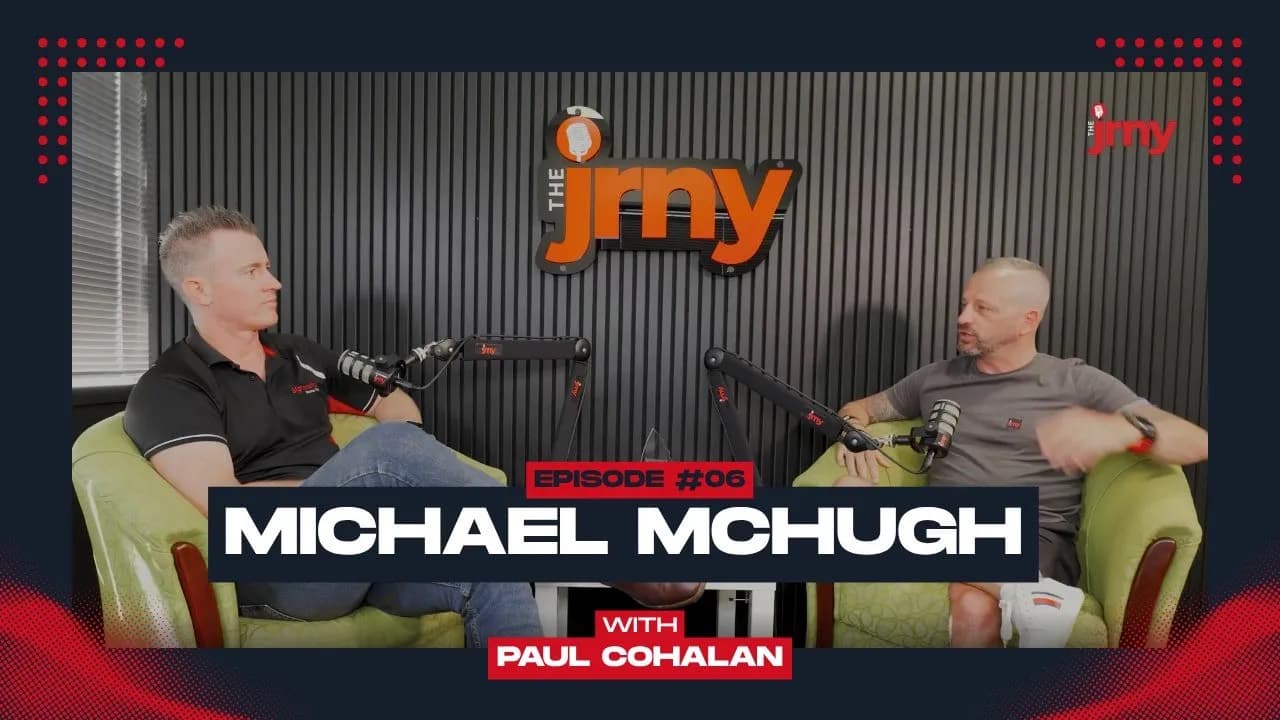
Meet Michael McHugh
Business owner, Signarama
Michael McHugh runs Signarama and has built multiple sign installation businesses across Perth. He spent fourteen years at one company, starting out lugging furniture and moving through sales into store and regional management, before backing himself in business. He is direct about the setbacks, the calculated risks and what it actually takes to keep going when the pressure is on.
Episode summary
In episode 6 of The JRNY podcast, Paul Cohalan sits down with Michael McHugh from Signarama to unpack the real story behind building multiple sign installation businesses across Perth. Michael traces the path from fourteen years inside one company, starting by lugging furniture and working through sales into store and regional management, to backing himself and taking on ownership.
He is honest about the setbacks he had to push through and the lessons that came from taking real risks. The conversation looks at what being an entrepreneur actually involves in 2026, how the landscape has shifted, and what it takes to keep moving when the pressure is high. A grounded conversation about business ownership, resilience and calculated risk.
Key takeaways
Learn the trade before you own it. Fourteen years from the warehouse floor to regional management gave Michael the foundation his own businesses now stand on.
Risk is calculated, not reckless. The risks worth taking are the ones you have thought through and can absorb if they go against you.
Setbacks are the tuition. The lessons that shaped the business came from the things that went wrong, not the easy wins.
The landscape keeps changing. What entrepreneurship demands in 2026 is different again. Staying in business means adapting to it.
Transcript
Read the transcript
This transcript was generated automatically and lightly edited for readability. It may contain minor errors, and speaker labels are not yet added.
there for 14 years all up started lugging furniture went into sales and then regional management store management and I loved it the owner of that business was just an exceptional leader he ended up selling the business in 2007 to a private equity for 500 million and he and he yeah and he and private equity took it over in 2007 late 2007 you think about the timing of that like I mean he could not have made timed it better but he and then he signed he owned all the buildings so he 24 buildings to rent them out. So, it was just unbelievable. He's he's worth about I think he's he's in the rich. He's worth two and a half billion now and he just invests in property mainly.
All right. So, we got Mike here today. Um Mike's uh the owner of Signarama in Osborne Park. Um I've been using them for a few years now and Mike's owned it what the last 18 months.
12 months. 18 months. Yeah. Yep.
Um, so I hit him up to get this sign done and um, this is the first cast now without a white wall and the journey up and he's done an amazing job. So get out there to Osborne Park and um, give Mike a call directly. He's done a fantastic job and his team, we got a bit more happening he's doing for me as well out the front. So thanks Mike and yeah, trust him to come in and pick it.
We all love it and he's coming in picking little bits off it. But, uh, no, it looks really good, man. And, um, just ironically, I think it's really good that you're you're on here on the first one that we have the sign up. Yeah.
So, anyway, um, how do you feel today? Great, mate. Yeah. So, we'll just touch on before behind the scenes.
You've done a couple of these before. We go back to um, you had a RTO and it was to do with leadership and training and then you were interviewing CEOs and that. Let's kick off there. Tell me a bit about it.
Yeah. Yeah. Well, look, we when we had the RTO, we were just building it up from scratch. So, you know, a lot of it was about um getting momentum out there and meeting connecting with key leaders.
We were targeting um businesses that were 500 employees or more. So, we were thinking, well, let's go after some CEOs and start connecting at that level and try and build down. So, you just tapped our network really and you know, I was fortunate enough to interview interview a couple of people. One in particular was Emry was John Hughes.
He's a guy obviously about 94 at the moment. Still working every Saturday coming in every week. Um but yeah, it was a lot of learning. Um bit like what you're doing here, I suppose.
You know, you you can not only were we doing it from a perspective of trying to understand leadership from people who have been in the game for a long time. Um yeah, there's a lot of personal growth in it as well by learning from their stories, experiences, and Yep. and things. So it's amazing how you resonate with people.
Hey um and just having like I was saying before before we started like not being in a niche it leaves it really open and um but in the end we all have the same similar things. It's like when I was part of the CEO Institute, um I always go back to that. The biggest thing I learned in that room with 14 other business owners is whether you're concrete, whether you're, you know, it doesn't matter what you do, insurance broker, whatever. Um you always end up with the same problems from the fundamentals of business people, HR, you know, mistakes with clients, accountability, vulnerability, you know, um winning more work, the cycle of WA like is a big piece, all that.
So like when you do this, you still resonate like flat out. Like me and you, we got chatting in the car. I remember asking you, "Hey man, you going to get on the podcast?" This is like before you come out last time and you're like, "Uh, ask me again soon." And we got in the car one day. He's dropped me off at Osborne Park cuz everyone knows I haven't got a license.
So he dropped me off at Osborne Park and I got in the car. I'm like, "So what did you do before here, man?" And then the whole I think the whole chat we peeled back to the le and I'm like I had to get out quickly to the lights and I'm like, "Mike, see that? That's what we're doing on the podcast." She's like, "All right, lock me in." So, it was really cool. And um yeah, so um so how long did you when did you start the RTO and how long did you do that for?
So I actually um I came to Perth in 2008. So I was I grew up in Brisbane. Um Brisbane boy. I was over there.
I came over with um Amart Furniture actually. So I was with them for 14 years. It was my first job. Yeah.
So I left I left school. I remember I hated high school. Um, my mom basically said to me, I was 16 at the time. She said, "All right, well, you can leave, but you need to get a job." So, I got a full-time job the next day.
Yep. And that was that was at uh that was at Amart and I just classic comp corporate ladder climber. So, there for 14 years all up, started lugging furniture, went into sales and then regional management, store management. Yep.
And I loved it. The owner of that business was just an exceptional leader. you know, he um he ended up selling the business in 2007 to a private equity for 500 million and he um right and he Yeah. And he and private equity took it over in 2007, late 2007.
You think about the timing of that like I mean he could he could not have made timed it better. But he and then he signed he owned all the buildings. So he had 24 buildings he sold, you know, 20 year lease to the to to rent them out. So it was just unbelievable.
He's he's worth about I think he's he's in the rich. He's worth two and a half billion now and he just invests in property mainly. But anyway, look um I digress. But I guess one one of the things I learned from him was just running businesses and you know that's where I got my passion for running business and he really spent the time for us to teach us about profit and gave us profit share and was just amazing.
Anyway, um I came over with um AMART to Perth in 2008 and um it was the first state that we went into other than Queensland, New South Wales in the whole history of the business. So, it was a big deal coming over here. Y was a lot lot of lot of eyes on how successful it was going to be. Can I can I just touch on something?
So, just go back to the whole you left school, you left school at 16 to get a full-time job. Yeah. Now, I'm not condoning leaving school. I said, but I really do believe the school system and going into school is to, and I was watching something the other day, it's to stop your creativity.
It's so the the system is so old school. I don't I think it's evolving now. Um I think it is needed. I'm really big on the whole B student, C student, people skills is better than A+ student.
Correct. Like nailing the school system, A+ student. Because a lot of the people out there like like yourself, um it it's not about like getting the test right and all that and we all learn different. Some people are good at you know you know the school system is like go to school, do the classes then do the test at the end of the term or whatever it is.
A lot of people can't do that. It's like communicating. It's like having a relationship. You got to work out your communication skill and all that.
School doesn't do that for us. It's like cookie cut one all. And how many people fail or you know don't work now. How many billionaires or successful people not even billionaires out there are dyslexic or you know had challenges and we're talking like big names to even people you know every day.
Now the reason is is because they you got to work it out. You got to get in there and work it out. Now if you if you do it easy go back to being an A+ student you do it all easy. Do you get that resilience and that push and take the risk?
No. Yeah. So back at your age at 16 you wouldn't have known this intentionally. you were just doing what you wanted to do because you didn't want to go to school because you didn't feel comfortable for whatever reasons, but you took that you took that jump, that risk.
Now, that's that's pretty cool in your personality to go, "Fuck it. Mom's given me an open ticket, but I got to comply." That's right. So, I'll go find a full-time job. Next day, you had a full-time job.
That's I mean, look, I think the the drivers, you're right. I mean, mate, I I totally agree with what you're saying. I think one of the the biggest bug bears for me is just just the lack of transparency around teaching the fundamentals of money, you know, at a young age. Um I think that's a massive gap in um schools.
But for me, the driver was, you know, I was from a broken family, but yeah, we were pretty much on the bones of our ass for, you know, most of my, you know, to definitely through my early teenage years. So a lot of the driver for me was I was just sick of struggling. you know, mom was mom did her best, but she struggled. So, I just want to get out there and earn, you know, and that's what that's where I saw that.
But, yeah, I I I think you're right. You know, some people just aren't cut out for it. There's, you know, there's so many different ways people learn and um you know, that cookie cutter approach is just not for everyone, you know, and it is evolving. You know, they got stems now and you know, I think they start to think outside the box now.
I think it's just that far gone now. Like I I I'm not even like it's probably different my dynamics now. I'm not going to go shift with my kids and like obviously I'm separated but I reckon if I thought back younger again and I was more intentional when my kids are younger. Um the whole homeschool thing I wouldn't be against either.
Like do you know what I mean? I think that's in 10 years that's going to be really popular. It's like it's like people now are they sticking in jobs or are they going to work for themselves? I reckon in 1015 years most people work for themselves.
Even if I'm working for Mitch I'll still probably work for myself under you know an ABN or a company. That's just happening more and more because of freelancing because we want lifestyle. We want to do what we can do, you know, because of content and all that. People can go earn money without having to go put a shovel in the ground.
You know what I mean? Like definitely, mate. And you know, I think with the next 5 years, we're we're going to be I mean, you watch all of the guys talking about this AI and where it's going. I mean, we're going to go through a significant shift in change over the next 5 years.
So, I think we already are. It's going to be um one of those and education is going to going to be at the forefront of that. So, I think people are going to want more flexibility. You know, they're going to be hunting for different ways to just to survive, you know.
You know, it's bloody hard out there. Yeah, it is. Um I think I just registered me and my boy on an AI course, actually, a 30-day AI course. Um I don't even think about the school thing.
I think it's just it's something that's been dubbed into us. We got to do it. But go on the outside of that. What can we do?
Yeah. Like I talked to my boy a fair bit about this. And um I think you got to stay up with it. like code digital that Mitch runs.
Um, we do heaps of AI stuff and it's emerging. There's no right or wrong and like we go down the rabbit hole with it and made How old your boy? How old's my boy? 11.
How good is that? We're going to we're going to do about 11 on that. That's that's awesome. So, we like next time I have him, we're going to start it and I'm going to try and get it get him to do it while he's at his mom's and do it's only 10 minutes a day and it's learning all the apps.
Um, you know, they live on their iPads enough, Robux, Roblox and all that and buying Robux. that's that transaction and um but if you can spend you know if he's going to do that I'm going to counteract him like no worries you can play that and do that like you know the boundaries and that but go spend 10 15 minutes a day on this and I'll do it with you. So there's that whole like if we don't keep up with it we'll get left behind. Oh, definitely, mate.
Oh, Tony, I was listening to Tony Robbins the other day. I mean, I've been following him for years, but he's pretty forward thinking, but his concern in the states at the moment is I mean, there's about 8 million drive truck drivers, Uber drivers, you know, that are there. He was saying something along those lines. And in his essentially in five years, he reckons that those jobs are going to not be there.
Y and you know his biggest concern is around how to reskill people you know and his sort of his advice was exactly what you just said you know the people that are going to be able to make that shift are the ones that are going to be able to pick up the new skills and learn quickly and like even software companies are coping it like I had a meeting with a um young guy he's PhD in coding and development and stuff like that and he's going to do some work on on a tech system that I built and him and Ben are close mate of mine and he's like the big thing is like you're not just sitting there and doing all this like things happen quick now with AI. Another mate of mine just posted yesterday Josh over in Queensland. He's like Mr. AI he's a legend.
I'm trying to get him on here. Um he's just like he's gone another level cuz he gets it. So he's not getting caught up on hey we're still going to do this. He's like just adopting the AI and he's like that the possibilities are are endless and it's like everyone's worried about the jobs.
Yeah, jobs are changing, but I still think my kids jobs aren't invented yet. I always say that. I reckon that's so true. Um, but how do we give them the best foot forward moving forward?
Um, the great thing, the exciting thing about right now with AI is it's not concrete. It's not like, hey, it's been out like the internet and everything else. It's like it's emerging. So, there's no right or wrong.
So, there's no keeping up, being in front. I could do something today and be in front of the guy that's been doing it for 12 months. Yeah. Because, do you know what I mean?
Like, it's still emerging. And there's still the apps coming out. Like we're still working out what it's doing. It's going to take years to evolve, right?
Yeah, that's right. And like we're all going to be using it even if we don't use it. So, so I think AI in the end is going to be in the background. You won't even know whether you're using it, right?
And it's kind of already happening. So, it's a big piece. Yeah. Anyway, let's go let's go back to was it 2018?
So, 2008 came here. Um yeah, then I we set up the the stores here. this we went did Osborne Park first and then um Coburn and then Canington and went really well. It was bloody hard and we employed about 100 people in that period and then we set up a there was a 10,000 square meter distribution center we set up out at um out at Bibra Lake.
Yep. So it was it was bloody hard. Um but we and then I think it was it would have been so we opened in June 2008 in Osborne Park over the four days like we smashed a record. We did like, you know, one and a half million in four days of trade.
Like it was it was chaos, you know. And then we were overtrading. So we were doing 800 a week, 800 grand a week in furniture when we first started. Right.
So just on that just on that that that four days and opening like I could just imagine like the stress, the pressure and all that in there. Like it was full on like like there's two things here, right? Like that would have been huge for you, right? You've come over here, you've like you've opened up and all that.
Now that would have been huge pressure but the feeling after it kicking off and achieving it. Oh man. Like what what that teach you? It was well taught us to to think quick because you know I mean we anticipated doing you know probably half that in turnover maybe even order in terms of our stock we and we at that stage you know 90% of it's coming out of China.
So you got to step back and then you know re-evaluate all of your ordering and then so within six months GFC really started to hit here. Yep. So, so we were doing 800,000 a week consistently overtrading. We got stock coming out of the wazoo and then it just just got decimated.
So, we dropped from 800 down to 150 200,000 a week which still bloody Is it still sustainable? Absolutely. Yeah. Yeah.
Sustainable. But the problem You didn't think you're going to do that anyway? No. That's right.
The problem the problem with it was it was just the overtrading. We I mean we ended up with stock everywhere, you know. So, explain explain to me about the overtrading. Well, over so in terms of overt trading, well, we we we we were just doing way too much for what the staff could handle, what the logistics could handle, resources, the capacity.
Absolutely. It was just it was just bedum. So then um Did it push you to grow more though? Yeah.
Well, we continued, we we we stuck we stuck to the schedule. So within um 18 months, Coburn had opened, we set that up and then within another six months, we had Canington going. So we although the GFC definitely smashed us in the beginning, it also um smashed the dollar. So um we were actually prices were actually pretty good, you know, they remained really competitive through that time frame.
So we still got we got market share quickly. But look and then look that rolled out for a couple of years and after that it was a pretty much a two-year project. I was my job was to come here and set it up and then you know what's next basically. But then, you know, that I just didn't didn't like the direction of the um private equity.
It it how common is that? Yeah. Look, I mean, I got there I got their intent, right? Um you know, I worked for 14 years with a guy who was a pure retailer who started this business from scratch.
You know, the owner would come in and spend time with you and, you know, g up and and and the range was was much better. you know, we he'd take us over to to um you know, to the international trading fairs and we'd go there and we' you know, go through the whole process with him, you know, to to get it here. So, it just changed the business and it just wasn't me anymore. So, um and that's okay.
Yeah. So, it was a so I was a bit of pretty much a crossroads. Um I decided actually I didn't finish high school as I said, but I well during that period I decided I just I don't know had to go back and do it just to say that I could. Oh wow.
So, I went and did that and I did that over 12 months. got my high school certificate, you know, felt like that was a just something for me personally. How did you do that? Was it remote or I was actually at um Canning College in in um in curtain near curtain there.
So, it's just like an adult, you know, adult learning school. So, just just talk a bit about that because a lot of people wouldn't do that, right? And then there'll be pride in there, there'll be the self- judgment, there'll be all that kind of stuff as well, but you had this little bit of fire in your belly and this box you had to tick which is pretty cool. was it was kind of I was kind of crossroads, right?
I was like, what am I going to do next and then I felt like I'd done this for such a long time. I'd done the retail thing for so long. I'd managed people, done all this. But I don't know, there was just something missing.
I felt like I had to prove it to myself that I could do that and I and I I I did enjoy it. And then I um straight after that, I actually went and saw Curtain and thought, you know, I'm passionate about business. I want to go and do a degree. And then I I found out you know because I was managing people for 10 years or leading a business for 10 years.
A lot of that gave me credit to go go and do an MBA. So I went and did an MBA. Did that for two and a half years. But I think that whole process taught me I suppose through that transition and I went and worked for Business News actually after Oh did you?
After I left there selling bloody um advertising. That was probably one of the hardest things I think I've ever had to do. Going from, you know, intangible a furniture environment which is, you know, people come to you and it's tangible to selling newspaper advertising which is intangible was a bit of a shift. But one of the all through that whole period, probably two and a half, three years, what what back to your original question of where did the leadership training come about?
I don't know. I just I I felt like I had the skills to have my own business and I really wanted to um have something of my own, you know. So, so just just on that, right, what I see through that whole lot and why I started this, right, is there's no right or wrong with any of it, right? All of us have got a book.
We've all got our own chapters, right? You could look at it and go, I didn't finish high school and you could stick your head in the sand. You could do all that stuff. But in your world and your chapters and the reason you got an MBA and the reason you probably own your own company before and you went into this and it's a bit like me shift in industries.
A lot of people are safe and don't want to do that. But you got there because you didn't finish high school. You could look at it like that. Like everyone's got their stepping stones and I believe the universe does certain things.
You know, things happen for a reason. Now you didn't finish high school. You spent 14 years in something that actually would have made you go nail the NBA. Like let's be honest, you can't beat hanging around a business owner that's very successful.
You know what I mean? Like you wouldn't have had that if you went and finished high school. You probably wouldn't straight to do it. Yeah.
You wouldn't be on that journey. You don't have the you've gone back. It's it's made you appreciate and value yourself no matter what at your age then to go back and do school. Then you've gone it, I'm going to do the MBA, which you'd have more skills than most that would have went and done it because you've been rubbing shoulders with one of the most successful people in Australia.
goes back to the whole journey and the and the chapters, right? Things happen for a reason and it doesn't have to be in order. Well, it's funny, you know, like going through the going through that MBA thing, like I thought it was all right, you know, um but it was amazing. It sort of crystallized some of the stuff that that I'd picked up over the years, right?
So, you you know, around managing change, you know, like you go through the whole change process and well, I sort of naturally did some of those things. Now there was some things obviously I you know I didn't have it all worked out but you could you sort of through your experiences you've you kind of you know learn some of this stuff as you're going but then the MBA kind of sort of shape some of it does that make sense you know sort of put a bit more meat on the bone to go oh yeah right okay that makes sense that's how it works okay right just on just on that and talking to you in the car the other week just and what you're saying about shaping the MJ and and me and you might be a bit similar I I reckon I've always been good at being a sponge and I was corporate world and family business um my ex-wife's father and family and then joining the corporate world and being able to sponge and put it together right now. I think you've done the same like you've got all this experience like hands-on and all that rub shoulders with the people but I think that MBA must have grabbed you shaped it and then from then on it's all your own decisions. So you might not do it like he did it before, but because you went into like the RTO and all that and then you made a decision after seven years, I think to to move on, right?
But you were making the decision on your own then. So once again, it happened for a reason. You weren't caught up on his his style or his way, but did you pull all the nuggets out of there what you got to do? Yeah.
Yeah, you're right. I think um was proven to myself um that I had the the capability and maybe those steps to do it because I think you know like anyone I suppose you know I went through the whole self-doubt and am I good enough you know have I got the skills you know still question myself at times you know I think that's what drives me all the time I think it drives me but um yeah I think it it definitely helped shape it and but but what it taught me was that I had skills and I was Like I'm just so sick of making other people rich. Like I just I want I don't want my earning capacity be to be capped. Capp.
Yeah. Yeah. Yeah. That's how I saw it.
And earning capacity is a big thing, but I think in the end the other piece that people don't get when they first start a business because you don't get it at the in the first two to five years, but flexibility is a big piece and it comes back. Um sometimes it takes us longer than to realize that. Um but I think earning capacity is one thing and I think but the earning capacity also includes time. go to your kids things, go to the schools, like go on holidays, like you know what I mean?
Yeah, that's part of it. But you know, and then I think the other massive driver Yeah. was you know being with being seeing other being exposed to other key leaders and learning from them their experiences. The biggest thing I think my driver was I mean that probably the earning capacity thing is secondary.
It's actually about building something. Yeah. you know like so when we started this leadership business there was two other business partners that I went into it with. We had similar we had um different um goals but but essentially what we wanted to do was um create a leadership uh organization RTO that was going to help um coach and develop leaders because we had we were all passionate about coaching and developing people but in but in particular I suppose my own experience as a leader in a retail environment you know I classic climbed the ladder back in you know early 2000s you know you're thrown into roles and you so you either sink or swim Y and I mean it doesn't happen as much these days although you know I still hear stories about it but still does I think yeah but but I think you know there's something to be said about managing people and building a team and like some of the some of the mistakes I made early on like I cringe about it now right but you know it's a part of the learning but I think that that our our purpose for the leadership program was really about giving people the skills particularly new managers around you know how do how do you actually lead and motivate people you know and and it's a skill you know, so that that's what got us there.
So yeah, so that's kind of the story on how that started and we we started from scratch for seven years from I was in yeah from 2015 it's still going. So, Future Institute, it's still um you know a solid business. It was just time for me to move on after 7 years. But we when I left, we we built it from nothing to, you know, a $3.5 million business in within.
So, what what did you learn different there with business partners? I know we touched on this a bit and I've had business partners as well and and just like obviously it's good that you realize that it was like you said your time to leave. Um and none of it whether it was good or bad, it's like there should be no regret. Once again, it's that chapter.
It's that stepping stone. It's the learning and like you said, you want to go and um do your own thing and obviously there's no cap and it's on your own accord, right? And I think we all end up at that point. But what was probably the biggest thing in them seven years that you learned that you didn't learn previously with the MBA and being with AMA for, you know, 14 years, like start from scratch, growing substantially by the sounds of it.
Um having a really good business, two business partners, like there's a lot of different learnings in there all of a sudden. Yeah. No regrets because you you live and you learn. But yeah, I had I definitely didn't get on with one of the directors.
Yep. And that's okay. That's and and look, we tried but it just it was just a personality thing. And um you know, I just at the end it was just too much.
And you know for me personally it was but look no regrets but I think you know they're both decent people but I think the learning for me would be probably to spend more time on the front end making sure that there is um a strong synergy and that even even doing some work around personality profiling to really understand what you're getting into because it's a big deal right it's like it is like a marriage like my business master used to say that and you know if if I had if I probably had have done that stuff in the front And I I think it would there would have been some red flags early on to go well hang on although we're very different and you know that's sometimes good you've still got to get on right and you know you need to have some alignment there. So um the learning for me would have been be very careful who you get into business with because it's um it can be really um difficult you know and so but yeah look it as but as I said no regrets I think you know overall even with the challenges that we had in from a personality perspective we were still very successful and they are still successful so you know I wish them the best. Yeah that's great and you wouldn't be where you are today if you didn't go through them challenges or go through that journey. Yeah absolutely mate.
Yeah that's good. So um but yeah look it's it's it's been a been a good ride. So So I I believe you're a soul owner of Signarama right? Yeah.
So I um so in terms of next next after that I after a future institute I actually went and got a job for Rio. Um and it was a it was a it was interesting right because I was a it was I left my I had um that year my first son was born and um that was life-changing. When was that? 20 20 21 21 and I'd left during that year.
You know, I'd sold my shares out of the business and I'd sort of thought, well, maybe I might just take some time off and just reset, throw my heart into a few things and a role for Rio came up. It was like a leadership role managing their leadership programs. I just thought, "Oh, that's that's sounds awesome." You know, and so I threw my hat in the ring. Funny story, I I did uh did the application, spent a lot of time on it, and then I up the date, the expiry date.
So, I missed the date. I put all this time and effort into the into the application and then it had closed and I was a you know so I end up finding the um finding the guy who was basically would have been was my leader and um I said mate look I've totally stuffed up here fair enough if I don't don't have any opportunity it you know I understand but but here's my application anyway so I got an interview and turns out I ended up getting the role but um I actually ended up getting the sack from Rio did you how come and Um, I haven't said this before, but I feel like this is a bit therapeutic for me to just to get it out there because I being a business owner, um, I suppose one of the things when I was running future is I was very aggressive in getting opportunities. My role was to grow the business. I thought I was I think I'm pretty good at doing that.
I suppose one of the things that I mindset as doing is when you you know, I haven't really worked in a big corporation like that before. Certainly, AMA was a family-owned business, so it was and though they promoted entrepreneurship, right? He was he he loved, you know, seeing his leaders be entrepreneurs and run the business. So I I've had this entrepreneurial spirit, I guess, if you like.
So when I you put someone like that into a into a Rio um and when I went in there, I was just stunned at the waste and the the amount of money that's thrown through that organizer. I mean, when that the year that I was there, they made 20 billion US after tax. Yeah. Right.
It it's hard to comprehend how much money they're making there, right? It's just phenomenal. But the amount of people and layers and politics and it's just not for everyone. It certainly wasn't for me.
So, I didn't know you were at Rio. So, I always say that I resonate with something just quickly. I was with BHP. I went from the family business.
Wow. Exact same thing, right? My my GM at the time, Brago, he was he was there was Gary Wood and then Brago. They legends, right?
So, they backed heaps, but all's the same. It was like whether it was HR or performance managing someone, it's like or going hard or making something happen, the red tape and the and the politics, but I had really good managers and it was like I'd always be pushing the boundaries because you come from family business and my like my ex-father-in-law, he's like picking phone up, make it happen. So, he taught me that a lot, right? You know, like as an analogy, right?
and um and then you go to these big corporations corporate and that's why I got out in the end and I was paid a mozzar and run my own routine and all that kind of stuff and I wasn't fo I was here but it was it taught me a lot and that's what I mean by merging it by understanding it and then taking the best of both worlds when you find that balance it's next level then yeah sorry it is m and look and to be credited like I did actually really get on with my leader at the time and you know he was he was just good he was a good dude but anyway long story short we were putting these programs together, you know, they were they were significant. We're talking thousands of leaders going through. So, you know, so the the the first PO I think was 800 grand that we we did for for the leadership training, right? You know, without I suppose going into all of the levels of detail.
Um I didn't follow the process to the tea in terms of the the the um the PO process, right? So, I mean, I essentially was given a mandate to to set up and deliver these programs and and hire contractors and I felt like we'd done enough due diligence to move forward. But I was wrong, you know, and there was no there was no absolutely no underhandedness or maliciousness whatsoever. It was just I got tangled in uh in bure bureaucratic requirements of of a company of that size which you would expect right but me coming in someone who's run my own business who you know you don't have time to make layers of rules and regulations we just make it happen right yeah long and the short of it is there was a bit of an investigation around it and they basically said that I you know hadn't hadn't done enough due diligence and you know they would have expected to you know someone of a of my leadership to have made ask more questions basically.
Wow. And um so yeah, that was the end of it. And look, it was I was devastated. You know, you want to know the contradicting thing there, and I think most people know this is if they needed something done tomorrow, it all goes out.
There's still a process. I shouldn't say that. I shouldn't speak out out of school too much, but things can get sped up, right? So, um and a lot of it is contest or politics or someone threatened on their job because you make happen.
But look, it it one of those things I think you there's always these things where you go through and you learn, right? And I think there was a lot of ego and it tied into for me because um you I was paid really well, you know, to do this role and I felt like it was a good transition or at least I felt that like I had to constantly prove myself. I was, you know, really worried about what people thought of me and self judgment. Yeah.
And there was a lot of that tied into it and and I made made mistakes. But but I tell you, I feel like I really let my family down at that point. Is that right? Um my my wife and I made a decision um when we had children that she wouldn't work.
So, and we're still stuck to that. You know, my my oldest boy is five now and we she's been doing what's Flynn. Flynn. Yeah.
I just felt like it was a it was a up that you if I had have just followed a couple of more steps in the processes, I might have still been there. Right. And I I went on this cycle where I just beat myself. How long did that go on for?
The self judgment, the ass kicking off yourself. Oh, ages. Ages. Did it really?
Yeah. Yeah. pages. So, let's talk about that a little bit if you don't mind.
How'd you get through it? Like in the end when you reflect and look back cuz I've had heaps of that last two years, right? And it's and when you're in the moment, it's reallying hard to get out of it. And I think a lot of us are lucky and we get out of it and we learn from it and we reflect.
There's a lot of people that don't get out of that self judgment. It lasts a lot longer than probably, you know, maybe you and I have been through it. Like, can you tell us a little bit about that and maybe something that will help someone else? Uh, yeah.
Um, uh, there's a couple of books. I'll I'll have to give them to you later because I've forgotten the the name of it, which is No, the the the untethered soul. The untethered soul. Untethered soul.
Um, a friend of mine referred that on to me and you know when it's it's funny, right, when you're going through these periods of adversity and you're really disappointed in yourself cuz I mean I I I'm not someone who blames someone, right? I up in that situation and it accountability and it gave and it and it gave that result. But the untethered soul um was written by a bloke who was investigated for fraud in the US and he was you know completely innocent in the end but it was a very traumatic period. It was unbelievable.
I I can't I think I I listened to it it was an audio book. I think I listened to it about three times. Wow. It there was so much gold in that in that book that just made me realize that you know what um I've made I've made it blue.
Yes. Yes, it's impacted, but it's not the end. Like, it's it's a case of, you know, it hurts now, but you just got to keep finding a way to move forward. And that just guided me.
It just helped helped me. And and obviously, you know, my wife was there by my side the whole time. And we we we also went we had another child in between that. So, he was he was born a few weeks after I'd you know, all that went down.
So there was that book. The birth of my second son gave me three months at home just to connect with family and re you know because it was pretty important was that then now? Oh man, it was it's it's made me realize um you know just how important it is to me. You know I think I I didn't get I'm 40 46 this year.
I so I had my first kid when I was 40 and you know I met my wife when I was 36 you know we've been together 10 years this year but she's she's just my rock you know and yeah so my fam I think I was on this been on this journey of keep continually to try and prove myself and you know find certain ways of you know reaching certain earning capacity to provide for my family and you know I was chasing this and I was you know in this cycle I've just got to do it I got to find a way and got to the point of not neglecting them, but just not being 100% present all the time. Words present. I did exactly the same and I didn't realize it till after I separated and I left. Um, and we don't mean it, but the also like my ex-wife probably doesn't see it like this, but it's like, you know, just just hearing you talk there and how important that is.
I I realized it after I left because you your drivers, you let the walls down from your drivers and your drivers are what put you there and whatever they are, right? Like usually it's the family trying to succeed because you come from a broken family. I remember you said that at the beginning. So did I.
And it's like they end up being your drivers and all you see you end up blinkered is I got to do it. I got to achieve next. And you go and you and you keep going until you get broken, right? and your max and then all of a sudden and that's why I think it was really important that you that all that happened to you now you reflect on it because you got to spend that 3 months at home and just stop for a sec and go what is the most important thing in my world I don't need to be paid 200 grand I don't need to be going that hard I don't and now you've gone and got your own business no business partners not getting told what to do you you it probably doesn't matter what you earn as long as you obviously earn enough to be comfortable and have flexibility and your family's first.
Yeah. And you're not going that hard. Yeah. I've done exact same cycles.
There you go, mate. So, so peeling them layers back. Hence why we do this. People don't stop for a second and go all of that mattered.
It mattered that you got the sack. It mattered that you know you pushed the limits. It like it's unreal. Yeah.
That there is the nugget. Yeah. So look, it it is I think you know it's the other thing I when you get to I mean you start thinking when you're 40 I suppose you start thinking more about um your life transitions right it's more around okay well um I'm start everything I do now is for my children and what you know helping them to be good people and um how true is it that uh the the women and the females mature a lot more than the males I think we hit 40 we hit 40 just me just starting to get warmed up. Yeah, that's right.
Yeah. Yeah. No, I I agree. Say that out loud.
Yeah. No, definitely. Oh, she reminds me. But um but no, look, it's um it's definitely a stage now, I think, where you I just more grateful of, you know, just being healthy and, you know, having the family and that.
And look, the the work now for me is it's definitely comes back to that building something like I'm I'm really passionate about building a team, you know, and I've I've got some good people where we are and and I want us to I want us to grow, you know, the business or actually um we're I went left Rio and then ended up getting a similar job with a with a crane company and just realized I was Frio Group Fri. So, and then I ended up realizing about I was there for two years, but I was through that journey. I said to my wife, um, I definitely want to buy a business, you know, and we were at a stage where we had a bit of equity and was like, what do we do with equity? Do we buy a do we buy an investment property?
What is that going to return us? Do we look at buying a business? And I coming off across another book um from a friend of mine uh it's called Main Street Millionaire. Yep.
And it's by this lady Cody Sanchez. friend of mine introduced her to her and she she's a weapon. She's unbelievable, mate. I follow her heaps.
Yeah. And it just hit me. It's like, you know, we're at a stage in Australia and even in America where and the rest of the world where there's this massive transition of wealth, right? Mhm.
And I've got all of these skills in business and but I didn't necessarily have an idea of a new business idea. just thought, "No, I want to buy something and I want to buy something that's been around for for a long time that's not going to be impacted massively by by technology. It's in fact going to probably be enhanced by technology." Yeah, that's true. Um, you know, the other thing is um good recurring income stream.
So, anyway, I I said to my wife, "Want to buy a business? Let's start looking." And so I'd spent 12 to 18 months while I was at FRA looking really and um looked at lots of different stuff, you know, but but essential services, exactly what Cody Sanchez does, non sexy businesses where they're in your community, they provide a great service, and they just they're just they're an essential part of that community, right? And that's what signage is. I end up looking at several signages along with other businesses like pest control, um you know, electrical contracting, all sorts of stuff.
And uh I just really like the idea of it. You know, it's it's really a salesdriven business. It's it's customer focused. You need obviously experienced people.
I've got a team of I've probably got 50 years of signage experience in the team. How good. Um you know, but my strength is I can grow the business. I know manufacturing from furniture and we are a manufacturing business and processes.
And process. Absolutely. We're going to we're going to we're going to be a force in that business. We're doing, you know, 1.2 mil at the moment.
We're we're going to probably do 1.5 this year. Um but but in 5 years we my my aim is that we're going to be 3.6. Yeah, I remember talking about it. Yeah, that's awesome.
and and we can do that and it but it's about that's the outcome that it's about building the right team, you know, and you know that we go to work every day to actually add value to businesses and we do you know we we really add value to people's businesses and and if we can continually do that um you know we're going to we're going to be successful and you know so but yeah but but so looping that back building something over the next period but mate family's number one yeah I was going to bring that up so Like I I keep obviously keep resonating with everything you've said. There's there's more synergies with me and you than I than we thought. Um and and this is what I love about doing this right now. I I've done the similar thing.
Right. So everything I'm building now is about around what's important to me. And it's like the kids, it's the it's the health, it's the fitness, it's, you know, all that, my mindset and and loving life. Right now you're doing the same now, but you're still ticking the box that you always wanted to tick.
I always wanted to start my own business even before I was with BHP and all that kind of stuff and and um it was 2015 right about the same time 10 the start 16 2016 years 10 years that's right yeah yeah I got the 10 years and uh March April uh the business the entity was actually registered 24th of April. Yeah. So, um, congrats, man. That's epic.
And it's, uh, it's hard work, right? And, you know, you reflect on all the pieces, which I'm going to actually add my story to the journey website. So, I'm going to do episodes on that, man. Me just working on that at the moment because I love this.
Yeah. And then I can incorporate it. But, but me and you, like, I'm 43 next month in April. I think the big piece here is you're you're actually back at one of your drivers which is building an empire or building your thing or building something which I think entrepreneurs have that naturally originally right and it usually comes from probably having nothing a lot of the time not saying all the time you went through it all but you done it we do it I'm not going to say the wrong way because you wouldn't be where you are but they were your drivers with other drivers and then you realize you got to change your focus and your priorities right and we do that but you are back doing that but you're doing it smarter than ever And you're not sacrificing your family and you're not sacrificing your presencess like your, you know, your time.
Little one on me now, like when I separated, I I was always on my phone. I'd go home, I'd park in the driveway, I'd still be on the phone for half an hour. This is only 3, four years ago, right? I had a new partner recently and um or even with anyone, I'll go to lunch, I'll go to dinner and it's like my phone will ring and I'm like if N assistant doesn't if she rings me twice, I'll answer it.
Other than that, if I can't have lunch for an hour or two with either a friend, a partner, my kids or anything, what the did I just spend the last 10 years building the business now and then you know you get you get with a new partner and they're like no answer it. I'm like trust me in in 6 months you won't like it. So don't tell me. I said and it's not actually for you.
It's for me to show that my whole world's changed. I don't want to be on my phone all day every day. That that's an US problem. We create that back in the you know go back a few years now.
Did it get us where we are? Yeah, it did. Of course you did. You're talking to clients late.
And I still do that. Like if if it's needed, but you learn to draw the line in the sand and appreciate and value yourself and back yourself, right? And the moment you do that, I think other people have more respect for you. Yeah.
Now, when you learn to do that, it's probably, you know, you going to buying your new business now. I think you probably do it a lot different than what you did before. Your boys, your your wife, and everything comes first. But then they also when you when you give back to them the appreciation and the presencess is they allow you to go a bit harder to build that thing because they're like the balance is right.
I go back 5 years my balance wasn't right. It's probably why I end up arguing with my wife and then when you argue you you I used to just run to the office. It was my home right now. I joke about it.
Um would I change it? Probably not. It's all part of the journey and the learning is um but now would I do that? No.
I just wouldn't. It's just different. So, um I just relate so much and I I love the the spot you're in, man. It's exciting and I can't wait to see the next two, three, four years.
And credit to, you know, I think the other thing is with BS, I think, you know, is sometimes we kind of just bury what you've just said, but you know, that self-reflection and that ownership is where the growth is, you know, and deep work, mate. Well, well done. Like last Yeah. And I I love talking about hence why I want to talk about this stuff.
Like I, you know, everyone's got an opinion. I don't give a right. It matters what I do about it. Do you know what I mean?
Like, and usually the people that have got an opinion, it's because it's actually a 180 and it's their own they're dealing with, I actually feel sorry for them. Keep having an opinion cuz if that helps you finally get to where you need to, but the moment you put your hand up and like kids make that happen, probably more than your wife to be honest. No disrespect to the lady, but my my ex-wife was an amazing woman and um and she was my rock for a big part and she was a big part of my journey and no one knows this yet, but I'm actually going to try and get her at 10 years even though we don't talk much. Um I want my kids there and yeah because of the vulnerability and the reflection bit like it doesn't mean you void everything.
You wouldn't be here if you didn't have everything. Do you know what I mean? Um that's awesome. and and and just reflecting on like everything that you said today, it's um corporate world, family business to corporate world.
I done exactly the same and then and then I I resigned from BHP and like I remember everyone coming in and going shaking hands and I'm like it's just not for me. I can like I got awards at BHP and all that stuff and I'm like but I can go do this for other people that matter more and you know what I mean and have flexibility and and also I was paid too well. I had in my head for like six months I need to go not get paid well. I need to hit rock bottom a bit.
And um I end up working for myself in logistics when Roy Hill was getting built because I went into transport BP and then I went to I resigned and went work for a heavy holage company and Samsung on package one on the Roy Hill. I still got paid pretty well though. But after that when I jumped into business after a year and a half and then I started the insurance that was a big leap going into an industry I didn't know. Yeah.
Um stopped flying in and out earning good money because it was ad hoc. I was a project manager and then all of a sudden I had to back the money and all that. And my wife was right beside me. We had two kids, 13 or 14, but that was the bit I needed, not not getting paid five grand a week or whatever the it was.
Do you know what I mean? Because that's when you learn. And I love adversity and the and the pressure, you know, like because the outcome of that is second to none. I've actually had it now probably the probably the it's probably been bigger.
We It always feels bigger. The last six months has probably been go back six months is probably on par with what a couple of my hardest times starting a business and um and I call it a bushfire and I talk about it a bit but I've got through it and I I laid in here at like 3:00 in the morning and then by myself and my whole team had been turned upside down here but I got an amazing team nationally and remotely and um it was a bit of a cleanup, a bit of a change. I think the business had outgrown certain people. I wake up the next morning, I dug my heels and I'm like, let's go.
I love that. And then um still still some days sit in the corner by yourself and you're like, that's lonely. Am I doing the right thing? Am I not?
Did I? But you're like, go to the positive. How many businesses are 10 years in? How many businesses are national?
How many businesses are like I could go stick me head in the sand. I never blame anyone else. I actually get told no, some people are responsible. Yeah, they are, but I hide them.
Yeah. And because the moment you do that, no one can say that and judge you. And you stop judging yourself. Yeah.
And and everyone judging you. It's your own judgment that actually holds you up more than anything. You worried about what people think or and I'm I'm I used to probably judge myself more than anything because that's how you get the 1 percenters right. But the moment you go my fault.
Okay. So what's the solution? I had a chat late last night with uh Jackson uh my business partner over east and it was like 600 7 at night over um over an employee and a few things going on. And I'm like, "Dude, we needed this.
We didn't see this in the business. We through the bushfire last six months, excuse me, we fixed all this stuff and this one bit we didn't." And I'm like, the universe is saying, "O you miss this bit now. Get hold of it." So we're in this morning and we're like on the phone. Let's go.
Like let's shift it. Let's find the solution. And that's actually the cool thing. Definitely, mate.
Don't you reckon? Absolutely. Yeah. And and it's I suppose people like you and I I suppose in terms of that, you know, that that hardness on yourself, it's always actually going to be there.
You need it. Yeah. But you just get better at kind of going, do you know what? Let's go.
I'm all right. I'm okay and it's all right, but we'll get through this. And you got to use it as reflection, not ass kicking. Yeah.
Cuz if it's ass kicking, you can sit in it in days. And that's when you stick your head in the sand. Just smashes you for You need the standard. You need the benchmark because that's what got you where you are, right?
You can't lose that. I believe a lot of people like don't be hard on yourself. Correct. Yeah.
Like be hard on yourself, go for a couple hours maybe for tomorrow morning, but pick the back up and go, what how am I going to use that energy and adversity to go and find the solution? No, that's it. And yeah, I found that even just when you're chasing your business and you go through periods of where it's where it's tough, you know, some people kind of just go in a cave. I kind of use it as well, I need to make more calls or you know what I mean?
like it just hurts a driver. So, so what you're saying just there, we'll go back to the roadblocks, risks, and resilience, right? Yeah. Like, like even what I'm saying and what you're saying, by the sound of it, we're pretty similar.
So, it's like, but that's the resilient bit. That's the bit you stick your head in the sand for an hour. I might go shut me door, go for a walk, go home. I I done it at the start of this week and it's like, go to bed early, it I'll wake up tomorrow morning, deal with it then.
Deal with it, right? Because you need that space sometimes. I wouldn't have got there if I didn't go through the stuff. Like you wouldn't get there and just have that instant pull your head in, get back over it, get on top of it if you didn't go through the industry changes, the learnings, the not going to high school at 16 cuz you're like, if I didn't go to high school at 16 and now I've done all this, I can do anything.
So why why would I let let it stick my head in the sand and not get out? Now that's the resilient piece you've built over all the risks you've taken. Yeah. Just we'll go to right now, right?
And then I want to talk about the future a bit and we're probably close to wrapping up there. I don't watch the time. Actually, I need an on on air sign too, Mike. And a clock over there.
I don't like my phone. Leave that. Okay. So, a bit old school, you know, the on air.
Yeah. So, the last what is it 15 months you've been going? 14. 12.
- Oh, it is 12. So, in the last 12 months, what's probably the risks or the the walls you've hit that you don't see? Because everyone's like, it's like business plans.
I'm not really big on them. their guides and the market drives and everything and there's also you don't know what you don't know now when you're like you were me and you change industries a bit and very comfortable with it I love it I could start a fish and chip shop I could start anything right what what are the things that you seen in the sign game sign that you just gone I would have never seen that and smacked you in the face and you thought you had it all worked out oh far out um oh it's been a massive learning curve just in terms of like the business side's no worries right even the sales side easy. It's just getting your head around the the scope of product. Like it's a pretty simple business, you know, it's, you know, it's all about the front end.
Understand the customer need, provide a solution, then get it made. Yep. But the extent of product is massive. You know, it's it's so wide.
Um, so yeah, I think that's that's been the biggest learning curve. And then, you know, really understanding the, you know, the intricacies of installations. It can be quite complex. M you know we just did Delbaso Europe Delbaso up here like it was we pulled 100 meters worth of panels off and you know had to come up with a solution and we you know we had to paint it and repair it and you know it's it was massive massive job.
It looks bloody fantastic but there's lots of um you know that that job in particular probably didn't factor in some of those intricacies around the install. So I probably probably left myself probably left a bit of money on the table there, you know, in terms of, you know, we were probably a little bit too cheap for what for what it was in the end. But that's that's their learnings, right? Like you can't you're 12 months in.
Yeah, that's it. So but in terms of where we're going, I mean, we're 10% up on last year. Um, you know, profitability is good. Um, I've just started a salesperson.
you know, roadblocks for me um is probably just myself, you know, just just um you know, knowing that I'm only just 12 months in, so I've only just got that 12 months of data. I've obviously had the history of the data of the performance of the business, but we're we're tracking, you know, yeah, we're tracking ahead. If we were going in the other direction, well, that would be a problem. So, yeah, for me it's probably more a case of look, I've set myself a fiveyear goal.
You know, it's lofty. Y um I know what I got to do to get there. I know what the percentage growth of each year. I know how many sales people I'm going to need.
I know what strategic stuff I've got to go after. So, I've got a business plan, but I know the bigger stuff, you know, where I'm going. I I'll tell you something. Uh so, let's touch on something.
So, your other RTO business, yeah, not so much local communitydriven, it's business driven. You had, you know, 500 people, CEOs, like RTO is a bit different. They can come from anywhere, right? I I believe Sinaurama is more of a community local area driven like this, you know, it's a franchise for starters.
Yeah. But like your main customers are going to be Osborne Park and surroundings, right? Yes. You might do the odd, but like that's a different dynamics in business now for you.
So I think it suits you a lot like you're a people's person. You like that, you know, you daso. What's the differences there? Is that is it a positive, a negative?
Is it a It's a good point. It's a good question. Yeah. Look, I mean we you're right.
We we can service anywhere in Perth and that depends on our own personal networks really. Y so if I you know know someone that's you know a business owner in um you know Henderson you know we can we can service that area. But yeah I think it is community driven. So for me it's been getting around to the local businesses.
So we had we serve about a thousand people a year. Y so for the last 12 months my focus has been to get in touch with the you know the top 250 clients call them personally. Yep. Say good day.
that's that had an impact, you know, in terms of taking her home, the new business owner, just wanted to connect with you. That made an impact. But if they're getting around to to I've also I've jumped into a BNI locally, um that's actually been really valuable. Oh, good.
Um they don't suit everyone either, but I think they do suit what you're saying. They suit our business. Yeah, they definitely suit our business. Um yeah, look, the the local community thing is as I said just said, you know, we're providing a service that affects businesses in the community.
like it's a genuine service that adds value. So, you know, we need to be out there, you know, um local sports clubs, connecting with businesses and, you know, regularly within our area. We just go and knock on doors and say good day. You know, we're around their corner.
Um here's our It's good. It's that old school traditional piece of it. How good's that? It's people don't do it.
They're scared of it. And I suppose the other great thing is, and I'm going to have a look at Delbasa when I go past, but is your stuff is the shiny bit which is great. It's the front end. Yeah.
So, like if you service, I don't know, 10% Aussie park or more, whatever, you can show examples. You can go drive past here. Like that's really cool. That's a huge upside.
Very tangible. Yeah. But look, man, I'm I'm really excited about it. I think it there's a lot of there's a good fit with a lot of my skills.
Um, good team in place. Like, we're going to go places with it. I think that's awesome. And, you know, and the other the other thing that excites me about the network is there's 12 sonorama stores in Perth.
Oh, yeah. I didn't know that. One one guy actually owns four of them. Um, you know, he's doing I think he's doing about 7 million a year, you know.
So, he he's I love his model and, you know, there's a lot of the owners in the network are, you know, probably 55 plus, some of them a bit older. So, there'd be opportunities there, you know, perhaps acquire another. That was going to be one of my questions to you actually like is it worth because if you get a really good model culture like let's talk about leadership and culture which you know all about and you replicate that the product and everything still the same stuff but replicate change that foundation and the culture of the business like that that's hu that's a huge upside when I come back to the building bit right it's about building the right people to do that you know you need a really core group of people and we're on the way to that um that's what excites me and I I'm not looking at bloody having 10 stores or anything like that, but it'd be nice to have a have a couple where we're really adding value to the community, you know, and um you know, and the people that are there are really enjoying what they're doing. That's awesome.
Getting a buzz out of it. So, yeah, man. It's exciting times. So, I suppose I don't have to ask a question in the future.
You're touching on maybe acquisition. You want to hit 3.6. Yep. Um what what are you doing?
Probably the only other thing is what are you doing different to go hit that 3.6 besides your knock on door and phone calls? Like are you doing like a business meet with a coffee vet? Like cuz it's community based, right? So how do you get people to know about you more and being the new owner?
Yeah. Uh look, uh that's something that I've I had a catch up with a mentor of mine only this week really. And I think probably the the the part for me is, you know, growth is going to be about we're always going to have those repeat customers. There's always going to be those, you know, $10,000 orders that you're going to the sales people are going to focus on, right?
But for me, um, I'm really going to spend probably 25% of my time looking at the strategic stuff, right? So, what can we go after some of these big events that are in Perth where they where we can really add value, you know, the guy in South Australia is the biggest biggest in the country in terms of revenue. He's he works at the lift tournament. You know, he pulls a million bucks out of that a month, you know, while the live the live tournament's running in Adelaide.
You know that that's an amazing strategic first two years of that epic. I'm not a golfer. Signage sign did all the signage m. Yeah.
Yeah. It was good. Yeah. Amaze.
Yeah. We used to go with um four lads ex-Navy mates and we're all in different states. I went two of us here and it and it's on it was really cool and it's just like that yearly. It's actually on right now.
It is. Yeah. Yeah. Right.
He's right in he's right in the heart of it. But yeah, I think just being a bit more strategic around that, like you know, we can go through the motions and do that stuff. It's important to have that local um service and we'll continually do a great job there. Differentiate ourselves through service.
Um but yeah that there this part of my strength I think is you know particularly with future is growing the business like that was finding strategic partnerships where you can partner with people that they're going to be consumers of signs and they're you know instead of a $10,000 order it's you know 2002 $250,000 you know you know the main thing that comes to my mind in Osborne Park is the cars all the boys with cars. Yeah lads in that. Yeah that's right. Uh it's pretty big.
It actually goes to my old gym there next to cam. Uh that's where they park in that car park. Yeah. Yeah.
Yeah. And um they they do some decent events, don't they? Yes. A lot of business owners there.
I think could be obviously because of Barbello Sky Beach Road like Osborne Park's huge on this piece. Yeah. Yeah. And you know Yeah.
Um maybe about there's um they they do it fantastic, you know, and it's growing heaps. the whole supercars and not even just supercars you know M Club and BMWs and whatever else but everyone like WA is so clicky right you're from over east there's nothing like WA two degrees you know relationship wise or knowing someone um but I I'd be finding it's really about cars in your park like and the auto industry is probably the biggest besides you know your big retailers um it's the auto industry it's huge and then going to the beach so it's either one of them right even scarra down at the theater thing. Um they have a lot of functions and stuff going on there like dances and you know the fitness and Yeah. Yeah.
So they're the three main things that come to my mind in Osborne Park. That's good advice, mate. Appreciate it. Thanks.
Anyway, we'll bounce off that later. So I suppose we we'll probably wrap it up there, Mitch. Um is there anything else you'd want to say or No. Well, look, thanks for the opportunity, mate.
It's been been great. Just My question is what what did you get out of today? Just off the off the cuff. always there two questions I ask and that's one of them.
Oh, I learned more about you and that was uh and I thank you for that as well. Yeah, I I think we've got a lot of synergies there and you know I think we're going on a similar journey, mate. Um so, but yeah, look, I mean I always um think it's good to stop and just reflect, you know. Um yeah, it's it's easy to get sort of um stuck in the grind and sort of forget where you've come from.
So, it's it's good just to Yeah, you know what? There's been some ups and downs, but yeah. Jeez, I've learned a shitload and I'm still learning. Still learning.
I think um I I love sitting here watching you go through the emotions. So, it'll be it they'll hit a couple of heartstrings, then the like heartstrings up, down, whatever you want to put it, and then there's the happiness, there's the smiles, there's the laughs, there's the then there's I can't remember that. That's right. I didn't really I've never I've never thought about that like that.
So, I love watching that through this uh doing this podcast. Um, I suppose the other one is one or two people that I could get on here. I always ask this at the end and u because when we launch the podcast, we'll tag him. I'll even get you to intro me and then I'll say get them on because I I just want to keep smashing this.
We're doing one a week. I uh there's one bloke, he's going to love this. But actually, two guys come to mind. They're both um people guys that guys that I admire in terms of their approach to life in general.
One guy you find fascinating is Ryan Winston. You're welcome, mate. Uh Blancc Homes. He runs he builds beautiful um you know, high-end homes.
Yeah. Awesome. But he's uh he's just an interesting he's one probably one of the most driven BS I know I've known. He's he's gone through a stage now where he's going to go through muscle competition because he's been he's been possessed with um uh health and fitness and he's he's just a beast.
Yep. So, you definitely need to reach out to him and I will uh I'll lock you in. I'll get you to do an intro, man. He's uh and you know, he's he's got a fascinating story.
He's um really cool story. And the other bloke is um Jamie Stewart. You're welcome, mate. Jamie Stewart um uh runs a building construction company.
He's uh proud indigenous man, but he's got a um uh another fascinating story about his personal story if he I'm sure he'll share it. but he he's also running a bloody good construction company and he's he's focused on building stuff that is um you know sustainable and yeah really reach out to you too Jamie it'll be awesome I'll get you to do an intro mate that be great and um well what episodes this seven or eight or something like that so guys we'll um this won't come out for a bit because we haven't even launched the first one yet um but it'll get momentum we'll start connecting I'll get intros yeah it'll it's just going to it's going to just evolve so much and off the back of that like I've got a whole list, but I really want to like you I I think you had a good time and you reflect and then for you to say two names at the end of that. I think that's where the the network and the leverage and the you know the ongoing will be there. It'll be good.
Yeah. It will just keep keep the momentum. They're good guys. Yeah.
Cool. Well, thanks very much, Mike. Really appreciate it, mate. And um we'll probably do I'm going to try and do recaps in like 6 months after just come back and go, "Hey, you going towards your 3.6 Z or I thought I was out of the woods now.
No, no, not at all, mate. And we're not sure how we'll do that. It might not just be a podcast again. It might be coming to your business.
Oh yeah. And we, you know, walk around with lapels and go touch on a few of the points that come out of this podcast. It's not just about cutting off and going, "Thanks, Mike. No worries." It's like, "How you going on your journey, Paul?
I've gone backwards at 200 grand this year." You know, whatever it is. And okay, so what are you going to do about it? Like, you know, just as an example. And um and getting to see other businesses places and all that as well.
It It'll be cool. Okay, sounds good. Awesome.