
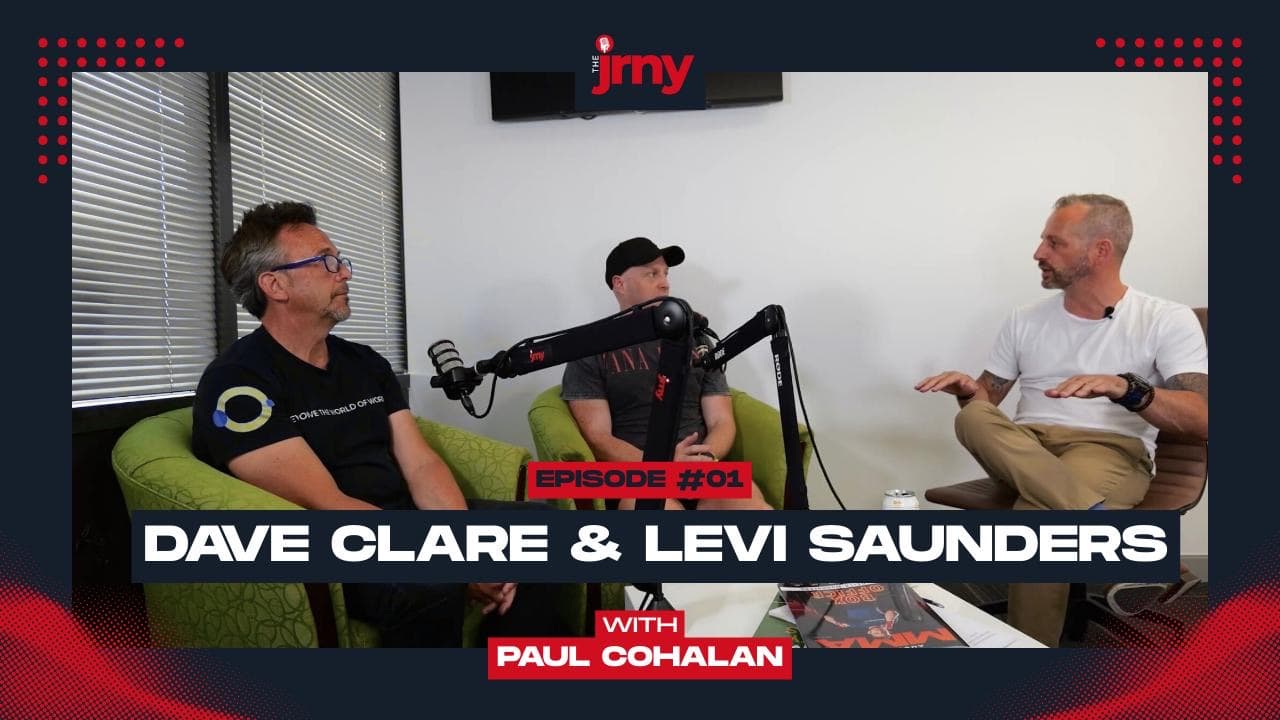
Meet the guests
Dave Clare
Leadership and culture specialist
Dave Clare is a leadership and culture specialist who works with organisations around the world on purpose, vision and values. He helped Paul rebuild the mission and values behind his business, and he is known for pushing leaders to lead people rather than manage resources.
Levi Saunders
Digital marketing entrepreneur
Levi Saunders is a digital marketing entrepreneur known for his work at Digital Hitman. A long time friend of Paul, he has come through a tough personal chapter in recent years and is now partnering with Paul on new ventures.
Episode summary
In episode 1 of The JRNY podcast, Paul Cohalan opens the show with two people who have shaped his own journey: leadership and culture specialist Dave Clare and digital marketing entrepreneur Levi Saunders. Dave unpacks the difference between speed bumps, hurdles and the walls we invent in our own heads, including the 2017 pizza box moment when his business was on the edge and he chose to keep going.
The conversation moves through what leadership really means now, leading people rather than managing resources, and the shift from trading time for money to building recurring revenue. Levi opens up about how adversity shows you who is genuinely in your corner, and why being present and repairing relationships matters more than pretending you have it all together.
Key takeaways
Speed bumps, hurdles and walls. Most obstacles are speed bumps or hurdles. The hardest walls are the ones we build in our own heads.
Lead people, manage resources. Treat people as human beings to lead, not resources to manage. The best leaders get that order right.
Commit through the hard moment. Dave's 2017 pizza box moment is proof that commitment shows up when the business is on the edge, not when it is easy.
Adversity reveals your corner. Hard seasons show you who genuinely backs your growth. Presence and repair matter more than appearances.
Transcript
Read the transcript
This transcript was generated automatically and lightly edited for readability. It may contain minor errors, and speaker labels are not yet added.
Hey guys, Paul Cohalan. Uh, the journey podcast episode one. I got Dave Clare, Levi Saunders. Um, long-term friends business relationship.
I met Dave Clare about 201819. He helped me uh recreate when I change when I uh updated the business name to connect the mission, vision, uh, purpose and values. And, uh, they're still here to this day. He's the global guy, leadership and culture.
I got Levi Saunders that um, known for about the same time. and he was the main man at Digital Hitman with uh Brad. Um it's funny how it goes around. He he's turned into a close friendship and we've helped each other on the personal roller coaster the last few years which he's been through.
He's got a little boy Rain and um he's been there for me the last couple of years as well and now we're actually done full circle. We're back in doing a business partnership um again. So uh hope you really enjoy this episode. Boom.
As a resilience, there's two things to resilience, right? You have to like most people don't understand what resilience actually is, right? So resil resilience one is a strength. So if something happens to you, it can bounce off you.
I don't think it's what's shifted is people's perception of what leadership is now. Yeah. Okay. So we've always believed in evolution first, right?
Create evolution as a natural steady business and that we should look at, you know, human beings as, you know, resources for humans, not humans as a resource. And you lead people and you manage resources and people a resource. And the world's just starting to work that out. What's changed is that with especially with AI and technological advancements and stuff like that, all this stuff that we've moved away from human doings getting back to being human beings again, right?
But the problem is we don't know what it means to be a human being in the workplace anymore. Today we're here with Dave Clare and Levi Saunders. Um, this is the the first episode of the journey and um, I've been trying to get Levi on for a couple of weeks to help me kick it off. He's been through a bit of a journey recently and um, it it just didn't work out, but then he he sent me a message Sunday night and this man here is uh, I think found an unlocked door wandering down the spare bed into my house and now he's found uh, his way into the office.
Yes. And uh I I think what was really um was key for me when Levi messaged and we had to make this happen this week around all our schedules is I met Dave Clare we're just talking about now not sure 18 19 20 um and Dave spent a fair bit of time with us uh went to one of his summits and then he uh spent a lot of time with connect uh working through the values the mission the vision and where the business was heading in the future um and that was when I uh parted ways with a business partner and then just wanted to get a get a new vision and road map moving forward. So, thanks for that, Dave. And then and with um with Levi, we met in I'd say 2018.
Yeah, something like that. Levi with a business partner had digital hitman. Um they probably the first agency that we um engaged with and we had a great relationship ever since. And uh you've had such a journey business, personal and all that since then.
Everything in between. um ego kind of in I think we've all had that. Yeah, I think so. And uh in that in that whole journey and that whole space uh these these two have helped each other out a lot uh personally and become really good um mates and that's really great to see.
Um so personal mates uh business um yeah so it couldn't be any two better people to be on the first episode of the journey. Isn't that funny? um adversity and new found commonality how it brings people together. Yeah.
You know, like one thing someone told me is with relationships. Um it's it's ne it's neither like consistency is neither just here. It's always traveling somewhere like going up, it's going down or whatever. Or you know, you got a bad relationship with someone.
You know, that's just where you are at this point in time. Um in the opportunity to to further that relationship might be down the road. You know, maybe you're not invited to their wedding at this stage, but that's not to say that they won't be invited to yours in the future. Yeah.
So, you're nearly there. So, when you get married, when you get married though, there's one missing ingredient. Yeah. Yeah.
I say like the um I think I find it fascinating when you think about people come in and out of your life though for seasons and reasons. Yes. Right. And various Yeah.
And the um when you go through some adversity or challenges uh and I remember talking to Levi about this when he was going through a significant situation I said you'd be surprised when it certainly I went through something similar that you'd be surprised who stepped forward and then who step back. Yeah. Yeah. Right.
And the people you felt were think your nearest and dearest friends doesn't mean they're bad people. It just some people step backwards and other people step forward. Like I hardly knew Levi when he went through some significant parts of his journey. I'd only met him twice.
Yeah. Homes. And then Yeah. And then it was time with I was hopefully one of those people who step forward other people step back.
Yeah. And I had the same thing happen to me throughout all my you know journeys and that and that's got me to realize as the oldest one here that very easily never have guessed. Yeah. Yeah.
Quite easily. I didn't say I was the oldest looking here. I said I was at home. Very cool.
But yeah, it's just that you have that seasons and reasons and people will some people will surprise you. Yeah. On either stepping in or stepping back. I I I had it recently too uh just going through the personal stuff and then business and you realize when you shift and change and once again they might not be bad people or whatnot, but I had three really close people that end up parting ways with.
And you know what? At the beginning it's really hard because you think that you should keep them forever. But when you're young and everyone says by the time you're older you can count the people on one hand probably. It is so true and I'm being a bit of a socialite and that like all of us it's really hard to understand that until it happens.
And now I'm like it's about me myself development work on yourself where you're heading and obviously your kids and family and yeah it's um yeah it's it's haunting especially when it happens for the first time. adversity strikes and then people that you've almost woripped and idolized step back and then you still don't know who the people are that are going to step forward because you haven't started that relationship with you. So there's that that bit in the middle where it's um it's very lonely and until people make themselves known. I think I was just lucky that uh people like Dave stepped up pretty quickly.
Um but um yeah, it it it leaves a bit of a hole some people that leave or whatever um even to this day. But um you also learn you're like that I don't think I was ever really meant to be uh that close contact with that person. Well, see see what you said there, right? I think what I've learned is they're they're there, but like let's talk about journeying them in a book and chapters.
I think they're there for a chapter. They come in and out and it's kind of what you said earlier and what you said, it's like they come in and they're there for a piece. It's a learning curve, right? And like it's, you know, me being from over east and then coming over here.
So I don't have people here I grow up with. But then you had I had the Navy and then then you go through business. So your circles change as well and you look back on that and you know some people you're still close with oddly but I think the really close ones are the ones that if you don't talk to for 6 months, 12 months and then you pick the phone up. Yeah.
I think they're real key. But other people just come in and go and that's okay as well. Yeah. I've al also noticed that people that hold you for to the person you are the way that you were um they don't they don't see the growth.
Yeah. They don't see your evolution. I've noticed that those people um inevitably can't possibly stick around forever. Y because they just hold you to who you were 10 years ago or something like that.
And um yeah, it's just just very noticeable. Yeah. So Dave, risk, resilience, and roadblocks. I know you've had plenty of them because you probably taught me a bit.
Plenty of risks, not many roadblocks and Yes. Well, give give us a risk that might have turned into um a bit of resilience. Um or a roadblock. Well, I'll tell you about the risk and I took the risk because of surpassing roadblocks and building resilience.
Yep. Okay. Um and so it was actually 2017 when I decided to start circle leadership in the format that it's in today is um you know I've been doing leadership development in three continents 30 odd years as a practitioner and everything and had multiple businesses and you know I would say I've gone under virtually twice u and then I went back into the the trenches and um you know led organizations to make sure I wasn't one of those who couldn't do teaches and all that sort of stuff and turned around some amazing organizations and and then when I started circle the leadership the first year was like horrific. It bombed like I went out there and I wasn't I was like it was just virtually went through all what was left of the savings everything we had and uh put a lot of pressure on us financially obviously and all in my relationship with my wife and um and I remember sitting in our garage.
We were sitting there and like literally there was a pizza box on the floor and and I said to her I said I said said to her like please understand that if I have to sleep in that pizza box or in a friend's couch or whatever I'm going to build this thing. It's the last I'm not getting another job. I'm you know I was 50 years old at the time or just under 50 and um and I'm like I'm not going I'm going to build this thing and if I have to sleep in that I'm willing to do that and now I'm asking you if you'd like to come on that journey with me. if you don't, I would totally respect and understand that, but I'm not going to have another job.
I'm unemployable. I'm going to build this thing no matter what it takes. And so I took the risk and then here we are today with a team in US team in Australia. My daughter runs I was about to say and your daughter's running the company like talk about role model and yeah, you know, she's definitely the boss.
Although we don't have bosses, we have coaches, not bosses. But yes, but definitely like to have that um you know going over to the US after this to work with our team as they're kicking off a new client in the US. So I've got people doing business. Is that where you're flying out tonight?
Yeah. Yeah. Yeah. Oh, okay.
Yeah. Like actually uh four six seven hours. Yeah. So I'm very lucky to get day time here passing through.
Yeah. Well, literally I am the um but that was a really big risk but it's because of the roadblocks that I have faced. Now I look at roadblocks as three fundamental things. There's speed bumps, hurdles and walls.
Yep. Speed bumps slow you down. Yep. Hurdles you have to jump over and walls perceivably are made up in your mind as impenetrable barriers.
And usually here Yeah. Yeah. said they're made up in your mind. But what you might look at as a speed bump, someone else might look at as a wall and someone else might look at a hurdle versus a speed bump and vice versa.
So it's your perception of those things. Can I can I ask you one question? So go back and you told me this when I first met you and um and you know I think it was one thing I admire about you, but when you were standing there looking at that pizza box, what was the bit growing up that probably made the resilience that you weren't giving up? There must be something go back peel the layers back, right?
if if something comes to mind. Yeah. Well, I would say we're the resilience and I guess this is why we do the work we do in the world today is I saw my dad bust his ass for you know 70 80 hours a week and sometimes as kids we like the joke was I'll wait till your father gets home and we'd be laughing because well by the time he gets home we'll be in bed by the time he we get up he'll be gone right but he did what he had to do to provide for our family so I I don't judge him for that different generations and yeah absolutely and he didn't have a father his father walked out and so on but and I looked at that and I'm going and then I saw myself fall under that pattern and like when I started working in my career in banking and finance and I'm working 60 hours or so a week and you know I had a young son at the time then and I'm like what am I doing here and for organizations that really don't give a crap about you as a person you're just a resource to that organization and I guess so for me having seen that and then see my dad go for into entrepreneurship and then that well he was a franchisee and the two went broke the two franch what was that for uh one was swimming pools visit back in Canada and insulation. Yeah.
Swimming pools in Canada. Yeah. No. Well, there's a lot of swimming pools in Canada.
I assure you ice skating. Yeah. Yeah. Well, that's what we do.
We drop the water halfway through in the winter, then you put his ice and you've got an instant free pools in Tasmania. Yeah. But yeah, but they have the um but yeah. And so like seeing him do that and it really the conditioning belief that we received growing up is go get a safe job, go do this stuff.
But then I saw what happens in a safe job and I'm like until it's not Yeah. Like and then you could I think Jim Carrey he talked about with the his dad as an accountant. All right. And he said like his dad told Jim Carrey the comedian, right, to go get a job and do the same sort of thing, same kind of conditioned belief.
And then he saw his dad lose his safe job. Yeah. Yeah. He's like, "Well, if I can lose my safe job going staying safe and trying to get my, you know, work to retire 40% of my things, working 40 hours a week, why would I just go after my dreams?" Yep.
Right. But I also saw my dad bounce back and then he got into business and partnership with people and he built and so as I look back on the journeys and all the things, what I realized is you know what as a resilience there's two things to resilience, right? You have to like most people don't understand what resilience actually is, right? So resil resilience one is a strength.
So if something happens to you, it can bounce off you or it's your ability to bounce back, get back up from things, right? So you create that resilience. So I could see my dad always bounced back. He would always do whatever it took to do whatever he needed to do.
So that just hit that just answer my question. That's where I will say that's where I bought from. And then I realized I'm sitting there and having my moment and saying, you know what, I' I know historically that no matter what happens, and I've worked with people, I said, what's the worst case scenario? What's the worst?
If I had to go pump coffee at the dome or something like that to provide for my family, I'd do that. Yeah. So, if I would do that, that's the safest, simplest option for me and that's the worst case scenario. Put food on the table.
Wouldn't I go after because I've know over history and time that you'll always bounce back if you believe that you're willing to do whatever it takes. Yeah. Right. So, there has to be that sense of belief.
Right. Now, courage isn't the absence of fear. It's going in in regardless of fear. Right.
And so you have to be having that in life and or business. But life's going to throw crap at you. We've all known that. Some of us didn't realize it was going to be thrown at us until we hit us.
Where'd that come from? Yeah. So, um, but if you look back in your own life, as I have in mine, I've always bounced back. Yeah.
And I've always found a way. And so I knew when I looked at that pizza box that I could make that commitment. I've faced roadblocks. I've done that.
And it was worth the risk because for me, I'd rather go out screaming and in in a fiery inferno doing what I'm doing right now than have a safe job and lose it. I've always said the same like, you know, entrepreneurship, you know, there's all the memes, you know, you're so close you don't realize, don't give up because you never know, it could be tomorrow. But it's like um just the ups and downs and going through it. And I've always said I'd go I'd go empty bins if it was for myself.
And no, no disrespect there to emptying bins, but like from what I'm doing, I would go always go work for myself than go back and work for someone. Um, unless you best bin empty the the best. That that's the way I think about it. It's like do it better than the guy down the road or put food on the on the table, right?
Yeah. It's probably a fair bit of money pressure washing bins. I would say you instantly think, oh, come on. How do we go about that?
Look at cleaning these days. You can't even get a cleaner. Like go back 10 years to 20 years to now and it's like 50 bucks an hour. Yeah.
Yeah. Well, that's already something that AI won't be able to do. I mean, you'll have AI robots, I'm sure, in time have a outfit on and they'll just clean up your house and do stuff. I was going to get you on this topic afterwards, but um yeah.
Uh so that's great. Thanks for that. Um so as of today, just another quick snapshot of today. Your daughter's running the company.
Um you have just moved how long ago? 12 months ago. 12 months ago. I remember when you're moving.
Yeah. Now, just talk a bit about that and being away from Perth and you're just saying how your boy uh well, you got a couple 26 and 29. Yeah. Well, Jordan, she runs.
She's 26. My son's 29. My other son in Canada, he's 34. So, Yep.
Yeah. Your son has a disorder where he can't smile. Yeah. I do the smiling.
Yeah. I do enough smiling for all of it. So, yeah. How's Queensland and stuff?
Yeah, Queensland's awesome. Like I say, it's funny coming back here now, like just being over there, I really haven't had a huge amount of time to enjoy it with all work and travel and whatnot. But coming back here, it's interesting. You go, "Wow, breath's a lot flatter than I remember.
It's a lot drier than I remember after seeing the lush because where we live in the sunny coast, you know, palm trees and greenery everywhere. It's lovely." And um and each place has its its beauty, right? And um but one of the reasons for moving over there was because like I travel about four and a I think last year I traveled four and a half months if I added up all my trips. Oh, wow.
And you know that that I'm traveling and you know, we were just talking to Mitch about it like when you leave Perth to go to Melbourne, you got to if you want to spend a day in Melbourne because you're going back in, right? So you you got to fly through the night to spend a day there and either fly back through the night to, you know, or the next morning. So at least two nights with my wife, whereas on the sunny coast, I can go to Milbour and back same day from Sunny Co. I can go to Sydney and back and it's easier to come back to Perth.
But like last year, I spoke at a keynote at a conference in Tampa. It took me 36 hours and 45 minutes for it to get there. Oh, I did it again this year and it took me 19 hours and 45 minutes. Big difference.
Yeah, cuz I just go Brisbane, Dallas, Dallas. Y and that was it. Like it was quick. Like so traveling wise, it's made it a lot easier for us.
Yeah. So, but the whole family is still here, right? So, it's only I my wife and I who are living in What was the main reason? Was it the time thing?
Did it suit or different opportunity or why then? Yeah. Like why why 12 months ago? Well, we we'd actually talked about it um back in 2019 and we were planning to do it in 2020.
Y and then something came along and screwed that plan up. All right. CO or something. Yeah.
Something like that. And so we decided to stay in WA where you know for the way that we we handled CO here in West Australia was fantastic. So we just went about our business, right? And so we decided to stay there.
And then with all the advent of being able to work more from home and all that stuff that came out of all of that, I didn't really need to travel at that stage. But then it got to the place where now okay the kids are all well settled everything's there and the business is at a stage now where I'm traveling a lot more and you know because starting to build the teams and therefore my job as a go as the guardian of philosophies of the principles of the organization and promote the message and get out there um and to help build the team around the world that I was going to be traveling a lot more. Yep. And so it's just easier um and of course to book golfers so you know there's more golf courses and So there was some lifestyle stuff.
Nice. But also when when as Canadians when we would go for winter snowbirds, we would go down to Florida every winter, right? Um and go golfing and all that. And where we used to, you know, either travel through Brisbane and, you know, up to north um every time we drove through this feels like Florida here.
It just always reminded us Florida. And we were going to move to Florida at one stage instead of Australia, but we decided to come back to Australia where my family was. And so it just reminded us of Florida. There's lots of golf courses.
It's better for business. Um and you know, the kids were all settled and building their own lives and it was our turn to then, you know, have a different lifestyle and then allow me not to have to be away as much, especially domestically, but internationally also easier for me to get. Yeah. So you say 10 hours on that last one, by the sounds, a bit over.
Well, I've got Melbourne to Dallas. Once I fly to Melbourne tonight, then I go Melbourne to Dallas is 16 hours. Yeah. Or 15 and a half if just on just on your journey, just reflecting on it again.
and I haven't spoke to you for a long time uh in person. Um I think one thing you say you go back 10 20 years and you're like you you look at other people that are probably say where we're at now in the journey and you're like they just know it but no one really just knows it. Like we talk about road roadblocks resilience and risk, right? You're actually learning along the way.
So did they they might be in ahead or someone might be behind but I think that's one of the biggest pieces by just watching you then you're learning along the way. You don't just know it. Someone might think you do, but you still got the same doesn't matter what point you're at. You probably got bigger problems the more the more you go on, the more risk you take.
But but just go back to the leadership piece from when I met you, Dave. So you just started the circle leadership year before, two years before, whatever it was. What do you think and generations change as well and learnings in technology? What's what's one or two key leadership points that you could probably say that might have shifted a bit then you do a little bit different or has evolved?
Yeah. Well, actually it's quite funny because we were talking about this with the team this morning on our team meeting is I don't think it's what's shifted is people's perception of what leadership is now. Yeah. Okay.
So, we've always believed in evolution first, right? Creating evolution as natural state business and that we should look at, you know, human beings as, you know, resources for humans, not humans as a resource. And you lead people and you manage resources and be a resource. And the world's just starting to work that out.
And the generations are helping with that. like younger generation. I don't want to work like you guys had to when we were your age. I don't want to be treated like we call them lazy, but they don't have to.
No, I guarantee they're not lazy. They're they have a great work. They're smarter. You know, they're they're 100% smarter.
Um this the way that we classify these groups of young people, it's so wrong. And I've had this debate with people said they when they're working, they work really really well. They just don't want to work like you did or I did. They don't want to get up at 7 to 6 in the morning and work through till, you know, like eight or nine at night.
And you know they they may want to they're happy to get up there early do some work then they want to go take their kids to school these days and then they have to do some more work and they want to go to the gym or Pilates or whatever then they happen to and do some stuff on the train or whatever they just want to work differently and it's okay and and and what are we trying to do now go to the gym and have a bit of flexibility right but I had this you know argument with some more mature age people than myself who are related that's a great debate not saying more definitely more mature than I am but we're the mature But about this fact, I said like I remember having this chat with my dad like and like, "Dad, did you and Uncle Eddie not want to just go out and play soccer all day?" He goes, "Yeah, of course." I said, "Well, these kids just want to do this." You didn't have had to, though. Yeah. He said, "Yeah, but we weren't allowed to." I said, "Oh, that's the difference." So, we're not allowed. We live in a world where you could possibly do that, then why wouldn't you?
Yeah. So what's what's changed is that with especially with AI and technological advancements and stuff like that, all this stuff that we've moved away from human doings getting back to being human beings again, right? But the problem is we don't know what it means to be a human being in the workplace anymore, right? Because we're just human doing now.
If AI is going to take away a lot of the doing and technology and other things will do that for us, what's left is our creativity, curiosity, our imagination, our intuition, our empathy, what do we really need? That's it, right? So we don't need modern management to take care of that. What we need is leadership because you lead people as resources.
We don't need to treat treat people like a resource anymore. Not that we ever should have but we don't need to do that anymore. So what we need is more leadership in the world. And that's what we've been preaching is that this and when I wrote simplified which was 2017 which was all that's that book mentioned.
Yeah. So that was the the launch of that. It's that's was it leadership is simple. You lead people, right?
And people are not a resource. And so I don't know if like we've gotten a little bit clearer and sharper in our message, but I it's kind of like the old Canadian adage, you know, skate to where the puck's going, not where it is. Not where it is. Yeah.
So we were skating so far from puck maybe. I don't know. Investment stock market. Everything's the same, isn't it?
Yeah. And but now organizations are getting it that you generation. If you want to attract the best talent, then you have to create an amazing experience in your workplace, right? You have to have coaches, not bosses.
You you can't just boss someone into greatness, right? You need to coach them and help them to be their best. Create an organization where they can bring their best self to work and they become even more of what they're capable of while they're here in your care and beyond. You know, just on just on that, I think every industry right now, go and try and hire someone.
Insurance, you know, business or it doesn't matter digital, whatever, right? It's hard to actually get people right now. I always even recently hiring I had someone ask me a few people ask me, "So, what do you really want?" And I'm like, "That's not the question anymore. Not for me.
you're not for a long time because it's like what if what if they're not out there then you've just pigeon holed. It's like let's keep it a bit broad. They're like what what salary? What hours?
What the you can't do that cuz you'll go you'll get no one. So I come back I've just hired a guy from an international broker and he wanted three days he wanted flexibility because he travels. He's just coming off the back of it. But he goes in I don't know 8 n months he goes I'll come on full-time but if I just went sorry full-time this that wouldn't have got him.
Yeah. And and it's insurance is really hard to get good brokers at the moment. And um yeah, just to that point, right, it's all changed. So like even we were talking as we were walking over here, the organization you're working on right now.
What's the first thing you said you needed to get right? First thing I needed to say, oh, it's the paper. The culture. Yeah.
Right. Culture. Culture. Right.
Always. So right. So this is the funny thing. It's your culture obviously.
That is your one true sustainable competitive advantage. In in your business, your business, I could go and start an insurance organization crossroad. I can get similar colors, brand tech, you name it. Everything I can use similar product, services, tech stack, you know, everything to say.
What's the one thing I can't copy? Culture, right? It's your ability to capture the spirit of your people. And so, once again, from a leadership point of view, this is why then it's your culture.
Obviously, it's your people. So, we need leadership that can capture the spirit of people, not manage people. Can I can I got to touch on this? So why it resonates with me so much is obviously in the last 18 months I've been I till the start of this year I was in the background of connect a lot and me being out of the business I thought I had all these people east west coast you know all that kind of stuff but what shifted and and why a couple of people left is because I wasn't in here in the same leadership motivation culture wasn't in there right like I'm really flexible motivated energy all that kind of stuff and um you know my fault in the end But um it just it I just learned a lot from the shift.
Yeah, the business kept running but did we lose clients? Yes. Did we you know did things change? Did people change?
Was it different? So it just really taught me a lot like that that was a really big learning roadblock um and learning curve. Yeah. And it just I just resonate with that so much.
Yeah. Well, I assure you we don't learn from our successes. We all the mistakes that you made. Great that you can reflect on it mate.
Huge. Huge. Yeah. You wouldn't believe how many people that can't actually self-reflect.
It's uh that's called ego. It's it's oh maybe not not in it or or a bit of fear as well, you know, failure and some some people just can't look at themselves. The first thing you said to me today just before this, I said just give me a few points, Dave. I haven't seen you for a while and you're like only went bankrupt twice.
It's the best best learning and reflection. Not that anyone wants it wrong. I could tell you all the wonderful successes, but they only came because of those things. Well, the reason we're on here this year, the journey is like it's get both.
We can all sit here and go, we won this client or we done this or we turned over revenue like you know which a lot of people throw out there out in the public but it's like what really got us where we are today and like me and you talk about we we catch up a bit now and we talk about this heaps and um but you know the whole uh diamond comment right like under pressure but the last four or five months have been really changing for me but the the reward and the purpose and the feeling when you get through it though when you dig your heels in you're like it I'm going to like I'll come out the other side, you know? And if you're going to go, I know I'm going to go into a hard spot here. This is what I've been doing to myself to get through it. You're like, when I get out that other side, yeah, it'll be amazing.
Well, when you think about the biggest shifts you've made in your life, the lessons, it wasn't from you achieving something amazing. It's kind of a big thing that shifted the way that you look at things. And you know, we you use the word evolution. You know, we're here to evolve the world of work.
I've been preaching evolution since 2017. And now everyone's talking about the need to evolve, right? And um become fashionable. Yeah.
Yeah. No. Yeah. Like it's um but but I learned that the hard way like back in 200 five um when I went through my separation and divorce, you know, I had my business my my leadership and personal organization business back in Canada.
Y and we were so growth focused. Everyone's like growth focused. Please let me assure you that growth is one thing that kills tasty. Yep.
Right. Because Right, bro. Yeah. Because growth, how do we be more for more and serve more and get more and do then we need more and more and more.
Then you got to feed that beast. So, everyone's so focused on getting bigger, but very few people are focused on getting better. Yeah. And so, we were so focused on growth and also what I realized is, you know, you know, I had a team of seven and you know, seven people out there, facilitators, coaches, we're you were probably on the number one team in Canada.
Um, and things were going great. then went through divorce and half the team left because my partner was my wife was my partner in the business. Y and then that caused a rift in the business. Um but then I also realized is that we were living and dying by the program.
We're like if you you got to sell the next program, you got to sell the next. All right. And then so I learned a that we had no um sustainable cash flow. So we lived and died by the sale.
Yeah. By the contract. And it was all based on programs and programs have a start and finish date. Uh so everything we do today is process y not program.
We don't sell programs. We don't offer programs. Everything we have at circulation is a process, right? It's a system, right?
So we've systemized way that we work with our clients and provide a system to our clients. So it's an ongoing process. Yeah. So there's no start and finish dates.
So I don't have programs. Also, we're building a recurring revenue plus new revenue type model if you want to talk straight business. Yeah. Yes.
Um, and so from a resilience point of view, I don't have to live on the the road maps that we do. We have our next 90 business evolution system that our clients go in. So we and seven out of 10 of our clients we do road maps for go into that. Mhm.
Right. On average. So now we have recurring revenue that keeps coming in. So we built resilience into the business so we don't have to live and die by the contract.
Yeah. Right. And the same thing we work with our clients. But I learned all that from not having all that and not from the pizza box.
Right. And well, no, that was the pizza box. It was the journey to build that. But going back to 2005 when that happened and then you know then 2008 so I went through my divorce 2006 then 2008 the global financial crisis came.
Now, here in West Australia, people like, cuz that's why I call my dad like, "Dad, like I've just lost another 70% of my business. lost half through that and the other 70% because we had a lot of it automotive and Obama reached in and took the plants out of southern Ontario back to the US which understandable and now all of a sudden now I'm gone down and I started to diversify into a few things um different other industries but man I'm just like my dad's going what crisis like you know 2008 2009 and west Australia specifically was just the beginning of the construction boom in mining right it was just and and so but I learned then a growth you can't have a business that's just focus on growth You have to be constantly evolving. You can't rely on cash flow. You can't just live and die by the contract.
You can't. And so everything that we do today was because of that and then the financial crisis and everything like that. And like that's where the resilience come from, right? And that's way the business we built the resilience into the business because I was taking risks back then that I shouldn't have.
Yeah. Right. And the roadblocks were no no don't worry like you know but I was being advised by my mentors and gurus who are the master franchises who are licenses of the organization. Oh no you just got to get out and sell more Dave sell more sell more sell more sell more.
So I'm like okay so I'm just going to do that. So now so just talking about building resilience into the business. I like the way you put that. I've never put it like that.
Build it into the business. Um, I think I've kind of naturally been doing that since a bit of a shuffle and a bit of a reset in WA actually and with my national manager and East Coast team. I've had a big reset with clients and whatnot. And it's like I call it a bushfire and it was it was coming probably before my divorce and personal stuff, but then that happened.
Um, so then, you know, it took its time and it probably hit me a bit harder. Carsonist who lit that bushfire. Sorry. I was 100% always say that and I was and um but the green shoots coming out of it well we're probably past the shoots now it's probably a bit further and we go through this storming stage and now we're into the forming and then you know go into the growth and probably back on track where we were and I just spoke to my east coast manager today Jackson about just getting back on and being that dog with the bone again in the start of the new year um just by the reset and the people but just coming back to building that resiliency and it's something I'll probably go away from from here I probably need to jump on and have a chat with you.
It's been a few years and you know because you can learn leadership and it's it's not about the level you're at. It's about like where you're at. I suppose I've learned over the years from working for your your corporates and that they're they're pretty good at leadership but there's also a lot of downfalls. You go to a small business good at modern management.
Yeah, that's there you go. Yeah. Yeah. Very true.
And um and then coming into you know the theme world and all that. Um but even that's changed over the last 10 years since I started. So well outside of this because you do have the tools still the stuff that we worked on your purpose, your values, your vision and your mission. You have the tools of leadership in your your power in your presence and might just need a refresher on how to bring those back into life to the highest level for you to use them as tools not just stuff that sits up on the walls.
So something I'll tell you something Dave and it sinks in my head. But I told these guys when we worked through it with the digital team and we we revamped the uh values, but I think it took about four weeks or something to get the values done. I can't remember exactly, but you're you're up on my whiteboard and a piece of paper and we're going through it and you're like you'll be already doing it and when it clicks it'll click and you'll probably never change it, right? Like it's evolved, but they're actually the same still, right?
Cuz I when I had this uh lady in revamping the branding two years ago, I'm like you're not changing any of it. And we we evolved it. I actually really like it and we weren't going to change much but it stayed on the same you'll bang on it like there's no point changing when it clicks and cuz we all work a certain way and you know it usually comes from management or the owner the culture and and the values and uh it's something that stuck with me heaps and I always say it. Yeah.
And like it's it's funny because like you look at your purpose that you the the problem you guys are passionate about solving understand build trust and educate right that defines you but it doesn't confine you. Right. So your purpose defines you but it does not confine you. So you could be doing that with this here and that there you know we've all been told with a strong enough why you have many hows many what that sort of right.
Well that's the whole point of it. It's there. So your resilience comes from having a clear sense of purpose. If your business does not have a clear sense of purpose it it will be very difficult to build the resilience in because hey this just tells us why we're here every day and it's so now we know why we're here.
What way are we going to deliver that? or hey this thing does that reject it this purpose yes or no if it's a no that you if it doesn't reject at it keep doing it if it does reject at it why are you doing it right so you it should help there that gives you strength should bounce off right one of the key effects of resilience or if you get pushed you have to go well hang on this is why we're here this is what it is what other way can we do it what else can we do what other ways can we bring this because it doesn't doesn't confine you there's more than one way to find forward right so now you have the ability to bounce back that that way didn't work. Okay, let's do it this way. Yep.
Right. And this is why having these things are so important to build that resilience into your business because it starts with that because actually your culture should become a shield like a like and it it creates like a magnet, right? You want to talk about resilience. So what are the two aspects of a magnet?
What are the two things a magnet can do? Positive and negative. Yeah. Push.
Pull. So attract and repel. Yeah. All right.
So basically you can attract in if you have the right culture the people that you want but it will also bounce off repel bounce back resilience in your culture becomes stronger and purpose is the seed of culture and it's the first decision making and and and go I'll go put my broker hat on and and the business risk bit if your culture is not on you want go back to insurance and talk people injury risk controls following systems safe systems you know all comes back to that culture piece right yeah absolutely so so I'm going to ask you off topic. Okay. Um, so out of all that, you love business, you love culture, leadership, and all that, which is fantastic, but your wind down, I believe, three things is golf, whiskey, and cigars. Well, it's changed a little bit.
Tequila, and Oh, I haven't seen you for a long time. So, so, so what's your favorite cigar at the moment? Um, I still love an Olivar B series. I've got no idea.
Yeah. Yeah. Money number two. Money Crystal number two is a beautiful baseline.
Y yeah, but yeah, I do quite enjoy it. We might have to go after this and have one. And uh as far as tequilas go, um I've been enjoying the Heroda and of the moment. So Simon, do you know what them cigars are?
Simon Develin. Yeah. The um we sent him that. And actually, well actually when when I go to the States, the the cigar lounge there, the humidors are the size of like Delib's.
Oh, they Oh, yeah. Like you know definitely you go into their shop right that shop front that whole shop is the size of some of the humidors like literally and then there's I just appreciate that without without smelling a cigar like you know what you like as like you go walking through Bunnings and the wood section you smell the pine and oh I just like to walk through there just to smell the wood. It just So you mentioned golf already so we don't care about that. We know what that is and I'm hopeless at it.
I'll drive the card or drink beer. So me and you do that bit. Tell me about the tequila beans. Why did you go from whiskey to tequila?
You It's funny actually cuz I was just having a buddy didn't have any whiskey. He had the tequila and I had it and you know what? Um sometimes you have I'm not a big drinker, right? So I've never been a big drinker anyway.
But after two or three whisies you can feel a little bit foggy in the morning but after two or three tequilas I'm fine. How do you have it on the rocks? Yep. Just just a wedge of lime or something.
That's it. Remember when you made me out of cigar? Oh I do. I was telling that story the other day.
I was telling you the story. G give us a 30 second version. So we're sitting at and then we'll go to you. Sounds good.
But I think this was more interesting. This this was this is this is the beginning of our friendship. This was the moment, right? This is the moment where I knew we were going to be best friends for life.
We're sitting across like you and I at the little table and it was it was him up and cominging birth of his boy, right? And uh I said, "Okay, I'm going to wet the baby's head." So I brought these two cigar little shorties, right? They're like 4 inch by 60 ring gauge. And I and I said, you know, Levi, I'm the cigars here.
We're gonna we're gonna have these cigars here. These are the little short ones. They're fine. And uh I only have one rule with my cigars.
If you're smoking one of my cigars, you got to smoke the whole thing, right? Well, the price is Well, the price of cigars here in Australia, it's right. Like I could pay 12 bucks for a cigar in the US and here I'll pay 100 bucks for it. It's like, you know.
Anyway, so we're sitting there lighted up having a cigar and we're having a really great conversation and then you know uh for someone who's never smoked cigars or whatever even he's just smoking away and also I can see his face go white and that's kind of looking getting to get a bit green and he's looking at me he's like I don't I don't feel too good right now said yeah and then but he looked at me and this was the moment he said I reckon if I threw up on myself right now you wouldn't even b and you wouldn't care I said no I wouldn't man wouldn't fault me in the slightest all Right. So, we know what happened next. I can't even remember. No.
So, I said, "Look, dude, you don't have to finish it." I think I finished it for him. I'm not letting that go the way. It's so lightheaded though. I can't remember.
Yeah. Got really lightheaded. Got hell and like he was getting like the cold sweats and his whole face was going a bit green. That So, that was a road.
Oh, this guy. I was like, "Oh I don't think this guy would actually care if I threw up on myself." I feel like he just keep talking to me like I just go grab a cloth here and go wipe that up. Anyway, we having a great conversation. We're talking about future life and him becoming a father, all this school Amazing time of life.
Yeah. Yeah. Like, you know, having had three kids myself, you know, I remember the moments and we were sharing stories about I think my kids being born and all that and uh Yeah. And then he just had that all of a sudden you could just see that look on his face.
I could actually picture it with Levi. Yeah. So, let's get on to you, Levi. Thanks, Dave.
That that was great. And it was a good recap that um and to see you again in person. No, absolutely. So mate, obviously we've known each other for a while now and you know had business part of ways in the business which now you got a great relationship again with Brad which is fantastic.
I've actually done that myself. Um and then you had a bit of a personal journey. You got your own few little ventures going on. You got your boy now which is amazing.
I met him you know a few times. is uh fantastic and the main part of your life and and I think going back to that whole work hard and all that the main thing I've seen you do besides go through some roller coasters and recently is your whole world revolves around the boy and being present and who gives a I know you got to put food on the table but if you can make that happen that's always priority for you and it's uh it's actually absolutely amazing to see and I'll tell you now I I've learned a lot from that also because I go back to uh 67 whatever 10 15 hours a day. I don't know that for a long time and I probably didn't learn enough about that until I split with my with my ex-wife. Um beautiful person by the way but just part of ways and then you self-reflection you learn all that and like now I have my kids and it's like the presence trying to be present is unbelievable and I seen you do that a few years ago.
Oh absolutely. I mean you've got you we've got limited time with them. Yeah, there's a mother on the other side that loves them and you know, you've got to utilize that time with them and be present and everything in a in one sense it revolves around them, but they also need to see you uh being fulfilled in yourself at the same time as well. So, it's um it's a bit of both.
But um for me, you know, if if he's not okay and there's something that I could be doing better or I could be giving him uh more of my attention or whatever when when I have my ability to do that, then um you know, I I I need to be doing that because that that that helps me show up in other ways and stuff as well. Um some something that Dave helped me with. And sometimes it's not until you see them upset or you know like little little little indications or little behaviors um and they mirror you and all that kind of stuff and then you realize um very quickly I mean what's what's important and that for me has kind of led me to be I suppose a better person in myself as well because um over the last year things have really started to go exponentially in terms of um uh new business and and work opportun But it's a place where I'm chasing feelings. Like I'm like I really enjoy the way that that made me feel.
Um and the feelings is is is like that feeling of freedom. Um that feeling of of being the provider, that feeling of, you know, I can um take my son to to visit my family in Tasmania and not look at the bank balance or or have any different worries. So instead of chasing things, you know, we've we've got a beautiful home that we live in. Um, you know, we're in a a first world country.
We've got very limited threats compared to a lot of other people in the world. Both both health healthy. You know, we've uh we've all faced adversity and continue will continue to do so until the day that we die. Um, but then you're like, geez, I really like the way that I felt in that moment with my son.
How how can I protect that? How can I get more of that? And then from there, I've um been making some really good decisions. And then I've like not worried about being someone or something or worrying about how much, you know, how much money comes in.
It's more kind of how the behavior of what's coming in, how that, you know what I mean? I like what you said there because growing going back to what's been instilled in us and growing from a different generation, you know, survival, I always call it the old school survival generation and how we get trained. And it's like you've got to have a house, you got to, you know, have the things, not feel the things, right? And now big shifts, splits, kids, all that kind of stuff that purpose or getting through that advers just being present for your boy or the love being there for him.
Feeling around other people as well like you know um being able to relate to you in in uh in in changes in your life and um all these different people in all different situations. being able to to to feel them um have the opportunity to help them to exercise their own feelings and pain. Um and uh you know being able to relate to people on another level is is just just been amazing. I think it comes back to that emotional intelligence bit and empathizing for other people stopping listening um all that stuff I think comes into when you start to learn a bit more about that.
Yeah, absolutely. and um and and the opportunities present themselves when you are actually listening and you do actually care. Um I don't think there's been points in my life where I'm at point blank blank range not cared with people. I just I haven't been had the ability that I do now to empathize with them um because there's certain things that I hadn't got through.
So I feel like um any any form of adversity um one thing I've noticed over the last 5 years and there's um a lot of men in Australia um that that struggle um in in family related issues or whatever and u they they seem to go one way or the other um and um some some men capitulate and and they can't cope and there's issues with suicide, depression and um substance and all sorts of issue. And then there's um a lot of others that that get faced with diversity and and it's the making of them. So I've I've made that decision for myself and for my son um and I take great pride. It's not I don't think I've saved anyone as per se, but um I've been able to challenge a lot of people's thought processes when they're in the middle of adversity.
Um and um and kind of help them on this. It's pretty it's pretty amazing, right? Um, I think going back to what you were saying, I think it's that focus bit, you know, I think growing up our focus is go work hard, drive, build a business, like that's what you were doing, right? You start a digital hitman, all all that kind of stuff, but now that's not your focus, but but it comes with it naturally if you get your priorities and your focus right.
I think the the pursuit of happiness. Um, so it's all a part of it, but but my um my why is so much greater now and my why isn't isn't a physical thing anymore. It's it's it's uh it's a state of mind and it's it's um uh certain feelings that I enjoy that that that I can um dip into in any moment or you know right now because I'm pursuing that on creating an environment where that go back to what me and Dave were talking about before and I reflect on this heaps right like when I first separated it's like you can work out instead of worrying about trying to fix the other person work on yourself right and it comes back to this bit being happy But why are you thinking like that now? Because of the hard resilience roadblocks that you went through.
It's the same as business or or personal, right? I've chatted to Brad about this in Digital Hitman. I mean, I had a lot going on at the time and um you know, I I found myself in a situation where I could couldn't sustain um uh managing, you know, quite a decentsized business. Um and um you know he he wanted to part ways with me at the time and and for a long time after I kneejerked and I wanted to go into self storage in an innovative way and do all these bits and bobs and do all these things and you know I resented him for a while as well after that and he knows that but um you know then I stopped focusing on him and stopped focusing on uh the the reasons why things didn't work out and what people did to me didn't do to me or whatever it is.
That's the that was the moment right? He don't do to me. He was a great business partner. Um and then I start to realize that um I dug my own grave and I got things to a certain point and then and then this happened for me.
Um and then I you know even the knee-jerking and and all the ego that came after it. Um it it's all worked for me and and and taken me to this moment. But you know I look back in those moments I was like you know I wanted I wanted I didn't want to be the best marketer. I wanted to be known for being the best marketer.
There's a big difference. Um, and now I just enjoy being the master of my craft. Um, the moment you put that hand up and you just look in the mirror, hold the mirror up. I always talk about this a lot cuz I've had to do it But the moment you hold that mirror up is a shift, right?
Yeah. And and and you actually listen to it as well, not just hold it up, say it, and then Yeah. I was I was um I was under siege by my my own mind in those situations. Most of us are.
Yeah. And um you know I would have been an absolute at times it would have been an absolute nightmare to work with and um and you know it's it's all taken me to this point in time and now you know opportunities present themselves every day. But because I'm so clear on the way that I want to feel um I also able to distinguish what is an actual opportunity and what's going to be a burden. But what what's your purpose?
You told me the other day. What's my purpose? Yeah. You told me the other day I've got my why.
my why was about creating uh better experiences for myself and Raid. Um, so you said creating better experiences for freedom or something like like was it Yeah, better better um better experiences that um I guess it breeds freedom. I know that's not exactly what I said. Yeah, but so will this create better experience or freedom that allows better experience or something, right?
So whatever is will it do this? Yes or no? And if not, why are you doing it? A big part of that is protecting your state of mind.
like if um if there's people out there that are invading your state of mind, then I now believe that you must uh do the hard yards and take action immediately to ensure that um you're not in you're not in a situation or position where someone can attack your state of mind the same way. You've got to you got to take the steps, but you have boundaries. Yes. Boundaries then if someone bounce resilience resilience piece.
Yeah. I've I've I've been such and you said this to me, I'm going to say it back to you. It's been an absolute privilege to be a cheerleader on the sideline of your evolution. Yeah.
And that you said on your success, but for me, but for your evolution to see you, how you've evolved from that person that we welcomed into our home at that time through to who you are today, the resilience you've because you built those boundaries so that when something hits it, it bounces off. But the only reason it bounces off is because you fortified those boundaries with action, right? because now you're taking action on those things, right? So like you said, you're sitting like when this happens, you need to do this with it cuz that proves that it exists.
If you don't take any action, but I that action also comes from sitting in the ditch for such a sting period of time. Um and what made you so you just said you mentioned about 10 minutes ago about the whole you could go this way, you could go this way or it could be a bit of a mix, right? or or you're there and then then you shift to the bit I'm going to dig my heels in and I'm going to Yeah, exactly. And I'll do it through analogies and Okay, nice.
So, do you like Game of Thrones? Never watched it. So, there's ah anyway, keep them that didn't work. We were the last people to watch it.
We didn't watch them when anyone else was finally sag or something. Yeah. Like um this um breed well they're like the Ling Dead or whatever. perceived at the time.
And they were so horrible and they were going to take over everything or whatever. And they had to see them like the to believe that the um the evil or the cynicism could be bad real. Um and um I I I saw the result of um of a lot of men and women not not confronting their the sustained um compounding pressure of what's what that um not facing your fears um in in in so many different levels what that can actually look like and what that can do to you and how that can erode you over and over. I've had a lot of people talk about these horror stories of um unresolved issues um spanning well over a decade and um kids involved and yeah and um you know I watched a lot of videos and things like that and I kind of thought to myself gez you know if I if I don't find a way to move forward could be 10 years you only get one life and and you know you're not going to get any younger and you're not going to get any more prime physically or you know in some goes back to the safe job or taking the risk you know so I saw for it and I was um you know and and it was it scared the out of me.
Um so I I didn't I didn't want that for myself but um but that still meant that I had to to sit there in in that place for a very long time and um it didn't matter who you talked to in in sometimes like you had to be with those feelings and exercise them to to get to the next level. No short that's the work. Yeah. I didn't know it was the work the time.
I thought torture. Yeah. Yeah. I think that's the journey.
Yeah, the journey and that, you know, and so so many people relate to this though, like like exposure to different personality types, good, bad, and and um and and extremely bad and and um extremely good. And we only know what we know. Yeah, that's right. Um in the moment that we know it.
Yeah. Yeah. Yeah, that's true. I like that.
Every set of every set of words uh that comes out of someone's mouth has a designed purpose. Um, some of those purposes aren't necessarily good. Um, some of them are. And, um, and realizing that, you know, the the exposure to to good or bad can can all be good because it's all it's all learning.
But, um, it's, um, it's it's very hard to for a lot of people and even me, like we all get caught out in the moment is to learn through feelings. But one one thing um that's been a difference is um water. Yeah. Sport water.
I was about to ask you about that. Yeah. Yeah. I love water.
Um is is the acceptance of bad news. Um so one piece of bad moods or a set of words with a design purpose. Um 5 years ago um it might it might sideline me for three weeks where it wouldn't do much. um and and I'd just survive for three three to five weeks.
That same set of bad news. Um yeah, maybe it's a different set of words, but it's a it's a similar intended purpose or whatever. It could could come from anyone, you know. Um a family member being ill or whatever.
Um it's sad, but but but you also in honor if if it is a family member sick, in honor of that person, you must keep living for them and still resilience pieces for them. So, you know, you can snap into gear very quickly. Um, and that to me is the difference. It it's acknowledging that these things still affect you and you are a human.
It's to it's something to do with your family or whatever, but when and how and how much you can be in control of. And I think you can only build that muscle by u progressing through life. Yeah. But you what what you said and this is where the bounce off and bounce back, right?
Yeah. You were talking some of the in the early days you know you were a victim. Things were happening to you. You felt that were happening to you and then you started to realize that okay is this then you start asking the question well hang on is this happening to me or is this happening for me and then you move into victor mode right so the even today as we're human beings right like even like I can talk about all this sort of stuff I'm not immune from it because I do it for a living that stuff could hit me and I can I can see myself going into victim mode.
So that's me being pushed back right. Yeah, but it the main thing is like for you what's the progression which has been beautiful is how fast you notice it now and how fast you act on it and no different any of us, right? Is it's it's okay to go into victim mode. It's just not okay to stay there.
Okay. And it's because you're human. How do you respond to it, right? And then so how how long does it take you to notice it?
Yeah. And then to respond to it because then then it gets for some things well this instantly is coming. It's like oh this is just happening for me. Yeah.
And that's where it bounces off you because this is just something that's happening. I reckon I I must say that once or twice a week now and that's probably what's helped me the last 18 months a lot. He's like I'll come out the other side of this and it'll be better or you'll learn or you'll you know why is it happening for me? I just I just accept that there will be moments in the future where I'm going to be overcome with fear and anxiety.
Um we all are. Yeah. But that ability to recalibrate and and reload is oh my god satisfying. Like it's it's not an attitude of um you can't with me.
It's just like, let's continue on. Yeah. Like, okay, so take that to the boxing ring. The thing you told me about Yeah, let's talk about that.
Because what you real micro story, there was a really wicked moment in the fight. So, you can talk whatever you want about the fight, but that moment, you know what I'm talking about when you realized Yeah. Yeah. I'm happy to talk about that.
I remember you told me that the next day as well. But that was so cool. just firstly my opponent Michael um me me and him are developing a very um a deep friendship and um he Paul um was also sponsored me and one was the guy one of the guys at the start that kept me in it um there was tears there was lack of sleep and you know there's a lot of stuff I've got to maintain in my life around boxing turns out everyone else had the same problem yeah you were unique there was single parents there was there was everything. Uh there was kids at the boxing gym with their iPads and um their puzzles and and whatnot, you know, we just formed this big community.
So, um but the boxing fight itself, I mean, the training was really hard. Um I bled more than anyone else. Um me, Mike and I probably both struggled a bit um to to pick up the skills. Um you know, I'm quite a sportsman myself and I found it really hard.
Uh can I just comment on this? So I reckon once or twice a week I seen Levi coming three four weeks coming up to it and we'll talking about the sponsorship piece and I was like oh I'm already sponsored this other thing but he come around my house and we had a sauna and he's like it'll really help me. He was anxious about the fighting he was nearly quitting. He was also anxious about asking people for money because you know he didn't feel comfortable fighting.
And then the moment he said that he left and I said mate I'll just do it anyway. Just make sure you stick into it. And um and then from there we sat I think we sat in the sauna but every time I speak it was like oh this or I might not be able to do it cuz it was a bit of a like a probably a try and get out in his mind thing and justify and I'd go but how much you improving and then you go oh yeah I was you know got my job right or what whatever it was at the time and I think it just gave that little positive. It was probably once or twice a week wasn't it that you you like quit but it was a defining moment stay in.
It was good because it led to me getting the other sponsors and everything else across the line so good. Um John Schulz as well is um someone that I admire. He initially asked me as well and he didn't tell me to do it. He he just said I just said, "Look, you know, I got I'm a busy man.
I got life going on." He goes, "What do you got going on?" He goes, "That's fine, Le, you know, I was running marathons and employing 500 people, but if you feel like you can't do it, um that that's fine." And that I was like, you know, it. But isn't it funny how perspective it actually? So then I I said yes. Roadblock.
I said yes. speed bump hurt a wall for him, speed bump for the other guy. Dalen, the owner of the gym, also was the third person that kept me in it. Um, and that was when I really I had a sleepless night and rocking up to training.
Lots going on. Um, maybe a few tears, I don't know. I still rocked up to training. Um I sent him an email and you know I explained you know how I felt and um he came up to me and instead of lying um he said this is either going to be a really um positive distraction or it's going to be a negative distraction but you need to decide which distraction this is because no one else can decide for you.
boom. So then I made the decision that it was going to be it was it was a positive distraction. I looked around me and you know everyone's in their own own way kind of struggling. Um, and then I trained and trained and trained and trained.
And then, um, everyone's telling me, "Oh, everyone gasses out on their first fight or whatever." And I thought, "I'm just going to train so much cardio." And I just made that soul bike my And then and then um I was just cutting laps um around the oval near my house and the last 100 meters of each lap I'd just sprint. Yeah. Um and then Mag Pies would be swooping me everything and I just kept going and going and going and um and then um you know Mike um the guy you know we we sparred a lot together which is unusual apparently with a fight to be sparring your opponent he was southpaw so I'm grateful that I got to to spar him. Um, but he was so supportive of me and likewise as well.
We're always checking in. How you feeling? You know, how's he had sore ribs and how always had a blood nose always. So, when you So, we'll fast forward a bit cuz we got a bit of time, but you got in the ring like you say all this nice stuff.
Now, then when you looked at each other for the first time and you're like, you know, ready to go, how what was that feel? Yeah. Touch gloves. Oh, just a funny m actually just I have to say this.
I can't believe you hit me. Well, a funny moment for both of us. Uh cuz we had the wine down drinks the other day. Um and I was laughing to him cuz I said the guy that puts your gloves on, he he wants you to tuck your shirt in.
And Mike and I both thought with this guy that they wanted to see the the protective box that we're wearing in our pants and we both dropped our daxs on camera. We both did it. And he said, "I did that, too." And we just absolutely pissed ourselves. Uh but yeah, I got in the ring and um they told me it was pretty spongy.
And I got in there and it felt like I was walking on the moon. Like is that right? Yeah. I felt really zapped and um you know I was trying to you know go to I' been told to go to his left and keep swatting his guard down and um he just seemed a lot more composed and organized than me in the first round.
And good on him. He did a good job cuz he he really laid into me and um I just get smacked in the head and then the moment my brain came too um credit credit to anyone that does martial arts by the way cuz um I couldn't be more amateur for yeah you know what I mean um you know credit to them and um yeah every time I I started to think I would get whacked again and then um you know I sat down in the corner and then um I just had this epiphany and I was like I just thought to myself I'm like I'm actually not going to get knocked out. Um and then when I stood up, I just he can't knock me out. Yeah.
I was like, if he can't knock me out, then wow, just going to um put my hands up and and try and enjoy this a lot more. And u I knew I had the cardio. Um and then I started to come to and really kind of engage in the fight and enjoy a little bit more and hit him pretty hard. And um you know, but he was we were both competitive throughout and that heaps of people said that we were the fight of the night.
Everyone in the group was saying, "We didn't know you guys could hit each other or hit like that." And I was like, "Neither did we." Yeah. But um there's a lot of humility from both of us and acknowledgement of, you know, and and everyone reckoned that that out of the group me and him probably improved the most. Um you know, Don was taping my arms up because I just kept dropping them down in telling me that actually. Yeah.
He taped them up and there's a video of me on Instagram with my arms taped up and him whacking me over and over again. And so so so go back to the resilience and all that, right? 3 4 weeks beforehand and how many times you quit, how many times you're probably trying to talk yourself out of it cuz you know all that kind of stuff. And I know the personal stuff you had going on.
So definitely not throwing stones here. It's a credit to you. And what was the outcome in the night? Um yeah, I was able to win.
Um but what was the feeling like after? And it's not to do with Mike there. It's just to do with yourself personally. I got to the end of it.
I no idea where I was. Yeah, it was a bit like that. tears, everything. And um I I I was um I was so not gassed out, but I was just like I'd unload.
I unloaded on Michael. Um and um he unloaded on me too. And um we got to the end of it and I was just so exhausted like and it there was a relief when the thing got I forgot that the winner was even going to be announced. And then um then my hand went up and I couldn't believe it.
Yeah. And just um and then um cuz Dalon will tell you I had no idea like if I was going to win or whatever and um like a typical boxer may do a bit of a babble on the microphone after as well. Um and I'd read it down your feed. I went over I went over to Dave Dave and he got him goes a psycho.
Everyone loved it. Everyone was talking about it and um are you glad you went through that journey? Oh, mate. I just I can hold that moment for the rest of my life.
What did it change? Uh what did it change? I'll tell you. Um that that um we I mean everyone can endure so much more than what they think.
Uh I was I was booking in more work meetings. I was holding true to myself in other areas in my life. Um and um you know that Yeah. I was getting babysitters.
I was when I needed to, I was doing everything I could um to to make make it still work for my son throughout the whole thing. Um you know, he he got to see the boxing gym and um you know, he became part of it as well. My my dad um had a really special personal training session with Darren and myself in the gym and that I saw that. Yeah, he was just going on and on and on about it afterwards and um that was a really special moment for us as well.
So all the all my friends and everything became a part of it. I was I was worried about filling tables for the event and then you know I ended up filling two tables obviously but it was different people than what I thought on and we we had a great time too. We really enjoyed it. Um it was awesome.
Yeah. Oh yeah. No, I just went went upstairs and had a spew spew in a shower and then came back down and just started partying. Did you have a cigar up there?
No. Oh, we know what brings it on. Thank thank you Paul for um sponsoring me and encouraging me to do it. And I feel like our relationship has um you know it's bloomed and it's gone to a whole new level as well.
And um the there's a few people that I've noticed in the last um 5 years that um have have actually you know sat in things a lot less time and progressed a lot more in terms of uh certain things that that go on outside of their life. And it's so admirable and you're one of those people. Yeah. Thanks.
You know, it just it it says a lot. Yeah. It says a lot. Um that that radical acceptance that that uh wanting to um enjoy your life, allowing yourself to enjoy the life the way you have um you know, it helps me.
People with similar wavelengths will come together. And that's why I think other people go, you know, different wavelengths and we're we're in similar situations, different points. you're understanding of yourself. Like you know that you're a small doses person.
Yeah. You know that when I spend a whole day with you, I'm cooked. But but it's funny now like cuz we understand and we understand Levi and um and you were never not someone that that I would enjoy hanging out with. We've just gone to a whole new level of connection and um and it's it's awesome and I I want that for other people and I hope I get that with with other people.
But I'm sure I will um along the journey I think just touch on quickly and then we'll probably wrap it up um this you know basically double episode because normally it just be one person. Just quickly why this is really important for all of us I think whatever that is but your water polo has been a big piece. I know I joked about it before but I know um how long you been to water polo for now? About 5 years.
Yeah. Yeah. And I I just remember a couple of times when you really got into it you stopped drinking your water polo got fitter. I think that helped you get through a lot of them hard times that you went through when your world was changing.
Right. Well, I'm a trained train phys teacher. Um, you know, I was um swimming um at a national level um in my uh late teens, I suppose. Um, you know, sports always been a big part of my life and for a while there I drifted away from sport and I was um more fixated on myself and the way that I looked rather than how I performed in terms of having the big muscles in the gym and all that kind of stuff.
and um you know spend a bit too much probably. Yeah, who gives a right? Like I spend a lot of time in front of the mirror worrying about how I looked rather than what and then I found water polo um through um uh different times in my life and and just how wonderful sport is as a whole but competitive and team sport and and that was just your thing. Oh, it still is.
you know, like I played a practice game last night, you know, like it you you find some sports later on in life and then there's people that have been doing it their whole lives and you know, can you can you compete with those people? No, not really. But it you can as well, but um I just get so much enjoyment out of it, you know, to low club level. Um and again, the people in the club, it's also a great release at time, you know, when you stress and anxiety going on, that kinetic energy built up in you and then it's so intense.
And then every once in a while you find the back of the net and it just feels amazing. Go back to feeling but you're Yeah. That feeling but that also um when you're in a game of water polo it's so intense that you can't think about anything else. You can't think about any other worries or successes or whatever you're in the pool and you're playing water polo.
Boxing was the same. Boxing was like a whole new level of that. And and you got something you're really good at and something you've just begun but both of them are the same feeling. effort, you know, getting through it, the challenges.
Absolutely. And and also not worrying what people think. I mean, we weren't going into it, but my walking video for the boxing was pretty questionable. Uh but you just got to ride that humor train as well.
I'm not a professional fighter. I'm just going to do something that's hilarious. Um and um I could hear people laughing backstage as I was walking in like people just shocked. Yeah.
Um so I like, "Oh yeah, let's leave that." Yeah. So, yeah. Look, I think we'll wrap it up. Um, question.
Yeah. Go. So, what has it now inspired you to do? Because if you pass through those, you broke through all those things.
You were told me the other day that now you're going to do this and now you're going to do that. Like, you opened your mind to all these other cool things you can do. And this is really, I think, one of the most important things. It's great to break through those barriers, but all of a sudden, you have an infinite like a much greater capacity for greatness, right?
You increase your capabilities outside. Yep. Right. So you you've now created your greater capacity and what are a couple of things that you're going to be doing now?
Uh my sort of jetty swim. Um I've just signed up to the port to pub and then I've um aspirations to do something a lot bigger. Um so going to be asking myself the question whether I can do that thing throughout. Um but yeah, just the next challenge it just um it changes everything else.
It makes work better. How am I going to have the time for that? We've all got the time. Yeah.
Um it's just whatever's priority. Yeah, that's right. But um we're all busy. You'd be surprised how much you can fit in when you're um passionate on a few different planes.
Yeah. But if I said to you five years or whatever, four years ago when we sat down at that moment said, "Hey, don't worry. You're going to be in a boxing match, you're going to be think you're going to be running ser. So don't worry about there's a you'd gone.
Are you nuts?" Yeah. How old are you now? I'm turning 37 in a few weeks. Oh yeah.
Nice. But but the thing is like you you you just don't know like you know in the moment but this thing when you go through the resilience you you build the resilience you go you take the risks you know you do these things that this is all about the the other side and as you said the feeling on the other side now so anybody watching or learning from this look at Levi's story look at his journey that he's gone through your journey my journey doesn't matter we're all where we are now because of that through it. Yeah, most strong strongest thing is our mind and and it helps us so much really but but it's the one that protects us so much as well and it's meant to right but um you know it's breaking through that getting outside our comfort zone and I think we've all done that at times but why I wanted to start the podcast off with you like when we talked was just watching you go through that fight at the end I think that was just it was key right it was perfect timing to suit the journey the book the chapter and I think you did close a chapter there because you've just you've risen in so grown in so many ways so it's awesome I challenge you to to do something like that. You said that to me.
Yeah. I really think it'll change your life. It's changed my life. Um I'd really encourage you to do it.
Yeah, definitely. So, I'll definitely support you. Yeah. Awesome.
I'll I'll take on the pillow fighting champ. There's a pillow fighting in the box. A pillow fighting with the wife or Yeah. No, no, no.
Just there's actually a pillow fighting tournaments now in the boxing ring. I think that's more my speed. Sense of humor comes from your dad. Clearly.
Yes. Hey, qu question for you. Uh, I think we've gone through a lot there. You said you mentioned someone before about getting on this podcast about the journey and that and you guys are the ones that have kicked this helped me kick this off.
So, just who who was it and uh I'll make a point of reaching out and get you to intro me. It'll be really good. Um, a person that I think that you should interview. Yeah.
Um, I think you should interview Darren from the boxing. Yeah. Because another thing that this has really cemented in my mind is is how he measures success. Um, and you know, he's he he everyone in that gym loves him.
You know, there's there's moms with newborns that come in that might find it hard to train somewhere else. And he's literally nursing the baby while these moms are training. And he's bothered to weep them. Yeah.
Literally. And um, you know, he he he's a father of six. His children love him. Uh, and I and he's one of the happiest people I've ever met.
And so he's like what we're looking to be as well. Role model, kids, you know, all that stuff. Oh, I just I just think he would he would be amazing. I haven't met him before.
You talked about him a lot through the through your boxing journey. So, it'd be great if you give us an intro. Yeah, I would love that. And him um connected, you know, just a lifelong friend for me.
Yeah. What about you, Dave? Anyone off top of your head that you recommend? Oh, I would have recommended Levi, but he's already huge.
I don't know why. No, I'd have to think about that, but happily to very much so now I understand what it's about. Yeah, I'll know a bunch of people who will be in there, but Awesome. No, thanks, Dave.
And thanks thanks for popping in on your trip through to overseas. So, we might try and sneak a cigar in or or a quick feed or something like that. Definitely. I don't know about, you know, face.
Well, you got to carry a brown paper bag with us. Plain bags. I won't see this guy as much, but um I'll see you, but thanks heaps. I really appreciate it.
I think it worked well. Um, so a bit of a double episode all in one, so it took a bit longer. Really appreciate it. Um, we're gonna continue this keep momentum now because this man over here, Mitch, he's gonna kick he's gonna kick my ass if uh if I don't keep the momentum.
So, yeah. Thanks. And, um, well, we need to cut this into part one and part two and then you have two episodes, right? Okay.
So, you guys talk about this after we wrap it up. No, thanks guys. Appreciate it. Yeah.
Cheers. Thank you. Cheers.