
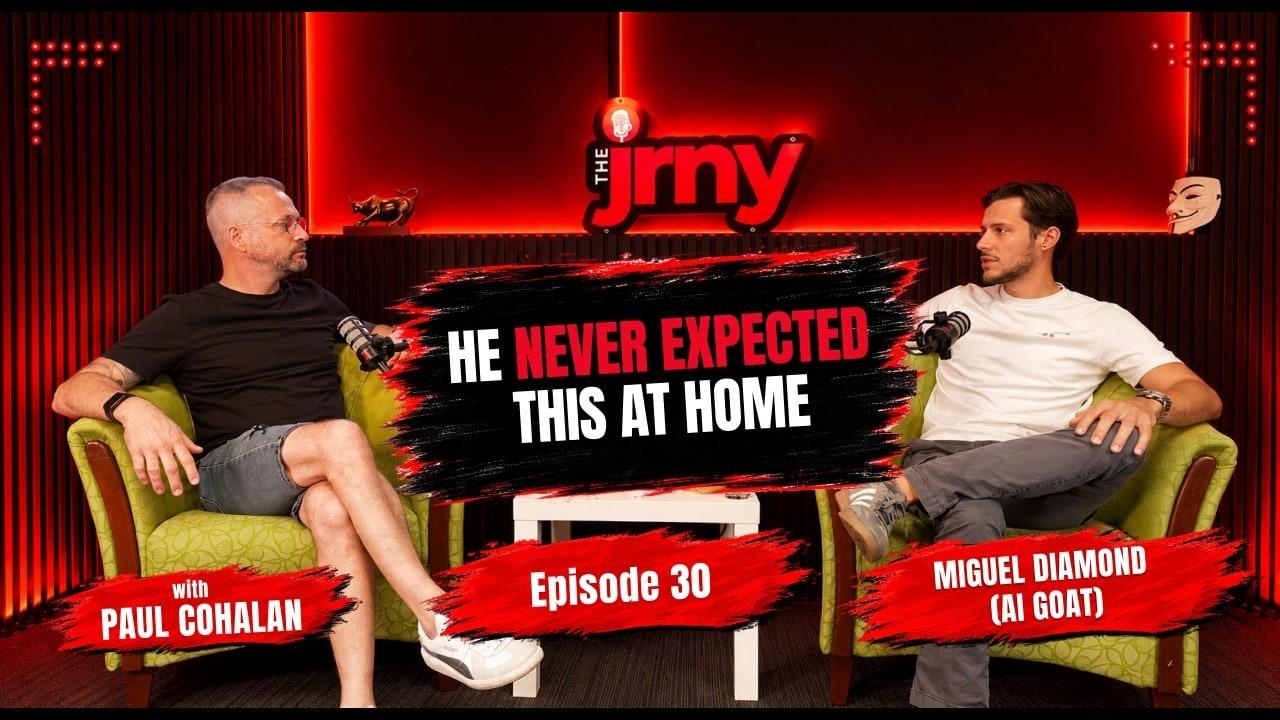
Meet Miguel Diamond
AI consultant from Porto, Portugal
Miguel Diamond is a 28 year old AI consultant from Porto in the north of Portugal, where he lives in Gaia. He grew up pulling apart toys and jailbreaking phones, learned Photoshop through photography, a passion he shares with his mother, and moved from social media content for businesses into web building in his late teens. He studied abroad in Lithuania, interned at a startup in Estonia, took a second degree in marketing and spent six or seven months in South America helping small businesses use digital tools. He went all in on AI about five years ago. Back home he and a small team build AI systems for businesses and teach Claude Code bootcamps, the second of which he ran in Australia, and his business has joined Anthropic's startup program. He now splits his time between Portugal and Perth, where he works on projects with Paul's mates Brad and Levi.
Episode summary
In episode 30 of The JRNY podcast, Paul Cohalan sits down with Miguel Diamond, a 28 year old AI consultant from Porto, Portugal, a few days before he flies home. Paul met him through two close mates, Levi and Brad, who Miguel has partnered with in Perth, and says Miguel has taught him a lot over the last few weeks. They start on motorbikes, which they only discovered five minutes earlier they have in common, then get into how fast AI is moving. Miguel's view is that you get more from acting fast on an idea than from trying to perfect it, and that iteration matters more than anything else. Paul adds his own rule: if it doesn't work, pivot quickly and don't dwell on it.
Miguel grew up in Porto, which he describes as the entrepreneurial side of Portugal. As a kid he pulled apart his RC cars and jailbroke phones, then fell for photography through his mother and taught himself Photoshop. Photography turned into social media work for businesses, then web building from 17 or 18, and about five years ago he went all in on AI. Some of the people who mentored him now work with him. He talks about leadership without hierarchy: after bosses who made people scared to speak up, he decided you can lead a team without ever being a boss. Paul shares his upside down org chart, how Jackson on his team told him to make the call on his own, and what it means after 11 years without anyone to bounce off.
On business, Miguel explains why his team doesn't sell subscriptions or quick quotes. They study a business first, its culture, its tools and its budget, and he is willing to lose a client who isn't the right fit. On AI, he argues that what AI produces is mostly generic, that humans are still needed to evaluate, create and decide where to step in, and that every business needs governance over how its people use AI. He describes his Claude Code bootcamp, four modules over two to four days, built so people who aren't developers can learn enough to orchestrate agents, and joining Anthropic's startup program. The conversation turns personal: his brother's barista business, his sister working as a chef in Copenhagen, his grandfather's last words, and the hardest decision he has made, leaving his family to come back to Australia last year. They finish on crypto, agents and smart contracts, and a plan to record a follow up in Portugal.
Key takeaways
Speed trumps perfection. Miguel's view is that you always get more from acting fast on an idea than from trying to perfect it first, and that iteration, how quickly you can put an idea into practice, matters more than anything else. Paul adds the other half: if the market doesn't buy it, pivot quickly. You have probably done most of the work already, and the idea may only need a small turn.
You can lead without being a boss. After working under bosses who made people scared to give an opinion, Miguel decided he never wanted to be one. He works with people on projects rather than as their boss, and hires for how people are with others, not only for technical skill. When people love what they do, he says, you don't have to act tough around them.
Understand the business before you quote. Miguel's team doesn't offer subscriptions, quick quotes or generic proposals. They look at the business first: its culture, what it does and why, the tools its people use every day, its budget and its timing. He would rather tell a client he isn't the right fit than take a job that won't hold up two months later.
AI is generic until your judgment goes into it. What AI produces is mostly generic, Miguel says, because it is built on everything on the internet. The value is in a system that works the way an experienced person would, with clear points where a human steps in to evaluate the output, and governance over how a team uses it. Before you can keep up with how fast AI moves, you need to know how the system will work with you.
Learn enough to orchestrate agents. His Claude Code bootcamp starts from the basics, what models, tokens and context windows are, then works through agents, agentic systems and harnesses over four modules. The aim isn't to turn everyone into a developer. It is to give a whole team the same base knowledge so they can direct agents and understand why a task takes as long as it does.
Make the call, then don't backpedal. Miguel's rule for hard decisions: if you decide to do it, do it, and don't keep questioning it afterwards, because second guessing wears down your trust in your own gut. Paul's version is to weigh the worst case before choosing, so that once you pick a path you can commit to it. You never find out what the other option would have done.
Resources mentioned
Transcript
Read the transcript
Miguel Diamond: One thing that it was hard and it was actually last year. This is actually one of the stories that I don't talk as much. And when I got to Portugal, when I actually surprised my family, my father had just discovered he was sick the day before and for some reason that I cannot justify or comprehend, I choose to go home in the moment that he needed the most. But that thing never left my head. The amount of coincidence at that time,.
Paul Cohalan: Trust your gut. There would have.
Miguel Diamond: Been.
Paul Cohalan: A bit of guilt. Bit of this.
Miguel Diamond: Yeah, a lot of guilt. A lot of guilt.
Paul Cohalan: So here we are, we've got Miguel Diamond from Portugal. He's just about to fly home in a couple of days. He's come over here to do a business deal as he's partnered with a few close mates of mine and which we'll get into. And 28, 29,.
Miguel Diamond: 28,.
Paul Cohalan: 28,.
Miguel Diamond: 1999.
Paul Cohalan: And only met him recently and we've had such a great time over the last few weeks and he's actually taught me a lot and I'm going to be a big sponge off this guy. He is in deep with AI, which we'll find out a bit about. But firstly, where do we start? Motorbikes. We just worked out.
Miguel Diamond: The.
Paul Cohalan: Whole time with nature. We haven't spoken. Motorbikes.
Miguel Diamond: One of the things we have in common. We just find out. Huh.
Paul Cohalan: And we just found out five minutes ago.
Miguel Diamond: Yeah.
Paul Cohalan: Talk to me. So what's the motorbike you just bought?
Miguel Diamond: Yeah, so I recently bought Tracer 900. It's one of the bikes I always.
Paul Cohalan: Enduro Adventurer.
Miguel Diamond: No, it's more like a touring bike. So it's one of those bikes you can do up to a thousand kilometers, you're going to feel comfortable, it's safe. Pretty good engine as well.
Paul Cohalan: Yep.
Miguel Diamond: I always been really a big fan of these bikes. Actually one year and a half while I was here in Perth, actually had one, but it was the 2012 Model.
Paul Cohalan: Y.
Miguel Diamond: So much less technology around.
Paul Cohalan: So.
Miguel Diamond: Still the Same engine but 12.
Paul Cohalan: Was it?
Miguel Diamond: Yeah.
Paul Cohalan: Yeah. That's a.
Miguel Diamond: Lot of mileage on top as well. It was 70k, I think so. It was,.
Paul Cohalan: Yeah.
Miguel Diamond: Had. Had come a long way.
Paul Cohalan: Same year as my Panigale Tricolore.
Miguel Diamond: Yeah, that's a different. Different breed.
Paul Cohalan: Yeah, they are, they are. So that was the year they revamped it from the 1198.
Miguel Diamond: Okay.
Paul Cohalan: Yeah, they ground up. Was wicked unreal. And I just went, my mate owns Ducati, he's coming on here soon actually in Perth and they just had the 100 year anniversary actually.
Miguel Diamond: Wow.
Paul Cohalan: Ducati. It was wicked. Went to it. It's about four.
Miguel Diamond: Weeks. A good experience.
Paul Cohalan: Yeah, it was unreal, man. It's. Ducati's come a long way. Also, another. Another thing on the weekend was the last race year at Phillip Island for the MotoGP for Australia. It's now going south Australia.
Miguel Diamond: All right, that's interesting.
Paul Cohalan: Yeah, I had a couple of mates go over. I was just watching it last night.
Miguel Diamond: Do you watch MotoGP?
Paul Cohalan: Oh, I used to, heaps. I watched a bit of it last night, but just time. I don't really.
Miguel Diamond: Yeah. Now and then go in the.
Paul Cohalan: Rabbit hole. Yeah,.
Miguel Diamond: Yeah.
Paul Cohalan: Otherwise you get caught up on it and then that ends up your window and. And. And you know what? Probably should now, because, you know, that's where you. You zone out. You know what I mean? Yeah. You follow your hobby or whatnot?
Miguel Diamond: Yeah. I mean, now and then it's good as well to just turn your head a little bit off. But the majority of the time, I guess there's not enough free time laying around to. Actually.
Paul Cohalan: So I got. I got married in 2012 in Croatia, as I told you, and I was waiting on the Panigale for then. But then when we got married in August, when we finished our honeymoon, we traveled to Budapest, Prague, and I went to Brno to the MotoGP, and then we kept traveling everywhere and we ended up in Bologna and went to the Ducati factory on the honeymoon trip, which was wicked.
Miguel Diamond: Beautiful. Must be an amazing experience.
Paul Cohalan: Oh, it was unreal. Yeah. Like. Yeah, the European MotoGP is next level.
Miguel Diamond: Do you enjoy Europe?
Paul Cohalan: Love it. You've.
Miguel Diamond: Been there recently or.
Paul Cohalan: I haven't been. I don't think I've been since 2017 when we took the kids back. Yeah. I hear there's another trip coming up sometime soon.
Miguel Diamond: Yeah, I hope so. I hope so. You gotta. You gotta experience again the European summer.
Paul Cohalan: Yes.
Miguel Diamond: Make sure you come in the warm months of the year, so. Why? Winter is way too rainy and foggy. Not the best experience.
Paul Cohalan: So what's. How's your trip been over here?
Miguel Diamond: Amazing, actually. It's been really good because I feel like, I don't know, in the five weeks, six weeks I've been here, I've been able to experience so much and to know you, and to know as well, other business partners and again, just feeling that I. That I'm part of something, you know, because we can. We all have our journeys, but I think that once we.
Paul Cohalan: Journeys. Journey,.
Miguel Diamond: Journey. Once we. Once we allow ourselves to understand that our journey will be Always crossing path with, with others. Then it's become something bigger, you know, and that's something that I think helps each one of us just get to the, to the goals we want. And once we realize that, then it's just the beginning, you know.
Paul Cohalan: Yeah.
Miguel Diamond: So I think especially comparing to the last year when I was here, I mean, I was here for longer, but I was meeting, meeting all these people in a more day to day thing. But I feel these last four weeks were on steroids in that sense. And yeah, I mean, I feel really lucky to be around. It's the thing that I always try to humble myself just to look around and to. And to enjoy the moment.
Paul Cohalan: I learned a bit with you being here. And I had nothing to do with you coming here, obviously, but I've always wanted to think what we could do outside, like not with you, just me in general, insurance is hard to do internationally. The next thing that really pushed me a bit more international was the podcast. Because why I really like starting the podcast was there's no limit. And I've had a Canadian guy on, like I've had like a couple of people that have been on here, they travel and their followers. A lot of it's us. So it's really cool. There's no limits with it. Right. Which is really cool. And then obviously you coming on. But the work piece, I've learned a lot about the work piece. Like, you know, you're from Portugal, you're doing the whole AI piece. And you know, Levi and Brad have told me a lot about that. But now just understanding that how the crossover, like 20, 26, man, like you can do anything. There's no limits. And that's pretty exciting. Imagine the next five, 10 years. And I think me and you spoke about this at Varnish the other night. Like we're talking later. We're like, the most exciting thing is what we don't even know yet. It's like imagine five years where the we are.
Miguel Diamond: Yeah. And that's the thing because I think that even if we are aware or we try to be aware of how fast things are happening right now, the compounding effect is something that no other human in history has actually experienced. So we tend to look back and to see how people build our own businesses and technological advancements, the web and all these things that happen that change the world.
Paul Cohalan: Yeah.
Miguel Diamond: And we try to compare with what is happening right now, but the reality is that the compounding effect is much higher, you know. Oh,.
Paul Cohalan: I think so.
Miguel Diamond: We look at the future and obviously it's we focus in whatever we're doing every day just to make something different and actually useful. But even if we try to be aware, we'll always miss the point that this is leveraging so fast, compounding so fast that it's really hard to predict next month. So imagine predicting next year, you know, and that's, that's what really excites me in this. In this, this era, let's say.
Paul Cohalan: And it was like. And it was part of the question I had for you the whole time you were here, and we only actually chatted about it the other day. And it was like, you know, Levi's told me, you know, Miguel is unreal. He's like a magician with this stuff. And, and, and there's a few reasons for this. Like, just to go back a step, I think five years ago, five and a half years ago. Like, you're like, that's it. All in on AI that we. We hadn't even really heard of it yet. Right? As in, like, getting in the trenches of it. And I'm like, why is, why is this Miguel? What's he doing different? How do you do something different when things are emerging so fast? There's billions of dollars getting spent out there. And it was really cool. And just the way your brain works and what you were telling the other night is absolutely amazing, which is really cool. But that's also the cool thing. It's like, I think as long as you don't get stuck, it's like doing a business plan 20 years ago, you know, it's like people get stuck on it and they sit on it for eight. You can't. You haven't got time to do that. It's like, what problem are we solving? What are we doing different? Or even if we're doing it the same as everyone else or similar, let's just go. And don't look back. Windscreens, begin. The rear view mirror, like, just keep going. You know what I mean? And I think that's what all the biggest tier one AI companies are doing it now, let's be honest. They're all similar and they're all jumping like this. It's like it's a race. I.
Miguel Diamond: Think it comes down at this point of how fast people act and groups of people act on a specific idea. You know, I always thought the idea, this idea really interesting, which is. It's always more. You always have more benefit from acting on something fast than trying to perfect it. Since the beginning.
Paul Cohalan: Trumps perfection, man.
Miguel Diamond: And I think that's that's something that's been true for a long time, you know, but now more than ever, it's, it's clear, you know, and we see that because, I mean, in this right now we're seeing that the market and the consumer is really focused on fast consumption. And I think that's was, I don't know, really powered and leveraged by social media. Absolutely. Because we now see the forms of content that people actually are looking for, but then it reflects to any other parts of the business. You know, that's why. And something I learned, especially from Devin since early, is that iteration is actually much more important than anything else, which is how fast can we actually put an idea into practice? And nowadays, I mean, we're living in the coding era more than ever. And so I think it's something that's common in every pillar of a business. You know, how fast you can make one idea happen.
Paul Cohalan: Yeah.
Miguel Diamond: Rather than just focusing on doing it perfectly. Since the beginning.
Paul Cohalan: And, and I reckon to add to that, and this has been the case, but now you've got to be, this is why you gotta be a quick thinker and you've gotta be all over it, right. And you've got to think different is you might, you might put it to market or you know, get it, get the idea happening. But if it's not gonna work, fail, pivot, try again, but do that quick. Like don't dwell on it because, oh shit, my idea didn't work, or it's not, or you know, like the market didn't buy it. It's like, okay, pivot, because you're not losing just because it didn't work. You've probably done 80 of the work and the idea could just be here. You just got to pivot that much. Do you know what I mean? Because the market drives everything, right?
Miguel Diamond: Yeah, absolutely, absolutely.
Paul Cohalan: I, I think our generation, well, I say my generation, but all our generation and where we're at at the moment, I reckon we're so lucky, I reckon we're just in such a fast paced shift. And I'm talking, I'm not just talking tech, I'm talking like even mental health, even mindset, even like upbringing, family, like being humans, evolving, like having kids, just everything is fast paced now. But it's because information's so transparent, right. So we can either dwell on it and go that, you know we're gonna lose jobs or it's too fast or whatnot, or grab a hold of it and leverage it and adopt it. You know what I mean? Yeah.
Miguel Diamond: It's super. Everything moves faster than.
Paul Cohalan: So. So let's talk about you and upbringing because you're 28. He's younger than I am. And so where were you born?
Miguel Diamond: So I was born in Porto. So it's, I would say, the second biggest city in Portugal.
Paul Cohalan: Portal, how do you spell that, man?
Miguel Diamond: So P O R.
Paul Cohalan: Yep.
Miguel Diamond: T O.
Paul Cohalan: Porto. Porto. Porto. Yep.
Miguel Diamond: It's pretty much on the opposite side. I wouldn't say the opposite, but Porto is just the north of Portugal, right up there. And then we have Lisbon a little bit south from center, which is obviously much bigger. And that's where the majority of things happen.
Paul Cohalan: Yeah.
Miguel Diamond: But it's really interesting because the north side of the country has been recognized since early stages as the entrepreneur side. So it's something that we have in our DNA and usually find a lot of business owners just establishing, establishing business there rather than the capital. And that's something I think I got with a kid, you know. Sure.
Paul Cohalan: That little hub is it. Yeah. Entrepreneur hub, Porto.
Miguel Diamond: Yeah. Very industrial parts as well. And I think overall, and it's something that it's more related to the country rather than the city. But Portuguese people in terms of culture are very like hustle culture. And so we always like to do different stuff. We're a little country, small country, but with. With really strong desire to do things differently, you know, and, and yeah, so I was born there, always lived there.
Paul Cohalan: What was like, what was the first 10 years like for you? Growing up? School.
Miguel Diamond: Yeah, just normal life as a kid.
Paul Cohalan: You're always into tech? Always like.
Miguel Diamond: Yeah, I mean, when I was really, really young kid, I know I. I had the, I don't know, the curiosity of knowing how things work. I was always deconstructing wherever I. I was having. Have new toys. So if me.
Paul Cohalan: Too,.
Miguel Diamond: Like a new, I don't know, RC car or anything that would you.
Paul Cohalan: Pull it apart and pull the.
Miguel Diamond: Motors out, mess it up like 99%. Yeah. You know,.
Paul Cohalan: I don't know, I'd get my ass kicked and I think when I got older my parents just let it go. Yeah. But even computers back then, like you probably wouldn't even see them, but I used to just pull them apart. I remember at a country school, I remember I'd self teach how to use a computer and like you'd be showing teachers and I'm like, I'm a kid but like I remember an art, I remember the talk, you know, the chat. I just always picked it up.
Miguel Diamond: Yeah. And yeah, I mean it started with that and eventually I think I got my first phone and computer probably when I went to fifth grade and from there.
Paul Cohalan: So what's that, 10 year old?
Miguel Diamond: Yeah. I think around the mobile was not, was not like the smartphones we have now. Usual Nokia we had at the time placing music. So it was not something that allowed me to explore a lot. But then eventually with the computers and the first Android devices coming, I realized that I was doing really cool stuff. I was jailbreaking phones, I was going on YouTube videos and realizing how could I do something differently? Get some free games that I was supposed to pay for, you know, So I was since the beginning and even with gaming and video games, I was trying to do things differently, you know, and I think that allowed me to be comfortable around technology.
Paul Cohalan: Yes.
Miguel Diamond: Yeah.
Paul Cohalan: Think outside the box.
Miguel Diamond: Yeah. But I think that the journey was not as much as a straight line because eventually I fell in love with photography because my mother as well was really into photography since I was a kid. And so that eventually it gave me the. Put me the necessity of being able to use, for example, Photoshop.
Paul Cohalan: Yes.
Miguel Diamond: And so that's the exact stage where I actually get comfortable around computers. And I soon realized that I was learning things really fast. Not something specific, but I was dominating how the software works. How could I find specific forums online to go around and get this version and update and do different stuff.
Paul Cohalan: With photography? Was that at school?
Miguel Diamond: No, was something that I.
Paul Cohalan: Separate.
Miguel Diamond: Separate. Yeah. So I always learned things by myself a lot, especially because after, when I went to the 10th grade so to college, I think I went on a course was related to science and so it was something that didn't, didn't captivate me too much. So I ended up just using my free time to do whatever I, I thought it was interesting. And it was mainly computing and digital things. And that's where it all started.
Paul Cohalan: Yeah. Yeah. Wow. So what are you now? You're 28, so go back five. So 20. You were 23 when you started to dip your toe in the AI piece, right?
Miguel Diamond: Yeah, yeah, I mean I was much so how I got into AI is actually really curious because as I say, I really started in photography. So I started doing a lot of. I started supporting a lot of businesses doing social media management. So I was actually taking the video and producing the content for them to, to use on clients. And eventually I realized that I liked photography when I did it on my own. So I was not being paid to do it.
Paul Cohalan: Yeah, yeah.
Miguel Diamond: I kind of lost the energy for it when I realized I was being paid to do Something I didn't want to do in a specific way. And from there, I just started on web building. And so since 17, 18, it was very clear that I had this vein on the technological side. And then, honestly, I just had the luck to meet the right people at the right time and be mentored by people that still walk in this journey with me. And that's how I.
Paul Cohalan: Hear a cool little comment you told me on the night that some of the guys that mentored you now work with you.
Miguel Diamond: And that's something I. I really value. Because obviously I'm. I always treat. I'm always a really humble person.
Paul Cohalan: Yes.
Miguel Diamond: And the fact that I managed to learn from people, and since the beginning, they also learn from me.
Paul Cohalan: Yep.
Miguel Diamond: And don't have the fear to speak out just because their ego would make them.
Paul Cohalan: Yeah.
Miguel Diamond: You know, and so that made me realize I really. I'm really lucky to have good people around and right now continuously, like, learning from each other. And I think that's something really, really healthy, you know,.
Paul Cohalan: And that's a credit to you, man. Like, especially at 28, like, and doing really well at what you do, especially this topic, which is probably the number one topic in the world. And not to get that ego in the way, you know, have that great relationship and have these guys that want to follow you. Because when people do that, it won't be just for money. It'll be because they want to work for you. And that's amazing leadership and culture.
Miguel Diamond: Yeah. And because, like, absolutely. And because we share the culture that we all love, what we do. And obviously we. We need to. We need to have money to pay for expenses and stuff. So at the end of the day, obviously, everyone works for money, but the vision itself, it's much bigger than that, you know, and so since the beginning, we. We fell in love with this. And so when you fell in love with something, you don't actually see it as.
Paul Cohalan: A job.
Miguel Diamond: A job. And so the sacrifice would be just the amount of time that you spend doing stuff and maybe some personal moments or some joy moments that you, I don't know, lose with family and friends because you're actually focused on something.
Paul Cohalan: Sacrifice.
Miguel Diamond: Yeah. But at the end of the day, because we like this so much, what remains on top of our heads is when we want to walk further and closer to our vision, you know, and that's something that we share between. Between each other.
Paul Cohalan: You've got to be a bit delusional. Yeah,.
Miguel Diamond: Absolutely.
Paul Cohalan: And.
Miguel Diamond: When.
Paul Cohalan: You're a bit delusional and you're Passionate, and you love what you do. You will sacrifice and. Yeah, and you will. You go through hard times because everyone will be like this against you, whether it's family, friends, or you'll miss out. And it doesn't mean you don't feel it, but it's probably the only way to get there and be different to everyone else and be that 0.01%, you know,.
Miguel Diamond: 100%.
Paul Cohalan: I always say that. I think the reason. You gotta love what you do, and you really gotta. It's not the easy days. It's not the wins. It's not the high fives. Everyone can have a win, win a client, you know, get some money in, but it's like to get through the hard days when you're laying on the floor and there's no one around, you're like, what am I doing wrong? You question yourself. You're about to give up. You're like, should have done something different.
Miguel Diamond: Especially, Especially when there's no one that can give you the answer you're looking for. You know, I think the hardest decisions. Yeah, the hardest decisions I had to. To take were precisely the ones that absolutely no one could tell me if I was doing it wrong or correctly. And I would.
Paul Cohalan: And you wouldn't have listened anyway.
Miguel Diamond: Yeah. And I would even say that if I took the opportunity to ask some people or try to convince them about what I was doing, I wouldn't get the validation that. That I needed. So you need to. You need to go really deep on yourself and just do something because you believe and eventually, eventually you, you realize that you made the, the best decision, you know, and that's, that's the, that's the, the hard part that people now and then just don't acknowledge, especially from people that, I don't know, just work the usual 9 to 5, and they don't have this entrepreneur vein is that they see the life of, I don't know, a business person, and they fail to realize the amount of sacrifice and hard moments that someone needs to go through to stick to his own ideas. Because, I mean, some things you just need to do it yourself before others actually believe in it. You need to.
Paul Cohalan: Believe. I love you say that. Yeah. Because on the outside, usually when you're making it look good on the outside, and I've done it a bit lately, actually, just going through a couple of hard things. It's like. Because deep down you kind of gotta, you gotta, you gotta make it seem okay because you're really dealing with it in here. But as long as you're dealing with the way you've got to deal with it. And then, and then you gotta stop and you've gotta at it and you've got to make a decision. Right. And that could take 10 minutes, could take an hour, could take a day or a week. And I've literally laid on the floor. Only 12 months ago, I actually laid on the floor and I'm like, what do I do? What am I doing wrong? You know? And you start second guessing yourself and you're like, it's one thing I don't do is I back myself and I don't second guess. So give it a couple hours and shut the, and dig your heels in and let's go.
Miguel Diamond: Yeah, once someone, I can't remember who told me this, but it was really interesting, which is whenever you're having a hard time just, I don't know, making a decision at the end of the day, either if you do it or don't, just stick to it.
Paul Cohalan: And you don't know the other way.
Miguel Diamond: So if you don't do it, don't do it. If you do it, do it. But don't question after you do it back yourself because this is a funny word I learned just on Friday with you backpedaling.
Paul Cohalan: Oh, backpedaling.
Miguel Diamond: Because once you start doing, especially with yourself, then you're just wasting your time.
Paul Cohalan: Yeah.
Miguel Diamond: Because if you make the decision, okay, I need to make a decision, I'm not sure. But wherever I decide to do, that's what I'm going to do. I'm not going to be thinking about.
Paul Cohalan: Don't backpedal. Because then you, you know, you're losing your confidence. You. And you know, if you're gonna go in, go in.
Miguel Diamond: Yeah. Because every time you do it, you're slowly, slowly, slowly getting used to kind of not respect yourself in the sense.
Paul Cohalan: That.
Miguel Diamond: Your gut feeling, I mean, maybe, maybe this sounds, can, can sound a little bit, I don't know, cocky. But that's something I share with my brother, especially because he's starting his own business as well. Which is, if I look back, I think there wasn't one time that I felt like that my gut feeling was not right on something.
Paul Cohalan: Never.
Miguel Diamond: I'm not saying some, I'm not, I'm not saying all the things went good. What I'm saying is that the instinct, it.
Paul Cohalan: Still worked out.
Miguel Diamond: The urge to do something and something that especially no one can comprehend. I'll always stick to my gut feeling because it's something that we can't. Intuition.
Paul Cohalan: I trust my gut Heaps. And there's actually a lot around that I haven't gone down the rabbit hole with it. I just stick. Cause otherwise, you know, you think about it too much. But I'm like, just back yourself. But even your gut, like, even on something that might not be right, it's like, fuck. And I think me, you and Brad spoke about it the other night. I said to Brad, and I won't go into what it was. It's a me and Brad conversation. But I'm like, it was my gut and it put me off something. You know, we spoke about it and I'm cool with it. Look, and this was. We're talking years ago and like, look where we are now. It's cool, right? And if you pick A or B and you go B, you never know what A was gonna do. You might go, the grass was greener. You don't.
Miguel Diamond: Know.
Paul Cohalan: Just shut the. And go with B. You know what I mean?
Miguel Diamond: Yeah. And then especially because once we make a decision, and then obviously that has different effects, good and bad, we have that tendency to look, well, maybe if I made X, Y or Z, then I would be in this position or that position. And that's something that we actually shouldn't do because it wouldn't be that way.
Paul Cohalan: So. So when you make a decision, right, I. I love this because I'm like, people don't think I've got patience. I've got a lot of patience, but I usually do a lot of it before I speak up, believe it or not. But I'm like, I'm usually looking five steps ahead. I was trying to explain to actually Nat, my EA and her partner in Melbourne. I'm like, you don't realize how much I analyze everything, even after the fact. I'll go down the rabbit hole with like, I can't even explain. Like, it actually sounds weird and it didn't sound right. But I'll be like. Because what I'll be doing is like, I might be picking A, you might pick B. Say you come to me with a problem, but I'll also have C and D up my sleeve. Because it's like, worst case. And what am I willing to cop? Whether it's business, personal, my kids, fitness, like, not doing something, doing something. Like, I'll actually be looking at D when me and you will be only looking at A and B. And it's like. And the reason you've got to do that in my. And I do that in my head because it's worst case. And usually if it's Client related. I don't want to a client. But it's what I'm willing to do. It's what I'm willing to cop. Whether it's integrity, values, loyalty, or just your values. And sometimes you do push the boundaries of them. Right. But there'll be reasons. So you're doing it risk versus reward. Right. And I've nearly already made them decisions. So if a doesn't work, I'll be okay, cool. Cause this is the path we're gonna go down. Cause if you've already done that, that backs up what me and you were saying before about just pick one and go. Cause you should have already done that in your head. The risk. That's probably the point I'm trying to make. Some people don't do that. Like I read the room, I read the room as soon as I walk in and it's like. And then you're gonna make a decision. I'm like already three steps ahead in my head where it is. But then the good thing is, is being open minded and getting someone else's view because. And that's the great thing about having different strengths in the room as well. You know what I mean? Like we spoke about this the other night about how cool it is to have everyone's at a different point because you don't know what you don't know and you only see it from your perspective. Right?
Miguel Diamond: Yeah. And once you have different ones, you question things.
Paul Cohalan: And how powerful is that also when it gels, you know what I mean?
Miguel Diamond: No, it's really interesting.
Paul Cohalan: And don't be yes. People don't just say yes to you because I don't upset you. It's like, shouldn't be personal. But you know, whatever you decide, talk business. It's like, nah, Miguel, I fucking, I wouldn't do it like that. Why? And you'd be like, oh, because. Oh, okay. Do you know what I mean?
Miguel Diamond: Yeah. Just being open to, you know, to question yourself and others and actually change your mind regarding a specific thing. Especially because nowadays I think, I don't know, I think we can see this happening in like politicians and politics and stuff, which is it's either left or right, it's either black or white, it's either good or bad. And so the majority of the time we see that, I don't know, just a human being has this huge tendency to say it's either one or the other, you know. But then in a room full of people that actually know how to engage and discuss, you realize that it's somewhere in between. It.
Paul Cohalan: Is always in between.
Miguel Diamond: That supplies to relationships as well. Either if it's business relationships or personal relationships, because maybe you really value a specific client or a specific friendship and you realize that you can have different opinions, but you're going to find the midpoint in between, you know, and you're going to make it work for both sides. And that's something that a lot of people are not willing to do because they hurt their ego in the sense that. Oh, but I said publicly that I believe A was the option and now I'm stepping back and saying this. And so I think the ability,.
Paul Cohalan: What someone thinks.
Miguel Diamond: Yeah, exactly.
Paul Cohalan: Usually. Yeah.
Miguel Diamond: And so I think it's really important to, just to, to be sure that we're open to do it because then it's just always, always ends in something better and bigger than sticking to your own ideas and just believing one thing or the other.
Paul Cohalan: So I used to work with Brad and Levi years and years ago. Right. And we, we've always stayed friends, we parted ways, whatever. Then me and Levi become good mates again. Not that we weren't, but, you know, you go in and out with people and then he's like, hey, we should come back in and have a bit of a JV or a business venture, which we have.
Miguel Diamond: Yeah.
Paul Cohalan: And it's like. And going back to what you're saying, like, if I was pigheaded, we probably wouldn't be sitting here. Right. But I was also very staunch because I'm pretty close knit what I do now because of other, other people, not cause of them boys.
Miguel Diamond: Yeah.
Paul Cohalan: And me and Levi are in the. What do you call it, Sauna and half naked too, by the way. No. And we're talking and he's like, man, honestly, this is kind of my business model now. I'd really like us to do that. He goes, I will shift a bit if I have to, I'll do it my own. Like, he'll not go against his values with Brad now, but we'll just structure it different so it still works the same. And then, and in the end I'm like, that was really credible from him. Right. Because I was pretty staunch on my thoughts and, and over time, me and Brad spoke about this the other day and I'm like, I couldn't be happier where we're at and you guys are the experts, like, make it happen. Like, and it's just once again, you know, I didn't care what anyone said. Like, it's not like Levi's coming up going, told you so or you Know what I mean? Like, I was just really grateful that he pushed me that extra bit, and I'm like, yeah, you know, so it was a great outcome, and we're only crossing the starting line, right?
Miguel Diamond: That's awesome, because that's the starting point of a relationship that holds to so much more. Yeah,.
Paul Cohalan: Yeah, yeah.
Miguel Diamond: That's one of the, One of the best things about it, you know?
Paul Cohalan: Yeah. So pull them guys aside. I know a bit about what you guys are doing, but talking about teams and culture and leadership and bouncing off people. Tell us a bit about yourself or as much as you want to. When are you. Yeah, don't worry. It's a new podcast. It's not that much of a following.
Miguel Diamond: No, no, no, that's all good. All good. You know, I always, I, I,.
Paul Cohalan: It's exciting.
Miguel Diamond: For me, obviously. I started working really, really early as a young kid, and leadership has been always something that I question a lot.
Paul Cohalan: Yeah.
Miguel Diamond: And for a while, because I did, I did. I did corporates for, for. For quite a bit as well. You.
Paul Cohalan: Done more.
Miguel Diamond: Corporate jobs?
Paul Cohalan: Yep.
Miguel Diamond: And so I always question leadership a lot in the sense of how they usually work, you know, and so I had, I had this, this idea for a long time, especially in Portugal, but that's mainly related to the working culture we have, that the majority of leadership is not done correctly, you know, because it makes, it makes people feel the. It makes people feel the hierarchy from, from jobs. So I'm your boss, your employee, and I have my own boss. And people tend to. To play a hard effect on that on the other day. And so when you're a good leader, you don't need to enforce that into people. You don't need to say, I'm your boss, so you're gonna do this or.
Paul Cohalan: Hide away,.
Miguel Diamond: Boss. It's been, it's been, it's been a long journey for me to realize because I always said, I don't want to be a boss. You know, I don't want it to be. I don't want to be something that's, I don't know, terrorizing or stressing others and making them unhappy and making them, I don't know, scary of coming out and telling their own opinion. Because I suffer from that for a while. You know, I had, I had people being my bosses that were in good leaderships. And so at some point, I realized that you can be a leader and you don't need to be a boss, and you can have a business, you can have people working with you, and you will never want to be a boss. And you don't need to be a boss because it comes to the culture that you're trying to cultivate and it comes to the person as you are in terms of a human being, you know, and it applies in personal life as well.
Paul Cohalan: Yep.
Miguel Diamond: Because you can be a leader without owning something or, I don't know, ruling people or being the last word on every conversation, you know. And so once I realized that, it was really awesome for me because I realized that I could have a great teams beside me and I would never need to be a boss or be people or make. Make people do whatever I want them to do. And that comes down to work culture. And that's something that I really appreciate, especially in the, with Brad and Levi and the working culture they have, because even you don't see that happening. You know, you don't have that toxic environment where people are scared to give their opinions or they're scared to leave the office a little bit early because they have, I don't know, a personal appointment or something at the end of the day that gives space, gives a lot of space to people to do what they want because they love it. And that just enhances the creativity you're willing to put into things, you know, and that's, that's really interesting. And so what I'm doing right now and what I'm, what I'm developing in my own journey, especially back home with, with Nortex, is specifically reds. Because. Because sometimes people come to me and say, oh, I saw that you have these guys working, working on these projects. Are they are your employees? And I'm like, no, my employees, we work in projects together. And they're like, oh, but do they own the business? And I'm like, no, but they don't need to. They don't need to because one thing is the business and another thing is persons and projects and I don't know the vision each one has. So whenever I look around and I see the people that I have working with, with me, it's amazing because they're living their own lives, they're passionate about what they do. I don't need to be worried about not them putting the effort that they need to do because there's not a pressure to do it, you know, and that comes down to having good people around. And that's, that's something I think the majority of agencies and businesses end up failing, which is they hire more towards what the individual has in technical expertise rather than the way of them being too to others. You Know, and I think once you unblock that, then you're just releasing a huge amount of stress from your life because you don't need to, you need to act tough, you know, around. Around people.
Paul Cohalan: Yeah. And that's.
Miguel Diamond: Something I value.
Paul Cohalan: And I think when all that's out the door, what you were just saying, usually it's ego.
Miguel Diamond: Yeah.
Paul Cohalan: And you know, some people don't know what they don't know, but I'm like, there's two sides of it. There's ego, there's holding, controlling too much. There's also not having expectation of line in the sand, too much rope. And finding that balance and learning that over the journey over the last 10, 20 years has been a challenge. So I was navy, so I worked on farms and stuff when I was younger over in Victoria Tobacco actually, before they cut it out of Australia. And then I was butcher when I was a kid and that. And then, you know, joined, went to Tasmania, joined the navy, come over here and then went into mining and then corporate manufacturing equipment, all that kind of stuff. Transportation basically ended up here. Long story, but I'm so glad I did. I'd done all that stuff and I learned all the different ways of leadership. Boss, all that stuff. I think I don't want to be big brother. I want to give people enough rope. But you need to give them expectation because we're human.
Miguel Diamond: Yeah. Just.
Paul Cohalan: Because what I think. Well, you know, you should know that because. No, no, you've got to make things clear. Communication. Communication comes down to communication. Right. You know, to speak to people like this and you know, I can be a bull at times and sometimes you probably speak out of line. But what do you do after that? You go back and you realize it's self reflect as well. Right. Everyone's far from perfect.
Miguel Diamond: Absolutely.
Paul Cohalan: I do it with my kids. I'm like, do you want me to be a dad and pull rank or do we just want to have a level conversation and we get the shit done and then we can go and have fun? And they're like, all right, dad. So even having that. Cause obviously I'm the dad, I can pull rank. It's the same at work.
Miguel Diamond: Yeah, absolutely.
Paul Cohalan: I'll be like, to Nat or Jackson, be like, I'm pulling rank on this. It might be a joke or some things. We're like, guys, we're not doing that. And usually it's like. And I let everyone do what they're gonna do. As long as it's gonna be 80% or more, I'll be like, just don't the client or the business.
Miguel Diamond: Yep.
Paul Cohalan: Otherwise go to it, come back and let me know whether my idea or your idea was better or you know, what worked and didn't work. You know what I mean? And I don't mean in competition. I mean like come back and tell me I told you so poor. I love, I love it when.
Miguel Diamond: And it comes down to the thing that he told in the beginning which is just being aware and breathing the room. Right? Yeah. I think there's a moment for everything, you know.
Paul Cohalan: So my team, like Jackson will come to me and like I work for him now. I got an upside down org chart. So I'm like, I love working for them. He's like, can you do this for me? I'm like, love to. It's great. And then he'll come bounce off me something serious and I'll be like, okay, what do you recommend? Like this is not just my choice. Now do you want to do we bring that in as well and we have a three way like and we'll bounce off different ideas. And I know there was something the other week and they're like, whatever you want to do, Paul. And this, this here locked me in for business partner. Right. And Jackson goes, Paul, tomorrow morning you're going to make a decision on your own because you're going to be by yourself. Whatever you go with, whether it's what we thought you thought or the third person thought, we're all back on whatever decision you make anyway. Now that was game changing for me because it didn't matter what I picked on the spot. They trusted what I was going to say and I do the same for them. Cause they're like whatever you reckon. I'm like, no, no, I need your view because for about 11 years I haven't had anyone really to bounce off. I've gone hard by myself. Right. Like my wife is at home, et cetera, et cetera. She didn't, wasn't in the business. So it wasn't like you had a business partner and they had a bounce off. And now having a couple of people there that to be honest I've handed more over to,.
Miguel Diamond: It's.
Paul Cohalan: Great.
Miguel Diamond: It is. Because it takes a little bit of the. Even.
Paul Cohalan: Though they'll look up to me and I'm like, guys, you have no idea how good it feels just to bounce off someone.
Miguel Diamond: And it spreads a little bit, the stress and you know, all this, I don't know, shoulders weight we carry. Sometimes when you have to deal with something and you can spread a little bit with others. And that's.
Paul Cohalan: The last two weeks they have been there, silently checked on me and they know the two things I've been working on and it's been hard deep down and. But it's just like you can just tell the gel and I'm like, it's us three. That's it. Because when you've got that empathy and you can understand and, and nothing's a problem, you know what I mean? Like, it's not like, oh, Paul, you know this or.
Miguel Diamond: Oh, that's.
Paul Cohalan: Yeah, it's good, it's really good. And to have someone to bounce off. So awesome. So like going back to you, kicking your team off, where's your vision the next five years besides taking on the world?
Miguel Diamond: You know, it's really. I think we. Once again, I find myself coming to this topic a lot recently, but I think we live in a time and space where in general, in general people value a lot what's trending at the moment. So we live in the fast consumption environment where people just want to know what's trending now, what's working now and tomorrow it changes. And so what we see is that either so businesses end up building on that specific vision itself. So we're building something that needs to work for the next six months or a year. And so business models tend to, tend to work on top of that a lot. But I never enjoyed that idea because then it comes down to making money. Because vision is not something you do for a while. You know, normally vision or the, the definition of vision to me is something that holds up along my journey, you know, and that's something really hard, especially when you're talking about tech because tech changes every day, you know. And I, in my, my, my, my opinion, my take about that, it comes, it doesn't come down to the tech or the technology. It comes to the purpose of what you're doing and how you're doing it, the values and the principles that you're using. Because I don't know especially I think with Web and with SaaS era coming to, I wouldn't say an end, but to a time of change and especially about what's IP and who owns what. We're getting to a time that people value transparency the output they get and on top of all that the relationship they have with the specific groups of individual and Nortex comes about that which is expertise having the, having the pursuit of always knowing the best and trying to know what's trending on the market. So we can advise with a neutral decision because especially in Portugal, and I know the Portuguese market a lot, we see agencies being paid to promote specific tools. And I experienced that a lot with E Commerce and with new tools like Shopify at the time coming in the market. And we realized that a big part of them, they actually work in that specific business model, which is they actually pay and hire agencies to promote their, their, their, their, their solution. And I'm not saying the solution is bad, but the solution is not made for everyone. And when you assume that you can put someone just selling them to everyone because they're getting a take, if they sell it, then you're missing the point, which is you're not building a relationship.
Paul Cohalan: White labeling or selling.
Miguel Diamond: Yeah, either, either one of them, you know, either one of them. Because at the end of the day, if you're selling because you're getting a commission, then you're running the risk of just selling because they're making money and not selling because not.
Paul Cohalan: The real value. Yep.
Miguel Diamond: And, and so with Nortex and especially with the team that we have, we focus on having really high expertise in the technical, the more deep technical parts. But at the end of the day, don't propose and don't provide client generic decks or generic proposals because it's not going to solve a problem, you know, it's going to solve the DEC and the presentation, but then it stops there, you know. So we do a joke which is in the majority of the proposals we see around agencies throwing at clients, their peak moments is in the last deck of the slide. And so.
Paul Cohalan: It's.
Miguel Diamond: All good until you have to put in practice because then, then usually it goes, it goes downhill. I'm not saying it wouldn't, it's not going to work. But the highest peak was the last deck of the slide, you know, because it was meant to impress. But at the end of the day we see that the stack decision was not neutral or was not the best. And so our idea, and that's why we don't offer subscriptions or we don't offer quick quotes or I don't know, forms that give you expected quotes on a service. We analyze the business first, we analyze the culture, what they do, why they do it, industry. And on top of that we will deliver that to the clients in terms of what we think your business stands in terms of technological stack. And from there we, we, we actually propose either, I don't know, a study on, or investigation on whether if it fits the market, doesn't fit the markets, what's your budgets, what's Your needs, how do your employees work with what tools they use every day? And so it comes down to actually taking time, having a small team that can focus on a specific client and not trying to scale just by the sake of scaling, you know.
Paul Cohalan: Yeah.
Miguel Diamond: And I think that's something that we, we add a lot as a culture from the team, which is we, we want to feel close to the clients to provide that, let's say, tailored solution.
Paul Cohalan: And you know what's hard about that? Right. And it's a credit to you is when people say that like from a business owner's point, it's longer winded, it's gonna take longer, you get outlay, more money usually. Right. So from a business owner, all that stuff you say, but the quality and the output's gonna be way better. Right. But there's a long road there. So it's not a transaction, it's not a numbers game. It's not like, let's try and get all these clients on it. It's like you want, you know, the really good partnership longer term. Correct me if I'm wrong. Yeah,.
Miguel Diamond: No, no, absolutely. And it's something that at the end of the day, you're cultivating what, what you like. So if you, if you're looking to sell quick and fast and scale, eventually you realize that the majority of the client relationships that you build will not hold up. You.
Paul Cohalan: Have churn anyway. Yeah.
Miguel Diamond: Because either people are looking just for the best work, some people are just looking for the cheapest option, some people are looking for the fastest one. And with this specific business model, the relationships you build and the ones that stay, which are a large number, they are with you because they trust the relationship and they trust that you are going to deliver the best at the precise moment of time and space, having into account what technology is laying around. And so it's a big group of things, you know, it's not the price, it's not how fast it is.
Paul Cohalan: Yep.
Miguel Diamond: It's not how, I don't know how. It's not just for the quality, it's for the whole package, you know, and that package actually comes down to relying on human relationship, you know,.
Paul Cohalan: And in the, in the client's defense, like me being just say I was a client or being a business owner, what's hard to go? Start locking in a longer term, a longer term relationship and partnership and going down all that DD before you even go. And then you're gonna end up with a bigger fee. The hard thing is thinking how, how quick this shit's Moving. So it's like, where's the outcome? How good? But it's not, it's like you've got to get on board together and go, what's the roadmap? What are we trying to achieve together? Yeah, yeah. And that's not easy.
Miguel Diamond: No, no. And that's why I think you need to deep, really, you need to dive really deep on the working culture and especially on the business owner and for, at the end of the day, to someone that makes the decisions to actually understand their vision as well, you know, because a lot of people try to sell and they focus on the solution they're providing and that's obviously, that's important, but it's always good to understand what's the pain point, you know, what's the biggest pain that made them contact you? Especially taking into account that the market is flooded by agencies and tech providers, you know, and so obviously when you receive an email from a specific business asking for help, they probably send 50, you know, and so you need to stand out. And the, the reason or the best way for me to try and stand out is just ask the basic questions first, have a talk, have a meeting, you know, and understand the business and not rushing to provide a quote.
Paul Cohalan: Yeah,.
Miguel Diamond: Look, I had multiple businesses just on the first meeting saying, oh, but really, like, we're in a hurry. We need to get this quote. We need to get this quote. I'm like, look, I would be lying if I would provide you a quote right now because it wouldn't be suitable to wherever you're looking for. We need to, we need to, we need to analyze and we need to understand what actually makes a difference for you guys. Because otherwise I'm just selling you a generic proposal and that's what you are going to get in the majority of the requests you send, you know, and so I think that initial step is the most important one, which is really diving real deeply on their needs and what works. Because, I mean, if you're selling generic, then eventually you'll get generic results.
Paul Cohalan: You know, the other challenge with it being that different, you know, offering is that they will go back and they'll be compare. They, they're not comparing apples for apples, but straight away as a business owner, and when they don't really get it, they'll go back and compare, right? So if you just punch it out just as quick, they'll put you straight in the same bucket as everyone else and you're like, well, how come it's more. Well, I told you, I don't want to just give you a quick quote because I don't want to be in the bucket of every other service provider.
Miguel Diamond: Absolutely. And it's also important for us as business owners as well to. To actually understand what the client values more because it's legit. Can be a legitimate question, which is, what do you value most? Because maybe a client has. I mean, he needs a solution fast. He doesn't have a specific budget. So it's important for us to understand as well what they value more, because at the specific time, maybe the client is valuing more the budgets, and that's okay. But I think it's really important to be upfront since the beginning. And in Nortex, we prefer to be the ones that say, look, we don't have the right solution for here just because of this or that or the budget or the timing or the. The infrastructure that you own at the moment doesn't sustain what we can do. And so I think it's really important. And sometimes I'm willing to lose a client if I know it's not the right one, you know, because if I want to make, I don't know, a quick bucks now and then two months after I realize that, yeah, this client is not going to hold for a long time because we're not. We're not going to be able to solve his problem then I'm not, I'm not jumping. I'm not jumping on that client.
Paul Cohalan: Yeah. Because you only want.
Miguel Diamond: To. Honest since the beginning. Yeah,.
Paul Cohalan: Yeah,.
Miguel Diamond: I'm honest since the beginning because I think it protects the business, protects your integrity. And overall, it places you in the specific segment of the market that a few people try to. So.
Paul Cohalan: Tell us. So tell us some cool stuff. Tell us some cool stuff you've learned with AI. You don't have to tell us everything you're giving out if you don't want. Or you can. But. Yeah, tell us where it's at as of today. Where it was two months ago. Where do you think it's heading in three months? Like, I don't know.
Miguel Diamond: Yeah. So obviously I think it's not news to anyone, to everyone. That's like, it's moving too fast. You know, it's moving faster and faster and faster. So I actually did, while I was doing a boot camp, just teaching a team Claude Code. So it was a boot camp. There was some statistics we pulled off the. Some reports and it was really interesting because if we look back two years ago.
Paul Cohalan: Yep.
Miguel Diamond: Or one year and a half ago, the amount of updates we were seeing or new Models coming in in a year are now equivalent to 20 days. So.
Paul Cohalan: Say that again,.
Miguel Diamond: Literally one days. So think for one year we got X amount of updates and new models and things coming in and we're just looking now it's.
Paul Cohalan: 20 Days.
Miguel Diamond: OpenAI Anthropic, all these big providers at this point the amount of updates, updates and change logs and commits and new models and new tools comes down to 20 days. So one year,.
Paul Cohalan: 14 Times.
Miguel Diamond: One year is 20 days. Now.
Paul Cohalan: 14, 15. It's.
Miguel Diamond: Crazy, you know, and it comes to, it comes to, to a point there we ask is it humanly possible to keep updated for yourself? To keep updated we need.
Paul Cohalan: A couple agents,.
Miguel Diamond: You know, and that's, that comes down and so how do we solve that problem? And so then we ask ourselves, okay, how can we make a system that will help us focus on what's important? But then you soon, soon realize that before you can answer that question, you need to answer another first, which is how can I build something that first it will actually be used every day by the businesses and second, it's manageable and I don't know, let's say it needs to, it needs to have governance, you know, which is something we see missing nowadays a lot, which is, I don't know, specific agency or business hire someone to develop AI system After a couple of weeks, business owner is having a really hard time trying to manage Everyone processes are different, people are doing things differently, everyone works with their specific configs and so it's all decentralized, you know, and that's for me that's a worry because AI at this point does the majority of things for us. And so we need to know when does the human step comes in? Where does the human validate things, how we validate things, what practices does the system enforce on people? Governance, security, mitigation process. And so once we, we start to try and desiccate all these things and it changes from business to business, you know, and that's why it's not a SaaS subscription that's going to solve a business problem.
Paul Cohalan: No,.
Miguel Diamond: It's not. It's going to. That's why when I see a subscription I always tell it's meant to work for everyone. It's meant to work for someone that doesn't have a business or a team and wants to do something quick. Awesome, perfect. That's, that's the value you're getting, you know, and the simple single proof for that is that you pay subscription and it's working the moment after. Yeah, coming, coming back. What I'm trying to say is that before you answer the question of how you keep updated, you need to understand how the system will work with you and for you. You know, because a lot of people are, I mean, usually the human being with AI, and I felt that myself during the way is that we get lazy, we try to automate everything, and at the end of the day we neglect what we do the best.
Paul Cohalan: Yes. And.
Miguel Diamond: What we do the best is evaluate. It's having the creative idea and it's knowing where we have to step in, you know, and once you realize the exact, exact time and place you need to be around and validate things, then you can build a system around gut.
Paul Cohalan: Feel, resource reward. Yeah, before. Yeah.
Miguel Diamond: And so once you realize that for yourself, which was one of the biggest journeys I had, which was building a system that could allow me to scale, then eventually I thought, okay, I did it myself, how can I do it for others? And then I realized that I had to go a little bit more deep into how people work, how the organization works, what tools they use, how they use, how they work with clients, how they hold relationships and how they check for quality gates. How is the service being evaluated? Once you realize all those things, then you have the answer because you know what it matters. And so specifically with Nortex and for example, Digital Hitmen, what we're doing is realizing what, what does it matter? And so once we manage to centralize every single piece of service that we did, then you know what you need to be looking for. Either if it's website building, if email marketing, leads management, anything, you can create specific modules that work for the process you're having internally. Once you do all of them, then you can aggregate them in a single system that will hold up for a while. For a while, for a long time. Because it respects the way you did things before.
Paul Cohalan: And adapt to what's priority.
Miguel Diamond: Yeah, because everyone can use AI.
Paul Cohalan: And.
Miguel Diamond: Nowadays I see a lot of people just saying, look, I'm going to stop paying these guys to do SEO or this website building stuff because I can do it with ChatGPT or I can do it with this, I can do it with that. But then people fail to understand a single most important thing, which is what AI produces is mostly generic because it's made on a huge database of everything that we have on Internet. And so they're neglecting that someone that has 20 or 15 or 10 years of experience in a specific thing will be able to have a system that allows AI to work how they would work 10 years ago. You know, and that's something and I love it. And it makes the systems unique and it makes specific businesses using Nortex systems even better, which is, it's their own system. You know, it grows with them, it grows with their expertise, it grows with their decisions, you know,.
Paul Cohalan: I guess.
Miguel Diamond: And that's something, that's something really awesome because maybe I'm working with, with a team of five people and a specific member realizes that a single process is being done in a not so efficient way.
Paul Cohalan: Yeah,.
Miguel Diamond: He doesn't need to teach people because he will just say, look guys, I found out this, we can test this out, we can do some A B testing and in a matter of five days everyone is using the same process without having to, I don't know, five hour meeting explaining how to do this, you know, and so it allows you to scale your head counts much faster, allows you to, to assure quality much faster, allows you to control everything in a non intrusive way. Much faster. And so it, but it's basically the one, the one solution that will hold up internally with, with everything. And that's something I think a few, very few businesses are doing right now because they want fast solutions, you know, they want to implement fast and because that's what we see in social media. So if you go, if you go right now on social media you'll basically see people either selling courses or selling SaaS subscriptions. And so I think that's the answer.
Paul Cohalan: Who's a couple of good people to follow that you?
Miguel Diamond: Well, I have to say I don't follow specific persons. I tend to follow emailing lists. I browse a lot in GitHub and Reddit posts because that's where the majority of open source dev community actually puts really interesting things out. Wow. I just.
Paul Cohalan: Learned something. That's cool. I knew it was all there. I've never really gone down that path. Yeah.
Miguel Diamond: Yeah. And I have to say it's one of the things that we, and it's one of the reasons why we're building these systems this way is that it's actually the connection between two really distinct points in the learning journey, which is someone that doesn't have any technical expertise in coding and someone that has. Because either if you don't have, even if you don't know a lot about AI, if you're a coder and you know a couple of coding languages, you're already used to this GitHub and open source communities so you very easily can go around and learn about AI. But then if you're someone that's only starting now. And you're obviously being blasted by these front facing consumer tools like ChatGPT and these dots agents and Grok. So all these tools that we see that are really market to work for everyone, then you never, never see the light at the end of the tunnel of okay, how can I actually become more technical? And these systems and Nortex AI and the courses we actually provide on Claude Code and other harnesses as well is Right. The sweet point between non being technical or being technical and making sure everyone can start in the same level of.
Paul Cohalan: So how.
Miguel Diamond: Many courses.
Paul Cohalan: Are you putting out?
Miguel Diamond: And so right now we have a specific, let's call it bootcamp for Claude CLI, Claude Code CLI. And so Claude Code CLI is a specific command, command center way of using these systems but allow you to work.
Paul Cohalan: Who is this for?
Miguel Diamond: So this is meant for technical people. Okay. Obviously you can use Claude Code desktop which will allow you to do things still, but will not give you the flexibility you need to do more advanced or more tailored things. And so Claude Code CLI is mainly meant for devs, but it seems that it can be also used by people that don't hold the whole technical expertise thing. And that's what I managed to do specifically with Legion and DH and Berdoin back home. And then we realized that we could be the bridge between having someone that's starting in this and, and in about a few weeks or a few months be in a really deep technical way.
Paul Cohalan: Yeah.
Miguel Diamond: And it's interesting because the knowledge base or what we teach in those courses is not meant to teach everyone to do everything in a really deep level. It's meant to give them enough knowledge to overview and orchestrate agents. Yes.
Paul Cohalan: Well that's what we're all going to be doing in the future anyway. Right?
Miguel Diamond: Yeah. And because it's the same thing, how can, how can you hire an AI business provider if you don't know about AI? Because if you don't know then you just be relying in how, how honest the view, you know. And so I think that if we manage, if we manage to assure that everyone has the same base level knowledge on these things, we are potentiating the business from if it's for.
Paul Cohalan: Anyone. So if I wanted to go on there, what happens? What's the process?
Miguel Diamond: And so first of all, let's say that you don't have any technical expertise. Okay. So you're comfortable using AI and any like web based chat thing.
Paul Cohalan: Yeah.
Miguel Diamond: So Claude Code ChatGPT, all of those. And so what the course will do. It will start from a really early, early stage on what models are tokens, context windows, and so let's say the more basic concepts and maybe the majority of people in the room already know them, but I'm going to make sure that everyone knows exactly how the.
Paul Cohalan: Same, you know. Yeah,.
Miguel Diamond: Because some people hear the word agent and they think it's like, I don't know, a miracle, some, something that nobody understands. And so this course, since the beginning, it talks about basic concepts.
Paul Cohalan: How long you been doing this for the courses?
Miguel Diamond: Well, I have to say my second one was here in Australia, so it's something really, really new, recent, but it's been a nice process because it's basically me trying to condense a couple of years of my expertise in a couple of weeks with a team and trying to speed up the process as much as possible. And so slowly on these four modules that the course has, we slowly walk through understanding what agents are, what agentic systems are, what's the definition of a harness, and all these technical words. And at the end of the course we realized that we, we understand the basic concepts and that allows us to understand complex systems, you know. And why is that important? It's not important because now everyone ends the course and do their own agentic system. No, I'm not telling. It's that, that's the, the, the thing we're trying to sell because honestly it comes, it comes down to more complex things like servers and, and CPUs and GPUs and how all this techy thing and nerdy thing that goes beyond the, the, the, the front end of what we see. But then at the end we just assure that any individual in that room will have the minimum knowledge to orchestrate a system. You know, because maybe I have someone that says, look, I just throw a, throw this task at the bot or the agent. And it's taking so long to answer. Maybe it's broken because he doesn't understand how the system works.
Paul Cohalan: Yeah,.
Miguel Diamond: Once you start to understand the basic concepts, then you can orchestrate better because you know how it works on the back end. You know how it works, you know, you know how complex a task might be, even if you think it's a really easy thing, you know, and so if we can assure that everyone in organization has the same base level knowledge, then it's just much easier to implement things, you.
Paul Cohalan: Know,.
Miguel Diamond: And I think that's, that's the, the biggest gap right now. Yeah, especially because the market is pulling people to, to focus and rely on easy Things again, fast consumption.
Paul Cohalan: Yes,.
Miguel Diamond: Because.
Paul Cohalan: Well, how often you're going to have these courses?
Miguel Diamond: Well, for now we did two. We actually realizing that the market is really receptive on this in Europe as well. So we have been receiving a couple of, of requests. How.
Paul Cohalan: Long do they go for.
Miguel Diamond: The course?
Paul Cohalan: Like once a week, twice a week, daily. Yeah.
Miguel Diamond: So the.
Paul Cohalan: Months.
Miguel Diamond: Depends on the number of people.
Paul Cohalan: Yeah.
Miguel Diamond: So if it's a small group of people, like I don't know, five to 15 people, we can do it in two days depending. Because we can do one, the whole.
Paul Cohalan: Four modules. Yeah.
Miguel Diamond: So we can do two models today and two models tomorrow, or we can do two models today or two models next week. Just because the team is fairly small. Obviously if we're having a larger team, like for example, we receive the code for 75 people, that's obviously something that needs a lot of planning from our side. And as well it will not be only me teaching because I'll need people that will be able to assist the class at least same time, you know, especially because the course has a practice module where we actually do things with, with each, each person and they are, I don't know, they have the space to try and to lose their fear of messing something up. Especially because in the beginning, not on, not everyone is used to handling with code because that's something we teach as well, the basic concepts. And so really it can depend on how large the team is and how fast we want to do it, you know, but I would say between two days to four days, depending on the amount of people we can do that. And it's good. And because it's not only about Claude or Anthropic models, it's something that will apply to any model out there because again, it focus and it begins with the basic concepts that will apply to the majority of the tech that we're seeing.
Paul Cohalan: Tell. Us about Anthropic. And Claude, with yourself, you're pretty embedded with them now. Yeah. Like you're doing a lot around that. Can you tell us a bit about that?
Miguel Diamond: Yeah. And so I've been heavily focused on Claude for a while now just because I realized that there were the, there were the models that offered me the first of all the, the stability that I needed in terms of performance. Obviously they're one of the more, one of the more expensive models out there. So that's, that's a, that's a factor to consider. And again, just because of the purpose of the, of Anthropic as well and the, the how they put things out there and how they focus heavily on open source community. And that's something I've always, since the beginning. But at the end of the day it comes down to the models themselves. And so recently I actually entered the startup programs with Anthropic, with Nortex and that was a huge step for us because first of all it provided us approval which is something that sometimes it's good because it's that friendly voice saying you're actually doing something cool, especially coming from a big provider, it's a really big source of motivation. And second, because they actually provide you support. Yeah. So we can actually have one to one calls with them where we can discuss with a specific engineer about what we're doing and how can we do it. And second it, because it opens the possibility of having actually an Anthropic partner relationship in the future, which is something even, even bigger.
Paul Cohalan: Yeah.
Miguel Diamond: And there's something we're working towards to too.
Paul Cohalan: So you mean like they'll endorse what you do kind of thing in the future?
Miguel Diamond: Yeah. So at this point when you're in the startup program, they are actually just giving you support and they're providing you specific benefits on API rates. They're.
Paul Cohalan: Probably just sussing you out and trying to find the best of the best.
Miguel Diamond: I know. And at the end of the day, and it's this AI race, everyone is trying to win clients. So it's just a simple way for them to say, okay, you're doing cool stuff so we'll help you out. You have,.
Paul Cohalan: You.
Miguel Diamond: Can use this and then,.
Paul Cohalan: And then,.
Miguel Diamond: You know,.
Paul Cohalan: Pick you when you good.
Miguel Diamond: And then that opens the door or that opens the attention later if you actually want to do things more seriously to enter their Anthropic partners. And that's something really serious and much more harder to get into because it's basically saying, okay, this is backed up by these guys. At that point you can actually associate publicly your brand.
Paul Cohalan: What's something they're doing that you guys know that we wouldn't know the everyday person like you know, we see Claude and they're launching stuff like where's something that I don't know, just something.
Miguel Diamond: Well, one of the things, I wouldn't say any, I wouldn't say that being in this program allows you to have like inside information,.
Paul Cohalan: Maybe even just your knowledge.
Miguel Diamond: Yeah. But it allows you to have access to things faster and sooner. So for example, Anthropic right now is focusing heavily around the world on throwing these clothes, building base. And so for example now in Europe, in really big capitals they're throwing events where people come and they have community ambassadors just doing events where people actually bring their computers and build stuff together.
Paul Cohalan: Wow.
Miguel Diamond: So, yeah, and they have these really cool challenges where they throw an idea and everyone for a day is building something, and at the end of the day, they will shortlist something. And it's so. And it's building community days, and that's something really cool. And so with these kind of programs, you actually receive emails and newsletters that allows you to know these before the public in general. And overall, in terms of, let's say, more technical things, allows you to have just benefits on API rates and just a couple of more technical tools that again, will allow you to iterate fast on ideas and develop faster rather than just using, I don't know, the normal subscriptions you get. And that's something really, really, really curious. Honestly, I. I just started exploring those. So I'm still learning all the benefits that you're getting. Yeah, it's good. It definitely helps. Definitely helps. And I honestly, I can't wait to. To. To be at their first event in Portugal. I'm not sure when it will be, but I'm.
Paul Cohalan: You'll be. I'm.
Miguel Diamond: Looking forward to. To. To be involved and to be. To be. To be such a reference in helping them settle that up in Portugal. Because again, Portugal is a small country and I think only a few people are doing really cool stuff. And so it's nice to have it in Porter. Try to be on board. Yeah. I'm not sure when and how, but I think it's something that will come at the right moments. Yeah.
Paul Cohalan: All right, let's change subject and obviously tell us as much as you want. Some. Nothing to do with AI or AI. Didn't help with siblings, family. What do you got? Tell us about it.
Miguel Diamond: So I'm the youngest one.
Paul Cohalan: Yes,.
Miguel Diamond: I'm the youngest one. I have older brother and sister, so my brother is two years older.
Paul Cohalan: Yep.
Miguel Diamond: So we have a really good relationship since we were kids. And.
Paul Cohalan: What's he do? You did tell me that.
Miguel Diamond: So he works. He's. He's actually a barista.
Paul Cohalan: A barista?
Miguel Diamond: Yeah. He has his own business. They provide the barista and coffee services to corporate events. So you want to throw an event, you want to have quality, specialized coffee and all these. All these barista things. Let's say the more indie culture around the roasters and coffee and they provide that experience to corporate events and let's say festivals, and it's really good. I'm actually really involved with the business as well. Because all of this that we're talking applies to his business. And so.
Paul Cohalan: Really.
Miguel Diamond: I'm trying to be a pioneer as well in the industry. Well,.
Paul Cohalan: Branding and all that kind of stuff. You mean.
Miguel Diamond: Branding websites, lead generation, how they actually engage with clients, either if it's email marketing or even some brand activations on the, on the spot. So all of this at the end of the day can be potentiated by these technologies we're developing. And so it's been, it's been.
Paul Cohalan: And what's your brother's name?
Miguel Diamond: Gonzalo.
Paul Cohalan: Yeah. Oh, you did tell me that. Yeah, I made you spell it.
Miguel Diamond: Yeah. And. And it's funny because the majority of Portuguese that you know now here all have the same names. Yeah. So I presented you two people and one is Gonzalo and the other is Miguel Mig. Well, all the same names.
Paul Cohalan: That's funny as.
Miguel Diamond: And yeah, he's like, he's two years older. So it's really funny because we always had the same group of friends, so. Oh,.
Paul Cohalan: Did.
Miguel Diamond: You? Yeah, we have, we have a fairly, I wouldn't say large. We're like, we have a group of friends, we're seven. Really close to each other and.
Paul Cohalan: Always been on the journey together.
Miguel Diamond: Yeah,.
Paul Cohalan: Yeah.
Miguel Diamond: And that's really funny. We all work in different industries and we, we managed to be besides each other for, for the whole time and it's been, it's been a good journey. And then I have my sister which is a little bit older, so she's five years older.
Paul Cohalan: Yeah.
Miguel Diamond: And she works as a chef.
Paul Cohalan: Oh, nice.
Miguel Diamond: She works as a chef actually she's been into really world known Michelin stars restaurants. She works in Copenhagen in Denmark.
Paul Cohalan: Oh wow.
Miguel Diamond: I think she's been there for eight years now and, and so I think it's in the family's DNA to do in some sense this more creative stuff and doing our own stuff because we're all families.
Paul Cohalan: Anyone got kids?
Miguel Diamond: Not yet. My sister will or I hope.
Paul Cohalan: Yeah.
Miguel Diamond: Oh no, she was Uncle Miguel. Yeah. But. But who knows, we never know. Maybe it's my brother first, maybe it's me first. We don't know.
Paul Cohalan: Who knows.
Miguel Diamond: Of those things. We don't, don't control in life. But it's good. We have really good relationship as well with our parents. We're all always been really close to each other and that's something I feel really lucky to have that stability around me in terms of family and things.
Paul Cohalan: Amazing.
Miguel Diamond: And yeah.
Paul Cohalan: So obviously there's a bit of distance with your sister and your Parents, as in just work, travel. But you and your brother are close or usually close by to each other.
Miguel Diamond: Yeah. So actually, like I have to say, in the last eight years of my life, I, I didn't stick in Portugal too much. So I, I was living in Estonia and Lithuania for a while. So for a year, a little bit more than a year because I did the, I study abroad in Lithuania. Then I had, I was doing an internship in a startup in Estonia as well. Then I ended up going back to Portugal, taking another, another degree in marketing. Then I flew by to South America where I was for, I think six or seven months.
Paul Cohalan: Yep.
Miguel Diamond: And in that seven months I was pretty much volunteering to helping small businesses, just getting the benefit from the digital part of businesses without having to invest, so providing them small technologies so they can benefit from that. And then I went back to Portugal and then came to Australia and then Portugal. So I'm always, in these recent years just moving abroad now I think I'm more in between Portugal and Australia. And I was gonna say now.
Paul Cohalan: You. It's not a bad thing either now. Right? Like you've, you probably learn a lot from all these places. Oh,.
Miguel Diamond: Absolutely.
Paul Cohalan: And now you're building that foundation because you're building a team. Obviously come to Australia a bit, but still I think Portugal is now your.
Miguel Diamond: My home. Yeah.
Paul Cohalan: You're settling in there?
Miguel Diamond: No. And it's good, it's good to have a place where I always, look, I always been that type of person, person that's always complaining. Oh, this is all the same thing. I'm boring, like, you know, day to day life, blah, blah. So I was always moving around. But I realized really, I don't know, recently, maybe after the first year that I had here in Australia that you need to, you need to be in the place, you need to feel like you're home. Maybe you're moving around, maybe you're spending, I don't know, two or three months of the year in a specific place like Australia, but that's your safe place, you know?
Paul Cohalan: Yeah.
Miguel Diamond: And I'm really, I'm really connected and really emotional to that part of friends and family and being around and, and that's something I wouldn't be willing to exchange for any amount of money or dreams, you know. And so it's been good, but it's always, I, I mean, I, I feel really happy that I found a way to make that things happen. How many.
Paul Cohalan: People in your town, in your.
Miguel Diamond: City? Well, I would say a couple of. So my city, it's called Gaia, which is part of Porto, which is a city, but it's a district as well.
Paul Cohalan: I get you.
Miguel Diamond: Okay. And so Porto is a small country. So we have Porto, which is a district, and then you have Porto, the city, and then you have Gaia, which is.
Paul Cohalan: Yeah,.
Miguel Diamond: I'm not sure about how many. Honestly, I'm not sure about how many. I would say Porto. A few. Porto city. Maybe a few millions.
Paul Cohalan: Yeah,.
Miguel Diamond: Yeah. Or close to a million. But yeah, I really like to live there. The culture side is something that I value a lot. The gastronomy.
Paul Cohalan: Yeah.
Miguel Diamond: And. And it's something that I value and that I miss a lot when I'm spending more time abroad, you know, and so that's something I realized, is that I know what else.
Paul Cohalan: Is nearby, what other countries and everything is nearby. What are you on the border of?
Miguel Diamond: Just one country. We only have one border, and it's with Spain.
Paul Cohalan: Spain, yeah, yeah.
Miguel Diamond: And so Portugal is the. Just ocean around and Spain on the back, top and bottom. And so we were. Obviously, we share a lot of the culture with Spain. There's a lot of history going around with the two countries. Actually, the cities around the borders, people don't consider themselves Portuguese or Spanish. So there's a mix. You realize that a big part of people on the Spain side of the border speak Portuguese Spanish thing and the Portuguese speak a Portuguese Spanish thing. So it's a mix between.
Paul Cohalan: Yeah, yeah.
Miguel Diamond: Especially on the north, we have. We have. We have places that people don't actually consider themselves Portuguese or Spanish. And they're.
Paul Cohalan: Oh, they're in their own little.
Miguel Diamond: There's a huge history and culture around that.
Paul Cohalan: How often do you go to Spain?
Miguel Diamond: A lot. A lot. Yeah. Because my.
Paul Cohalan: What. Would you go there for?
Miguel Diamond: Well, my parents spend a lot of time in the north countryside of Portugal because they have a little place there to relax at the weekends and during summer. And so since I was a kid, I've been spending, I don't know, two months of the year when I had vacations there in summer and maybe a couple of weekends during winter. And it's literally like 15 minutes away from Spain. So there's all these places to visit. We go there shopping or just to enjoy the beach or, I don't know, to try some new food. And again, I'm really passionate about north side of Portugal.
Paul Cohalan: Yeah,.
Miguel Diamond: It's. I think it's the underdog.
Paul Cohalan: Yeah.
Miguel Diamond: Normally, if you have, I don't know, people coming from the outside doing tourism in Portugal, they will end up going to the south or to the capital. And so the north side, I think it has a lot of gems.
Paul Cohalan: What's it, what's Portugal known for? What's its thing?
Miguel Diamond: Well, I think the culture and the way of living of people is actually a thing that makes us really characteristic people. So really open people and let's say more close to Latinos. And so.
Paul Cohalan: We're.
Miguel Diamond: Really open to help a stranger, really open to talk with people that we don't know, to help them to, to, to show them stuff and.
Paul Cohalan: Empathy and.
Miguel Diamond: It's. You will realize if you're ever be in Portugal, especially in the north, that if you need something, a random stranger will help you actually.
Paul Cohalan: Yeah. Well,.
Miguel Diamond: Not only advice, but go with you and help you find whatever you need and give you expertise or even.
Paul Cohalan: What. About the water in that? What, what's it like?
Miguel Diamond: The,.
Paul Cohalan: The water.
Miguel Diamond: The water,.
Paul Cohalan: Marinas, the river like,.
Miguel Diamond: It's really good. We have excellent seafood, which is something. I love.
Paul Cohalan: It.
Miguel Diamond: We have excellent. I might.
Paul Cohalan: Book a ticket with you Wednesday.
Miguel Diamond: Yeah. The water is cold though. So.
Paul Cohalan: The water's cold.
Miguel Diamond: Cold, yeah. I wouldn't say it's much colder than Perth in winter, but it's still cold. If you go on, the south is a little bit warmer, but especially the towns that live or have the most history with, with this sea life are really characteristic. So I think you would love. And Portugal has a benefit which is a fairly small country. You can do 1, 1, 1. The north point to the, to the south is probably, I don't know, five hours, six hours.
Paul Cohalan: Ah, bit like Tasmania here in Australia.
Miguel Diamond: And so it's.
Paul Cohalan: Top to bottom.
Miguel Diamond: If you spend one month or even 15 days in Portugal, you can see a lot. You can see a lot. Really easy to go around. We have really good highways as well. So it's easy to move from one place to the other.
Paul Cohalan: So you could like, say you go there for a couple of weeks or whatever and you know, I spoke with you about this, you'd probably see Portugal and Spain. You'd see both, wouldn't.
Miguel Diamond: You? Yeah, yeah, yeah, yeah, yeah. Especially if you go to the north, you will end up going to Spain quite a bit as well as well because they have a lot to offer.
Paul Cohalan: The food. How good's the food?
Miguel Diamond: The food is amazing. I have to say that it's the thing I miss the most while I'm here.
Paul Cohalan: I love traditional food, like, you know, wherever you go, like, you know, because I've been to Croatia and that and, and it's just the best. It's like,.
Miguel Diamond: I just love it like the amount of stuff we, we do there that cannot find in anywhere else in the world. And especially because my, my, my father's side comes from really like interior part of the country, so not from the coast.
Paul Cohalan: Yeah, yeah. Inland.
Miguel Diamond: And we have this like more raw and earthy things going around like the foods, the dishes and so food for me is something that I, whenever I'm home for more than a month, the first thing that I do once I go to Portugal is like okay, I'm gonna have lunch here, then I'll have dinner here the next day I'll have lunch here and dinner here. And for I don't know, two weeks eating in these different places, going to my grandparents house, going here because I.
Paul Cohalan: Wasn't.
Miguel Diamond: I want to get everything that I didn't got while I was away. But I'm a foodie myself so yeah,.
Paul Cohalan: Me too.
Miguel Diamond: Biased to say, to say that.
Paul Cohalan: Do you love cooking yourself?
Miguel Diamond: Yeah, I like I have to say that whenever I'm alone sometimes I just lose a little bit of the interest because I overwhelm myself with work and all of this.
Paul Cohalan: Yeah. I'm the same now.
Miguel Diamond: So sometimes I find myself just doing the basic just as rice, veggies, some eggs and, and fish or meats. But if I'm with someone I'm actually allow myself to be more creative and I like to cook for others.
Paul Cohalan: Yeah.
Miguel Diamond: So I put more effort in doing that.
Paul Cohalan: Yeah.
Miguel Diamond: But if I'm alone one or the other day, I'm just like I don't know.
Paul Cohalan: Yeah. Yeah. I.
Miguel Diamond: Don't feel like I understand.
Paul Cohalan: I was the same when I, when I separated with the wife. Well actually before that a bit didn't cook as much but we had a pizza oven and all the stuff. Smoker.
Miguel Diamond: I like it because you can be creative, you can try, you can learn new things. It's good especially now that you can go on AI or even on Google and you can learn how to do anything.
Paul Cohalan: Anything. Yeah. It.
Miguel Diamond: Doesn't mean you're making it perfect at first, but you're making it, you know, learning. Yeah, it's good.
Paul Cohalan: Yeah. So you're a mix inland and seafood. So.
Miguel Diamond: Yeah. Yeah, yeah.
Paul Cohalan: So like what, what's the seafood you got there?
Miguel Diamond: Well, I think we have everything.
Paul Cohalan: Yeah. Like what, what kind of fish and that is it?
Miguel Diamond: Well, let's say there's a lot of things the, the fish that is more characteristic in Portugal. We actually don't, we don't fish it there Comes from Norway, Nordic countries which is Codfish.
Paul Cohalan: Yeah, codfish.
Miguel Diamond: But Codfish in a specific way of conserving it, which is with the raw salt. We call it bacalhau. So it means that it lasts a lot, lasts really long years. And it's basically a rock of salt. And then when you want to cook it, you have to put it in water, leave it for a couple of hours, change the water just to extract the. The salt, and then we do it in a thousand different ways. So that's the food you're going to listen more or know about more. If you go to Portugal, it's called the bacalhau.
Paul Cohalan: Yeah.
Miguel Diamond: But then seafood, honestly, we have everything that you can think about. Octopus, lobster, squid.
Paul Cohalan: What. What do you call your grandparents.
Miguel Diamond: In Portuguese?
Paul Cohalan: Yeah.
Miguel Diamond: So ao and ao. So grandmother is a. Like.
Paul Cohalan: Yep.
Miguel Diamond: And grandfather is a. So just. Just the last word. O and O.
Paul Cohalan: All right.
Miguel Diamond: It's really different. And.
Paul Cohalan: Have you got memories growing up? You know, the food, the.
Miguel Diamond: Yeah, absolutely. That's kind.
Paul Cohalan: Of where I was going.
Miguel Diamond: Yeah. Especially from my father's side. My grandmother, like the soup, all the things. Because we used to go to my grandmother house with my brother and my. My cousins, and food was always the center of the. The. Have you a.
Paul Cohalan: Lot of cousins and stuff?
Miguel Diamond: From my father's side, I have two.
Paul Cohalan: Yep.
Miguel Diamond: Because my. My father has one. One brother.
Paul Cohalan: Yeah.
Miguel Diamond: And for my mother's side, I have 18.
Paul Cohalan: I think that made up for the other one.
Miguel Diamond: Because my mother's side is quite. Quite large because she has seven siblings.
Paul Cohalan: Yeah. Wow.
Miguel Diamond: So each one of them had, like, at least one or two kids. So you can see.
Paul Cohalan: All adds up.
Miguel Diamond: And so.
Paul Cohalan: You'd have heaps of memories there. Hey.
Miguel Diamond: Yeah. Yeah. Yeah. Huge. Huge.
Paul Cohalan: Any other of your cousins into the whole AI space or entrepreneur or.
Miguel Diamond: Not that I know.
Paul Cohalan: Yeah. Well,.
Miguel Diamond: The majority of them are focused on. Are.
Paul Cohalan: You close with any of them?
Miguel Diamond: I am. I wouldn't say I'm not close, but I don't share as much right now, obviously, because I'm moving around and some of them.
Paul Cohalan: Are, like, focusing on your stuff.
Miguel Diamond: Some of them are moving abroad as well. Lifestyles to the front. Even the vision of life is too different. I have a good relationship with all of them and we see now and then, but it's not. I wouldn't say that the majority of them share the. I don't know, the day of life. You.
Paul Cohalan: Know,.
Miguel Diamond: There's a few people that actually know. Know me in that sense of. Know what I'm doing and how am I feeling. So I keep. I keep really. I keep it really to A close group of people, which is mainly my brothers and.
Paul Cohalan: Yeah.
Miguel Diamond: Couple of close friends. But we do have a good relationship.
Paul Cohalan: Yeah. Cool.
Miguel Diamond: But. But yeah, some of them are living in Japan, other others are living in India, so. But it was good because we're all so different and kids. Has kids were sharing life and now it's just spread across the world.
Paul Cohalan: Are they much older or.
Miguel Diamond: No, I would say similar. The majority of. Younger. The majority of them, yeah. Yeah. So I. I'm the youngest from the oldest group. Yeah. So from. I'd say from the. The sixth oldest. I'm the youngest and then the rest is all.
Paul Cohalan: Yeah.
Miguel Diamond: Really, really young kids. I don't know, between 5, 6, 7, 12, some of them 17, 18.
Paul Cohalan: By the sounds of it. Your parents must be proud of all you say you like you three siblings?
Miguel Diamond: Yeah, I think so. I think, I think, yeah, we have really good relationship with them. I think that's really.
Paul Cohalan: So what'd they do before?
Miguel Diamond: Sorry?
Paul Cohalan: What'd your parents do before?
Miguel Diamond: Before, like.
Paul Cohalan: Growing up, you know,.
Miguel Diamond: Growing up. So yeah, my father, he's from this call this place called Trás-os-Montes, which is. It means behind the mountain. So it's really in the countryside. That'd be.
Paul Cohalan: Beautiful. Hey. Yeah.
Miguel Diamond: So he came to study to the city. He built his life there with his parents. My mother at the other side had a completely different life because my grandparents, my grandfather is actually English, so from the uk. He has descendancies from Scotland as well. And so they were going to England and coming back every year. So they had a really, really, really interesting life because he had some consulate again roles. So he was going to the States as well. So they had really, really, really different lives. And in terms of personality, they're really different. So they met each other.
Paul Cohalan: Yeah,.
Miguel Diamond: My, my father is more chilled and more, let's say introvert, doesn't speak so much, blah, blah. And my mother, it's the opposite like me. And so it's they, they complement in that, in that, in that sense and they have a really good relationship. And I think that came to play a huge effect on how healthy the relationship that we have between each other as well.
Paul Cohalan: It's amazing. Yeah.
Miguel Diamond: And it's really good because it's not a source of stress to me. And I know a lot of good people that unfortunately don't have the same in their homes. And I can see that it doesn't help. You know, life is hard in any way.
Paul Cohalan: Yeah.
Miguel Diamond: So if you have something that you can rely on, home makes it makes things easier.
Paul Cohalan: What's Some of the biggest roadblocks you've had. Big, biggest risks growing up or maybe your parents had. Besides the travel bit, because I just picked up on that then. But.
Miguel Diamond: I'm not sure. That's a hard question. That's a hard question.
Paul Cohalan: What's something where you had to make a big decision? Was it. Was it traveling the first time, moving away the first time? Maybe.
Miguel Diamond: Well, I have to say that when I started traveling, I was naive and I didn't feel. I didn't feel I was making something that would make me suffer. So when I was studying with. In the. You're like,.
Paul Cohalan: Fuck it, I'll just do it.
Miguel Diamond: I was just going. Enjoying life, you know, there was not. There's no. There was not a lot going on in my head. Worrying about me being far away. But then obviously, things happen in life, you.
Paul Cohalan: Know,.
Miguel Diamond: People that you love actually eventually, you know, pass and go away. Who are you.
Paul Cohalan: Really close with? The past?
Miguel Diamond: My grandfather.
Paul Cohalan: Yeah.
Miguel Diamond: And it changed me a lot. Changed me, changed the perspective I have on life, even about marriage, about how I see.
Paul Cohalan: How old were you when your grandfather passed?
Miguel Diamond: Actually was not. Not a long ago. Three years.
Paul Cohalan: Yeah.
Miguel Diamond: Three years. Yeah. Yeah.
Paul Cohalan: So you're 25. Yeah. And. And how old was your grandfather?
Miguel Diamond: Well, I'm honestly, I'm not sure. So I might be wrong, but 80 maybe. 85. Yeah.
Paul Cohalan: Wow.
Miguel Diamond: And, you know, he obviously, he had a lot of kids and he had a really interesting life. He was successful in business. He had his. He was able to provide for a long, really large family. He was a great husband to my grandmother to.
Paul Cohalan: Credit to him. Yeah.
Miguel Diamond: Yeah. And so I remember one of the last words he gave us was obviously the translation to English might not be so accurate, but he's like, it was so good. Like it was worth it, you know,.
Paul Cohalan: And.
Miguel Diamond: That's. That's what I imagine that the feeling being in that position, having all your kids and grand grandkids around you and looking around and saying all the sacrifice I went through was worth it, you know, and that changed. He.
Paul Cohalan: Stated to what he. Yeah,.
Miguel Diamond: He's really. He's also really religious as well.
Paul Cohalan: Yeah.
Miguel Diamond: And so it changed a little bit of the perspective I have about what we should value, you know, and from there, it changed me, changed me quite a bit on everything.
Paul Cohalan: Did.
Miguel Diamond: It.
Paul Cohalan: Pull you back a bit? Did it humble you a bit or what? In which way? Or.
Miguel Diamond: Just it made me numb for a while, you know.
Paul Cohalan: Yeah.
Miguel Diamond: About not understanding why and how. And how. Because. Because sometimes when these things happen, you end up Finding yourself thinking about how should I react to this? You know, should I be feeling bad, should I be feeling wrong? Should I. Should I not think too much about it? You know, because we all deal with this stuff differently. Everyone.
Paul Cohalan: Knows you.
Miguel Diamond: And, and so I think at that time I couldn't get it. But really fast I realized that the legacy that he would leave me would be in the way I, the person I, I will become, you know, just because of him. Because he was always a reference and I think that's what was never a doubt. But once he was not here, that was more clear than that.
Paul Cohalan: Concreted.
Miguel Diamond: You know, it's.
Paul Cohalan: Like.
Miguel Diamond: So it's overwhelming and stuff. But nowadays I just look and I, I know that everything that I'm doing was in part due to the fact that he was the person he was, you know,.
Paul Cohalan: So 25. I think what you're saying like that and, and didn't know until after the fact. But that impact and just how much legacy even before it really, really come apparent and clicked.
Miguel Diamond: Yeah. And it made me realize that I already was, but I didn't. I didn't realize I were, I was because I didn't respect maybe or I didn't have the maturity. But once it made me grow in that sense, I realized that I'm already are a bunch of things that I think my grandfather was a provider, something someone that takes care of friends and family and looks for others and has a good heart and tries to do the good. And.
Paul Cohalan: It's beautiful.
Miguel Diamond: He teach me that because he, he did that on his life and he was heavily based on again, Christian vows and stuff. I don't care as much about religion, but I see the benefits from. Yes, in that sense. And you.
Paul Cohalan: Appreciate him having it.
Miguel Diamond: No.
Paul Cohalan: Disrespect.
Miguel Diamond: Yeah. It teached me a lot in that sense. And he was able to pass that legacy to me even though I'm not going to search every. Every Sunday, you know.
Paul Cohalan: Yeah.
Miguel Diamond: And that's something I, I value. I value. I value a lot. And when it was nice. But actually you made, you made. You asked me a question. I said it was hard, but then. I know, I know, I know one thing that it was hard and it was actually last year. This is actually one of the stories that I don't talk as much, but I'll talk it briefly.
Paul Cohalan: Thank you.
Miguel Diamond: Which is I was here in Australia and in June, July, I had some. I was having a talk with Brad and we ended up having a new, new agreement on a project that we were doing and I was like, look, I just, I will fly home for a bit, for a month because I'm having my grandfather birthday and this and that. Also my sister, which usually lives in Denmark is there. So let me go back for a while. I'll do my stuff remotely and then I'll come back. Yeah, I'll come back to Australia and where I. And I didn't tell anything. I didn't tell it to anyone. So I was doing a surprise and when I got to Portugal, when I actually surprised my family, which was already like unusual thing. So normally my sister is there, I'm in Australia, and suddenly we all are in the same house. And my father had just discovered he was sick the day before. And so they didn't know. I didn't know. And for some reason that I cannot justify or comprehend, I choose to go home in the moment that he needed the most, you know. And so the hardest decision I had to make was come back to Australia after I knew that he was having a really bad cancer thing. Happily, he's good now. He's living a good life. He's stable. He was lucky in that sense. But that thing never left my head. The amount of coincidence at that time.
Paul Cohalan: Trust your gut. Go. Things happen for a reason.
Miguel Diamond: I don't know, 15,000 kilometers away. I did.
Paul Cohalan: Wow.
Miguel Diamond: Like. And I decided to go home in the specific moment where everyone would need me to be around.
Paul Cohalan: Yeah.
Miguel Diamond: And so obviously coming here or coming back to Australia without knowing what he was going through.
Paul Cohalan: Yeah.
Miguel Diamond: Was. Was. That.
Paul Cohalan: Would have been very hard. Yeah, it would have. A bit of guilt. Bit of this. Yeah,.
Miguel Diamond: A lot of guilt. A lot of guilt. A lot of guilt. But it.
Paul Cohalan: Could on you though. And as we said when we first started, you know, you never know what path is right or wrong. You just got to trust what you believe. And obviously your intent is, you know, second to none. And it's all positive and all that stuff. But you don't always please everyone or make the best. But.
Miguel Diamond: And it's good because, you know, your personal life crosses path with your.
Paul Cohalan: Yep.
Miguel Diamond: Professional life a lot. You know,.
Paul Cohalan: It's your grandfather looking down on you as well. Right.
Miguel Diamond: You know, it's always like in three years, all these things happening that makes sense at the end of the day. And some things with simply cannot explain.
Paul Cohalan: Yeah.
Miguel Diamond: And the truth is that I came back to Australia in the end of August. Business was amazing. We did amazing stuff. My relationship with, with, with everyone here grew up. We did awesome stuff. Business grow. I grew too. And eventually in January, I decided to, to Come back and I managed to do that. To do that and still keep the relationship I have. And again, here I am after a couple of months. And so I realized that I can do both, you know, which was something that I would never think in the beginning that would be possible. And again, that's possible because I have the best people around me and we have really good relationships in business. Because otherwise, I think if we didn't have that, it wouldn't be. It wouldn't be sustainable. You.
Paul Cohalan: Know, it is because of the people around you, but the people wouldn't be around you if you didn't have the right values in your culture as well.
Miguel Diamond: Yeah, that's true. And be.
Paul Cohalan: The person that you are. So you gotta give yourself some credit. And a pattern.
Miguel Diamond: Yeah. I think has a collective. It does. We own that.
Paul Cohalan: And I think a lot of it's being vulnerable, accountable and honest with yourself in most circumstances, you.
Miguel Diamond: Know. Yeah, yeah. And. Yeah. And being honest. Being honest, you know, being with yourself,.
Paul Cohalan: Number one. And.
Miguel Diamond: Then.
Paul Cohalan: And then the environment. Yeah.
Miguel Diamond: Yeah. And for me, being honest is almost like being selfish because I'm honest because I own honesty to the people I respect. But I'm honest because if I'm not honest, I'm stressing myself out because I'm being honest. It's kind of selfish, you know, But. But the human being in the majority of. Of things, even if we're doing something for others, we're doing it for ourselves as well.
Paul Cohalan: Of course. Yeah, of course. Yeah.
Miguel Diamond: That's why when I hear people saying, I'm doing. I'm donating this because I love the cause and I'm like, that's. You.
Paul Cohalan: Fill in your.
Miguel Diamond: Awesome. That's awesome. You're doing something for others that gives you gratitude, but you have some pleasure of doing it, you know,.
Paul Cohalan: Every time.
Miguel Diamond: And that's why. That's why I think at the end of the day, everyone is a little bit selfish. But in the good way.
Paul Cohalan: You meant to.
Miguel Diamond: In a good way, you've.
Paul Cohalan: Got.
Miguel Diamond: To be.
Paul Cohalan: Gotta look after number one. Yeah.
Miguel Diamond: Especially with the grandparents and family. At first, for a while, I felt guilty not to be always around, but then I realized, like, they have this whole life that they already live, and obviously we need to support them, we need to be there, we need to love them, but we shouldn't hold ourselves. You've got to be.
Paul Cohalan: Selfish to be selfless as.
Miguel Diamond: Well. We need to manage that. And honestly was one of the hardest things. Yeah. To do. Especially when these things happen and then you don't know what to do. And you're like, what should I do? Should I follow my career? Should I stay here? Should I do that? So it's, it's a different game. It's a hard game to manage in that sense. But.
Paul Cohalan: Even it.
Miguel Diamond: Makes you who you are, you know,.
Paul Cohalan: It does, it does. And like that piece what you're talking about there, I try and pull myself up on it heaps whether it's a good or a bad thing while you're being selfish. Right. Because parents do it a lot. We don't realize like people or parents are like, I want to do this for you, for you, for you. But usually it's parents worrying about self judgment or judgment by other people is why they actually do stuff. It's not about the kid or the.
Miguel Diamond: Yeah,.
Paul Cohalan: You know, like I've watched that a lot actually and I get caught up, you know, we all get caught.
Miguel Diamond: Everyone. And now we're probably. And.
Paul Cohalan: As long as you, your intent and you know, and it's really good to self reflect because you grow a lot from it.
Miguel Diamond: Yeah, absolutely. But.
Paul Cohalan: If you're naive and a bit of ego and a bit of and you're naive to it and you're not think so like I'm doing it all for you because I want you to feel good. Well, no, no.
Miguel Diamond: Yeah, yeah, yeah.
Paul Cohalan: We're human sake.
Miguel Diamond: Absolutely. And you know, at this point, the relationship I have with my parents, obviously it's like I'm their kid and they're my parents. Yeah,.
Paul Cohalan: Yeah. Of course.
Miguel Diamond: The majority is not. Is actually friendship, you know, and that, that's awesome. For me it was a huge unblock because now I look at my parents and I realize that first of all, they were once kids. They were once my age.
Paul Cohalan: Y.
Miguel Diamond: Being an adult is not being an adult, it's pretending to be an adult. You know, no one is an adult. We're always pretending to be adults when we're, when you're speaking with someone that's younger, you know, so.
Paul Cohalan: And, and like when you're learning to grow and this is going a bit left field, but it's a inner child and stuff that we're still dealing with even as adults.
Miguel Diamond: And it.
Paul Cohalan: Comes from our upbringing.
Miguel Diamond: Yeah, absolutely.
Paul Cohalan: Good, bad or ugly.
Miguel Diamond: Yeah. You know, and it's really humbling to understand that because then I'm seeing my parents, I don't know, the telling me their opinion or talking with me or doing something and I, I'm like they're experiencing this for the first time as well.
Paul Cohalan: Well,.
Miguel Diamond: You know,.
Paul Cohalan: I, I, I Don't envy them. And I feel, feel for them because go back in the day, back in their generations or your grandparents, they didn't get a chance because they're in survival mode now that this is a whole different conversation. Right?
Miguel Diamond: No, but it's true, you know, my survival. So.
Paul Cohalan: They push it down more, more than we have.
Miguel Diamond: My parents told me like I never had the chance to have the relationship you have with me with my parents. Like my parents would not have 19. That's why the.
Paul Cohalan: Grandparents usually really good with the kids and they get. But.
Miguel Diamond: I think.
Paul Cohalan: Skips.
Miguel Diamond: Yeah, but I think that's so good because we're, we're improving, you know, and my, my thing is I'll. I'll improve myself as, as well as a human being, being a father. Not saying my parents did things wrong, but you know, it's. We're just looking forward, always looking forward to providing you with the best and the best, you know. And that's something that humbles me so much because then I'm like, well, this is a hard moment for me. But it's a hard moment for them because it's the first time that they have a kid that is 26, 6 and it's going abroad, you know, and so they're experiencing things for the first time as well, you know, because we grow up and we think parents are like, oh, they know everything. They don't stress, they don't fear, they always control things that crystallized figure that doesn't break. And then you realize that they're heroes because.
Paul Cohalan: Yeah,.
Miguel Diamond: They're exactly the same as us, but they don't.
Paul Cohalan: Imagine in their day. Like, I know now when I say I have a bad day, you wake up and you're going through stuff and you might be anxious, you might be, you know, whatever you realise, and I'm 43, so even when I was 35 or whatever, you realize your parents had that at that time, they just hid it from you, you know, they protected you. Like, it's what I do now with my kids. Right,.
Miguel Diamond: Of course.
Paul Cohalan: And that's why I like the level playing field with my kids now. Like say I say I snap at my kids or I react, I should, and I'm in a bad mood usually it's not about the kids, it's. I did it with my daughter the. Other week and straight away I go away five minutes. It's not the other way. When will kids. It's like, you go to your room for a bit now and I'll come back and I'll be like, hey, let's chat about what just went on. Because I want them to do the same.
Miguel Diamond: Yeah, you want them to feel comfortable going.
Paul Cohalan: Back to the whole pull and rank thing. I don't like that. It's like, hey, level conversation here. Because I apologize for what I did. So I bit my daughter's head off the other day. We were chatting in. And. Yeah, in my head. Anyway, you come back and I chatted with my daughter all serious, and I did. I apologize, put my head on. I said, we don't need to do that. Yeah, yeah, dad didn't need to, but there was reasons, and I'll sort it, whatever. And then about 20 minutes later, I went in the room and I'm like, all right, guys, Or, you know, we all do it to each other at times. Because you're maxed.
Miguel Diamond: You're maxed. Yeah.
Paul Cohalan: And I'm like, so what's the penalty? My daughter's like, take me to the shops. My boy's like, can I buy Robux? I'm like, no. I'm like, you know, we're gonna support each other and talk about it when we're in bad mood.
Miguel Diamond: Yeah,.
Paul Cohalan: Can I go buy something? When you yell at me, dad, and you shouldn't yell at me, but it shouldn't be perfect either. But that.
Miguel Diamond: Repair piece is.
Paul Cohalan: Important. We didn't get taught that repair when I was a kid. It was like, you get told, and that's it. Now, what you said earlier, my stepdad, now my dad, if I talk to him, some of the stuff they're doing now is for the first time, like, we talk about stuff. And I talk about stuff when I was a kid, you know, shit that I don't like and I'll probably never agree on, But I talk about that now. But we never did that when I was a kid. Right.
Miguel Diamond: It was different.
Paul Cohalan: But go back to them growing up.
Miguel Diamond: Yeah, absolutely.
Paul Cohalan: They only knew what they knew, Right?
Miguel Diamond: And I think he humbles a lot, you know, and he gives just. I don't know, gives us the possibility to look for others as human beings, you know, as persons that are experiencing.
Paul Cohalan: So you look at a macro level, right? And I do this heaps because I work on this shit heaps from my own journey. And it's like, yes, there's trauma, there's all the stuff, right? Good, bad, whatever. But Go back three generations, we all had the same kind of trauma. Four generations, all the same. Not the same. Exactly the same. Because, you know, is it evolution? Is it that we've been growing and learning, not condoning anything that happens, by all means, but it's like we're evolving. Yeah. Do you know what I mean? Like, stuff that was the norm 20 years ago, you've done it now. It's not the norm.
Miguel Diamond: It's not the norm.
Paul Cohalan: And so it shouldn't be today, but you can't go back and scrutinize 20 years ago. You know what I mean? You just got to learn from it and take it. And I reckon my journey, like, I reckon me, my family, on the shift in triggers and patterns, I do think, and I was only watching a thing on it yesterday about being the black sheep and, like, grabbing hold of it.
Miguel Diamond: Yeah.
Paul Cohalan: And, like, not following the norm and going, you, let's do it better. Learn from it and grow from it. And I'm really big on that. Like, I really, really like, especially with my kids and with.
Miguel Diamond: Your kids.
Paul Cohalan: Even my divorce. Put my hand up. Put the mirror up. Yeah.
Miguel Diamond: But that's interesting, and I think it humbles you a lot as well in the sense of, you know,.
Paul Cohalan: That's why when I do this and, you know, marrying Croatian, but then talking to you, like Portugal and asking about your grandparents and your parents.
Miguel Diamond: Yeah.
Paul Cohalan: I love it. I love that, you know, you're at this wicked relationship and your siblings are there and you're all really close and different age group. Yeah. You know,.
Miguel Diamond: One.
Paul Cohalan: Side of your family's got bloody 18.
Miguel Diamond: Yeah. And the other is.
Paul Cohalan: Kids, and you got two on the other side. And then, you know, you go back to. Was it your parents or grandparents that had to travel?
Miguel Diamond: My grandparents.
Paul Cohalan: Yeah. Like, even that, you know, there would have been a lot of heartache that you probably don't know there. Yeah.
Miguel Diamond: No, that whole.
Paul Cohalan: Travel and they're still together and.
Miguel Diamond: The amount of stories and it's. It's amazing. Like, their life looks like a movie, you know? Yeah. Like a movie. Yeah. And. But, yeah, it's curious because now and then I look back and I see, like, you know, sometimes you feel like you could write a book with your story, you know, and sometimes I look back, I look back and I just look at, I don't know, the last five years of my life, and I'll say, like, I wouldn't even imagine.
Paul Cohalan: The.
Miguel Diamond: Amount of stuff I'm experiencing and the things. The way things are rolling out, and it's like so unpredictable. That also makes you passionate about living new stuff and doing new stuff, you know,.
Paul Cohalan: But, but you go in 20, 30 years though, and you're talking to your kid or your grandkid, now will be pretty cool. And you could write a book. Like, look at the era we get. We, we spoke about that. We're going through.
Miguel Diamond: Yeah.
Paul Cohalan: Tech, the fast pace, the social. Like it's a whole. Yeah. It's not back then in the war and all that stuff, but it's like, it's a whole different piece.
Miguel Diamond: Yeah.
Paul Cohalan: Because in 30 years it's going to be different.
Miguel Diamond: It's going to be different.
Paul Cohalan: You know what I mean? So one last thing I got to ask you. And it's to do with tech, crypto, blockchain and AI. Now, something I learned yesterday, and I didn't really click to this and I know they're coming together in the world right now. I follow both a.
Miguel Diamond: Lot. Yeah.
Paul Cohalan: But yes. I didn't realize crypto can't work without agents. Do you know that?
Miguel Diamond: Yeah, there's a, there's a really,.
Paul Cohalan: That.
Miguel Diamond: Close relationship.
Paul Cohalan: Coming into the world together. And crypto cannot work without agents or agents can't work without crypto. Sorry. Yeah,.
Miguel Diamond: It has to do. Like, I'm not really technical in crypto. It's something that I never jump through, really.
Paul Cohalan: So If I got 10 agents working for me, because that's what we're going to be doing. Like we spoke earlier, we'll be managing agents. Right. Even in a normal world. Not a techy.
Miguel Diamond: Guy, not a.
Paul Cohalan: Dev or.
Miguel Diamond: Anything. Absolutely.
Paul Cohalan: How do you pay for shit? You're not waiting on the human to go and transfer money.
Miguel Diamond: But the thing,.
Paul Cohalan: It's the crypto that's happening. It's the digital transaction. And they're already doing it. Now, the bots, they're transacting heaps by billions.
Miguel Diamond: There's some people actually making their websites. Imagine that an agent or a bot tries to crawl your website. They need to pay to crawl the website. And these, these bots are paying with micro. Micro. Micro transactions of low values with. Correct. But I think this will be, this will even be a bigger move and will suffer a bigger jump. Once we see quantum computing.
Paul Cohalan: We're talking like a hundred billion transactions a day. Yesterday I watched this thing. No,.
Miguel Diamond: It's because.
Paul Cohalan: It's all micro. Right? Even, even stocks, everything. And it's like you want to go purchase something, so say you go, hey, go buy me that keyboard. And it's online. But it's all like you're talking to an agent.
Miguel Diamond: Yeah.
Paul Cohalan: And you're like, hey, you know, it's not Alexa.
Miguel Diamond: Anymore, it's a.
Paul Cohalan: Fucking agent. And you're like, how's it going to pay for it?
Miguel Diamond: And the question is, how do you comprehend how that interaction happens? Because we're getting to a point where new models are being developed 90% by the AI itself. So if we're entering a phase where we don't even comprehend how AI improves itself, we know it improved because we have benchmarks, but we don't know how you know and when.
Paul Cohalan: And.
Miguel Diamond: With what amount of knowledge. And so we're going to a point that eventually. Actually, I saw this, and this is really interesting. See, we. So cows, they're an economical product, right? We sell cows, we buy cows, we kill them. Meat, milk. So it's a whole thing. We sell and buy cows. Okay. There's a value because have no idea of.
Paul Cohalan: Yeah.
Miguel Diamond: How it works. They don't know. They have no idea they're being bought and sell. Just living their lives, you know? And so I saw this guy, I don't remember the name, but I thought. I thought this was really interesting. With AI, it's pretty much the same because we live in a world of bureaucratic things. So systems, systems, systems, systems, systems that we will always find hard to navigate. You know, we will want to do this, and we need to do this, this Piper. Blah, blah, blah, lawyers. So it's complicated for humans to navigate through bureaucratic things, but it's not for AI. AI does it like this.
Paul Cohalan: No emotion.
Miguel Diamond: And so AI is much more systematic. And so eventually, and that's the wave that's happening now, especially with crypto, is that AI just does it and we don't need to know how it does. And sometimes we don't have the possibility to know. So eventually we will be the cause of the financial markets because AI will deal and will manage the financial markets, and we have no idea what's happening. And if you think about it, we're not so far away from that because.
Paul Cohalan: Fucking no way.
Miguel Diamond: There's a lot of traders and really large stock holdings, entities already using agentic bots to trade. Influence is mainly the biggest factor on what happens in stock and crypto values. So everyone, I don't know, maybe Trump says something about specific company or Elon Musk or, I don't know, or Jeff Bezos. And so at this point, the markets is mainly regulated by two sides, influence and systems, you know?
Paul Cohalan: Yeah.
Miguel Diamond: And it's more and more and more and more. So eventually, I do think that AI will take the world in the sense of that we stopped being able to comprehend the system. So we just hope the system is meant to benefit us and not harm us, you know?
Paul Cohalan: Yeah,.
Miguel Diamond: But let's see how this.
Paul Cohalan: It's crazy, man. I love going in the rabbit hole with it. It's like even Wall street now, man. Like I've been following the whole US and financial system, how it's shifting from fiat, it's getting bridged to digital and like, like just every week it's closer and closer. Like it's huge. And you're talking like, you're talking trillions of dollars now. Like I think was it yesterday how much like real estate now there's like 100,000,000 billion loaded on the ledgers. Because everything's getting put on these ledgers, right? All the assets and it's going to change the economy. How big the economy? Like we're talking in the trillions now. Everything the way it's. Yeah, it's crazy. It is absolutely crazy. And it's all going to be. And all the trades going to be bots. So then it just expedites.
Miguel Diamond: Majority of them are.
Paul Cohalan: It just expedites it.
Miguel Diamond: And micro.
Paul Cohalan: Trades.
Miguel Diamond: The. What's the, the name of that tool in the U.S. it's a U.S. company where you can bet on stock values. It's called Polymarket.
Paul Cohalan: Oh yeah, yeah.
Miguel Diamond: Polymarket is already above 70% of bot transactions. So everything is there. Yeah, yeah,.
Paul Cohalan: Yeah. Well.
Miguel Diamond: That's funny. No, and honestly, that's one of the things that excites me about this is that one thing I'm sure is that agentic will be, but will be the base of things.
Paul Cohalan: Oh yes, of.
Miguel Diamond: Course we will stop interacting with the web the way we're doing right now. We still go on Google. Eventually Google will own the data because no human will write something on Google.
Paul Cohalan: No,.
Miguel Diamond: Independently of what system we are using, the main workload will be handled by agents. And that's why I'll tell you, I'm building all these crazy tools about how agents interact with the website, creating these boardrooms where we can see these interactions happening. Because I think understanding how these bots and how these crawler agents work is far much more important than understanding the user. Because if you're using ChatGPT or any other AI model, you can ask whatever you want, but at the end of the day, what AI provides has a solution. And the way AI uses your website has nothing to do with the human. And so I think that part is actually.
Paul Cohalan: Have you got your Head around blockchain.
Miguel Diamond: Not really. I'm getting more. Well,.
Paul Cohalan: Me and you. I touched on this with you the other night. Right. Without wasting our time and not. Not a chat for now. It'd be great to chat with you about that because I've gone down that path a fair bit and it's to do with smart contracts. Right, okay. Like even yesterday and this morning I was watching stuff on it and it's like. Yeah, it's probably. We'll chat about it.
Miguel Diamond: Yeah, yeah,.
Paul Cohalan: Definitely. Because it's all going to Interlink, right? No,.
Miguel Diamond: Absolutely.
Paul Cohalan: And it's all about like, we could. 100 Of us could own a portion of that. Because you can portion tokens and every, every single agreement, your little portion that you own of it is a smart contract, which is an nft, right?
Miguel Diamond: Yeah, yeah.
Paul Cohalan: But everyone knows it of the ape and the art.
Miguel Diamond: Yeah,.
Paul Cohalan: It's all relevant, but the fundamentals behind it, Finance, insurance, medical supply chain. From diamonds to insurance. Now, man, like, I'd love to be the first here local to put insurance on, but timing's everything as well. You can't be too.
Miguel Diamond: Early. Okay.
Paul Cohalan: Another great example is like go to an event and this was the original like five, six years ago. Understanding. I got Gary Vee's done it heaps. But it's like you go get a token, digital token to enter, say, like you normally get a wristband or whatever. But imagine if you own like the original NBA One event and then you went to 10 NBA events or you know, even now, and it written in the digital token, the digital contract said if you go to 10 of them, you get to meet Michael Jordan, whatever. But it's written in there and it's on the blockchain. Like you can't argue with it. You.
Miguel Diamond: Can argue with it. It's there,.
Paul Cohalan: It's there. Do you know what I mean? Like, so there's so many different aspects. Real estate's gonna be huge because if you want to own a portion of Optus Stadium and it was broken into however many tokens you can. So what it does, it introduces the scaling thing of property or anything or assets. Huge.
Miguel Diamond: Okay.
Paul Cohalan: You know what I mean? And raising money and like there's just so much. It's endless. It's.
Miguel Diamond: Endless. Yeah. It's crazy. Can go on the rabbit hole with it.
Paul Cohalan: Yeah. So anyway, but. But it'll come back to what you're doing or it's all going to cross over, right?
Miguel Diamond: Yeah, absolutely, absolutely. Especially when you own or when you focus on providing tools that I don't know can sustain any. Any of that, you know,.
Paul Cohalan: And unless you go down the rabbit hole with it, no one really trusts it because of the crypto thing, but it has to take 10 years or whatever. Yeah,.
Miguel Diamond: Yeah, no, absolutely. So.
Paul Cohalan: Maybe that's a chat for when I come over and visit you. Yeah,.
Miguel Diamond: Sounds good. I'm.
Paul Cohalan: Actually.
Miguel Diamond: Really looking forward to it. I'm looking forward to it.
Paul Cohalan: What do we miss today? Anything that you want to tell us?
Miguel Diamond: No, yeah, I think I. I think we covered,.
Paul Cohalan: Mate. Thanks heaps for sharing so much. No,.
Miguel Diamond: No, I'm a pleasure. Thanks for the invite.
Paul Cohalan: Miguel's first podcast. I'm. I feel privileged that we got him on here and then I met him through Levi and Brad and Brad's. Brad's coming on soon. So I normally ask who should I get on, but you're obviously not from here, so. But we'll get Brad. Brad's. We'll book Brad.
Miguel Diamond: Soon.
Paul Cohalan: All right. And what did you get out of it, man? What'd you get out of this?
Miguel Diamond: Well, honestly, for me, I think it was really good experience. It's a normal conversation, so I feel comfortable mainly because of you. So thank you. Thank.
Paul Cohalan: You.
Miguel Diamond: Making me comfortable, speaking as well. I think it's something that I would like to promote myself doing more because it's a conversation, but at the same time, we came with the expectation about speaking things, that we're passionate about sharing things, and at the same time, to a slight, like, percentage of change, someone will hear it and will actually see some benefits, learn from it, get some it. Even. Even at the end of the day, if it's just gaining motivation to do their own things or to have their own journeys, or maybe they're, I don't know, having a hard time and they hear us out and something clicked, you know, and so maybe it's 1% of chance, but knowing that maybe 1% of people actually take something from this, for me, it's. It's good. It's good enough.
Paul Cohalan: So two things for me and. And there's three, but you've nailed one, right? Because that's always my. Any social impact or impact to someone or help or motivation or even if I never hear about it, but if it does that, that's huge. The other one is, I love it. You're not from here because that helps the journey, because there's no.
Miguel Diamond: Limits,.
Paul Cohalan: Because we're not providing a service.
Miguel Diamond: Yeah, yeah, yeah.
Paul Cohalan: We're shifting, sharing content. We're.
Miguel Diamond: Sharing things,.
Paul Cohalan: People's stories, you know, roadblocks, risk and resilience. And you've been from Portugal, there'll be a different following, which I love that. And the other one is I always try six months later to do a check in. I haven't kicked that off yet. We're about to.
Miguel Diamond: Okay.
Paul Cohalan: But I always want to do it in the other person's environment. So if that's my excuse that we've got to do a podcast when we come to Portugal so bad.
Miguel Diamond: That'll be awesome. That'll be awesome.
Paul Cohalan: Yeah. Yeah, that'd be awesome, man. So thanks very much anyway,.
Miguel Diamond: Paul. Thank you for.
Paul Cohalan: Awesome and safe flight home, mate.
Miguel Diamond: Yeah.